Lord have mercy.
Christ have mercy.
Lord have mercy.
Christ hear us. R. Christ graciously hear us.
God the Father of heaven. R. Have mercy on us.
God the Son Redeemer of the World.
God the Holy Spirit.
Holy Trinity One God.
Holy Mary, R. Pray for us.
Holy Mother of God.
Holy Virgin of Virgins.
St Philip.
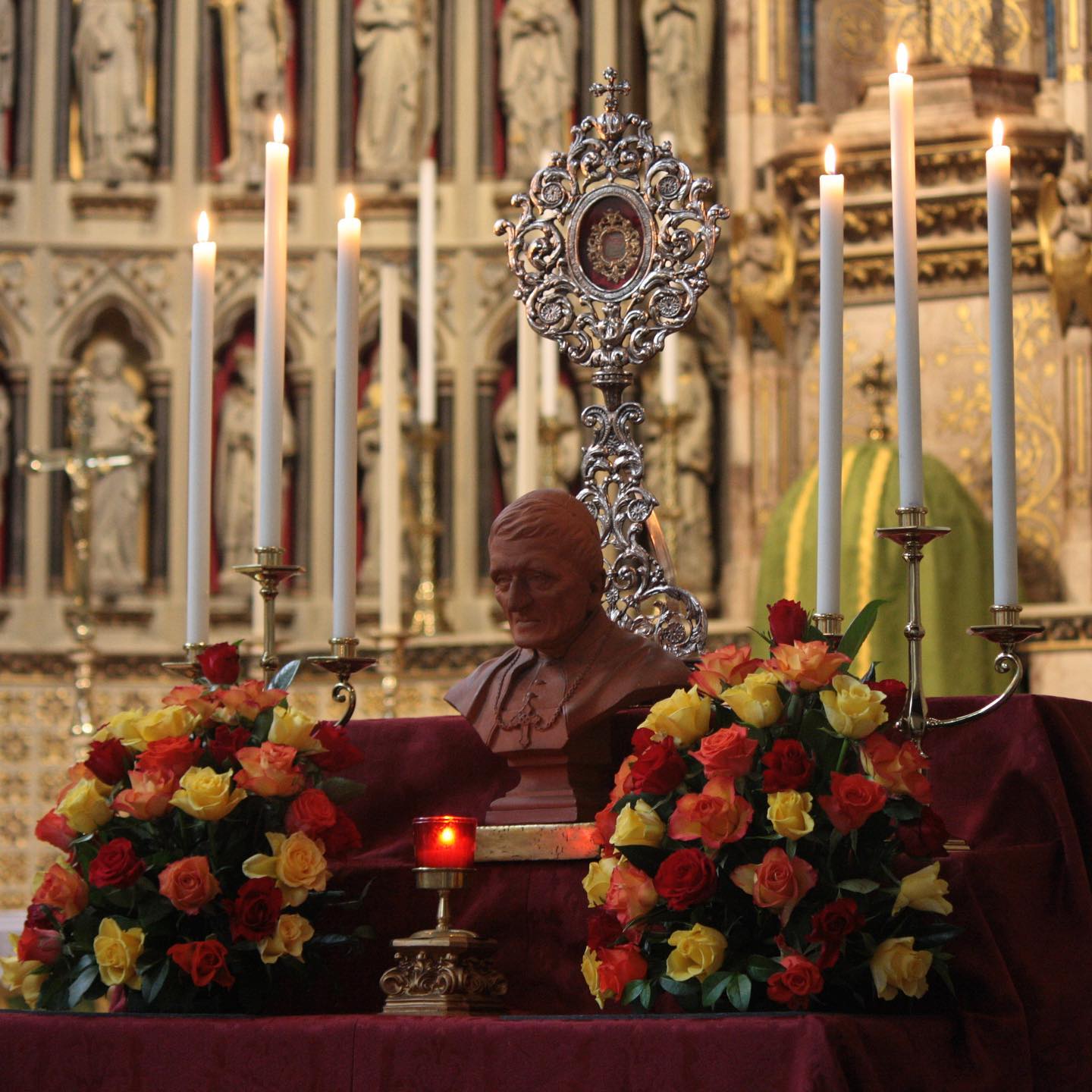
St John Henry.
Child of Mary.
Son of St Philip.
Man of Prayer.
Priest of God’s altar.
Minister of Compassion.
Herald of the Gospel.
Teacher of God’s wisdom.
Father of souls.
Example of priestly virtue.
Servant of the Church.
Seeker of Truth.
Guardian of Conscience.
Counsellor of converts.
Apostle of the doubtful.
Guide of the perplexed.
Educator of the laity.
Instructor of youth.
Pattern of perseverance.
Champion of the poor.
Companion of the sick.
Model of friendship.
Sentinel of purity.
Who abhorred sin.
Who separated yourself from attachments to this world.
Who yearned for the purity of angels.
Who longed for an increase in grace.
Who travelled from shadows into the light of Truth.
Who surrendered to the one true fold of Christ.
Who found such consolation in the Mass.
Who ardently preached the Word of God.
Who became for us a spiritual light in our darkness.
Who suffered calumny and injustice with patience.
Who bore insult meekly and returned good for evil.
Who set up a house of prayer.
Who turned so affectionately to the Mother of God.
Whose heart spoke to the Heart of Christ.
Lamb of God who takest away the sins of the world, R. Spare us, O Lord.
Lamb of God who takest away the sins of the world, R. Graciously hear us, O Lord.
Lamb of God who takest away the sins of the world, R. Have mercy on us.
Christ hear us.
Christ graciously hear us.
Pray for us St John Henry:
That we may be made worthy of the promises of Christ.
Let us pray.
O God, who bestowed on your priest Saint John Henry Newman the grace to follow your kindly light and find peace in your Church; graciously grant that, through his intercession and example, we may be led out of shadows and images into the fullness of your Truth. Through our Lord Jesus Christ, your Son, who lives and reigns with you in the unity of the Holy Spirit, God, for ever and ever. Amen.
Something that visitors often remark upon is how good a thing it is that the Fathers greet the faithful after each Sunday Mass. This is an important opportunity to get to know people, to arrange sick visits, baptisms and the like, and enables us to exercise the spirit of St Philip that our Cardinal expressed so well in his motto cor ad cor loquitur (“heart speaks unto heart”: the words of another great Oratorian St Francis de Sales). Recently one of our Fathers met with a family from Udine in Italy who were overjoyed to find in our church the image of St Luigi Scrosoppi, of the Congregation of the Oratory in that city, and whose feast we celebrate today. The great gift of the communion of saints is that friendship we find with them, as examples to imitate and as real companions in heaven who intercede for us and protect us.
Luigi Scrosoppi was born in 1804 and two years later his half-brother Carlo entered the Oratory in Udine. The Congregation had been established in 1650 but was suppressed in 1810 by Napoleon and the Fathers expelled. Fr Carlo came then to live with his family again and imbued the young Luigi with the joy of the Faith and the spirit of St Philip. Luigi discerned a calling to the priesthood and was ordained in 1827, celebrating his first Mass in the former Oratorian church of Udine where many of the former Fathers still functioned and thus exercised an abiding Philippine influence upon the faithful and clergy of Udine.
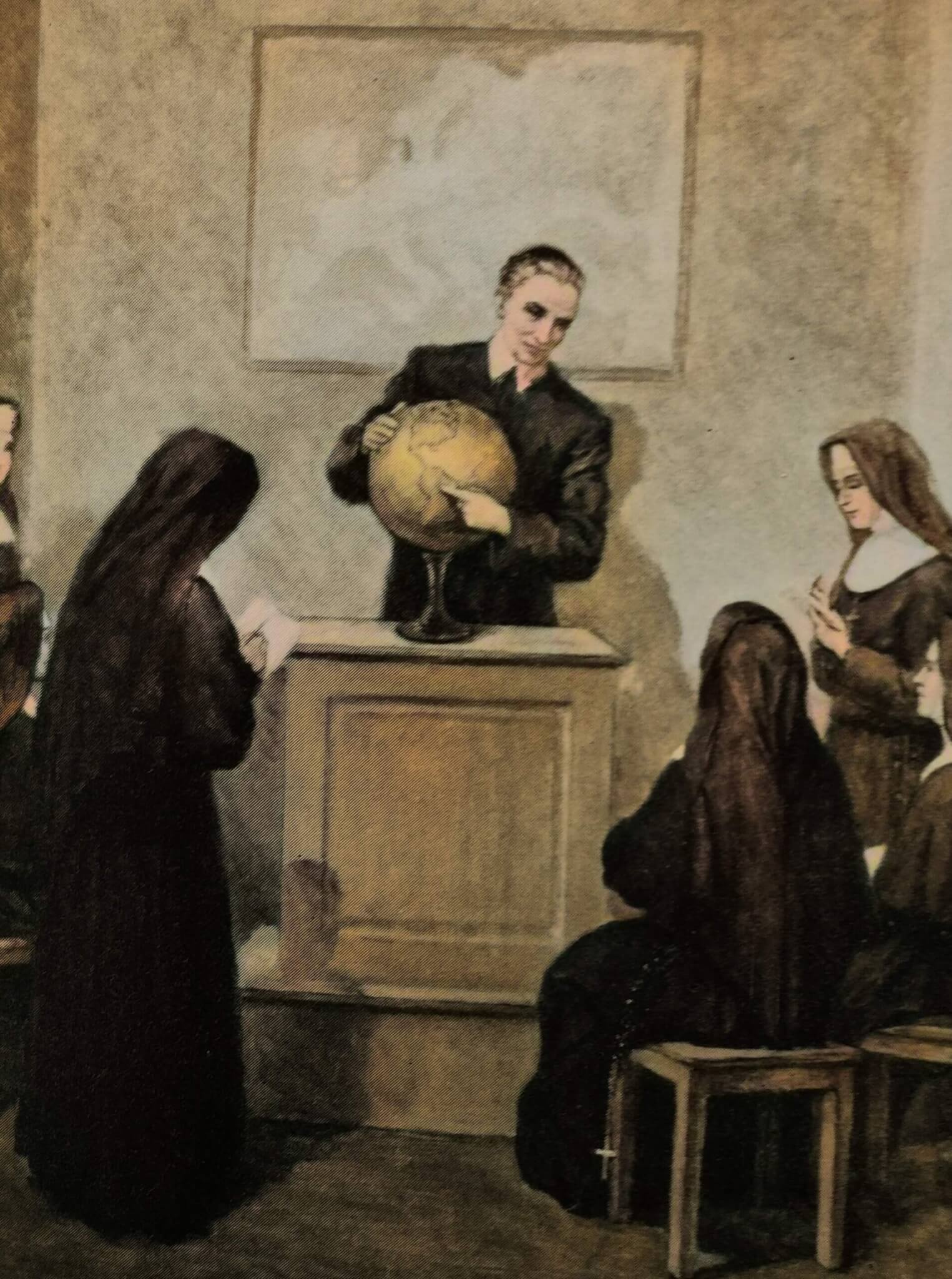
Father Luigi was a humble and devoted priest. Together with his brother Fr Carlo he took over the care of the Casa della Derelitte, an orphanage for poor girls. This included not only their spiritual care but also their material support and Fr Luigi could often be seen in the streets of Udine begging for food for the girls. He did not find this shameful or humiliating, but rather a means of living out the commands of the gospel. It is no surprise therefore that this experience caused him to ask himself whether the Lord was not calling him to further imitate the Poverello of Assisi by entering the Franciscan Order. Udine was his mission-field however, just as Rome had been for St Philip and the trials of his people convinced him that God wished him to work where he had placed him. Fr Luigi’s work with the orphans flourished and in 1845 he was able to gather a group of devoted women to help him in his work. These became the Sisters of Providence of St Cajetan, whose work with the poor and destitute continues to this day.
In 1846 the Oratory of Udine was allowed to reopen formally with Fr Luigi’s brother as the provost. Luigi himself received the habit of St Philip in this same year and his Oratorian life enabled him to work especially amongst the young people and students of the city. He was elected Provost in 1856 just as the fortunes of the Oratory were to take another turn in the wake of Italian Unification. Whilst he was able to prevent the Sisters of Providence from being disbanded, the Oratory itself was again suppressed in 1867 and its Fathers dispersed. For the rest of his life St Luigi signed his name “of the Oratory” and insisted it be engraved upon his tomb, leaving all his possessions to the Oratory of Udine in case of its re-establishment. He died in 1884, having devoted his last years to the work of the Sisters and the promotion of the papacy. His heavenly intercession continues to draw many friends to this humble and cheerful model of Oratorian life: notably the miraculous cure from AIDS of a Zambian catechist being the miracle approved for his canonisation. St Luigi has also become a patron for footballers in light of his work with youth as well as his example of perseverance and determination.
During his first years in the Oratory Saint Luigi had written a series of resolutions to follow in his own spiritual life. One of these reads “I want, Lord, to sanctify myself by sanctifying others, doing everything I can to prevent them from falling into sin, and to excite in others a love for you, and a desire to follow Jesus Christ our Lord”. This he did with all his heart.
We are looking at a section from the Canon of the Mass each week, to learn what the ‘law of praying’ has to teach us about what we believe. You can find the previous posts in this series in our reflections archive.
Remember also, Lord, your servants N. and N., who have gone before us with the sign of faith and rest in the sleep of peace. Grant them, O Lord, we pray, and all who sleep in Christ, a place of refreshment, light and peace. Through Christ our Lord. Amen.
Once again we stop to pray for people by name. This time we remember those who have died. And, once again, as with the living, we remind ourselves that God does not need our prayers to help the departed, but that he gives us this privilege of being able to assist them through our acts of love.
We can’t ever be sure where someone has gone after death. The only people we can be certain about are canonised saints — those that the Church has declared definitively to be in heaven. That doesn’t mean no one else is in heaven. It just means we’re not sure where anyone else is. And so we can pray for them. If they’re in heaven and they don’t need our prayers, the prayer is not wasted. And I’m sure that saint repays our charity by praying for us in return.
When we die, few of us are perfect. So when we die, even though our sins may have been forgiven, we might not yet be ready for heaven. The moral life is about far more than keeping rules, or even breaking rules and being forgiven. Our actions change us. The moral life for a Christian is about the kind of person we become and the characters we form through our actions. From the moment we leave the confessional, freshly absolved, our sins are forgiven. But we are not yet saints. We have to ask ourselves, even if we went to confession now and knew every single one of our sins were forgiven, would we still want to be as we currently are for the rest of eternity? Most of us are not ready for heaven just yet. Neither were so many who have gone before us.
This section of our prayer reminds us both to form good characters and to help the departed through our prayers. It presents Purgatory as somewhere uncomfortably warm and dry, dark and restless. Because the soul thirsts for God, and longs for his light, and, as St Augustine famously put it, ‘Our heart are restless until they rest in you, O Lord.’
Purgatory could work perfectly well without us — in fact, surely, God could do all the work that needs to be done in purgatory better, more efficiently, and faster if he didn’t choose to rely on us. But he gives real power to our prayers, because when we pray for the dead, it really helps them. And he gives our prayer real meaning, because the dead really aren’t helped, unless we pray for them. And so the work of purification taking place in the Church in purgatory is genuinely brought about with the participation of the Church on earth.
Sunday 1 October Solemn Mass 11:00 26th Sunday of the Year Missa Dormendo un giorno Guerrero Super flumina Babylonis Palestrina O quam suavis Vivanco Sonata IV, Allegro meastoso e vivace Mendelssohn
Sunday 8 October Solemn Mass 11:00 27th Sunday of the Year Mass in the Dorian mode Howells Vir erat in terra Palestrina Sitivit anima mea Cardoso Postludium Festivum Pearce
Monday 9 October Solemn Mass 18:00 St John Henry Newman, Our Cardinal Missa simile est regnum Lobo Veritas Mea Malcolm Salvator mundi Palestrina Angel’s farewell from ‘The Dream of Gerontius’ Elgar arr. Brewer
Friday 13 October Solemn Mass 18:00 Forty Hours: Solemn Mass of Exposition Missa Lauda Sion Palestrina O nomen Jesu, nomen dulce Ferrabosco Salvator mundi Blow O salutaris hostia Elgar
Sunday 15 October Solemn Mass 11:00 Forty Hours: Votive Mass of the Sacred Heart Missa Vidi speciosam Victoria O vos omnes Dering Sancte Deus Tallis
Forty Hours: Vespers of the Blessed Sacrament Solemn Vespers 17:00 Pange lingua Palestrina Magnificat Quinti Toni Hassler Tantum ergo de Severac Allegro vivace from Symphony No. 5 Widor
Sunday 22 October Solemn Mass 11:00 29th Sunday of the Year Mass for Five Voices Byrd Meditabor in mandatis tuis Palestrina O salutaris hostia a6 Byrd Offertoire sur les Grands Jeux Couperin
Sunday 29 October Solemn Mass 11:00 30th Sunday of the Year Missa Sicut lilium Palestrina Vadam et circuibo civitatem Victoria Qualis est dilectus tuus Victoria Sonata III, Con moto maestoso Mendelssohn
Holy Michael, archangel, defend us in the day of battle. Be thou our safeguard against the wickedness and snares of the devil. May God rebuke him, we humbly pray, and do thou, O prince of the heavenly host, by the power of God, thrust down into hell Satan and all wicked spirits who wander through the world for the ruin of souls. Amen.
We are looking at a section from the Canon of the Mass each week, to learn what the ‘law of praying’ has to teach us about what we believe. You can find the previous posts in this series in our reflections archive.
In humble prayer we ask you, almighty God: command that these gifts be borne by the hands of your holy Angel to your altar on high in the sight of your divine majesty, so that all of us, who through this participation at the altar receive the most holy Body and Blood of your Son, may be filled with every grace and heavenly blessing. Through Christ our Lord. Amen.
There is an idea present throughout the scriptures that our earthly realities reflect in some way the heavenly realities. Especially when it comes to the worship of God, what we do down here somehow shares in the more perfect, the more effective, the more real version of the same thing taking place in heaven.
This is very similar to the philosophy of Plato, who taught that the ‘ideal’ version of all things existed in a heavenly realm, and that earthly things participated in these ideal forms. The Jewish philosopher Philo of Alexandria thought the Greek Plato got so much right, the only explanation must have been that he had secretly read the Old Testament and stolen all his ideas from Moses!
In the Old Testament, the liturgy of the tabernacle and then of the Temple is based on the heavenly liturgy. In the book of Exodus (24:10), Moses is taken up the mountain and sees God. And he’s told to copy a heavenly model of the sanctuary that he’s shown (Ex. 25:40, 26:30, 27:8). The Jerusalem Temple is, as we read in the book of Wisdom, ‘a copy of the holy tent that [God] prepared from the beginning’ (Wis. 9:8). And this is further elaborated in Hebrews, where we learn that the earthly sanctuaries ‘serve a copy and shadow of the heavenly sanctuary; for when Moses was about to erect the tent, he was instructed by God, saying, “See that you make everything according to the pattern which was shown to you on the mountain.”’ (Heb. 8:5)
The worship of the Old Testament was meant to be an implementation of a heavenly blueprint. But because it was only an imitation in an earthly sanctuary, that worship could never be perfect. In order to be perfect, we want to share in the actual worship of heaven. In the Letter to the Hebrews, we read:
But when Christ came as a high priest of the good things to come, then through the greater and more perfect tent (not made with hands, that is, not of this creation), he entered once for all into the Holy Place, not with the blood of goats and calves, but with his own blood, thus obtaining eternal redemption. (Hebrews 9:11–12)
That greater and more perfect tent not made by human hands is God’s Temple of heaven itself. When Christ ascended into heaven, he entered the heavenly sanctuary to function as a priest. Again in that same letter,
Christ did not enter a sanctuary made by human hands, a mere copy of the true one, but he entered into heaven itself, now to appear in the presence of God on our behalf. (Hebrews 9:24)
Christ’s sacrifice was perfect — not only in terms of what was offered and who offered it, but also because of where it was offered, in an eternal, heavenly temple. St Paul makes it clear that because Christ’s sacrifice is perfect, it actually works. Because Christ completes his offering in heaven, in an eternal sanctuary, the effects of that sacrifice continue throughout all time. Christ’s death doesn’t just redeem those who were around at the time of the Crucifixion, but Christ is now seated at the right hand of the Father, living for ever to intercede for us, and we get a glimpse of that when the Mass is offered. That eternal sacrifice that Christ offers on a heavenly altar is brought down to our earthly altar. We get a glimpse of heaven and the heavenly liturgy, veiled under the forms of bread and wine. We are reminded that Christ is offering himself for us, and we get an opportunity to join our prayers to that offering.
This is also reassuring. No matter how hard we try to make our earthly worship the best it can be (and nothing but our best should be good enough for God) it will always fall short of perfection. The effectiveness of the Mass is not down to how much we concentrate on our prayers, on how well the priest pronounces the words, or the building or the music that accompanies the sacrifice. The one who offers the sacrifice is Christ himself — in heaven. We know his offering is perfect, and therefore ours is too. Every Mass, celebrated in any rite or language, by a good priest or a bad priest, with a congregation or without one, offered publicly in a beautiful cathedral or secretly in a prison camp, all of these are the same, united to that one perfect sacrifice that Christ himself offers for us in heaven.
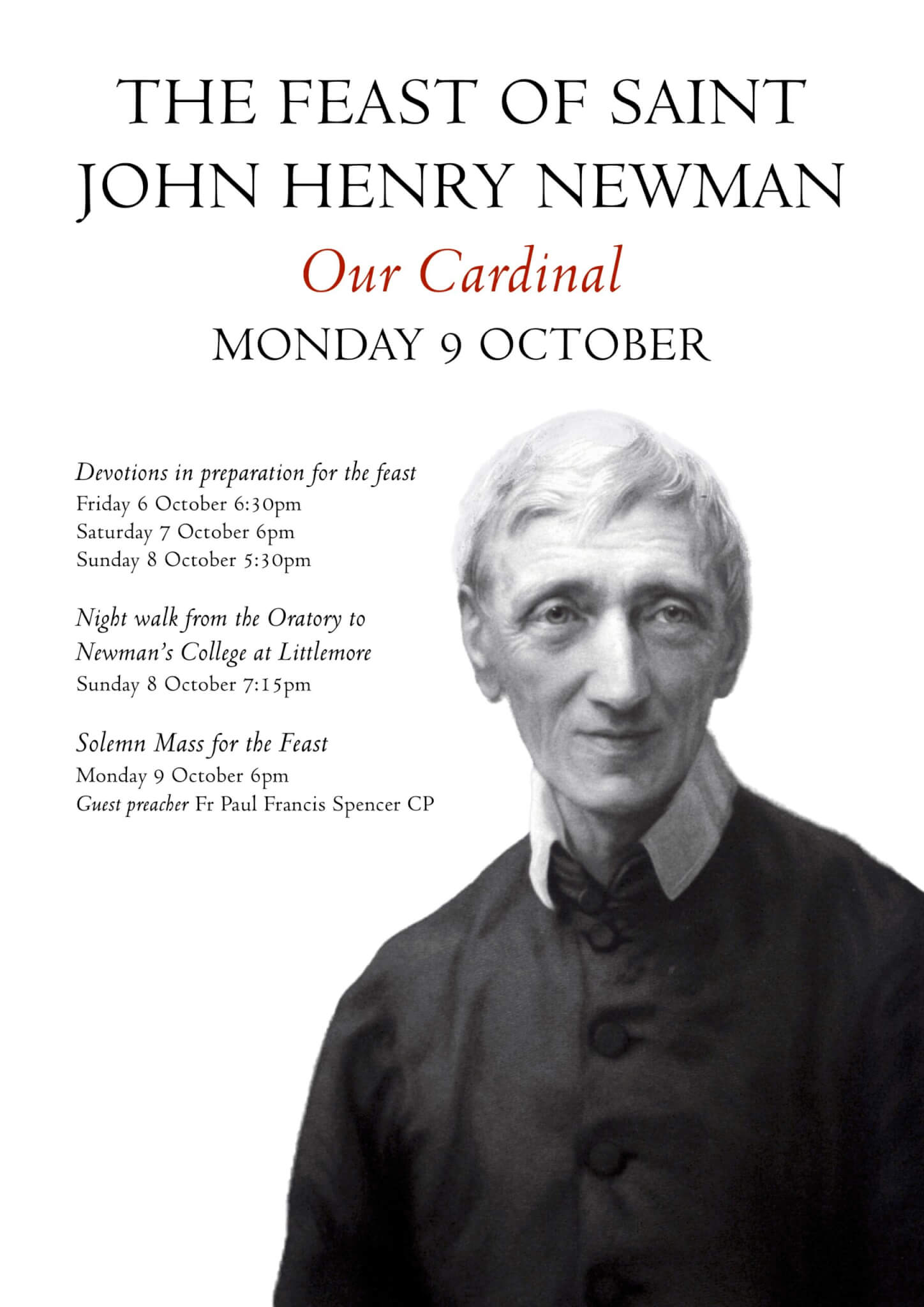
The feast of St John Henry Newman, our Cardinal, is on Monday 9 October.
There will be a triduum of preparation, with prayers and benediction, at 6:30pm on Friday 6 October, at 6pm on Saturday 7 October, and at 5:30pm on Sunday 8 October. Also on Sunday, we will set out on foot to Littlemore at 7:15pm, following in the steps of Blessed Dominic Barberi to Newman’s College.
On the feast day itself, we will welcome Fr Paul Francis Spencer CP as our guest preacher at the Solemn Mass at 6pm.
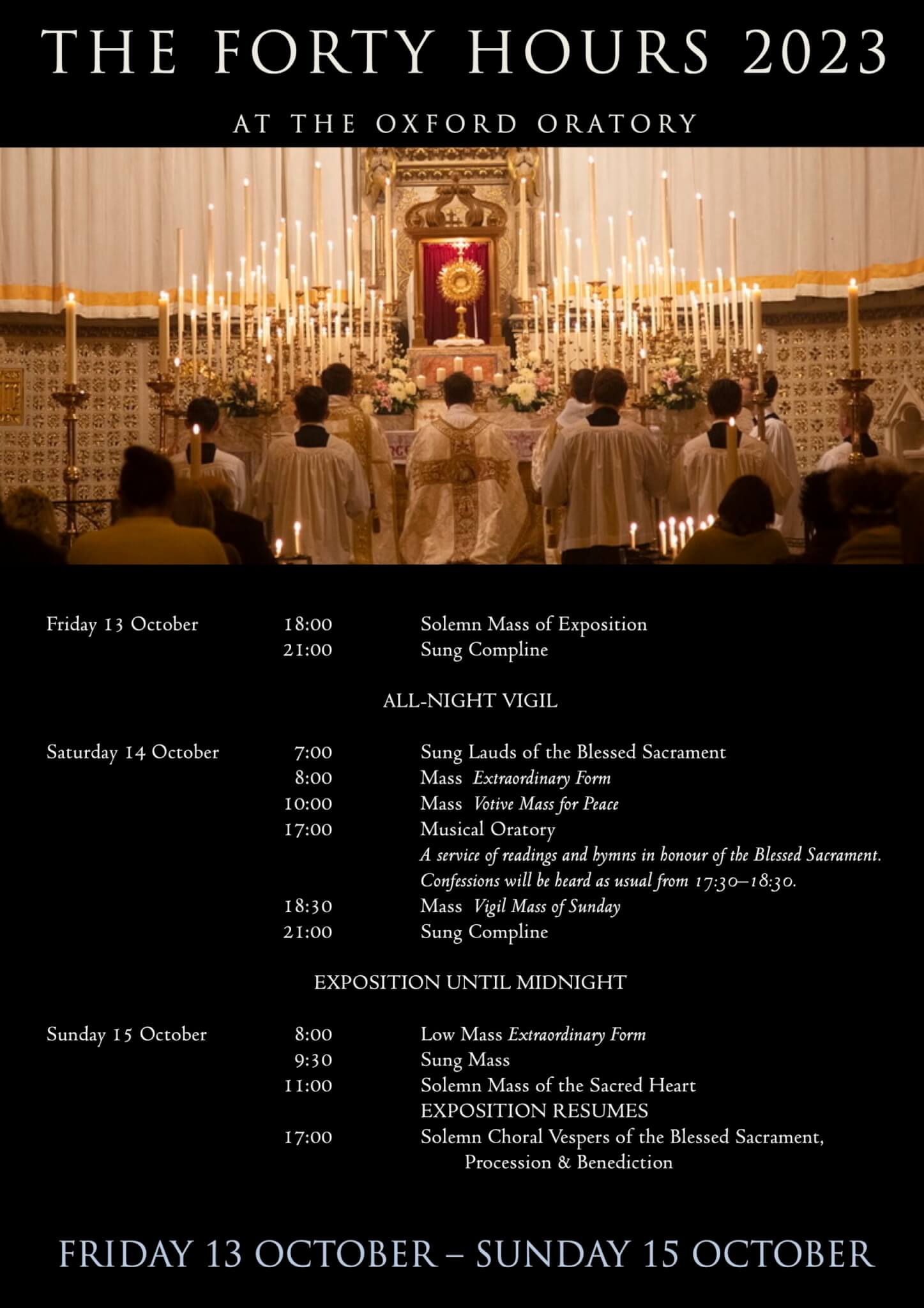
The Blessed Sacrament will be exposed in our church for forty hours, beginning with a Solemn Mass of Exposition on Friday 13 October at 6pm.
Exposition continues throughout Friday night and Saturday until midnight, with additional prayers and Masses taking place.
On Sunday 15 October, the Blessed Sacrament will be exposed again after the 11am Solemn Mass. The Forty Hours ends with Solemn Choral Vespers, Procession and Benediction at 5pm.
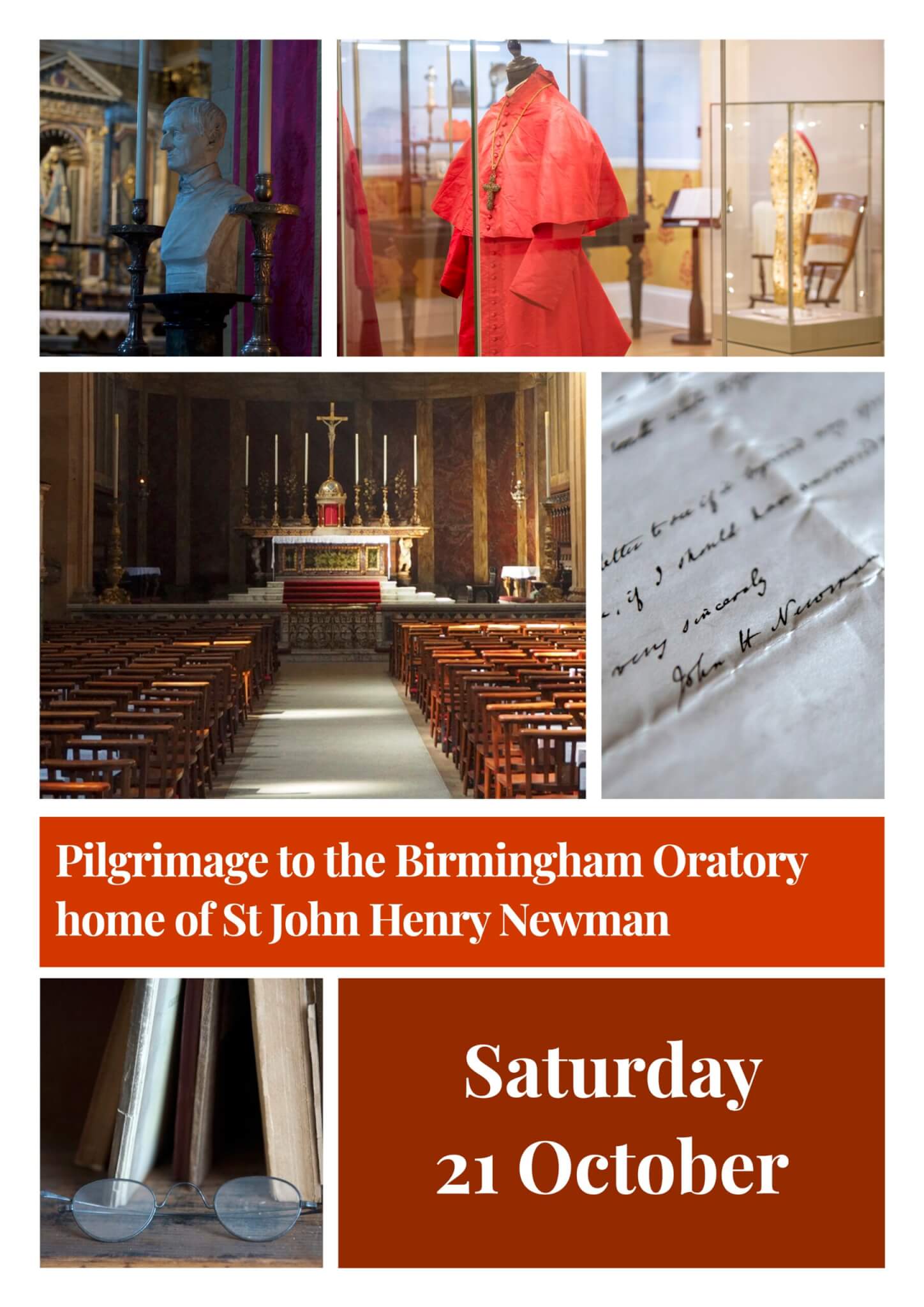
Join us for a day pilgrimage to the Birmingham Oratory, the home of St John Henry Newman.
Newman founded the Birmingham Oratory in 1849, the first Oratory in England, and it was there that he lived for the rest of his life. The beautiful Oratory Church now houses his shrine, and the Fathers opened The Museum of Saint John Henry Cardinal Newman in 2019 to celebrate his canonisation. In the museum, pilgrims can see his possessions and manuscripts, including precious historical items such as manuscript pages of the Apologia and The Dream of Gerontius, the chalice with which he celebrated Mass and personal articles such as his spectacles and Rosary beads.
The coach will depart from Oxford at 10am. We will not be able to wait for pilgrims who are running late, so please arrive in good time. We will celebrate Mass in the Oratory Church when we arrive. Please bring a packed lunch. In the afternoon we will explore the shrine and museum. The coach will return to Oxford around 6pm.
This is a wonderful chance to grow closer to a saint who is so important to us, who shared our love of St Philip, who brought the Oratory to England, and who walked the same Oxford streets that we know today.
The cost of the pilgrimage is £20 per person. Book your place in the Oratory Bookshop, and be sure to leave your details in case we need to contact you. Card payments only.
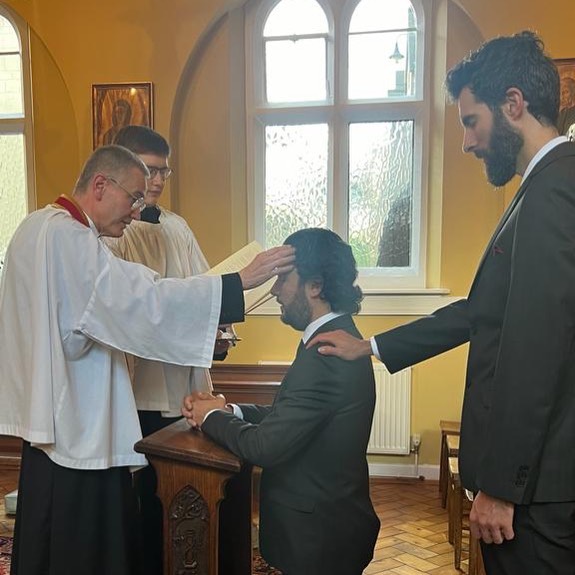
Congratulations to Elton who received the sacrament of confirmation this week.
If you haven’t been confirmed yet, speak to one of the Fathers. Our new series of weekly classes to prepare adults for baptism or confirmation will be starting soon. These classes are for Catholics who need to be confirmed and for those who are interested in becoming Catholic.
Enrolment forms for our children’s confirmation classes are available at the back of church now.
We are looking at a section from the Canon of the Mass each week, to learn what the ‘law of praying’ has to teach us about what we believe. You can find the previous posts in this series in our reflections archive.
Therefore, O Lord, as we celebrate the memorial of the blessed Passion, the Resurrection from the dead, and the glorious Ascension into heaven of Christ, your Son, our Lord, we, your servants and your holy people, offer to your glorious majesty from the gifts that you have given us, this pure victim, this holy victim, this spotless victim, the holy Bread of eternal life and the Chalice of everlasting salvation.
As we saw from the consecration, the Mass makes Christ’s Passion and Death present through the apparent separation of his Body and his Blood. But the Mass is more than a symbol. Christ is in heaven. Wherever he is, that place becomes heaven. Now that he is on the altar, it is as if we too stand with him in heaven. And we see history from God’s perspective. All of time is present to us. And so not only do we have a symbol of the Crucifixion before us, but we are, ourselves, present at the foot of the Cross, through this mystery. We are present at all those events throughout time, but especially those most important events in the history of our salvation. And we are present at the empty tomb as Christ rises from the dead. We are there watching Christ ascend into heaven.
We speak of Christ as a ‘victim’ here not as we hear it used by the police, but in its original sense of a sacrificial animal. Which prepares us to recall those sacrifices in the Old Testament that have foreshadowed Christ’s own sacrifice.
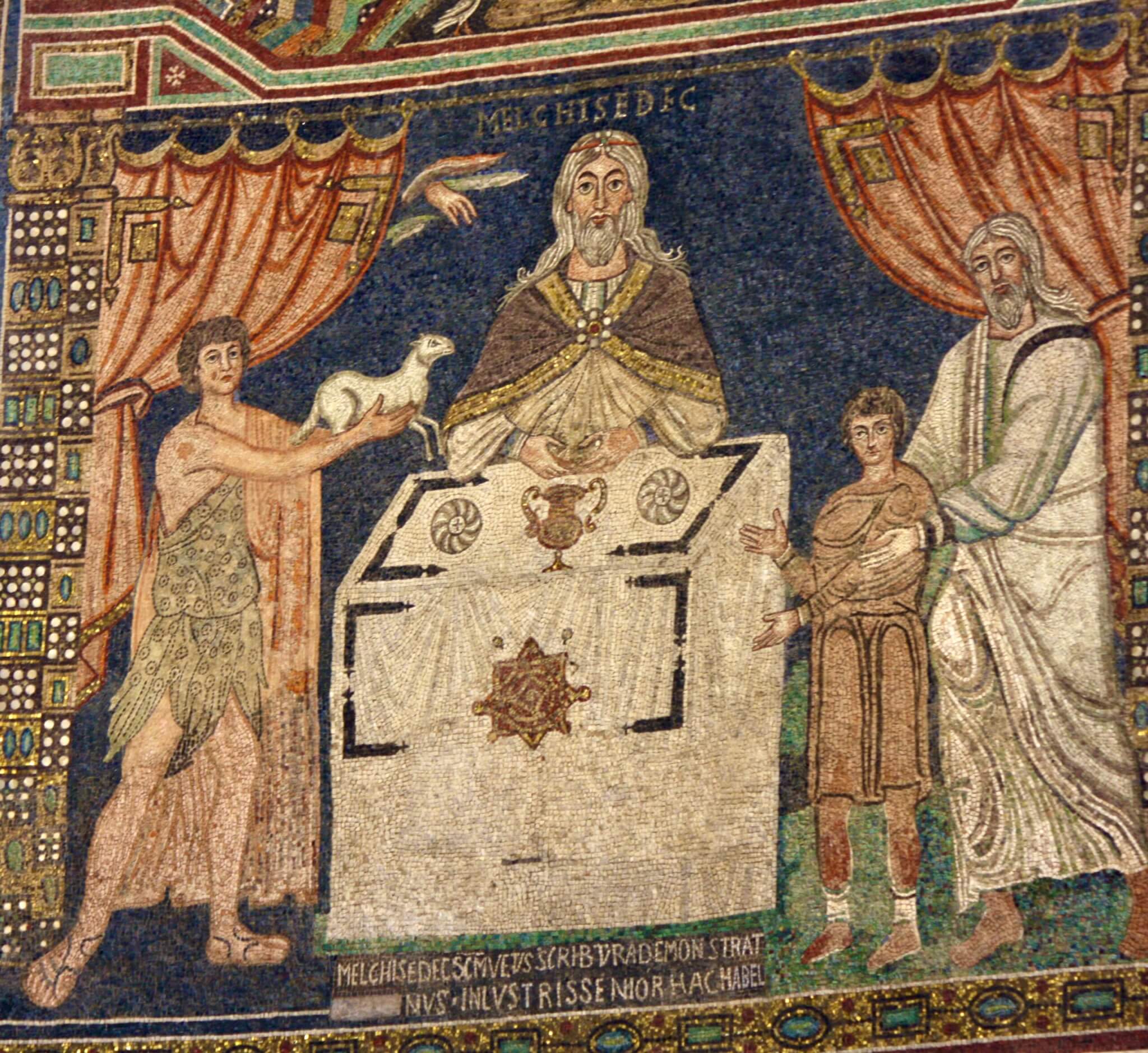
Be pleased to look upon these offerings with a serene and kindly countenance, and to accept them, as once you were pleased to accept the gifts of your servant Abel the just, the sacrifice of Abraham, our father in faith, and the offering of your high priest Melchizedek, a holy sacrifice, a spotless victim.
Three sacrifices are mentioned, but not those ordered in the Law of Moses, like the Passover lamb. All three are found in Genesis, at the very beginning of salvation history. Which shows us that, from the very beginning, God knew what he would do to save us, and was already helping us to understand Christ’s sacrifice on the Cross.
Cain and Abel both offered sacrifices to God. Cain offered ‘fruit of the earth’, while Abel sacrificed lambs. Abel offered a sacrifice acceptable to God where his brother Cain did not. What made his sacrifice acceptable was not God’s dislike for vegetarians, but the spirit in which each brother made his sacrifice. Abel was just, but Cain revealed the evil inside him when he gave into jealousy and murdered his brother. And so Abel gave us that first hint of a just man who offered a perfect sacrifice, and who would be killed for no reason other than that his spirit was perfectly united to God (Genesis 4).
Abraham was asked to sacrifice his son Isaac (Genesis 22). ‘Take your son, your only son Isaac, whom you love,’ he was told, preparing us for another Son, only begotten and beloved of his Father, who would also climb a mountain to offer himself in sacrifice, carrying on his own back the wood he was to be sacrificed on. God stopped Abraham from killing Isaac, but we are told that it was because of his faith in God’s power to give life even to the dead that he was willing to do so (Hebrews 11). Christ’s willingness to give himself entirely to God surpasses the obedience even of Abraham and his son Isaac. And it is through his obedience that God’s ability to give life to the dead was demonstrated.
Abel and Abraham are some of the better known figures from the scriptures. But Melchizedek is not often spoken about. And that might be because he generally creates more questions than he answers.
Melchizedek appears without any introduction. Abraham is on his way home after winning a great military victory. Melchizedek offers a sacrifice and blesses Abraham, so Abraham gives him a tenth of everything he won in battle. But that creates a mystery. ’It is beyond dispute that the inferior is blessed by the superior’ (Hebrews 7:7), so who could this figure be, who is greater than Abraham? No one is greater than Abraham, surely? And why does Abraham give him a tithe of his goods — the priestly portion?
Melchizedek then disappears from scripture as quickly as he appeared, until a brief mention in Psalm 109, where the Lord swears an oath to the Messiah: ‘You are a priest forever, according to the order of Melchizedek.’ For the first time, Melchizedek’s eternal priesthood is linked to the Messiah. And then, once again, Melchizedek disappears… until the New Testament. Finally, all is unpacked and explained for us in Hebrews.
‘He is first, by translation of his name, king of righteousness, and then he is also king of Salem, that is, king of peace.’ (Hebrews 7:2) Can we think of another king of righteousness, a prince of peace, who is also a high priest, who offers sacrifice in Salem (known later as Jerusalem)? Everyone in Genesis is introduced by some kind of genealogy or description of his parents. But Melchizedek is not. ‘He is without father or mother or genealogy,’ Hebrews tells us and therefore ‘has neither beginning of days nor end of life.’ Can we think of a kingly, high priest of peace and righteousness, born before all ages and whose kingdom will have no end, who offers sacrifice in Jerusalem?
All of this does, of course, point to Jesus, but so far this foreshadowing hasn’t taught us very much. Abraham met someone who foreshadowed Jesus. So what? The key is what he sacrificed.
‘And Melchizedek king of Salem brought out bread and wine; he was priest of God Most High.’ (Genesis 14:18)
Melchizedek doesn’t foreshadow Christ’s righteousness (as Abel) or his perfect obedience (as Abraham), but the means by which that sacrifice would be continued for the rest of time: under the forms of bread and wine. God had people looking forward for thousands of years in expectant hope of the great mysteries we now celebrate and can encounter every day.
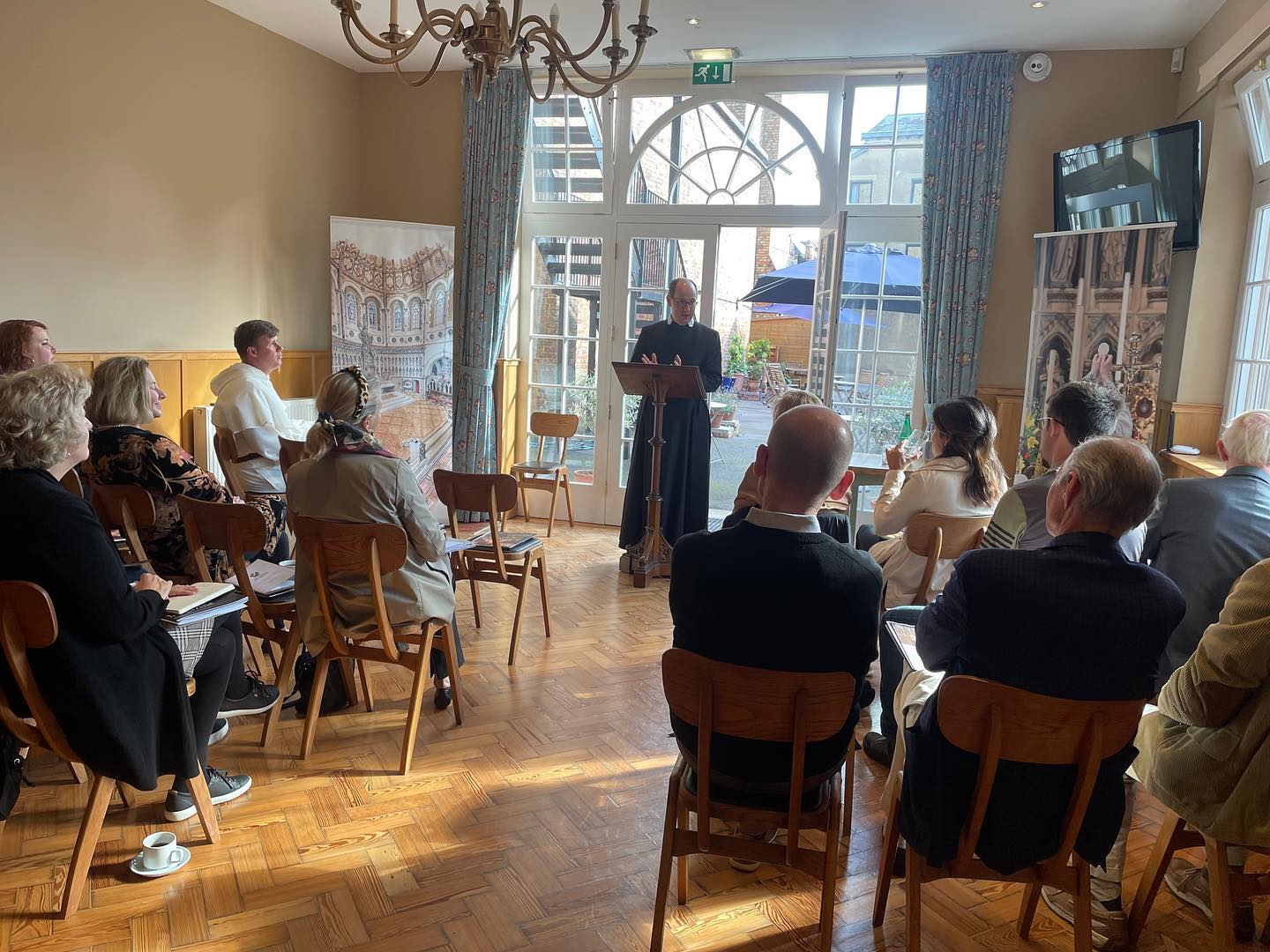
The Fathers were happy to welcome a group of US journalists who are on pilgrimage this week to England, focusing on St John Henry Newman and our Catholic history. After Mass, they were given a short presentation about our work in Oxford and a talk on Newman in Oxford. #oxfordoratory