The law of praying (7): Making God present

We are looking at a section from the Canon of the Mass each week, to learn what the ‘law of praying’ has to teach us about what we believe. You can find the previous posts in this series in our reflections archive.

On the day before he was to suffer,
he took bread in his holy and venerable hands,
and with eyes raised to heaven
to you, O God, his almighty Father,
giving you thanks, he said the blessing,
broke the bread
and gave it to his disciples…

Just as we begin to reach those pivotal words of the Canon, we have to pause. Because we are looking forward to the consecration itself with so much excitement, we might ignore the profound point being made in what we have just said. If we were to look for these words in the scriptures, we wouldn’t find them exactly. This is not simply an account of Christ’s actions at the Last Supper, but it blends in also elements from the feeding of the 5000. This shows us how the early Church read that miracle, where the Apostles distributed miraculous food to the crowds, food that came from Christ himself and that never ran out, even though all ate as much as they wanted. That event was understood to foreshadow the far greater miracle of Holy Communion.

During this most sacred part of the Mass, we also stop asking God for anything. It makes it clear that God is not responding to our cleverness. However beautiful or profound the rest of the words of our prayer may have been up to this point, at the heart of the Mass is simple obedience to Our Lord’s instruction to ‘Do this’. We don’t bring about the consecration because we impress God with our words. God brings it about when we do what he told us to.

And what exactly did he tell us to do? You might wonder why it is that the priest looks up as he says ‘with eyes raised to heaven’, but when he says ‘broke the bread’, the priest doesn’t break the bread he is holding. When Christ said ‘Do this’, clearly he did not mean ‘recreate this exactly’. We’re not taking part in a historical reenactment. We don’t require the priest and congregation to recline around a low table, to celebrate Mass in an upper room in Jerusalem, to speak in Aramaic and Hebrew, or to dress as first century Jewish men. Those who argue that the Mass should resemble the Last Supper exactly have missed the point, and are trying to do something impossible. What is possible — what is essential — is to take bread and wine, to consecrate them using the words Christ gave us, to offer his Body and Blood in sacrifice, and to receive it in Holy Communion.

The words of Our Lord that follow don’t match any of the biblical accounts exactly. It might be that they are part of an independent oral tradition that handed down these words of Christ from the Last Supper, but it is also clear that we continue to draw together references from many parts of the scriptures, stitching them together into a whole.

…saying:
Take this, all of you, and eat of it,
for this is my Body,
which will be given up for you.
In a similar way, when supper was ended,
he took this precious chalice
in his holy and venerable hands,
and once more giving you thanks, he said the blessing
and gave the chalice to his disciples, saying:
Take this, all of you, and drink from it,
for this is the chalice of my Blood,
the Blood of the new and eternal covenant,
which will be poured out for you and for many
for the forgiveness of sins.
Do this in memory of me.
The mystery of faith.

These are the words at the heart of the Mass, the ‘words of consecration’. Before this moment, we have only bread and wine on the altar. From this moment on, there is on the altar Jesus Christ himself, present under the appearances of bread and wine. To mark the change, the priest raises the Host and the Chalice for all to see and adore, and genuflects himself in adoration.

This miracle we call ‘transubstantiation’: a change of the underlying substance of what the bread and wine are, without changing any of their external appearances. There is no change perceptible to the senses, and yet the bread and wine are bread and wine no more.

Bread and wine are consecrated separately, reminding us of the separation of Christ’s Body and Blood on the Cross. If a person’s blood is separated from his body, then he dies. So this apparent separation represents Christ’s death on the Cross. However, Christ is no longer dead. ‘For we know that Christ being raised from the dead will never die again; death no longer has dominion over him.’ (Romans 6:9) Therefore, wherever his Body is, there too is his Blood, and the two can never be separated again.

In a similar way, the separation of body and soul is precisely what we mean by death. And so Christ’s Soul must also be wherever his Body and Blood are, and can never be separated from them. And ever since the moment of the Incarnation, when the Eternal Word, the Son of God, become man, he joined his Divine Nature inseparably to that human soul. So that after these words of consecration, whether we speak of what still has the appearance of bread, or what has the appearance of wine, they are each of them Jesus Christ himself, whole and entire, Body, Blood, Soul and Divinity, as the traditional definition of transubstantiation expresses it.

On that altar is found something more precious than anything else in the world. Indeed, St Peter tells us that the ‘Precious Blood of Christ’ is far more valuable than anything perishable like silver and gold (1 Peter 1:18). It is enough to ransom the whole world. What lies on that altar, what is contained in that chalice, is worth more than the entire universe. If we consider how carefully we would handle a priceless work of art that someone placed into our hands, how much more care should we take in handling and approaching that which is worth more than all those other treasures put together?

Christ uses words that are so simple, actions that are so simple, even bread and wine — everyday essentials in the ancient world — which are so simple and easily available, to make the greatest mystery ever encountered by man easily accessible. He makes himself present on Catholic altars across the world every day. Our response to this great mystery hidden under simple forms must also be simple. This moment of the Mass, when Christ becomes present among us, must be for us no only the focal point of the Mass, but the focus of our week — of each day if possible — and of our entire lives.
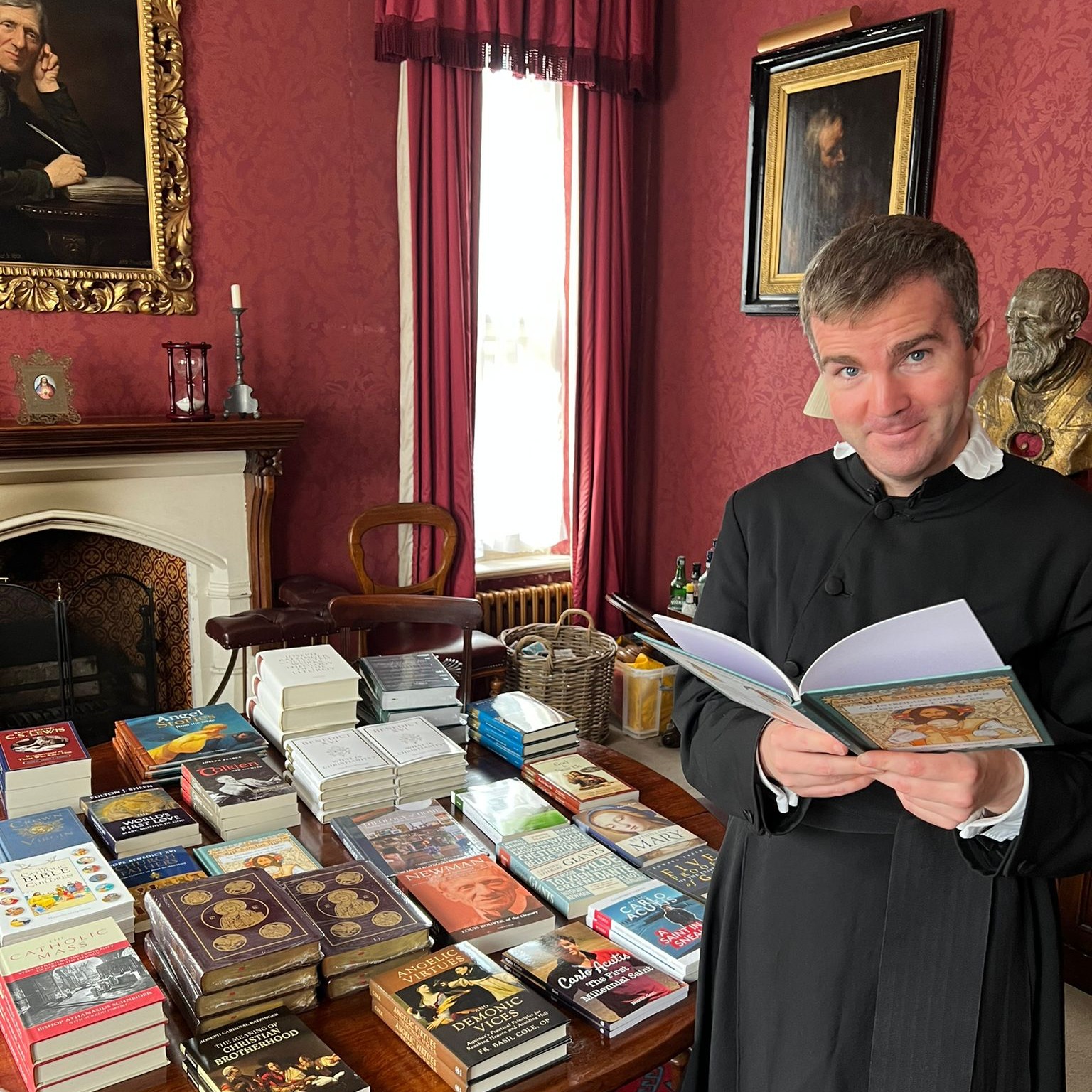
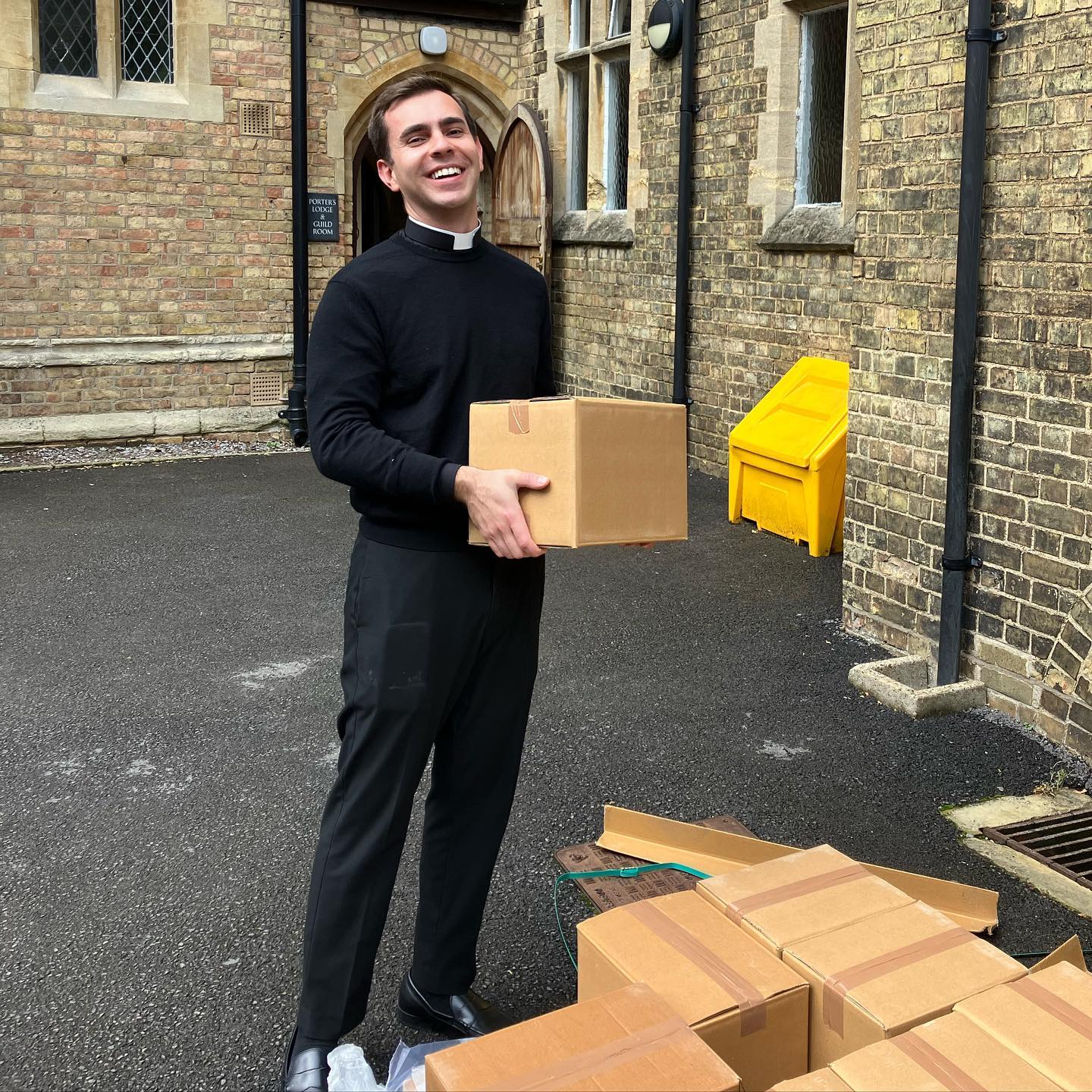
We have some great new stock in our bookshop that has arrived this week. Fr Rupert is seen here brushing up on his rubrics with the help of ‘Sanctus, Sanctus, Sanctus: An Introductory Latin Missal for Children’.

The bookshop is open after all Sunday Masses, on weekdays 10:30–6pm and after the evening Mass on Saturday.

#oxfordoratory

View on Instagram

The law of praying (6): Negotiating with God

We are looking at a section from the Canon of the Mass each week, to learn what the ‘law of praying’ has to teach us about what we believe. You can find the previous posts in this series in our reflections archive.

Therefore, Lord, we pray:
graciously accept this oblation of our service,
that of your whole family;
order our days in your peace,
and command that we be delivered from eternal damnation
and counted among the flock of those you have chosen.
Through Christ our Lord. Amen.

Our Roman way of praying draws on very ancient Roman ways of speaking to God. A covenant is a legal contract. The New and Eternal Covenant that the priest is taking part in is a legal exchange between the Church and God — and therefore there are hints of legal terminology as we form our prayer. This ‘therefore’ is not the first we have seen in our prayer so far. We are building an argument. This ‘therefore’ follows on, but from what? We have already seen that because we are in communion with the Pope and the Bishop therefore we are members of the Church founded by Christ. And because we are members of his Church therefore we know we are in communion with the saints in heaven. And because we are in communion with the Church on earth and in heaven therefore we have the confidence to pray…

Therefore, we ask God to accept the offering of our service (an ‘oblation’ is simply an ‘offering’), which is Pope St Leo the Great’s rather fancy way of saying, ‘accept the offering we make of ourselves, your servants’. We unite ourselves to Christ as he offers himself to the Father. We are reminded that the Church is a family. We ask for some rather obviously good things for that family, including that we be numbered among the sheep rather than the goats (Matt. 25). But if anything, this section builds suspense. It’s like the deep breath before plunging underwater, since things are now about to get really serious.

Be pleased, O God, we pray,
to bless, acknowledge,
and approve this offering in every respect;
make it spiritual and acceptable,
so that it may become for us
the Body and Blood of your most beloved Son,
our Lord Jesus Christ.

If we really want to get the sense of this section, we might translate the beginning of this paragraph as follows:

Which aforesaid offering, we ask you, O God, in every respect:
deign to make blessed, written-up [adscriptam], ratified [ratam], rational and acceptable…

Just as a legal document covers every base so as to close off every loophole, we leave no room for misunderstanding in what we are asking from God. This is not the first time we have had this kind of repetitive pattern and it certainly won’t be the last. The Canon is filled with them. Here, we insist that God makes note of our sacrifice on a list. He must write it down so that there’s a record that we were here and we fulfilled our duties towards him. We’re not taking any chances! We want it ratified too — we want to make sure that what we do is valid and approved. And we ask him to make it ‘reasonable’ or ‘rational’. We are asking him to make sure our offering has a rational soul — that is, a human soul. This is not the sacrifice of a dead irrational animal like the sacrifices of the Temple. It is not even the offering of Christ’s dead body, separated from his rational soul. Our bread and wine are about to become the living Body and Blood of Christ, united forever with his rational human soul, united forever with the Logos, the eternal Word.

This is not your everyday language of the Roman street. In fact, this use of legalism, repetition and rhetoric is an echo of pre-Christian Roman prayer. It shows us that the first Christians did not in fact speak to God in their normal Latin, but from the earliest centuries knew that they needed a sacred language to remind them they were doing something special. To create this sacred language, they borrowed heavily from even more ancient ways of speaking.

The very ancient Romans thought that the gods were constantly trying to catch them out, much like a genie in a story who finds the loophole in a person’s wish and grants them something they definitely didn’t want. So the Romans were terribly precise and legalistic when they spoke to their gods, and made sure they left nothing out. Now, we do not believe that God deals like that with us. We are talking here to our loving Father, who wants to give us fish, eggs and bread even when we ask for snakes, stones and scorpions (cf. Luke 11). But this way of thinking led to a way of praying that we have inherited. It has become part of our God talk. Just as we don’t think God listens to us more if we call him ‘thou’, and yet we still like to because it’s helpful for us to have a sacred language, so we don’t think that God will catch us out if we forget to ask for the right thing in our prayer. We speak in this way because we find it helpful. It puts us in the right frame of mind for speaking to God, and it means we can be confident that we have asked God for everything that we should.

September Music

Sunday 3 September Solemn Mass 11:00
22nd Sunday of the Year
Missa Dulce Memoir Lassus
Domine in auxilium meum Scarlatti
Salve Regina Lassus
Praeludium in C major BuxWV137 Buxtehude

Friday 8 September Solemn Mass 18:00
The Nativity of the Blessed Virgin Mary
Missa Ave Maria Palestrina
Sancta Maria, succurre miseris Victoria
Diffusa est gratia Nanino
Verset et Amen pour l’hymne ‘Ave maris stella’ Guilmant

Sunday 10 September Solemn Mass 11:00
23rd Sunday of the Year
Missa Vulnerasti cor meum  Morales
O crux splendidior Philips
Sive vigilem Mundy
Fugue in C BWV 547 Bach

Sunday 17 September Solemn Mass 11:00
24th Sunday of the Year
Missa Aeterna Christi munera Palestrina
Sanctificavit Moyses Palestrina
Adoramus te Gasparini
Ut Re Mi Fa Sol La BK64 Byrd

Sunday 24 September Solemn Mass 11:00
25th Sunday of the Year
Missa da Capella (1650) Monteverdi
Nisi dominus Carissimi
Sicut cervus Palestrina
Allegro Maestoso (Sonata in G) Elgar

The Oratory Prayer Book is now back in stock. Our first 1000 copies sold much faster than we anticipated, but 1000 more arrived this morning!

You can pick up a copy from our bookshop, or order online: https://tinyurl.com/opb-buy

Share a photo of your prayer book being used by tagging it with #oratoryprayerbook.

#oxfordoratory

View on Instagram

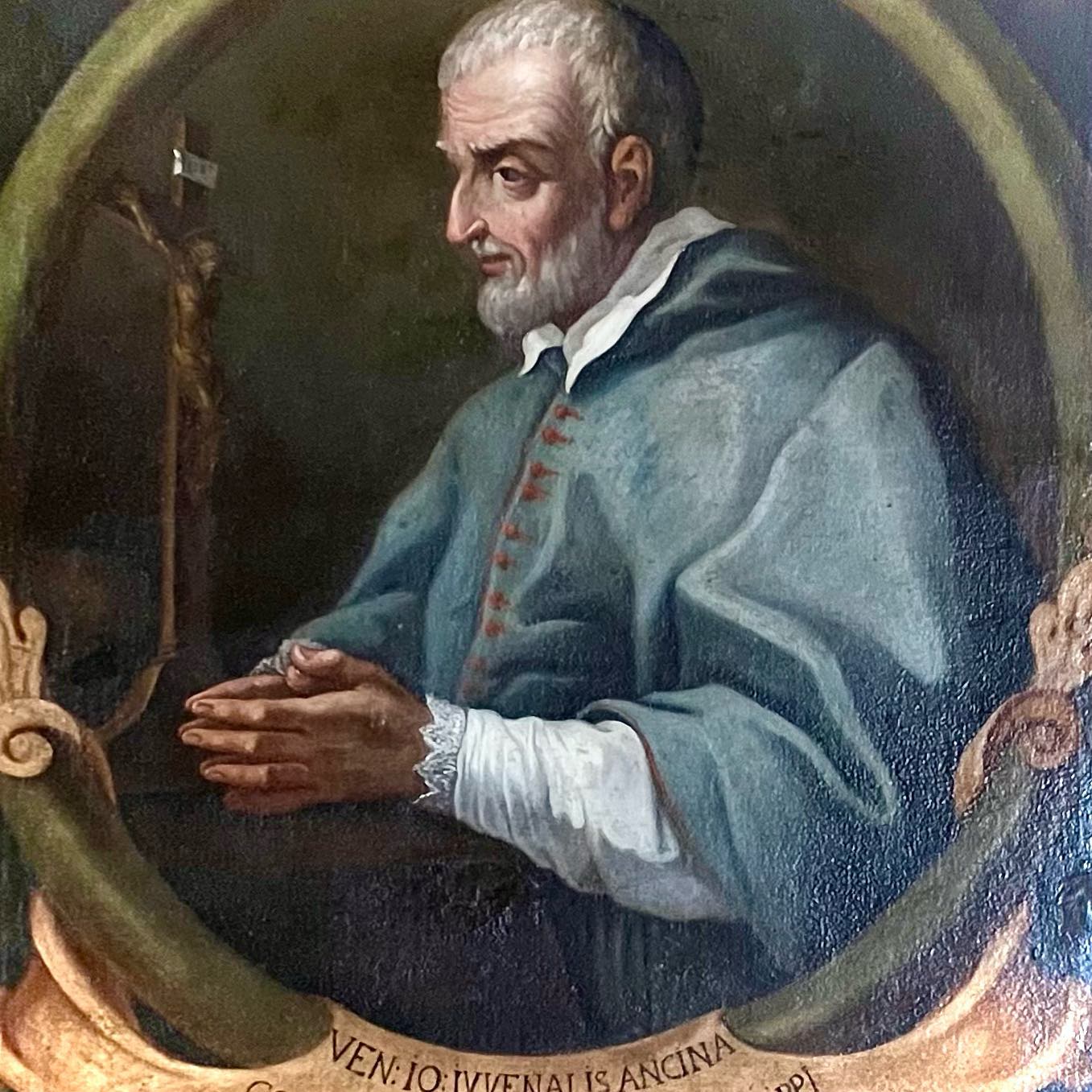
Today is the feast of Blessed Juvenal Ancina of the Roman Oratory.

He was training as a doctor when he wandered into a church where a funeral was taking place. He heard the ‘Dies irae’ being sung, and experienced a conversion. He met St Philip and joined the Roman Oratory. Later, he was made bishop of Saluzzo, where he was poisoned by a friar whom Juvenal had attempted to return to his religious order. He refused to testify against his murderer, so he could not be recognised as a martyr. However, his prayers and actions did bring about the conversion of the friar.

This prayer for his feast day incorporates some of the prayers Juvenal himself used.

O Lord, whose servant Blessed John Juvenal abandoned his training for the care of the human body for the yet nobler care of the human soul, that he might be spared on the day of wrath, who blessed him with a particular love for the service of thine altar and caused him to reckon his life of no account, if he should gain a single soul for thee; who surpassed his virtue of humility, only by his virtue of obedience; and having raised him to the dignity of the episcopate bestowed upon him the martyr’s crown in all but name; grant us by his intercession and example to be joyful, to serve thee, O Lord, in gladness, to forgive all who do us harm, to do good and to suffer ill, to persevere unto the end. Jesus, sweet Jesus, with Mary give peace to our souls.

#oxfordoratory

View on Instagram

The law of praying (5): Communicating with the Saints

Over the summer, we are looking at a section from the Canon of the Mass each week, to learn what the ‘law of praying’ has to teach us about what we believe. You can find the previous posts in this series in our reflections archive.

In communion with those whose memory we venerate,
especially the glorious ever-Virgin Mary,
Mother of our God and Lord, Jesus Christ,
and blessed Joseph, her Spouse
your blessed Apostles and Martyrs,
Peter and Paul, Andrew,
James, John,
Thomas, James, Philip,
Bartholomew, Matthew,
Simon and Jude;
Linus, Cletus, Clement, Sixtus,
Cornelius, Cyprian,
Lawrence, Chrysogonus,
John and Paul,
Cosmas and Damian
and all your Saints;
we ask that through their merits and prayers,
in all things we may be defended
by your protecting help.
Through Christ our Lord. Amen.

This is meant to be a spiritual commentary on the Canon of the Mass, rather than a grammatical one. However, in approaching this section, we have to point out the oddity that all other commentators point to first. ‘In communion with’ — well, that’s a tidied-up translation of the Latin original. ‘Being in communion with’ might be a more literal translation of communicantes. But you can’t make a complete sentence out of that form of the verb. (‘I kicking a ball’ doesn’t make a complete sentence in English or in Latin.) Where has the rest of this sentence gone?

The answer is that it was interrupted by the previous paragraph. How that happened doesn’t really matter. We are, in fact, continuing the sentence and the thought of the prayer for the Church we looked at two weeks ago. Recall that we prayed for the Church — that Church we know we are in communion with because we are in communion with the Pope and our Bishop, both of whom we named. In fact, we effectively presented our credentials. By naming our Pope and our Bishop, we showed God our membership card that proves we are members of his Church.

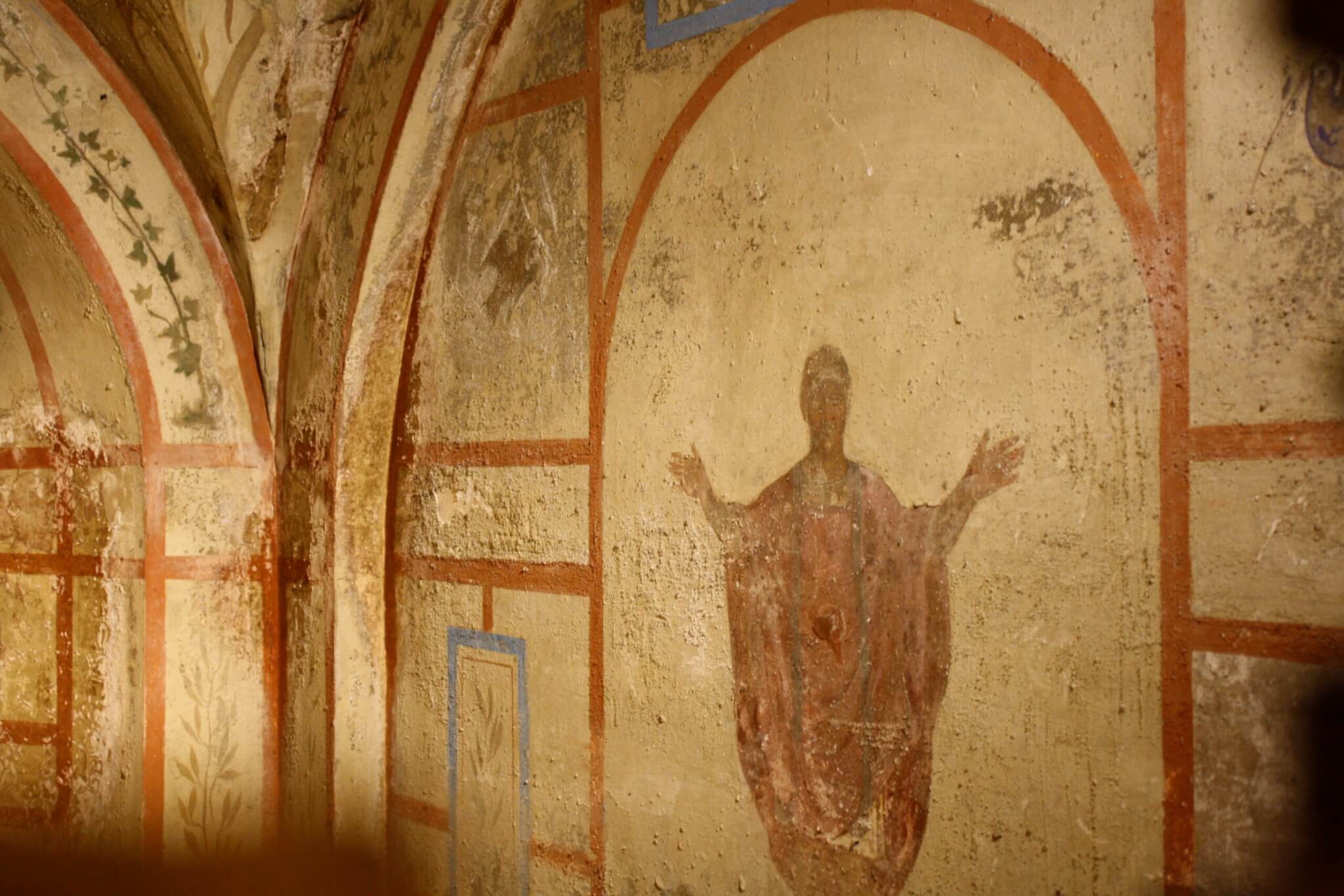
And now that we know we are members of the Church on earth, that must also mean we are in communion with the Church in heaven. So having presented our credentials to the Father in the earlier section, we now reap the benefits and invoke the protection of the saints in heaven. The act of standing at the foot of the Cross and presenting a list of demands to God should be a terrifying one. Thankfully, it is not — because we trust that God is our loving Father. But just in case we had any doubt, he also gives us the support of his — and our — friends in heaven.

Our Lady comes first of course. She occupies the first place in heaven next to her Son — never let anyone tell you that the Catholic Church doesn’t respect women. We also express two of the four Marian dogmas here: that she is ever-virgin and Mother of God. A dogma is a teaching so fundamental to the faith that you have to believe it in order to be a real Christian. The divinity of Christ, for example, is clearly a dogma of the faith. If you don’t believe Jesus is God, then whatever else you might believe that is correct, you haven’t really got the fundamental idea of Christianity. The teaching that Mary is ‘Mother of God’ is something we must believe, because she is the Mother of Jesus. If we say that she is not Mother of God, we must be saying that her child is not really God. And then we’re really in trouble. So we are reminded of this seeming paradox, this wonderful miracle, brought about through the overshadowing of the Holy Spirit: the Incarnation. The Word was made flesh, and dwelt among us.

Also occupying prime positions in this list of saints are the princes of the Apostles, Peter and Paul, so central to the faith of the Roman Church, and the remaining Apostles follow after. (Paul fills in the gap here left by Judas Iscariot. Judas’ replacement, St Matthias, appears later.) But then some saints follow who might be less familiar. They are all martyrs, as we are told, but how and why are these particular martyrs chosen?

Linus is the second Pope. He is St Peter’s immediate successor as Bishop of Rome, and appears in St Paul’s writings (2 Timothy 4:21). Cletus is the third Pope, Linus’ successor. Clement is number four, and also appears in scripture (Philippians 4:3). That shows us they were known to the Apostles, and were part of their generation. And that in turn shows us how quickly the Romans got through Popes in the early years of the Church.

Can you guess who Sixtus was? That’s right. He is of course the twenty-fourth Pope. Not the fifth as you might have expected, nor the sixth as the name might suggest. (‘Sixtus’ is our spelling of the Greek name Xystus, and has nothing to do with the number ‘six’. Though there was a St Sixtus I who was Pope number seven, just to really confuse things.) The Sixtus we mention here is the second Pope of that name, and lived in the third century.

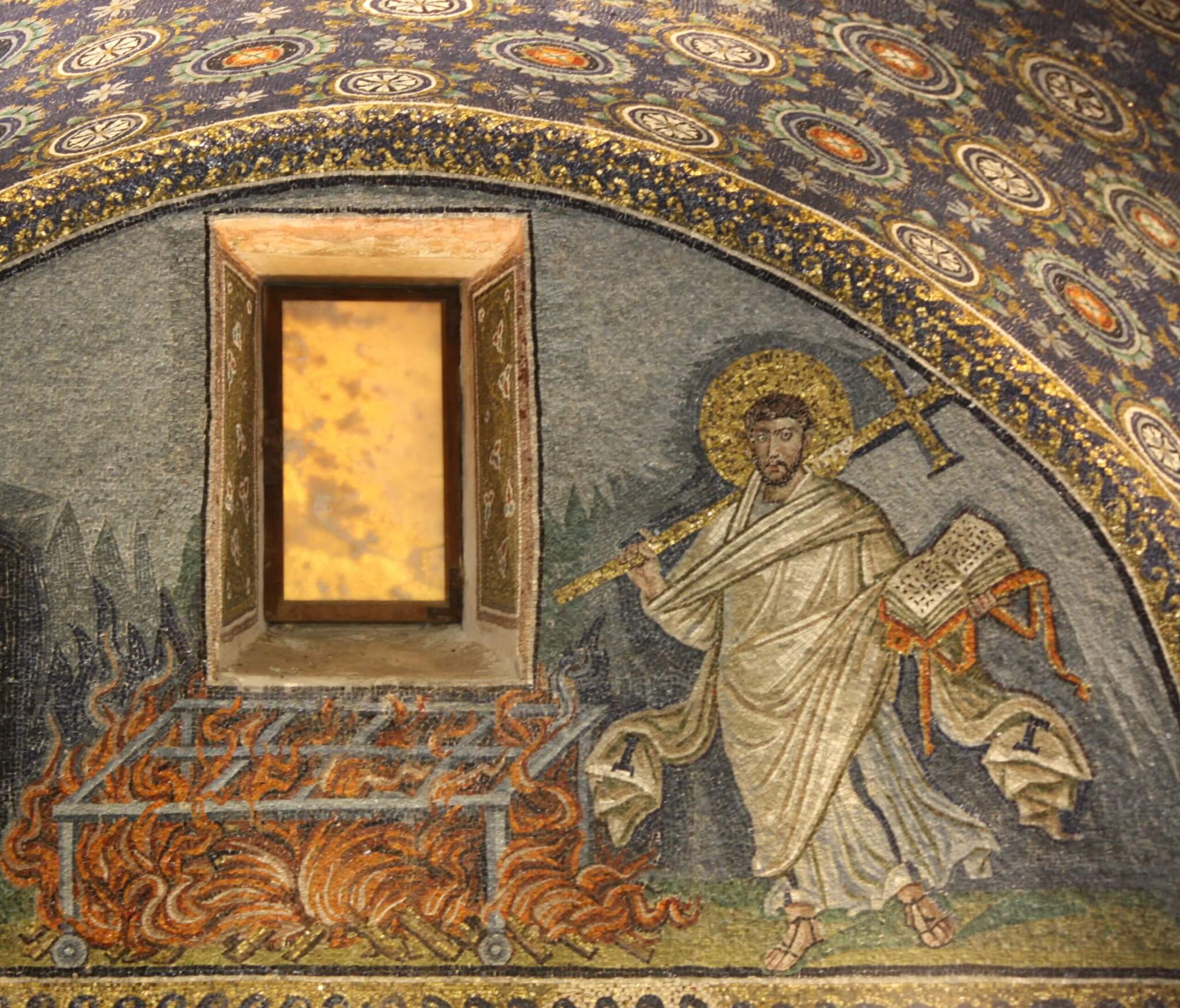
Cornelius is the last Pope in the list, then we get some other people the Romans just liked. Cyprian was a heroic bishop of Carthage and Father of the Church. Lawrence was an extremely popular deacon in Rome — his church is still today one of the seven principal churches of Rome. His popularity might be down to his generosity to the poor of Rome, or his sense of humour. Lawrence was in charge of administering the Roman Church’s finances. When persecution broke out, Roman soldiers were sent to him to collect the vast wealth of the Church. Lawrence told them he would happily hand it over, but that it was so great that it would take him a day to gather it all. Could they come back tomorrow? During which time, Lawrence took what money there was and distributed it to the poor. When the soldiers returned, they found his rooms packed with all those Lawrence had helped. ‘Behold the treasure of the Church!’ he said to them. It didn’t go down too well. Lawrence was sentenced to death by roasting on a gridiron. Halfway through his martyrdom, he called out cheerfully to his executioners, ‘You can turn me over — I’m done on this side.’ No wonder he has always been so popular with the Roman people.

Almost all of these saints are buried in Rome, with churches built over their bodies. St Philip used to say that when we find ourselves unable to pray, we should walk round the altars of the saints and beg their prayers as a spiritual alms. In Rome, this means more than simply visiting an altar dedicated to a saint with a painting or statue above it. In Rome, very often, the saint’s body itself is buried beneath the altar. To walk around the churches of Rome is to walk through the prayers of the Mass.

Most of these saints quite literally form the foundations of churches in Rome. All of them are building blocks of the Church that we know today. They played their part in handing down the Catholic faith as it has reached us through the Roman Church. It is because our faith — and especially our prayer — is so Roman that we can be certain that it is also Catholic. The catechism didn’t come to us directly from heaven. We each of us were taught the faith from others. The Gospel is not myth but history, and therefore it is transmitted to us through history, through real people. That’s what this list describes. We are tracing how the faith reached us: Peter passed it to Linus; Linus passed it to Cletus; Cletus to Clement… Sixtus… all the way down to us to us. We can trace our own Catholic faith back to these saints — who died witnessing to the truth of what they taught. And they in turn could trace their faith back to the Apostles, and through them, to Christ himself.

The law of praying (4): Remembering the Living

Over the summer, we are looking at a section from the Canon of the Mass each week, to learn what the ‘law of praying’ has to teach us about what we believe. You can find the previous posts in this series in our reflections archive.

Remember, Lord, your servants (N. and N.)
and all gathered here,
whose faith and devotion are known to you.
For them, we offer you this sacrifice of praise
or they offer it for themselves
and all who are dear to them:
for the redemption of their souls,
in hope of health and well-being,
and paying their homage to you,
the eternal God, living and true.

Now we really do pray for specific individuals. It’s been a very long time since the priest actually spoke anyone’s name out loud at this point, but the ‘N. and N.’ (standing for ‘Name’) are still printed to remind him to pause here and do so in silence. That pause is a wonderful reminder for all who are present to call to mind all those we should be praying for.

God doesn’t need our prayer for others. He doesn’t refuse to shower blessings on people simply because other people haven’t prayed for them. God can work without us. But what a pity it would be if he had to. Our ability to pray for others — to pray and actually make a difference to the lives of others — is a wonderful gift from God.

The image we must have is of a mother baking a cake. She knows what she’s doing; she can manage perfectly well by herself. Then her five year old son comes along and wants to join in. He doesn’t know what he’s doing, and it’s more work to let him help. But she does anyway. She lets him stir the mixture. She doesn’t need him to do it, and it’s not particularly helpful, and he splashes it everywhere and doesn’t really contribute anything to the process at all. But now he can genuinely say that he has had some part in making the cake. They’ve worked together to make that cake, even if the mother really did all the hard work. In a similar way, God doesn’t need our help to make good things happen, but in his fatherly love he allows us to be involved in his baking. It’s a privilege he gives us so that we can genuinely claim some share in the good things we bring about through our prayers.

If you ever get the chance to visit the private chapel that belonged to St John Henry Newman in the Oratory in Birmingham, you will see all around his altar pictures of his friends and family, and various letters people had sent him. They were there to remind him to pray for them during Mass. He kept a book as well, with daily and weekly prayer intentions — the names of those he loved, and those who had asked his prayers, and all kinds of other things he just thought he should be praying for. We ought to have great confidence in bringing all our needs and concerns before God. Christ himself tells us to ask. As St Augustine says, ‘He would not so encourage us to ask were he not willing to give. Let human slothfulness blush, he is more willing to give than we to receive.’

During the Mass, we pray for the needs of others. And we don’t just pray for abstract spiritual goods for them, but those things that are essential: health and well-being, as well as redemption. Because we are joined to Christ in baptism, we are called to share in his role of interceding on behalf of the world. There is a great value to intercessory prayer, as our part in sanctifying the whole of God’s creation, and bringing it into line with his will. And so we are reminded that our prayer really does have the power to change the world.