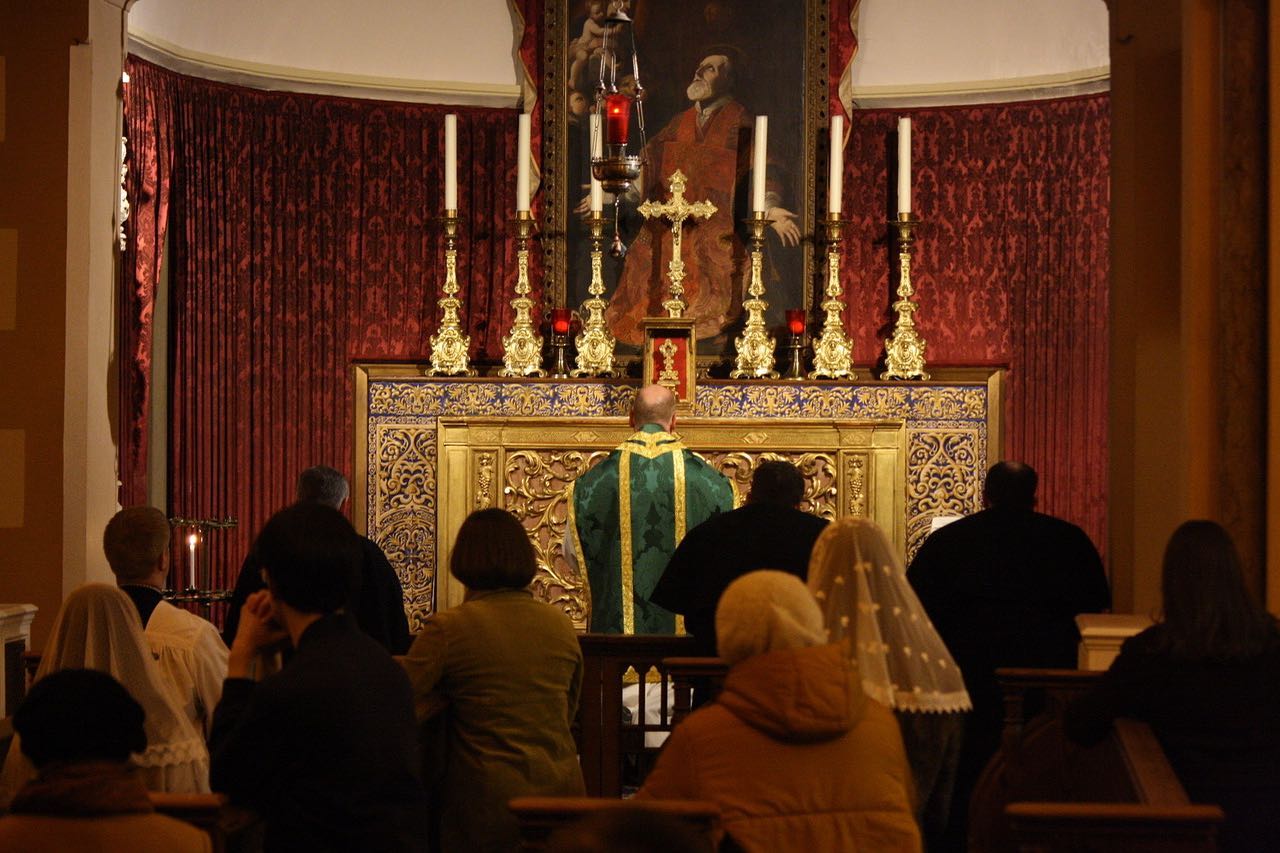
Our devotions to St Philip have returned to his chapel now that the crib has been put away. There are prayers to St Philip and a blessing with his relic after the evening Mass every Monday.
#oxfordoratory
Our devotions to St Philip have returned to his chapel now that the crib has been put away. There are prayers to St Philip and a blessing with his relic after the evening Mass every Monday.
#oxfordoratory
Tuesday 2 February Solemn Mass 18:00
Candlemas
Missa Beata Mater Guerrero
Diffusa est gratia Nanino
Senex puerum portabat Palestrina
Con moto maestoso from Sonata III Mendelssohn
Sunday 6 February Solemn Mass 11:00
5th Sunday of the Year
Missa Je suis déshéritée Maillard
Laudate Dominum de La Rue
Sicut cervus Palestrina
Fugue in C BWV547ii Bach
Sunday 13 February Solemn Mass 11:00
6th Sunday of the Year
Missa brevis Palestrina
Benedictus es Domine Lassus
Christe, adoramus te Monteverdi
Fugue from Symphonie I Vierne
Sunday 20 February Solemn Mass 11:00
7th Sunday of the Year
Missa Inter vestibulum et altare Guerrero
Verba mea auribus Hassler
Ave Regina caelorum Victoria
Sun Dance Chilcott
Sunday 27 February Solemn Mass 11:00
8th Sunday of the Year
Mass for four voices Byrd
Domine convertere Lassus
O sacrum convivium Croce
In the cathedral in Belfast for many years one could not fail to come across Josie Burns. A small, bird-like woman, always dressed in a long tan macintosh with a headscarf knotted under her chin, Josie spent all day, every day in the cathedral praying. She would attend all the Masses, adore the Blessed Sacrament, and it seemed most of the Catholics in the city would give her money to light candles for them, so that there was a continual flame of devotion burning, tended by Josie. That Cathedral had a major restoration, and at the consecration, at the part of the rite when the light for the candles is solemnly presented to the consecrating bishop, there in front of Cardinals, the Nuncio, Archbishops and dignitaries, the one to present the candle was Josie, in her trademark outfit, beaming as she stood among these notable clerics. Every year when we celebrate Candlemas, my mind turns to Josie Burns.
In the Latin Rite, Candlemas is very much a feast of light. The flames of our candles dispel the darkness of winter as spring approaches, they give us a glimpse of the light of Easter as we head into the season of pre-Lent, and they symbolise Christ’s triumph over darkness in the world. In the Christian East, the emphasis is slightly different as this is a feast of encounter, a feast of the meeting between the aged Simeon and the infant Christ. But there is another character in St Luke’s account, one who is often glanced over, and that is the prophetess Anna, daughter of Phanuel, well on in years, and ministering in the temple night and day with prayer and fasting — much like our Josie.
Light conquering darkness, and encountering Christ, of course, go together. Both these things unite the prophetess Anna in the temple and Josie Burns in Belfast, but something else does too — hope.
The supernatural virtue of hope energises our Christian life. It is a gift from God that directs us to him, and spurs us on towards heaven. We have to pray for an increase of it, and then we have to kindle the flame of hope by thinking of the things of heaven, doing spiritual reading and, most importantly, by praying. For those of us in the world, hope helps us see our life in context and helps us bring the light of faith into what we do. An increase in hope can be the antidote to so much of what holds us back in the spiritual life.
Hope sustains us. Josie was able to perform her divine service for all those years because she was full of hope, the same hope that kept Anna going. Anna was a prophetess (and I dare say Josie Burns was too). A prophet does not predict the future but is God’s sign to the world. Anna is a sign of the power of hope, a sign that hope in our salvation, in heaven is realised in a person who gives himself to us.
Next time you are in church, light a candle for Josie Burns who has long since gone to God, and remember that hope begins with a small flame in a darkened temple and grows into the light of Easter.
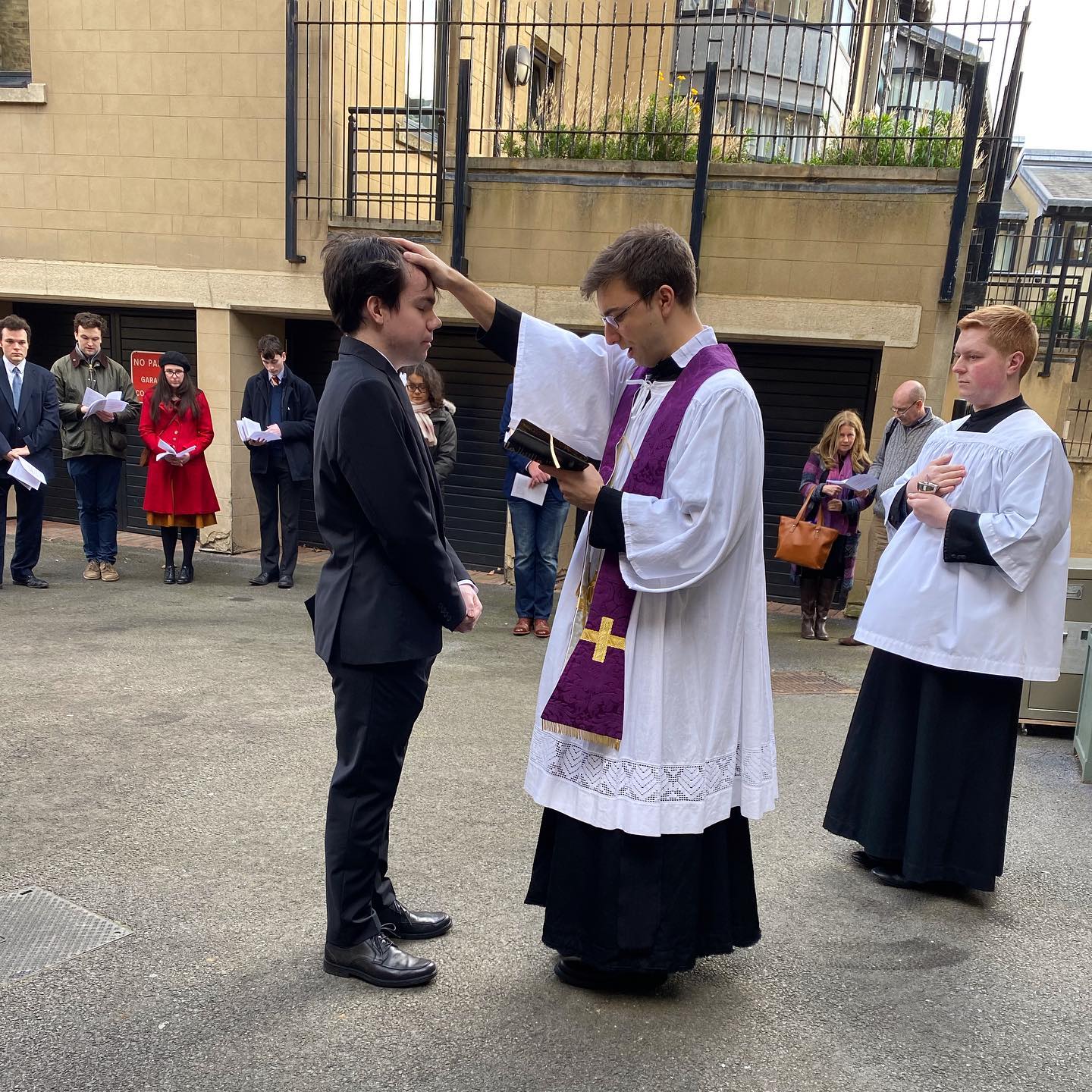
Today we welcomed another member of the Church. Congratulations to David who was baptised this afternoon!
#oxfordoratory
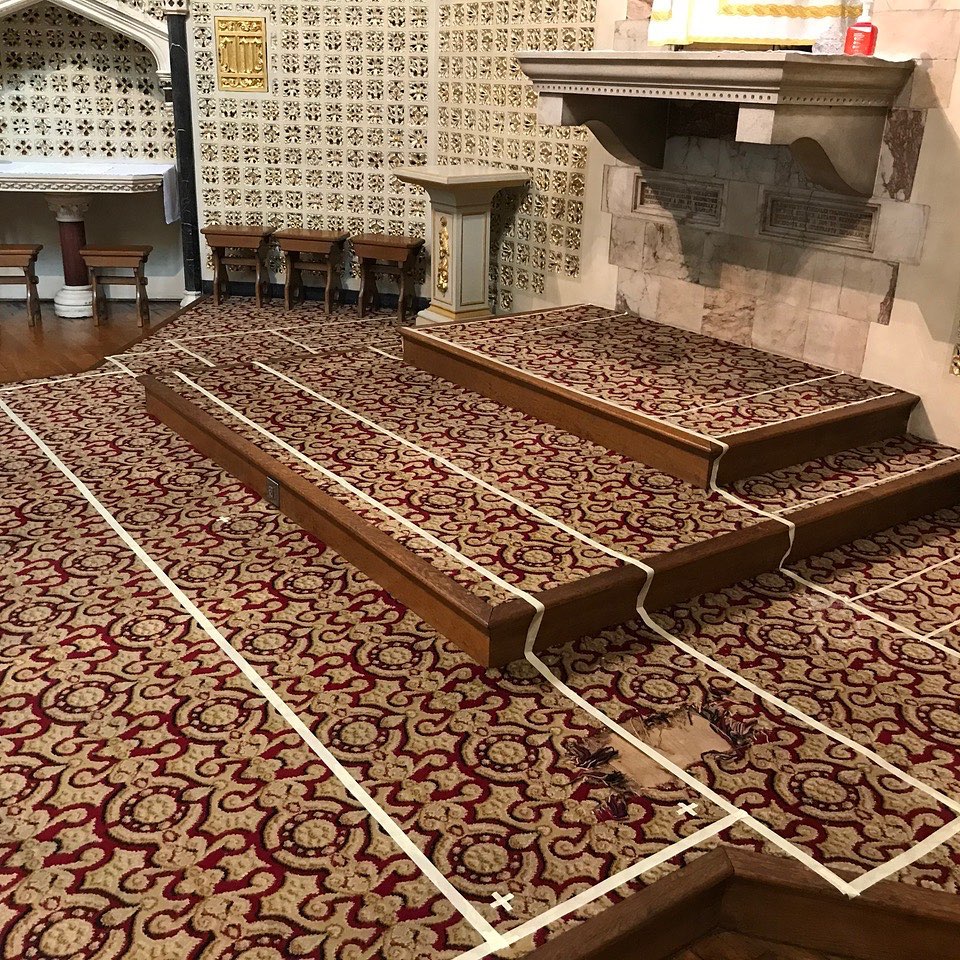
Our first photo of 2022 is actually one from last year. Our photo posts have fallen behind a bit thanks to our mini-covid outbreak in the Oratory house, but the Fathers are all fully recovered now. We’ve also been busy with lots of exciting plans for the future, which we look forward to sharing with you later this year! Can you guess what this is?
#oxfordoratory
If you are someone who makes New Year’s resolutions, by this point in January, you probably have a pretty good idea of whether or not you’re going to succeed in keeping them. When we look at those who are successful in their resolutions, what marks them out is that they have a plan. It’s the people who have a concrete plan for what time and which days they’re going to go for that run, or how they’re going to learn French this year, or what the diet is actually going to look like, who succeed.
The Christian life is no different. We all think we should probably pray a bit more. We all know we could be a bit kinder to others, use our time a bit better and give more to help those in need. Whenever we go to confession, we really do mean it when we say that we will try not to sin again. But unless we have a plan for when and how we are going to do those things, those resolutions won’t come to much either.
Those plans also have to be realistic. If a friend announced he wanted to begin his new exercise regime with a marathon, we wouldn’t hold out much hope of success. In the same way, we can spoil our chances of making progress before we’ve even started if we try to do too much too quickly. St Philip used to say:
It is not a good thing to load ourselves with many spiritual exercises; it is better to undertake a little, and go on with it: for if the devil can persuade us to omit an exercise once, he will easily get us to omit it the second time, and the third, until at last all our pious practices will melt away.
So when it comes to prayer, it is much better to have a short but regular time of prayer than to plan hours of prayer that never materialise. Many people take on too much when they begin to pray, and when they can’t keep up their new routine, they give up all together. Much better to start slowly — walk before you run — and once you form a habit of praying regularly, that time of prayer can grow naturally.
The same goes for the other positive habits we want to build up. If you don’t think you can commit yourself to a big volunteering project, or are cautious about giving away large chunks of your salary to charity, start by doing something small, and gradually build up from there. Better that we are actively doing something, however small, than always planning to do something big that never happens.
When it comes to our sins and bad habits, we may well find ourselves confessing the same list again and again despite a genuine intention to overcome them. But if we only resolve not so sin in some generic way, we won’t achieve very much. We have to form a plan, and focus on building up one virtue at a time. St Francis de Sales recommends this method in his Introduction to the Devout Life. ‘It is well for everybody to select some special virtue at which to aim, not as neglecting any others, but as an object and pursuit to the mind.’
Picking one thing to work on gives us a focus, and makes our target more achievable. It doesn’t mean neglecting the other sins we want to overcome, St Francis explains. In targeting one particular virtue, we grow in all the others as well, so long as we do so for the love of God. If we are motivated by charity, then our growth in charity brings all the other virtues with it. And so we may well find other struggles and temptations disappearing, without having to work on them, because of our progress in the one virtue we have been striving for.
‘When shall we begin to do good?’ St Philip would ask his spiritual children. Perhaps our answer will finally be ‘now’. Make a plan, and start making gradual progress, recalling St Philip’s other recommendation: ‘Do not let a day pass without doing some good during it.’
If we are to talk about holiness, we must first of all have a clear understanding about what we mean by it. I think I would say that it boils down to having a right relationship to or with God. Holiness is an interior state; yes, we may have certain outward devotional practices, or rules to help us, but these certainly don’t make us holy. Holiness, though it may be helped by things (prayers and devotions etc) is in no sense an outward thing — it is unseen, it is a relationship with God, which may be found in any state of life — providing, of course, it is one which is pleasing to the Lord. This was something the Oratorian Saint Francis de Sales stressed so beautifully in his Introduction to the Devout Life, where he wrote:
When God created the world He commanded each tree to bear fruit after its kind; and even so He bids Christians to bring forth fruits of devotion, each one according to his kind and vocation. A different exercise of devotion is required of each — the noble, the artisan, the servant, the prince, the maiden and the wife; and furthermore such practice must be modified according to the strength, the calling, and the duties of each individual. I ask you, would it be fitting that a Bishop should seek to lead the solitary life of a Carthusian? And if the father of a family were as regardless in making provision for the future as a Capuchin, if the artisan spent the day in church like a Religious, if the Religious involved himself in all sorts of business on his neighbour’s behalf as a Bishop is called upon to do, would not such a devotion be ridiculous, ill-regulated, and intolerable? Nevertheless such a mistake is often made, and the world, which cannot or will not discriminate between real devotion and the indiscretion of those who fancy themselves devout, grumbles and finds fault with devotion, which really has nothing to do with these errors.
No indeed, my child, the devotion which is true hinders nothing, but on the contrary it perfects everything; and that which runs counter to the rightful vocation of any one is, you may be sure, a spurious devotion. With the influence of true devotion, family duties are more peaceful, married love truer, service to our King more faithful, every kind of occupation more acceptable and better performed where that is the guide.
It is not only erroneous, but a very heresy, to seek to banish the devout life from the soldier’s guardroom, the mechanic’s workshop, the prince’s court, or the domestic hearth. Of course a purely contemplative devotion, such as is specially proper to the religious and monastic life, cannot be practised in these outer vocations, but there are various other kinds of devotion well-suited to lead those whose calling is secular, along the paths of perfection. Wherever we find ourselves we not only may, but should, seek perfection.
And we know that although the content of our Faith does not change, our way of thinking about it develops and changes as the years pass. Remember, perhaps, how years ago, a certain hymn stirred up great fervour and sentiment in you — yet now you sing it unmoved. We recall, maybe, how we had certain emotional experiences: when we looked at a particular crucifix or painting of our Lady, we might have had tender feelings towards them, but now feel quite differently. Is our devotion any the less? We might worry that that is the case, but it’s more likely that our tastes have changed, become more refined, or that we have moved on to another kind of experience. Because we do not experience what St Francis de Sales called “sensible consolation” doesn’t necessarily indicate lukewarmness or a lack of love on our part, only that the Lord is drawing us on by other means, wanting us to want Him alone, rather than what we can get out of Him. Someone once rightly put it: We shouldn’t seek the consolation of God, but the God of consolation. I recall Rabbi Blue once quoting another rabbi as saying: “I don’t want your heaven, I don’t fear your hell, I only want you God.” Not perhaps how I would have expressed it myself, only for fear of being misunderstood, but it gets to the nub of it. We are in the business of seeking the Lord for Himself rather than for any reward we may gain or through fear of any punishment we might merit.
The secret is to strain forward with eagerness to love God. St Thomas Aquinas was once asked by someone how could become holy. Thomas’s response was brief and to the point: “Velle”, or “Want it.” The will is of course involved — not mere good wishes, but a strong desire to be united with with God in Christ in a right relationship.
At the risk of sounding like a broken record, this new year 2022 got off to a rocky start, with two of the Fathers contracting COVID and having to isolate. But, while we are entering the third year of the pandemic, thanks be to God it seems to be burning itself out. This is evident in the return to something approaching normality in our lives in general: our national life, our work, family, and social lives, but especially in the life of the Oratory and our parish. A new year is always an opportunity to reflect on the past year, and give thanks to God for the many blessings and graces he has bestowed on us. It is also a time when we have to submit our annual pastoral statistics to the Archdiocese — so we thought we would share these with you too.
In 2021 we baptised 32 new Christians and welcomed Julia, Alfred, Sara, Jemima, Beatrice, Catherine, Jayron, Gala, Francisco, Lyra, Michael, Aoife, Tulia, Theodore, Claudia, Emanuel, Nicolas, Billie, Amelia, Isabelle, Edward, Elva, Helena, Stephane, Alexandre, Jessica, Olivia, Eloise, Leo, Aubrey, Arthur, and Leo into the family of the Church. Axel, Dominic, Simon, Alexander, and the Wells family were received into full communion in the One Fold of the Redeemer. The Oratory has always been a popular church for weddings, and last year 16 couples began their married lives together in our church: please pray for Henry and Caroline, Sesismundo and Augusta, Robert and Philippa, Dominic and Iona, Donato and Agnese, Daniel and Amy, David and Patricia, Thomas and Jessica, Lewis and Katrina, John-Joseph and Emily, Jamie and Anna, Stephen and Gemma, James and Stephanie, David and Regina, Sebastian and Eden, and James and Anna.
With the lessening of the coronavirus restrictions over the summer, we were able to restart two of our groups for young people, Young Oratory and Gaeta. To great popular acclaim, Cafe Neri reopened after two of the Sunday morning Masses, and we are grateful to the 15 parishioners who helped make this possible. Unfortunately Cafe Neri has fallen victim to the latest COVID wave, but we hope to restart it again in the coming weeks. Our Lodge and Bookshop continued to provide an important ministry to the parish and to Catholics in the City, with thanks to Fr Benedict, Christine Johnson and the team of 20 Porters for their hard work and dedication in this regard.
The reduction of restrictions also allowed us to welcome guest preachers again, and celebrate some of the feasts of the year with more solemnity than in 2020. Bishop Robert Byrne came home to preach and celebrate Mass on St Philip’s Day, and we were very pleased to welcome the Apostolic Nuncio, Archbishop Claudio Gugerotti, for the Solemnity of the Immaculate Conception. An old friend of the community’s, Cardinal George Pell, visited the Oratory and celebrated a special Mass of the Sacred Heart with us. In his homily, the Cardinal spoke of his time in prison and how he was encouraged and strengthened by the support and prayers of Catholics all over the world. Cardinal Pell was last in Oxford in 2009, when he said Mass for the intention of Newman’s beatification — how much has changed since then! Fr Benedict celebrated his first anniversary of ordination in September, and Fr Nicholas was ten years a priest in October. Please do continue to pray for vocations to the Oratory.
We were delighted to appoint Mr Rory Moules as Director of Music this year, after a competitive interview and audition process. Rory had been Acting Director for eighteen months or so, and we are immensely proud of him and our Oratory Choir. 2021 saw many musical highlights in our church, but I don’t imagine that any Catholic church in the country had more splendid music for the Paschal Triduum than us.
There was much to be thankful for in the wider community too. Like schools around the country, our parish school, St Aloysius, had to contend with online-learning, social distancing, class bubbles, and staggered start-times. The staff, led by Acting-Headteacher Hannah Duncan, must be commended for the amazing work they have done in keeping things going. This work was recognised and applauded in very successful Ofsted and Section 48 (Religious Education) inspections.
Our little Oratory and parish family here in Oxford was able to help a number of charities in Oxford and throughout the world through the generosity of parishioners. In total we were able to give £6,380 of “poor box” donations to the Oxford Food Bank, the Port Elizabeth Oratory’s township apostolate, Let the Children Live, the Father Hudson’s Society, Oxford Poverty Action Trust, the Santa Maria Eduction Fund, the Community Emergency Food Bank, Sobell House, and the Gatehouse. In addition, our crib collection raised £545 for Aid to the Church in Need, and the Lent Project for Mary’s Meals totalled £864. Thank you so much for your kindness and generosity.
Our parish has always been unusual in that we have far fewer funerals than most. There can’t be many churches in the country in which more babies are baptised and couples married than parishioners are laid to rest. But we did say farewell to a number of familiar faces, members of our parish for many years, commending to the mercy of God: Charles Grant, Kathleen Batten, Eileen Healy, Christopher Adam, Michael Kaser, and Anthony (Tony) Cockshut. May their souls, and the souls of all the faithful departed, through the mercy of God, rest in peace.
And so the life of the Church of God goes on. This year we will be celebrating 400 years since the canonisation of our Holy Father St Philip, along with St Ignatius, St Francis Xavier, St Theresa of Avila and St Isidore the Farmer — “four Spaniards and a saint”, as the Romans joked on the occasion — and we hope to organise a suitable way of marking this anniversary, together with the Jesuits and Carmelites in Oxford. We will also be progressing with the next exciting stages of our renovation project, with more news and information to follow. 2022 will be another Year of Grace, dedicated to the Lord and under the protection and intercession of Our Blessed Mother, St Philip and St Aloysius.
These reflections are sent out each Wednesday to all those on our mailing list. Click here to sign up to our mailing list, and receive our Sunday E-newsletter and these reflections straight to your inbox.
First Vespers of the Epiphany on Wednesday evening is cancelled.
Sadly, Bishop Robert will no longer be joining us for the Solemn Mass on Thursday for the Epiphany.
However, all Masses and devotions will continue at the advertised times this week, including the Epiphany Procession and Benediction for children on Saturday at 3pm.
Sunday 2 January Solemn Mass 11:00
2nd Sunday after Christmas
Missa Pastores quidnam vidistis Clemens non Papa
Dies sanctificatus Palestrina
O magnum mysterium Victoria
In dir ist Freude Bach
Tuesday 6 January Solemn Mass 18:00
Epiphany
Missa Tertia octavi toni Croce
Regis Tharsis a4 Byrd
Videntes stellam magi Lassus
Epiphanie Litaize
Sunday 9 January Solemn Mass 11:00
The Baptism of the Lord
Missa Puer qui natus Guerrero
Tribus miraculis Palestrina
O admirabile commertium Byrd
Prelude in C BWV545i Bach
Sunday 16 January Solemn Mass 11:00
2nd Sunday of the Year
Missa Frère Thibault Lassus
Ab Oriente venerunt Magi Sweelinck
O bone Jesu Anchieta
Allegro maestoso e vivace from Sonata II Mendelssohn
Sunday 23 January Solemn Mass 11:00
3rd Sunday of the Year
Missa Sancta Maria Gombert
Dextera Domini Lassus
Alma Redemptoris Mater Fernandes
Toccata primi toni Sark
Sunday 30 January Solemn Mass 11:00
4th Sunday of the Year
Missa Aeterna Christi munera Palestrina
Jubilate Deo Rore
O sacrum convivium Iribarren
Prelude in G BWV 541i Bach