Philip Neri was born in Florence in 1515 at the start of a tumultuous century; two years before Luther posted his theses at Wittenburg, which eventually started the Protestant Reformation and shattered Christendom, the turbulent marriage of Church and state which had predominated in the West for more than a thousand years, and still continued in the Orthodox East after 1054. Islam was an active and ambitious military power still keen to expand despite the loss of Spain. And the western naval victory in Lepanto in 1571 and the lifting of the siege of Malta still lay in the future. The printing presses were turning out more and more books. Literacy was starting to spread from a low clerical base and the national languages of the outlier states of England and Germany were developing, spurred on by the Reformation and the use of the vernacular in the liturgy.
The pope was ruler of the Papal States, the middle third of the Italian Peninsula, which was large enough to defend itself against the Hapsburgs and the Bourbons. During the lifetimes of Thomas More and John Fisher, executed by Henry VIII in 1535, there was scarcely a Pope who was religiously respectable, although they were often capable princes and patrons of the arts. Pope Julius II, one of Michelangelo’s sponsors, was the last pope to lead personally his troops into battle. But with the Counter-Reformation and the loss of whole peoples from the Catholic community, the popes became deeply religious, often in quite different ways. The free-spirited Philip Neri was in trouble: not only with the fierce Paul IV, the terrible Carafa pope, but once again with the Dominican hardliner Pius V.
Despite centuries of Protestant propaganda to the contrary, religious life in England in the 16th Century, when 800 monasteries were closed and so eliminating the only sources of social welfare, the religious vitality was widespread and persisted here for generations. Elsewhere in Europe this was not equally true, and especially in Italy there was a lot of corruption, ignorance and official indifference. When Charles Borromeo went to live in Milan as archbishop against the wishes of the pope, he was the first resident archbishop in Milan for nearly 80 years. Philip was 20 years old when he came to Rome and eventually he did more than anyone to revive genuine faith and devotion among all classes of Roman society. Northern Europe and England saw an exodus from the Church, which was unequalled until our own post-conciliar period. With the difference that today those departing generally fall into the new paganism, whereas then they moved into another serious form of Christianity — Protestantism. This wasn’t to be the case in Italy but while the poor were often ignorant and superstitious, the educated and elite, and especially Philip’s fellow Florentines, were heavily influenced by the 15th Century Renaissance: a rediscovery of the pagan classics, which according to Louis Bouyer produced, and I quote, “a paradoxical union of idealism and carnal passions, a languishing mysticism, which can never be satisfied.”
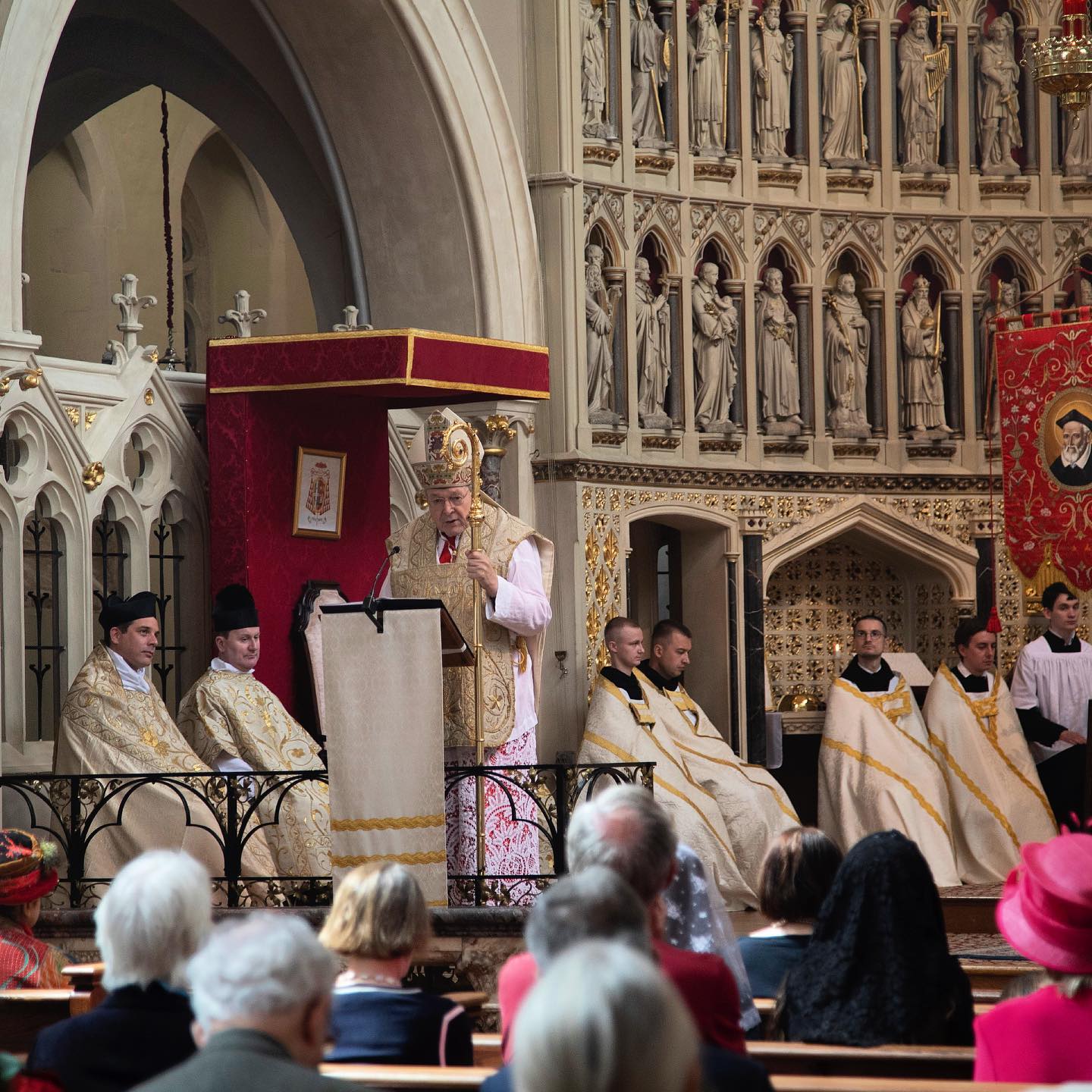
What was the contribution of Philip Neri to this difficult world? What does he say to us? First of all, Philip was a saint, a man of God, a mystic driven and transformed by his love of Christ. He was not the typical wise man praised in the reading of today from the Book of Wisdom. He was not a man of letters in the conventional sense, or a social commentator, or a philosopher — and in fact he destroyed most of his writings.
There are saints and saints. The great saints who are mystics, miracle workers, founders of immense movements which have continued for centuries. And there are other saints, so encouraged by Saint John Paul II with his many canonisations, who are less spectacular but models of perseverance for us.
Philip is among the greats, the giants. But he is one of the most interesting and encouraging of the saints: very human, with a great capacity for friendship; eccentric; sometimes irritating to his fellow workers; and sometimes tough and demanding. He was very hard on the brilliant young preacher, who obviously was a bit too full of himself, too proud of his work, whom he commanded to repeat the same sermon to his congregation seven times in a row.
We don’t have to learn to be frightened by danger, but we do have to learn the fear of God to develop an accurate concept of holiness, a loving awareness of the immense difference between us and the all-knowing compassion of our transcendent Creator. And of course, that Christ enables this connection. At least in Australia, where I come from, and probably more widely, we need to be reminded we Australians by the example of saints like Philip: that you cannot have religious revival without God or striving for godliness. Social justice, social work, ecology, gender equality — and the list could go on — are good, but are not the whole of Christianity or even (I think) the heart of Christianity.
My mother was an Irish Australian and she taught me that to be with a saint in heaven is bliss and glory, but to be with a saint on earth is quite another story. Now Philip is an excellent example of this, but a happy example, who would have avoided my mother’s disapproval.
The Catholic revival then in many places and in the New World of the Americas, was led by the new Society of Jesus, founded by the ex-soldier Ignatius of Loyola. And in those days it was a militant, closely-organised and focused missionary movement. Philip encouraged many young men to join them, but he was too much of a rebel for such an army. And being according to Fr Bouyer a combination of “primitive asceticism and humanistic freedom”. Newman put it beautifully when he wrote that, “Jesuit rigour would have had the same effect on the free-spirited Florentine as Saul’s armour had on David”.
The Gospel of today explains the central element of Philip’s message for us. He had a gift for friendship, he loved beauty, good music — the great Palestrina composed quite a number of his Masses for his Roman congregation. But Philip understood that to produce life we must remain attached to the vine; remain faithful to Christ’s teaching and to Catholic practices. Apart from Christ we can do nothing. Now we’re all dismayed by the exodus of Church members, by the decline of practice. But the remedy doesn’t lie in the German “Synodal Way”. For example by rejecting explicitly the sexual teachings of the Church as they were taught by Saint Paul and by Christ himself. Philip understood that we are servants and defenders of the apostolic Tradition, which alone gives life, and not the master of the Tradition, with a capacity to change it or abolish some of its hard teachings. Recent experience in the Catholic or Protestant and Anglican worlds show that the closer we move to secular models, the faster the decline. We have evidence of many dead and dying branches.
And a final word of thanks to Saint Philip for the stories which his extraordinary biography, preaching, buffoonery, have produced — some of them true and well-founded, perhaps some of them less so. The story of his enlarged heart and cracked ribs caused by his mystical experiences in the catacombs, is a consolation for all those with heart trouble today. Less well-founded, I suspect, is the story that when Philip was undecided about how to proceed, he would often go to Ignatius of Loyola, seek his advice, and then do the opposite. This reeks of anachronism, of the contemporary love-hate relationship of the orthodox with some of the elements of the Jesuit tradition today. But we must never forget that Ignatius was cut from a different cloth.
And I can’t really resist repeating the often repeated story of his penance of the woman who confessed to gossiping. He asked her to pluck some feathers from a fowl and throw them to the four winds. And then when she again confessed to gossiping, his penance for her was to collect the feathers she’d let go. She protested strongly that this was impossible. “Exactly”, he replied, “just like the progress of your gossip.”
Philip knew of the Catholic Church in England, as that extraordinary succession of martyrs from the English College in Rome would regularly visit him before they returned home to preach the Catholic faith. That enterprise which Campion saw as coming from God and as being impossible to withstand. Over 40 of them were martyrs, year after year, and they went to their fate with Philip’s blessing.
So we ask Saint Philip Neri to bless us also, bless our efforts in these troubled times, which always remain rich with the promise of fruit; rich with the promise and possibility of repentance and conversion.