July Music

Sunday 3 July Solemn Mass 11:00
14th Sunday of the Year
Missa Cara la vita mia de Monte
Populum humilem Lassus
Tu solus qui facis mirabilia Josquin
Fugue sur le nom Alain Duruflé

Sunday 10 July Solemn Mass 11:00
15th Sunday of the Year
Mass in the Dorian Mode Howells
Ad te, Domine, levavi Scarlatti
Ego sum panis vivus Byrd
Paean Howells

Sunday 17 July Solemn Mass 11:00
16th Sunday of the Year
Missa Beati omnes Gombert
Iustitiae Domini Mendelssohn
Ave verum Mozart
Prelude in C minor Mendelssohn

Sunday 24 July Solemn Mass 11:00
17th Sunday of the Year
Missa Primi toni Porta
Gaude Virgo Maria Porta
Salve Regina Obrecht
Offertoire sur les Grands Jeux Couperin

Sunday 31 July Solemn Mass 11:00
18th Sunday of the Year
Missa in illo tempore Monteverdi
Precatus est Moyses Palestrina
Adoramus te Christe Monteverdi
Tiento de falsas 2º tono Bruna

How to pray (1)

Our weekly reflections are paused for the summer, so in their place there will be a short extract from how to pray in ten easy steps. This guide is taken from The Oratory Prayer Book, a new prayer book of old prayers that we are publishing and will be available in the coming months.

1. Make prayer a habit

We very rarely have to be reminded to eat, drink or sleep. They are part of our daily routines. We do them out of habit. We always make sure there is time to do them each day because we don’t want to go without them. Prayer should be something special because it is time spent with someone important to us, not because it is something rare. If you want your friendship with God to grow, you need to spend time with him. Make a routine and form habits of praying at set times. Put prayer first so that it doesn’t get forgotten. Form a habit, and you won’t have to spend time thinking about praying every time you want to pray.


These reflections are sent out each Wednesday to all those on our mailing list. Click here to sign up to our mailing list, and receive our Sunday E-newsletter and these reflections straight to your inbox.
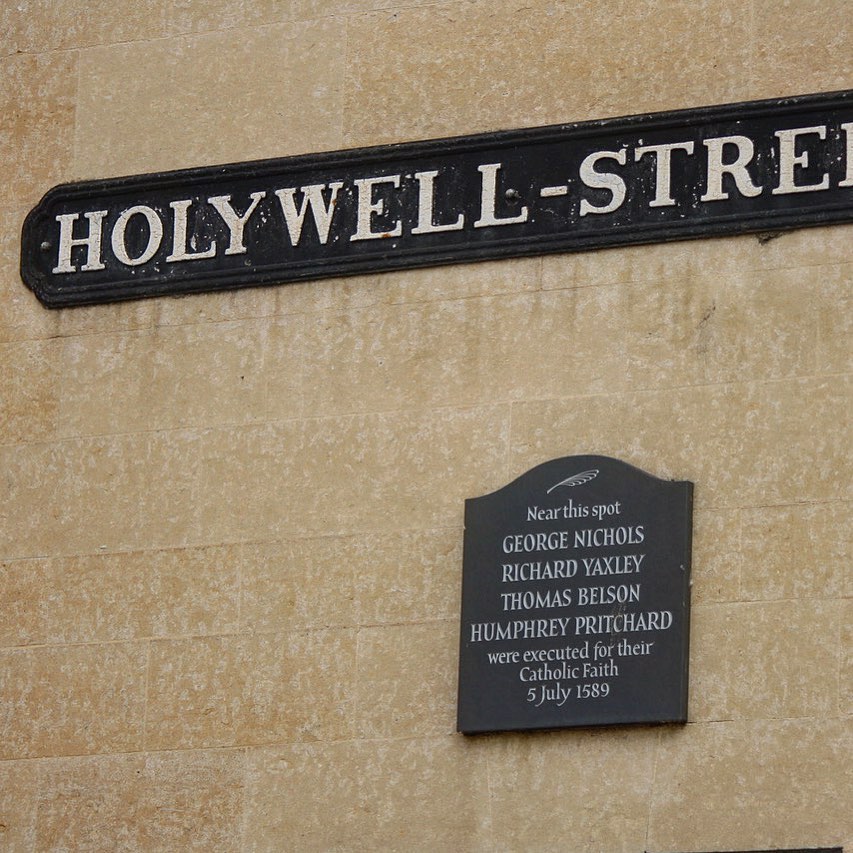
Celebrating the feast of our local martyrs.

“The executions took place at Oxford in July 1589. The two priests were each dragged through the streets on a horse-drawn hurdle. The first to die was Fr George Nichols. Having been refused permission to address the crowd, he made his profession of faith. He made it clear that he was being executed merely because he was a priest. Climbing the ladder to the gallows, he made the sign of the cross on each rung and kissed it. Then he was thrown off to his death.

“Fr Richard Yaxley was the next to die. He embraced the body of his dead colleague, then climbed the ladder and started to make his own profession of faith. But, before he could finish, he too was pushed off.

“It was now Thomas Belson’s turn to die. He hugged the bodies of the two priests and prayed that he would share their courage. He climbed the ladder, started his profession of faith and, like Fr Yaxley, was executed before he could finish. He was twenty-six years old.

“Finally, it was the turn of Humphrey Prichard, the servant from the Catherine Wheel. At the top of the ladder, he told the crowd that he died for ‘being a Catholic and faithful Christian of Holy Church’. A Puritan minister mocked him for being ignorant. Prichard replied that ‘what I cannot explain by mouth, I am ready and prepared to explain and testify to you at the cost of my blood.’ Whereupon he was thrown from the ladder.

“The priests were decapitated and quartered, their heads and quarters being parboiled in a cauldron. Their remains were then fixed to the wall of Oxford Castle, where they were mutilated by Puritan extremists. A couple of days later, the remains were fixed to the town gates. The right arm of Fr Nichols is reported to have swivelled round of its own accord. Some said it pointed accusingly at the city.” (From ‘Thames Valley Papists’ by Tony Hadland)

#oxfordoratory

View on Instagram

Romanità

It is a much-quoted line of Cicero which says that to be ignorant of the past is to ever remain a child. Memory and learning the lessons of the past is part of what it is to be mature. It is true of our faith, too. Remembering particularly the wonders the Lord has done is a constant refrain in the Old Testament and, for Catholics, being faithful to that which was handed down to us from the Apostles requires of us a remembrance of things past. But this requires not just a mere remarking upon the past as we might do in a museum, observing artefacts. Rather, the past of which we speak, the Tradition of the Church, informs the present and the future, because we live it in the now.

At Vespers this evening the Church prays, in the hymn for Peter and Paul, “O happy Rome, which was consecrated by the glorious blood of the two Princes!” They are called princes not because of any earthly power or stately glory at the time — the state put them to death — but on account of their faith and their share in the glory and kingship of Christ, sealed by the shedding of their blood.

It is not just out of pietas to these Apostles, these Princes of the Church of Rome, that our particularly Roman Catholic traditions and heritage is important. We speak of the importance of a Romanità in what we do in church not out of some sort of mawkish sentimentality. Rather, it is a statement and a participation in what has gone before us. Our Holy Father, Pope Francis a few years ago reminded us that: “To be modern, some believe that it is necessary to break away from the roots. And this is their ruin, because the roots, the tradition, are the guarantee of the future.” To be fearful of our tradition, to be anxious at the presence of the past is a fear that our ways, our innovations, our blowing with trends and fads — which at times seem attractive — might be curtailed. Tradition, its practices and above all its Sacred Teachings, free us. They strengthen our unity in faith, and they give us a trajectory.

Our Catholic remembering sees itself crowned in the Mass, when we not only remember and recall the sacrifice of sacrifices of our Lord and Saviour, but by our “hyper-remembering”, by action of the Lord made present again we participate in that sacrifice again. We receive its merits afresh, applied now. Our past, made present now, saves us.

Romanità is not just a particular decorative taste or an affinity for a kind of music (it includes those things and we must celebrate them). It is moreover an active participation in the faith and the sacrifice and the mysteries of those who have gone before us, who have sought to follow Christ in his way — and in the case of Saints Peter and Paul even to death. It is our tribe, our identity and culture. It is the way we express our fidelity to the Lord and to his teachings, passed down from these men who planted the faith at the centre of the world in the city of Rome.

We must learn about our Roman Catholic tradition. We must embrace it as our culture, as the roots from which we draw much to help us live well now. But it is so much more than just a source of inspiration. It is our participation in what St Peter and St Paul died for. It is our sharing in the life and work of all the other saints we hear of in the Roman Canon, or who were buried in the Catacombs, down to St Philip and his holy friends, or any of those great saints of the Church. With an active participation in that treasury of faith, we can face the future with confidence.


These reflections are sent out each Wednesday to all those on our mailing list. Click here to sign up to our mailing list, and receive our Sunday E-newsletter and these reflections straight to your inbox.
The Feast of God

One of the most iconic images of the Catholic Church has to be St Peter’s in Rome and the square in front of it. When a news article needs a photo to accompany a story on the Church, that’s the picture they use. So even if you’ve never been to Rome, we can all imagine that scene: the façade of the basilica, with the colonnade surrounding the square, drawing you in with the two great ‘maternal arms of Mother Church’ as their architect Bernini called them. And forming the welcoming committee, the friendly face of the Church, are the saints — 140 statues of them on top of the colonnade, all facing inwards, welcoming visitors to the square into their company. All, that is, except one.

As you enter the square, the first saint on your left isn’t paying any attention to what’s going on there. He has his back to the basilica, and is looking out over the city of Rome. That saint’s name is Norbert. And the reason he’s not interested in what’s going on behind him is that he’s holding up a monstrance containing the Blessed Sacrament and showing it to the world. Before you even step foot in St Peter’s, it’s been made pretty clear: this is what it’s all about. If you want to know what the focus is of the Church’s life, here’s the summary. Or rather, not what, but who. It’s all about Jesus Christ, who gives himself to us under the appearance of bread.

It’s at this point we realise we also have to admit something quite shocking: the French have got it right. They call Corpus Christi Fête-Dieu — the feast of God. It says something about what an important day it is. Christmas, Easter, Pentecost — all of these days celebrate the most important events in salvation history. But Corpus Christi celebrates one of the greatest mysteries in salvation history. We couldn’t celebrate those feasts — at least not properly, not in the way that we do — without the Mass. Corpus Christi is the celebration of what makes every other feast day possible, what makes it possible to encounter the Word made Flesh when we come to Church at Christmas. This is what makes us able to meet the risen Christ ourselves on Easter Sunday. Corpus Christi is the celebration of our own encounter with Christ, not in some vague and abstract way, but in a real, objective, and simple way. Christ makes himself present, under the appearance of bread, and gives himself to us.

At the Last Supper, shortly after giving his Body and Blood to his disciples for the first time, Jesus said to them, ‘No longer do I call you slaves, for the slave does not know what his master is doing; but I have called you friends.’ (John 15:15) This is one of the most important things that Christ ever revealed to us. God calls us friends, he calls us into a relationship with him not of slavery, but — and we wouldn’t dare to say it unless he had said it first — a relationship of equals.

Human beings are not purely spiritual beings like angels. We struggle to form purely spiritual relationships with other people. It’s unlikely that your best friend is someone you’ve never met in person. It’s through this gift of his Body that Christ opens up the possibility of a real, human relationship with him. We don’t have to imagine that he’s there, we don’t have to convince ourselves that he is close to us. We know it, we can be sure of it, because of this sacrament.

Just as this feast comes as a high point after so many other great feasts of the Church’s year, so this sacrament is the high point of all the sacraments. The feast of Corpus Christi couldn’t take place if Christmas and Easter had never happened, and similarly, we would never receive Holy Communion if we hadn’t first been baptised, if we didn’t have access to confession, if there were no men ordained as priests to celebrate the Mass. But, of all the sacraments, Holy Communion is the greatest because, as St Thomas Aquinas pointed out, the other sacraments all use some kind of instrument to do God’s work. When we baptise a person, the water doesn’t become God. When we are confirmed, the chrism isn’t turned into the Holy Spirit. But in the Eucharist, Christ is not working through bread and wine. Those material things are turned into him. Holy Communion is actually him himself. God works through all of the the sacraments, but only the Eucharist actually is God.

That encounter with Christ that each of us undergoes when we receive Holy Communion is hidden and private — so hidden that most of what he does in that moment is unseen even to ourselves. But the effects are not to be hidden. We can’t touch God and remain untouched by him. That image of St Peter’s in Rome is an image of what we are called to. We enter the church, we receive God, we enjoy the company of all those saints, but like St Norbert, our task is then to show Christ to the world, to draw them into his friendship as well.


These reflections are sent out each Wednesday to all those on our mailing list. Click here to sign up to our mailing list, and receive our Sunday E-newsletter and these reflections straight to your inbox.