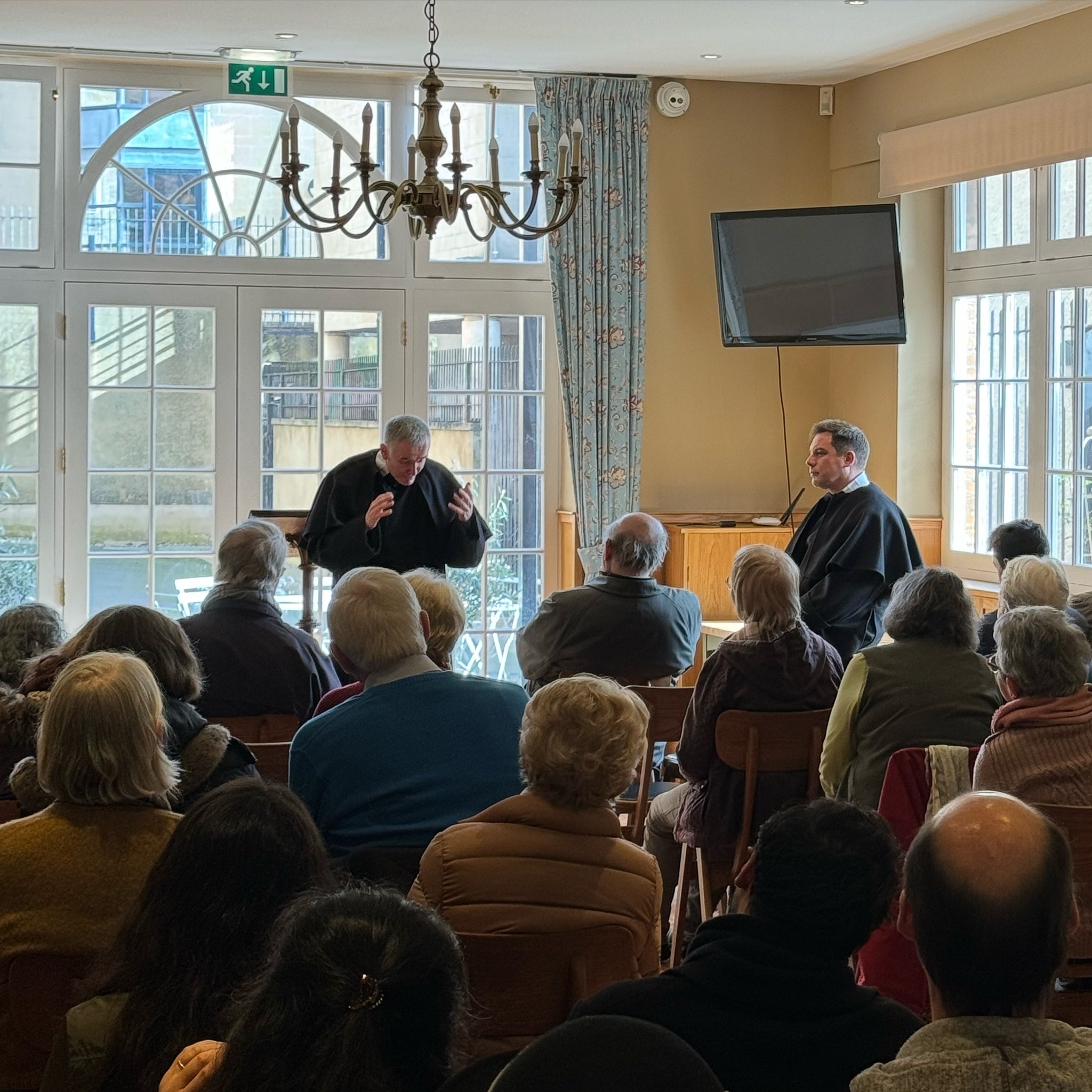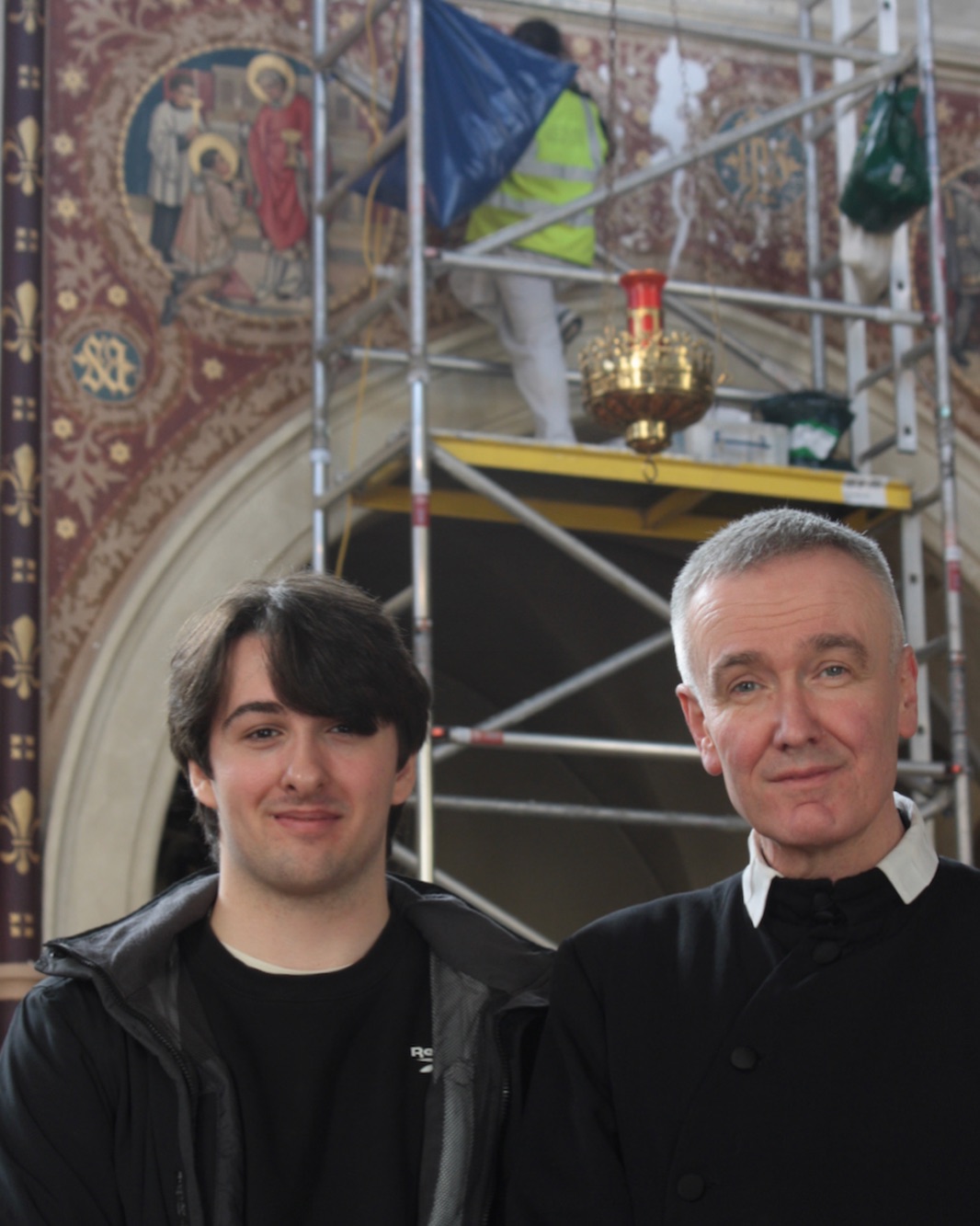
Charlie was received into the Church today, confirmed with the name “Aloysius” and received his first Holy Communion. In the background, another Aloysius can be seen receiving his own first Communion. #oxfordoratory
Charlie was received into the Church today, confirmed with the name “Aloysius” and received his first Holy Communion. In the background, another Aloysius can be seen receiving his own first Communion. #oxfordoratory
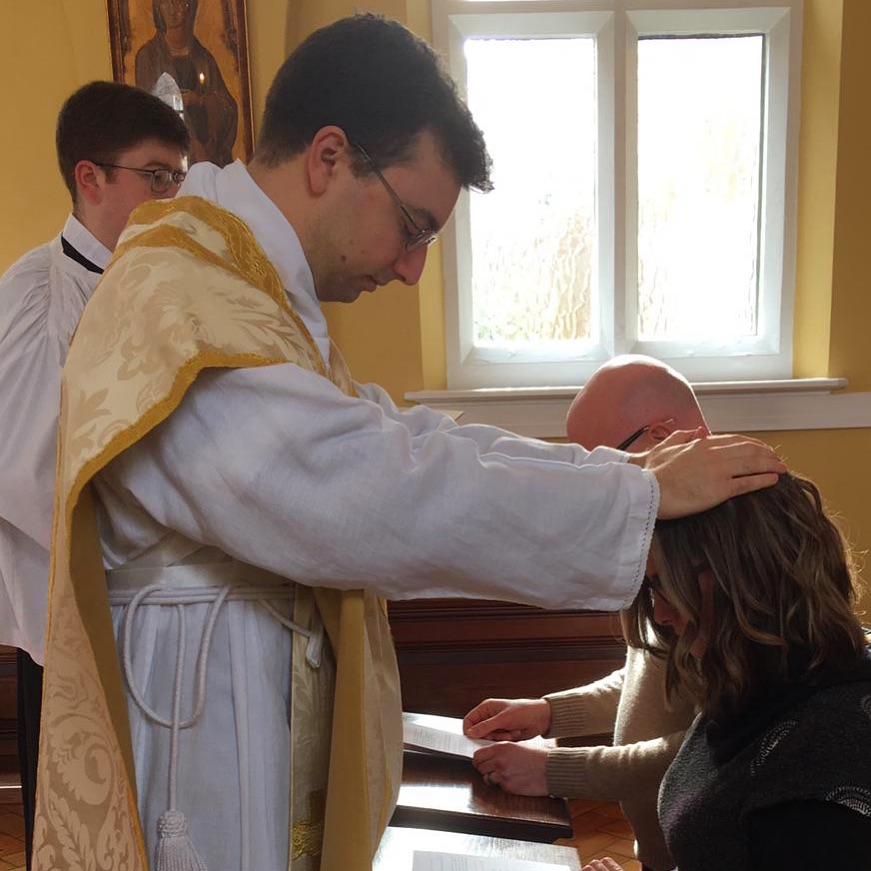
Today we celebrated the reception of Kevin and Melanie into full Communion with the Catholic Church.
Christians who are already baptised are “received” into the Church (and are not technically “converts”) because baptism joins a person to Christ’s Body — the Church — wherever it may take place. The fullness of Communion with the Church comes about by receiving Christ’s Body for the first time in the Eucharist.
Please pray for all those we have baptised or received into the Church recently, and carry on praying for those who are still on their way!
“We entreat you, brothers, as earnestly as we are able, to have charity, not only for one another, but also for those who are outside the Church. Of these some are still pagans, who have not yet made an act of faith in Christ. Others are separated, insofar as they are joined with us in professing faith in Christ, our head, but are yet divided from the unity of his body. My friends, we must grieve over these as over our brothers. Whether they like it or not, they are our brothers; and they will only cease to be so when they no longer say ‘Our Father’.” — St Augustine
Sunday 3 March Solemn Mass 11:00
3rd Sunday of Lent
Missa Inter vestibulum Guerrero
Rex autem David Ribera
Tristis est anima mea Kuhnau
Sunday 10 March Solemn Mass 11:00
4th Sunday of Lent (‘Lætare’)
Mass in the Dorian Mode Howells
Laetatus sum Vaet
Manus tuae Morales
Sunday 17 March Solemn Mass 11:00
Passion Sunday
Missa Quarti toni Victoria
Voce mea Porta
Ave verum Byrd
Sunday 24 March Solemn Mass 11:00
Palm Sunday
Pueri Hebræorum Victoria
Ingrediente Domino Malcolm
Missa brevis Palestrina
Christus factus est Anerio
Improperium Palestrina
Vadam et circuibo Victoria
Thursday 28 March Solemn Mass 20:00
Maundy Thursday
Missa Vinum bonum Lassus
Ubi caritas Duruflé
Dominus Jesus in qua nocte Palestrina
Pange lingua Victoria
Friday 29 March Solemn Liturgy 15:00
Good Friday
Christus factus est Bruckner
St John Passion Victoria
Popule meus Victoria
Crucifixus a8 Lotti
Versa est in luctum Lobo
O suavitas et dulcedo de Monte
Crux fidelis King John IV of Portugal
Lamentations I Tallis
Saturday 30 March Easter Vigil 21:00
Holy Saturday
Missa Tulerunt dominum meum Praetorius
Aurora lucis rutilat Lassus
Dum transisset Taverner
Chorale Improvisation sur ‘Victimae Paschali Laudes’ Tournemire
Sunday 31 March Solemn Mass 11:00
Easter Sunday
Coronation Mass Mozart
Christus resurgens Allegri
Surrexit a mortuis Widor
Hallelujah Handel
Prelude and Fugue in G BWV541 Bach
Solemn Vespers 17:00
Deus in adjutorium Croce
Haec dies Sheppard
Magnificat tertii toni Vivanco
Ecce vicit leo Philips
O salutaris hostia Howells
Tantum ergo Howells
Regina Caeli Howells
Finale from Symphony 6 Widor
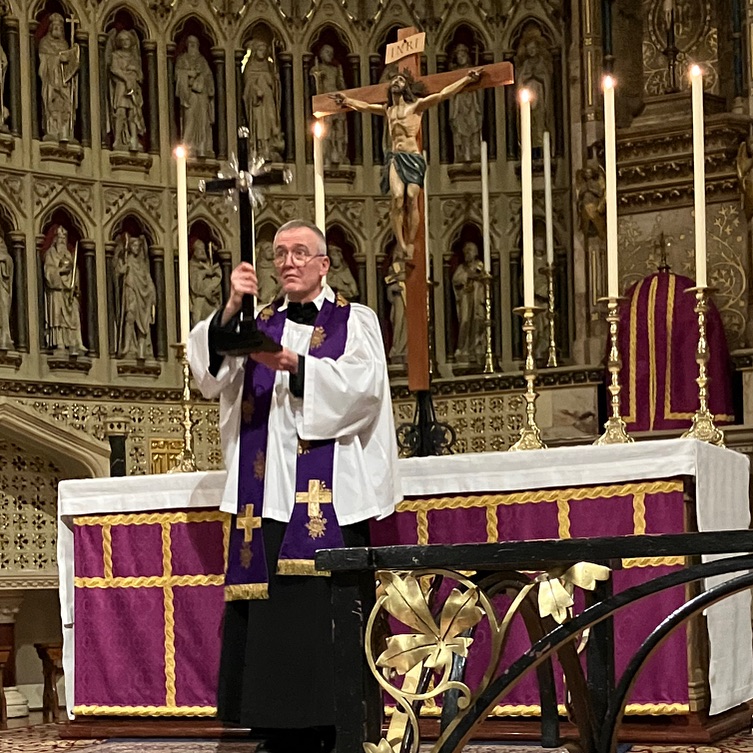
We pray the Stations of the Cross at 5:30pm every Friday during Lent. At the end, there is a blessing with a relic of the Holy Cross.
#oxfordoratory
On Ash Wednesday we asked the Lord to grant “that we may begin with holy fasting this campaign of Christian service, so that, as we take up battle against spiritual evils, we may be armed with weapons of self-restraint”. We were told to give alms, and pray, and fast. Self-discipline, penance, works of charity and, particularly, fasting will be demanded of us in the liturgy for these forty days. The ancient preface of Lent is all about fasting, by means of which God restrains our faults, raises up our minds, and bestows virtue and its rewards. We speak of the Solemn Lenten Fast — in fact, the Dutch and Afrikaans word for Lent is Die Vaste or Vastyd, “The Fast” or “The time of fasting”.
Fasting has always held a special place in Jewish and Christian religious thought and practice. Both Elijah and Moses fasted for forty days before seeing God. St John the Baptist and his followers fasted. The Lord himself fasted in the desert, not for his own needs, says Dom Guéranger, but to serve as an example for us. The Church has sanctified, encouraged, and sometimes mandated the practice of fasting. Why? According to St Thomas Aquinas, to “bridle the lusts of the flesh, to raise the mind more freely to the contemplation of heavenly things, and to satisfy for sins”. He quotes St Augustine who says, “Fasting cleanses the soul, raises the mind, subjects one’s flesh to the spirit, renders the heart contrite and humble, scatters the clouds of concupiscence, quenches the fire of lust, kindles the true light of chastity.”
For more than a thousand years, the Lenten fast was of the strictest kind. Abstinence from meat, eggs and dairy products was required of all Catholics for the entirety of Lent, and every day except Sunday was a day of fasting — with only a single meal allowed, and only after sunset. In more recent centuries this fast was mitigated, and by the middle of the twentieth century eggs and dairy were permitted and abstinence from meat only required on a couple of days each week. Fasting was still obligatory, but a small breakfast and an evening snack were permitted. Today, the only days of obligatory fasting for us are Ash Wednesday and Good Friday, and even then we are allowed one meal and two small snacks (which is what many of us would eat ordinarily anyway). So what are we to make of the liturgy’s assumption that we are all engaged in a prolonged and difficult fast from Ash Wednesday to Holy Saturday?
Some people have said that fasting means to give up doing something, so in Lent we should give up all sorts of bad behaviour: refraining from hurtful words, sadness, anger, worry, bitterness, selfishness, and so on. But surely we should be trying not to act in these ways throughout the year? Fasting has never been seen as giving up what is bad — that goes without saying. Rather, to fast is to deny ourselves something that is good for the sake of a greater good. We reduce our eating not because it is bad — or because we want to lose weight or be healthier — but because in denying ourselves we show the Lord that we are sorry for our sins, for all those times when we have indulged ourselves and let our appetites lead us away from God. We take our attention away from food and drink to focus it on repentance and prayer. We give up something good for the sake of him who gave up his life for us.
St John Henry explains how we should keep Lent, especially at a time when the rules of fasting have been mitigated, in a sermon he gave in 1848 (when, despite several relaxations, Lenten fasting was still much stricter than today). He says:
…fasting is only one branch of a large and momentous duty, the subdual of ourselves to Christ. We must surrender to Him all we have, all we are. We must keep nothing back. We must present to Him as captive prisoners with whom He may do what He will, our soul and body, our reason, our judgement, our affections, our imagination, our tastes, our appetite.
The great thing is to subdue ourselves; but as to the particular form in which the great precept of self-conquest and self-surrender is to be expressed, that depends on the person himself, and on the time or place. What is good for one age or person, is not good for another.
Newman teaches that fasting from food is appropriate in people or places where the struggle against sin is a bodily struggle: against lust, greed, gluttony, drunkenness, and violence. But when fasting rules are relaxed, it is a reminder to us that there are other sins and weaknesses to mortify in us — sins of the intellect, the affections, the will, sins of pride — which need subduing even more than our bodies. He suggests that we mortify our curiosity for news and information (how necessary this is today, with constant exposure to media and social media), and mortify our reason (taking time to hear the opinions of others, and getting into the habit of mistrusting our own views in order to properly try them and purify them). None of these involve giving up that which is objectively bad, but all will involve some effort and renunciation on our part — a real “fasting”.
Lent is a sacred time in which we double our efforts to reject sin, to amend our behaviour, and move from darkness to light. But it is also a time when we offer to the Lord true sacrifices: denying ourselves in little ways and big ones to tell him — and to show our selves — that we love him above all things and repent with our whole heart for having offended him.
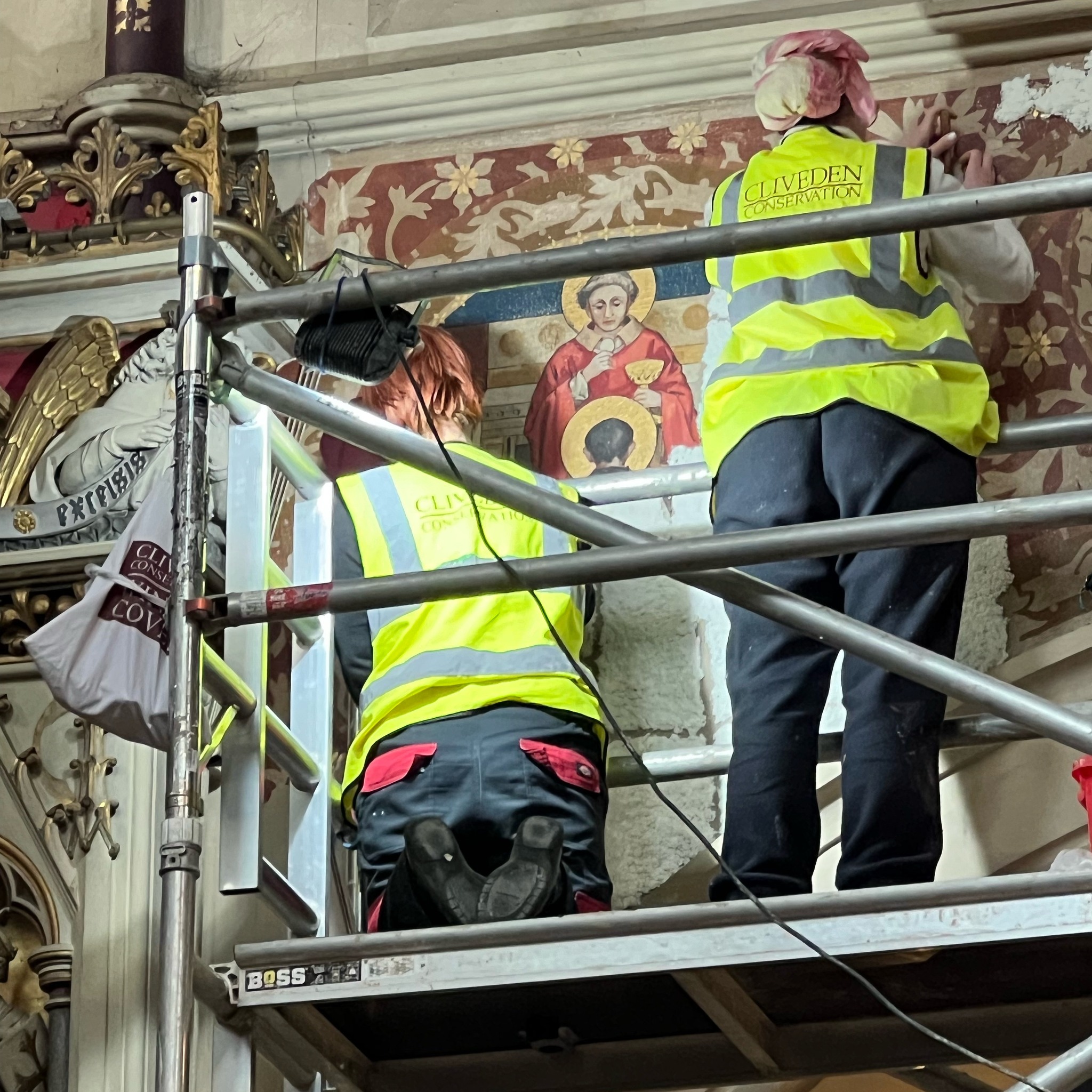
Today we discovered a section of mural depicting St Aloysius’ First Holy Communion at the hands of St Charles Borromeo.
#oxfordoratory #oratory150
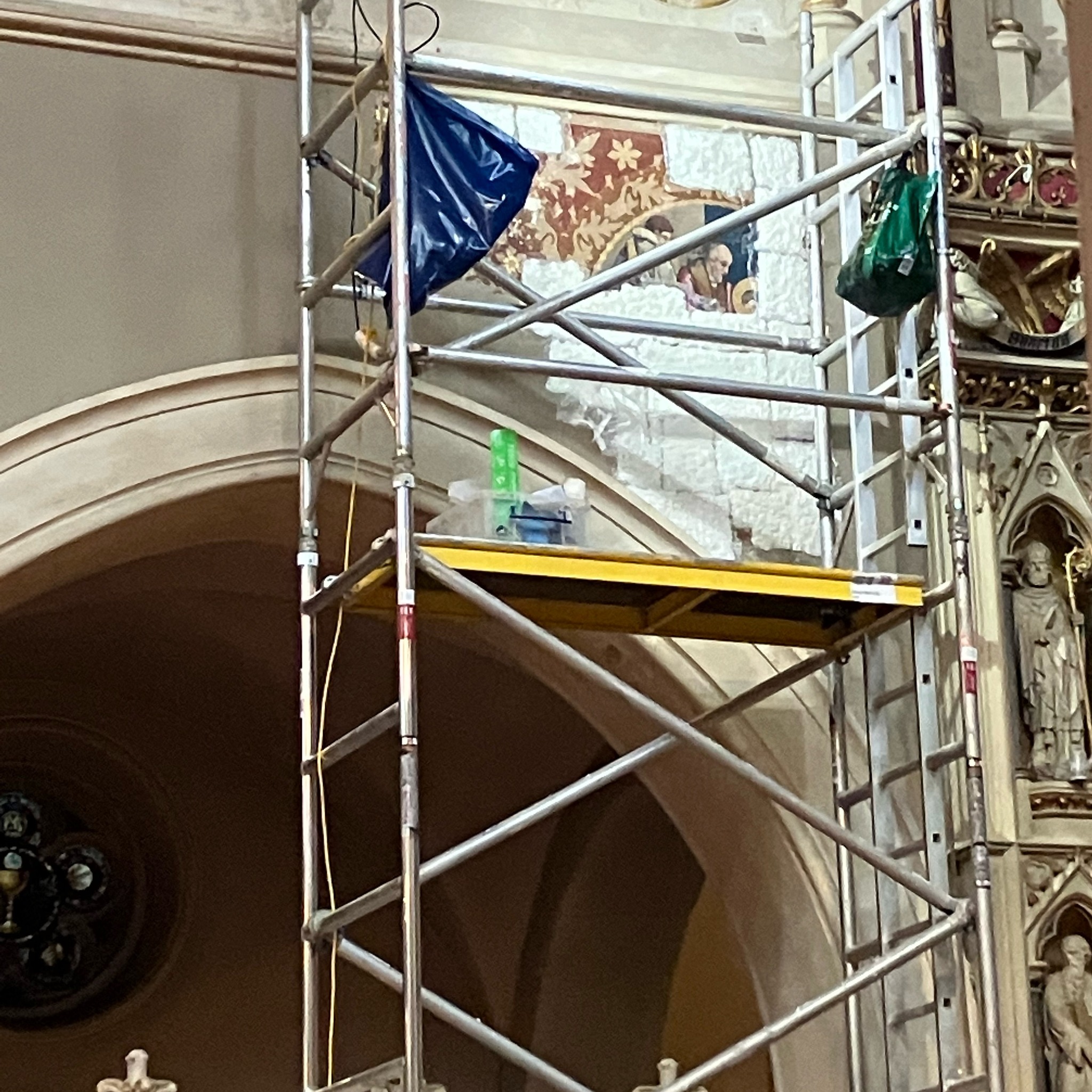
Work on uncovering our sanctuary murals began this week. #oxfordoratory #oratory150
Flanders and Swann once pointed out that England doesn’t really have a national anthem of its own: God Save the King is for all the United Kingdom, and so England is left with a patriotic song about the capital city of another country — Parry’s Jerusalem. This hymn, which poses questions in its words that can all be answered ‘No’, speaks to us of the constant fascination with Jerusalem, with the Holy City, which God chose as his own. This fascination we see in other outlets of mankind’s God-given genius: for example, the beautiful hymn, which I should like at my funeral, Jerusalem the Golden and the other 1960s version, which I should not, popularised by the Israeli pop ballad singer Ofra Haza. There are books, thousands of them, of course, which tell of Jerusalem’s tortured history or otherwise introduce us to her glorious cuisine. Pilgrims today, as in the past, bear her very name tattooed on their bodies, and in many Jewish homes there is a plaque on the wall bearing her name or simply ‘Mizrah’ (east), as Muslim homes will have an image of the Al-aqsa mosque. She is the focus of the prayers of billions each day, and has been fought over since first she was thought of. Etymologists debate the origins of her name but we suppose that Jerusalem is called the ‘City of Peace’, which only heightens the terrible irony of her suffering.
If you have had the chance to go to Israel and to visit Jerusalem you will know that for a Christian it is an unparalleled experience. The first-time visitor never knows quite what to expect, and some are disappointed that their pilgrimage is not an expedition into time-travel. But for all the modern dual-carriageways, impossible bureaucracy, and millennia-old general chaos which inhabits everything, there is ever a sense of the proximity of the Incarnation. In the Old City, those streets that wind about and those tiny courtyards that beckon one into yet another site of God’s dwelling with mankind, all of it changes, fundamentally, how one hears the Gospel and reads it — because with Jerusalem one can see it. These stones upon which Christ walked, these places where his Apostles preached him, this mount where his blood was shed…the wonder and the privilege to be simply there is something that not even hordes of selfie-takers can obscure.
As Christians, Jerusalem is in our soul. We have always faced East to offer the Sacrifice of God to God and in the Mass our very posture positions us towards the East: to Eden and to Jerusalem, that our faces and hearts may be lifted up to God and to his City and thus to the hope of the Heavenly Jerusalem. Each day we utter the name of Jerusalem: in our psalms, hymns, and prayers. Our minds and hearts are transported there by the words of the prophets, the songs of David, and all our sacred history as it is recounted. Just a few months ago we found ourselves only just outside her limits as we knelt before the Christ-Child in Bethlehem and then Candlemas took us up to Jerusalem — one always goes up to Jerusalem just as one does to Oxford — to the Temple itself, and now in these weeks we will follow Our Lord through her alley-ways and porticoes, to witness there his miracles and to hear his preaching, to follow him then from Gethsemane to Calvary. And not long thereafter we shall wait at the Sepulchre from which will burst forth his victory, to be taken thence out of the Holy City of Jerusalem to every corner of the world.
During Lent, each Friday in our church at 5:30pm, we pray together the Stations of the Cross, tracing Christ’s journey to Calvary to shed his Blood for our redemption. This is the Via Dolorosa. The Franciscans bought back this devotion from Jerusalem so that all those who could not travel there could instead trace Our Lord’s journey in every Temple of God throughout the world. The journey to Jerusalem has rarely been easy and at this precise moment would be rather precarious; if we want to see those streets and follow the Cross through them we are probably better advised to do it on Google Street View for the moment. Far better of course to follow Our Lord in his own House, in his Church. The Stations are not a re-enactment; they are a prayer — lifting our mind and heart to the moving and bloody reality of the price God paid for us in love.
This Lent, as we follow his Via Dolorosa in our own churches, as we pray those psalms and hymns, and hear day after day of Jerusalem, we do well to pray for the people of that Holy City and Land that Christ wept over. And for ourselves too, that we may follow Christ this Lent in every mystery of his Passion, to contemplate his inexhaustible love continually poured out for us, and know at last the “sweet and blessed country, that eager hearts expect! In mercy, Jesus, bring us, to that dear land of rest”.