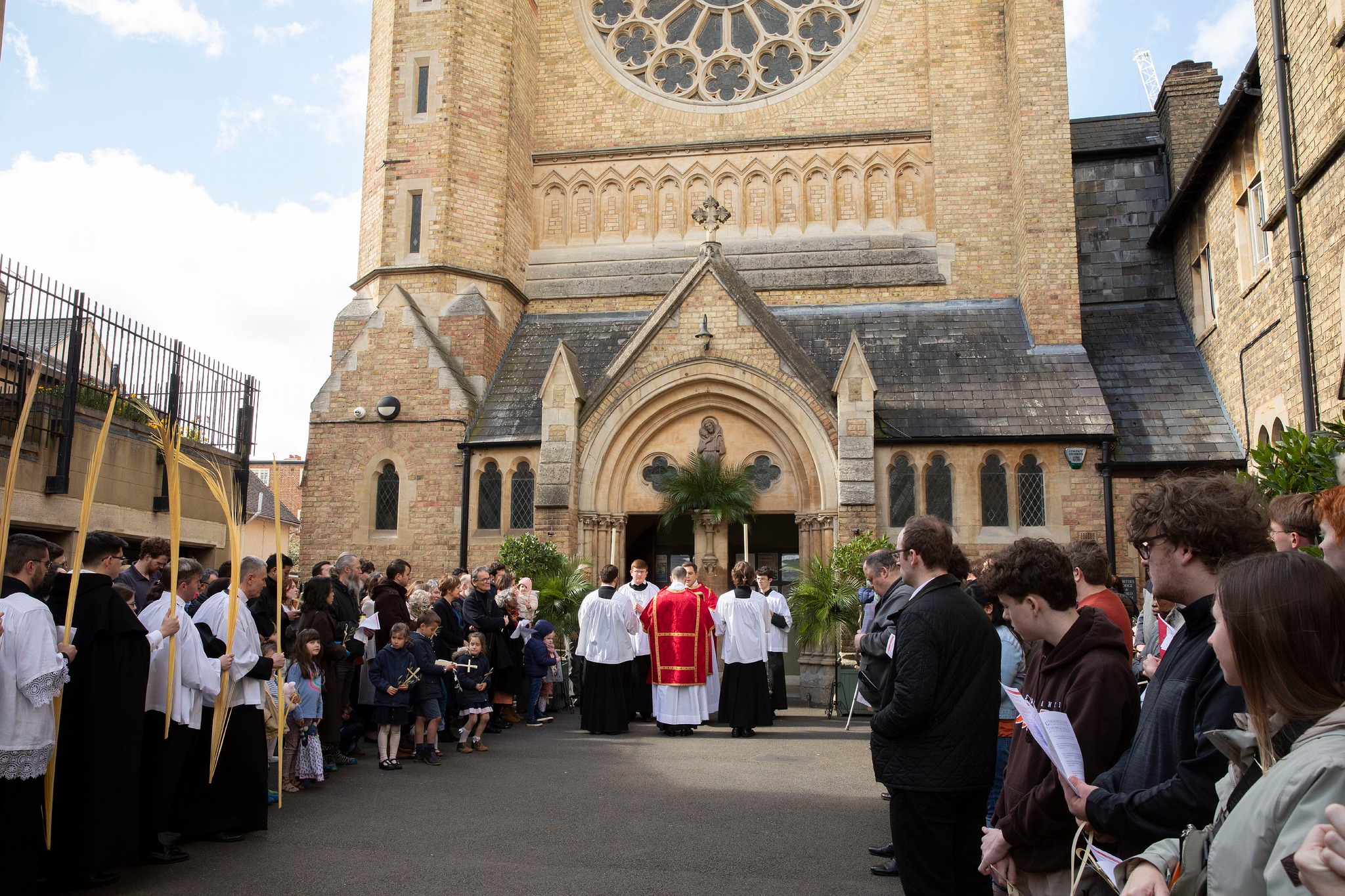
The beginning of Holy Week, and the Gospel of Christ’s triumphal entry into Jerusalem. #oxfordoratory
The beginning of Holy Week, and the Gospel of Christ’s triumphal entry into Jerusalem. #oxfordoratory
“The painter’s brush touched the inchoate face by ends of nimble bristles and, with that blush of first colour, rendered her lifeless cheek living.” So run the first lines of a relatively unknown poem. But there is truth in these words — by daubs of paint, even the most naive movement, emotion and life can be conjured. We’ve been thinking a lot about this as the layers of modern paint in our church’s sanctuary have been peeled away by the extraordinary skill of the team from Cliveden Conservation. Some came away easily, some by the painstaking application of a scalpel. Some cracks needed filling and re-colouring, some gilding needed a new touch of gold leaf and one whole section had to be repainted from fragmentary evidence. It was a labour of love, a slow and at times anxious process. The results speak for themselves.
Four roundels are framed by scrolling leaves and gilt flowers, each telling the story of a scene from our patron saint’s life. His first Holy Communion at the hands of St Charles Borromeo, the renunciation of his father’s wealth, his profession in the Society of Jesus and finally his all too early death. He is not alone in these scenes, those others — saints, parents, confreres — who played their part on Aloysius’ journey to sanctity are depicted too. There is an elegance and a simplicity to Gabriel Pippet’s work in the forms and shapes and the colours he chose. A fitting tribute to a life lived for God and others.
It makes one think. If my life were to be depicted in four or so scenes, either in the mind of others or on a church wall, which would be the defining moments? Perhaps we cannot choose, perhaps there are some which would make us blush to remember them, perhaps others are painful and challenging. We are all on a path to sainthood. In the last analysis our life will be weighed in that balance that only God, the just judge of our life, has an eye on. In the present we, by his grace, have the chance to form those crucial scenes. The choices we make now are always formative.
“You are God’s work of art,” St Paul writes to the Ephesians. We are a work in progress, perfected and helped along by the love and the mercy of our God who takes a keen and loving interest in our life. There is a process of restoration going on in us too — sometimes easy, sometimes by the painstaking application of a scalpel of repentance. Elsewhere, St Paul exhorts his readers to fill their minds with that which is “true, whatever is honourable, whatever is just, whatever is pure, whatever is lovely, whatever is gracious, if there is any excellence, if there is anything worthy of praise.” St Aloysius, in his short life, sought these things with an intrepid and uncompromising zeal and put them to the service of others. This was his path to conversion, fulfilled in that final scene of our murals in which he spoke of going to heaven, “as if it were a walk out to Tivoli.” The time to seek heaven is now.
Conversion has been much on the minds of many of us during Lent. By our prayers and our sacrifices we seek to draw closer to the Lord, to rely more on him, to seek his help more. As we move into Passiontide, the reality of his sacrifice of love should dawn a little more clearly on our minds. That loveable saviour was cruelly treated, disfigured, beaten and killed on account of our sins, but the love that was at the heart of his sacrifice was also on account of our sins since he knows his love saves us from them. Our image may at times resemble him in his disfigured state, but as we dispose our selves more and more to the action of his grace, we will resemble him more and more in his risen glory. That heavenly glory has to be the guiding inspiration behind all the scenes that form the artwork of our lives.
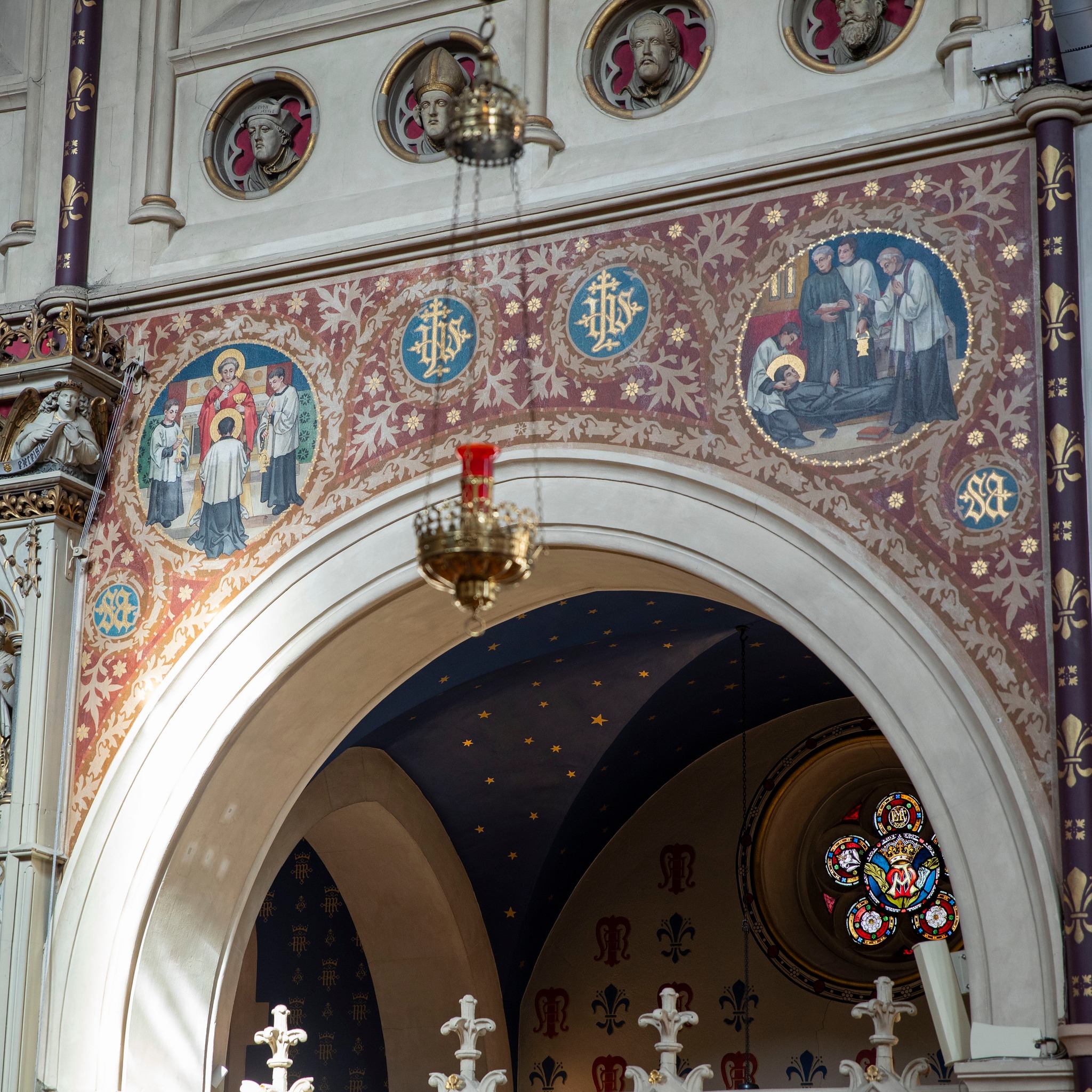
The final scene shows St Aloysius on his death bed aged 23, having caught the plague from those he had been nursing.
As well as the stunning scenes from St Aloysius’s life, this work has unlocked some of the general patterns that continued in other parts of the sanctuary. Notice how the leaf and vine pattern actually continues the mouldings above the reredos statues. It also ties in with the gold decoration behind the tabernacle and crucifix, and the brass railings beside the lecterns, showing us how the original decoration of our sanctuary all came together.
This work enables us now to reconstruct the decoration of the rest of the sanctuary, which has not survived under the modern paint in the same way as these murals, suffering from damp and flaking plaster over the years.
It is astonishing how quickly @clivedenconservation were able to uncover these paintings that had been lost for 60 years. Thank you to all our generous benefactors who made it possible to begin this work so quickly.
#oxfordoratory #oratory150
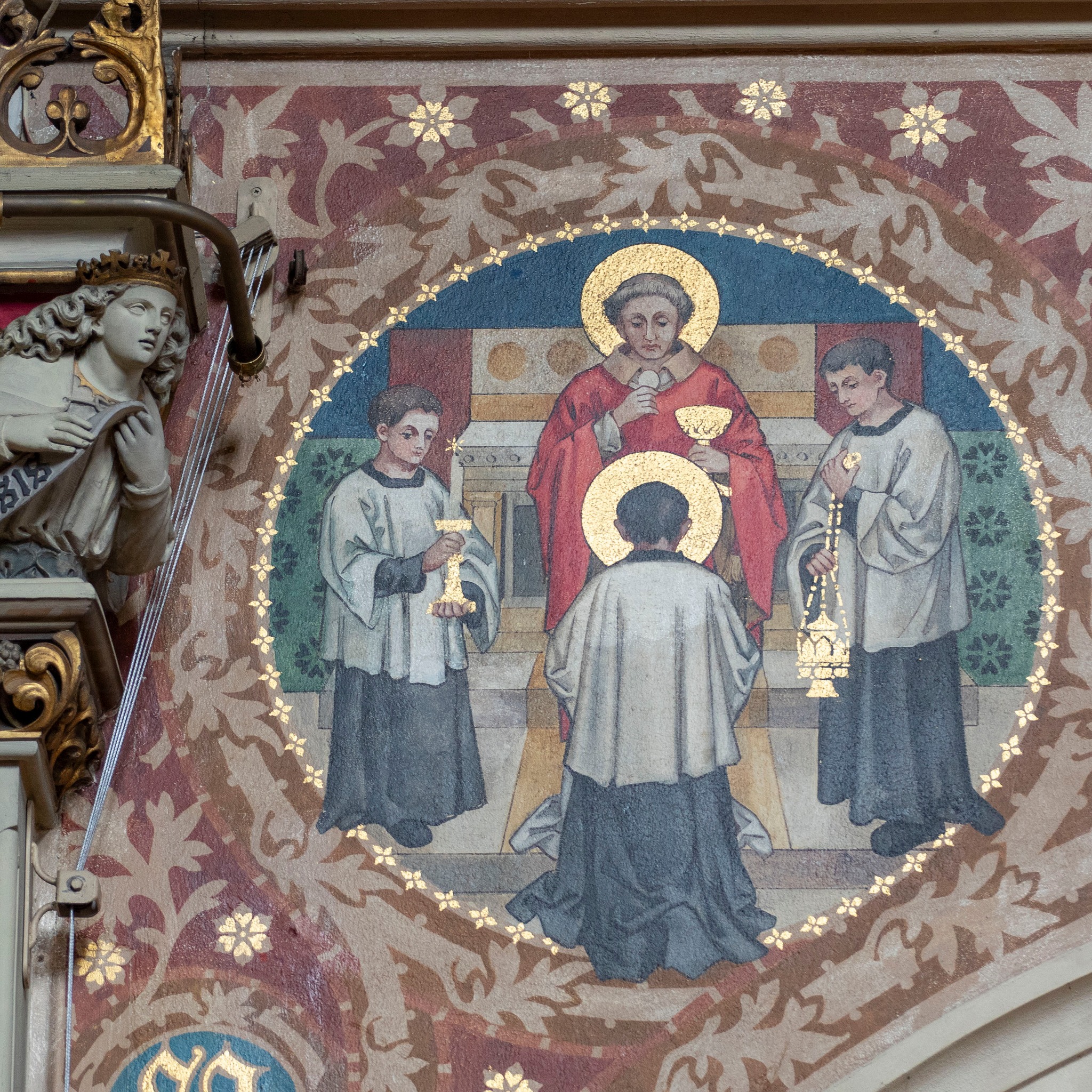
The next scene show St Aloysius’ professing his vows as a member of the Society of Jesus.
When this scene first began to appear, we saw the haloed priest holding a Host and assumed it must have been St Charles giving Aloysius his first Communion. When we found that scene on the other side, we realised we were wrong!
Unusually for a scene from a saint’s life, it depicts Aloysius with his back to us. This highlights his turning his back on the world to serve Christ alone. Jesuits make their vows during Mass directly to Jesus in the Blessed Sacrament just before Communion.
We‘re still not sure who the saintly priest is. The canonised superiors general of the Society St Ignatius and St Francis Borgia both died before 1587, when Aloysius made his vows. We think it is most likely to be St Robert Bellarmine.
A particular highlight of these murals can be seen in the beautiful detail of the acolyte’s candle, where the flame is depicted by a star in gold leaf.
#oxfordoratory #oratory150 @clivedenconservation
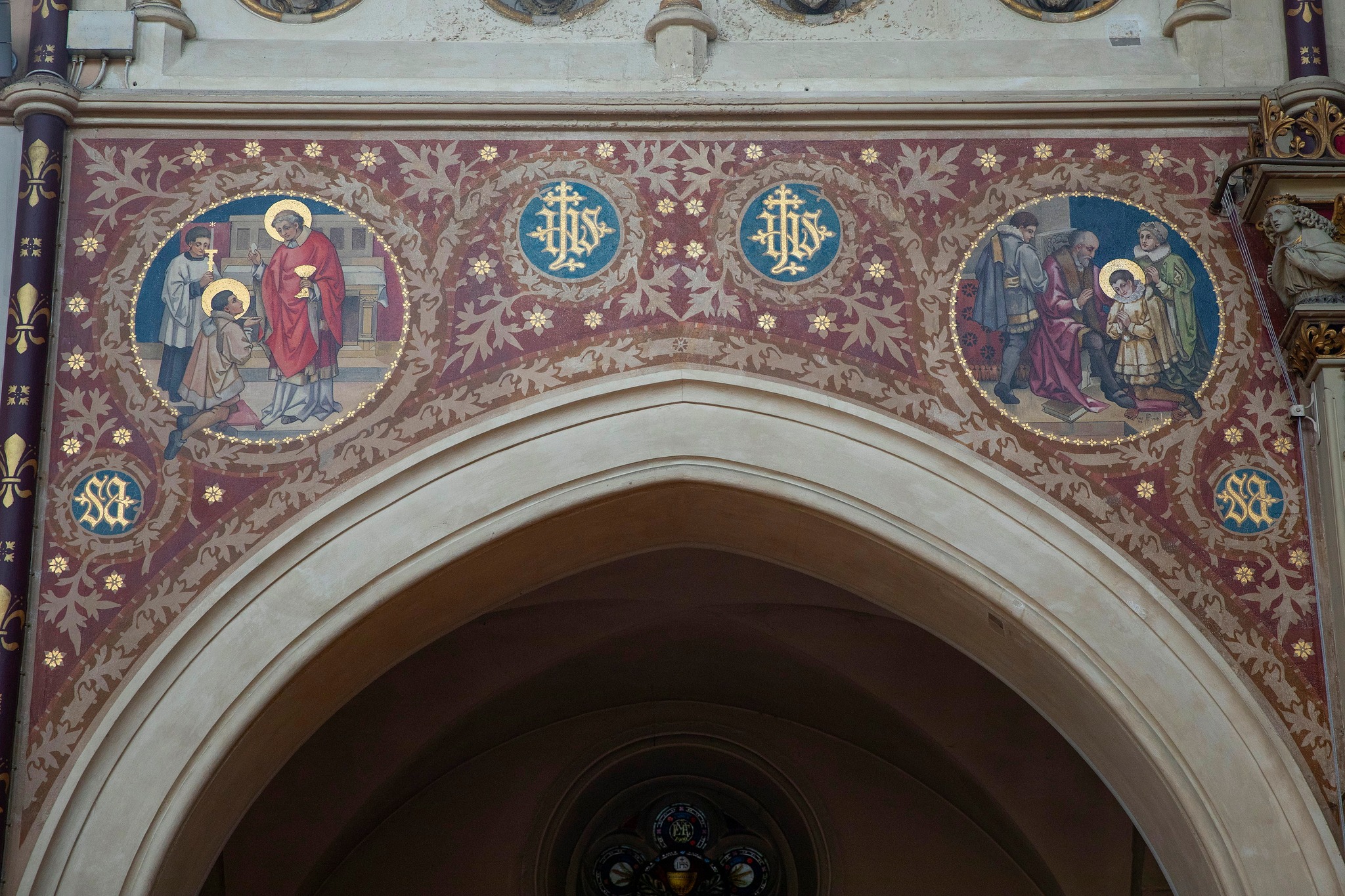
Here are the first two scenes from the life of St Aloysius in our newly restored murals. The first shows his first Holy Communion at the hands of St Charles Borromeo on the left. On the right, St Aloysius receives his father’s blessing to renounce his inheritance and join the Society of Jesus.
Around the scenes are IHS and SA monograms, representing the Holy Name of Jesus and “St Aloysius”.
Underneath the layers of grey paint, we discovered there was actually a pretty serious crack in the plaster on this side. It’s not even possible to see where it was now, thanks to the excellent work by @clivedenconservation
#oxfordoratory #oratory150
In March 2024, we completed the first phase of our plan of works, revealing once again the stunning paintings of the life of St Aloysius in our sanctuary.
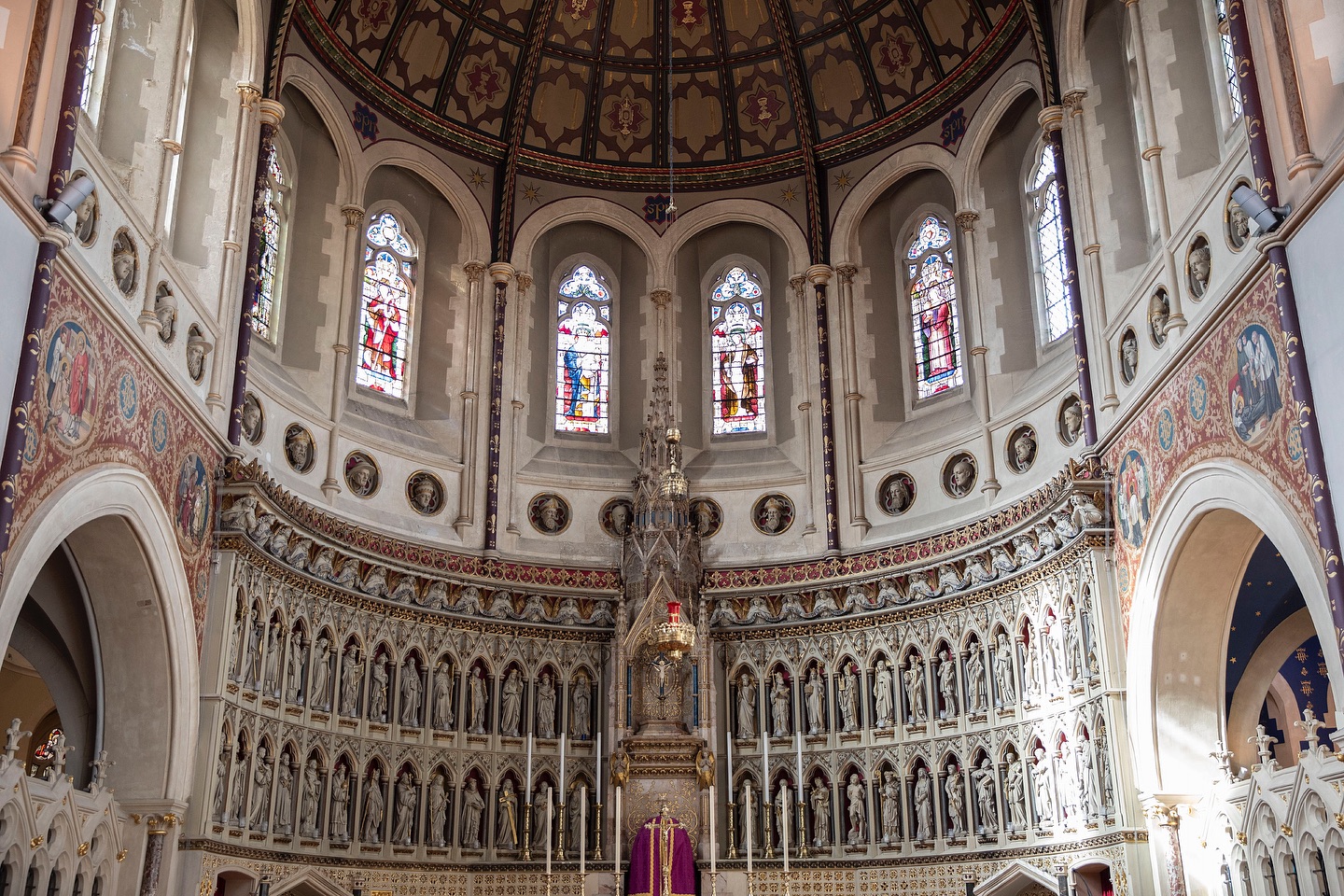
The two large murals, painted by Gabriel Pippet in the first decade of the twentieth century, depict the life of St Aloysius Gonzaga, the patron of our church. With vibrant colours, gold leaf and exquisite pattern, the paintings represent some of the finest decoration of the Catholic Arts and Crafts movement.
These wall paintings now unlock the details of colours and patterns used by Pippet throughout the sanctuary, and as we cannot begin other major works until the decorative scheme is in hand, this project has been key to the whole restoration.
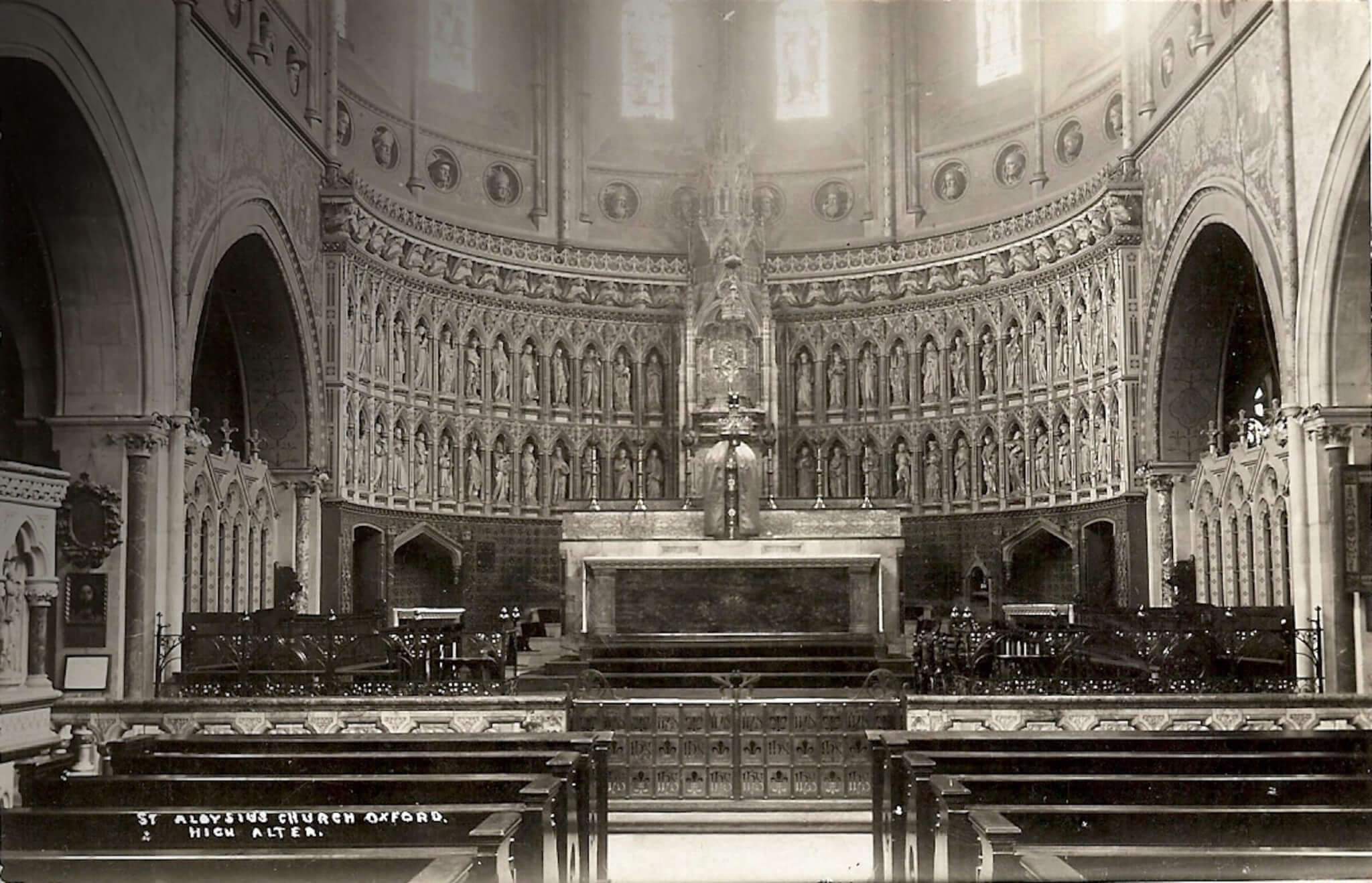
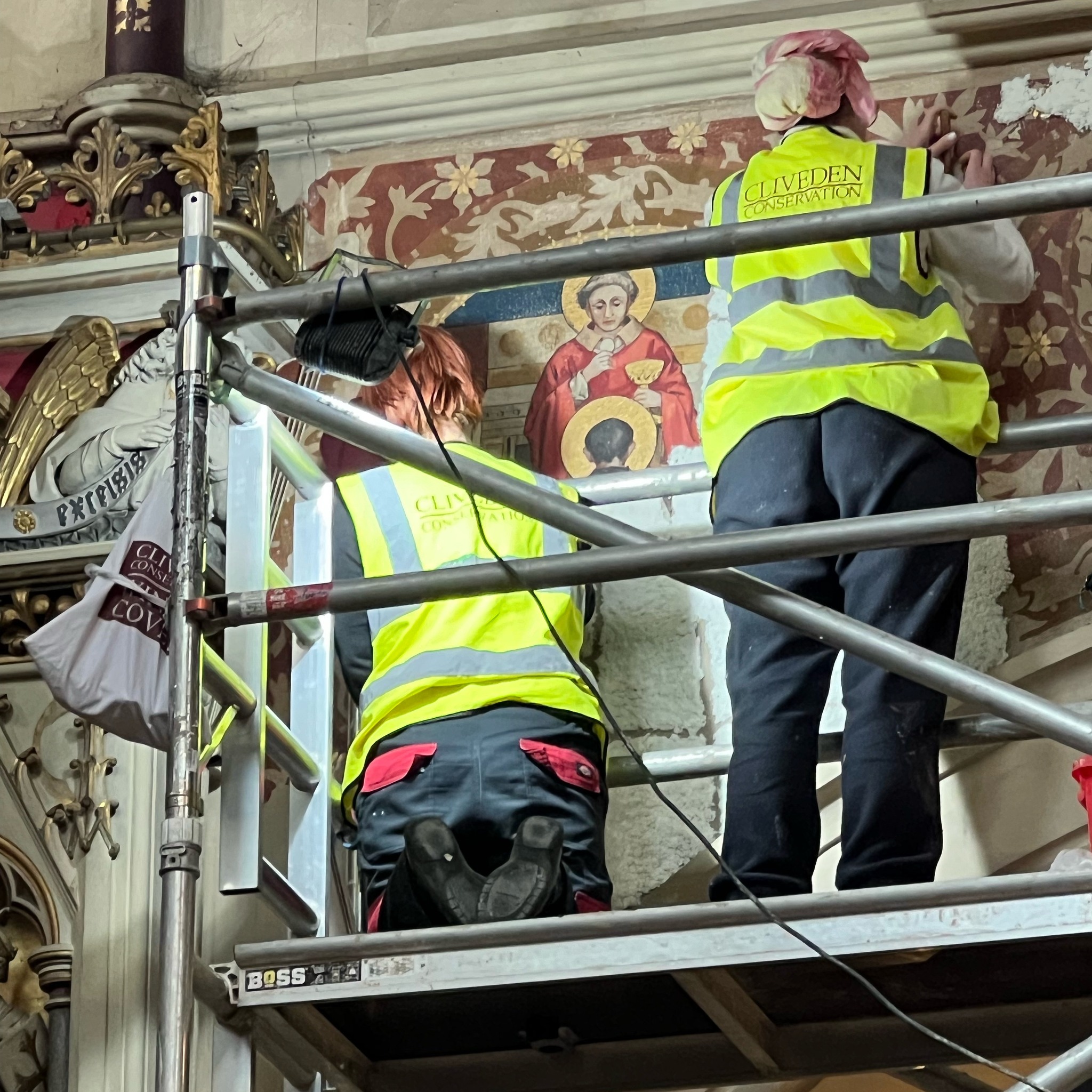
While we knew the Oratory church once had beautiful painted decoration, we had no real sense of the extent of it. A search in the Jesuit archives led to a remarkable discovery. There in a faded photograph were displayed the delicate lines and depth of detail characteristic of Gabriel Pippet’s work. In November 2022, we began a period of investigation into the Pippet decoration with the help of Cliveden Conservation, one of the UK’s leading experts in the conservation of historic wall paintings. After just an hour, small panels of colour, details of stencilling, gilding and the faces of the saints looked out from the murals once more onto the sanctuary of our church. They were in excellent condition beneath the layers of modern paint.
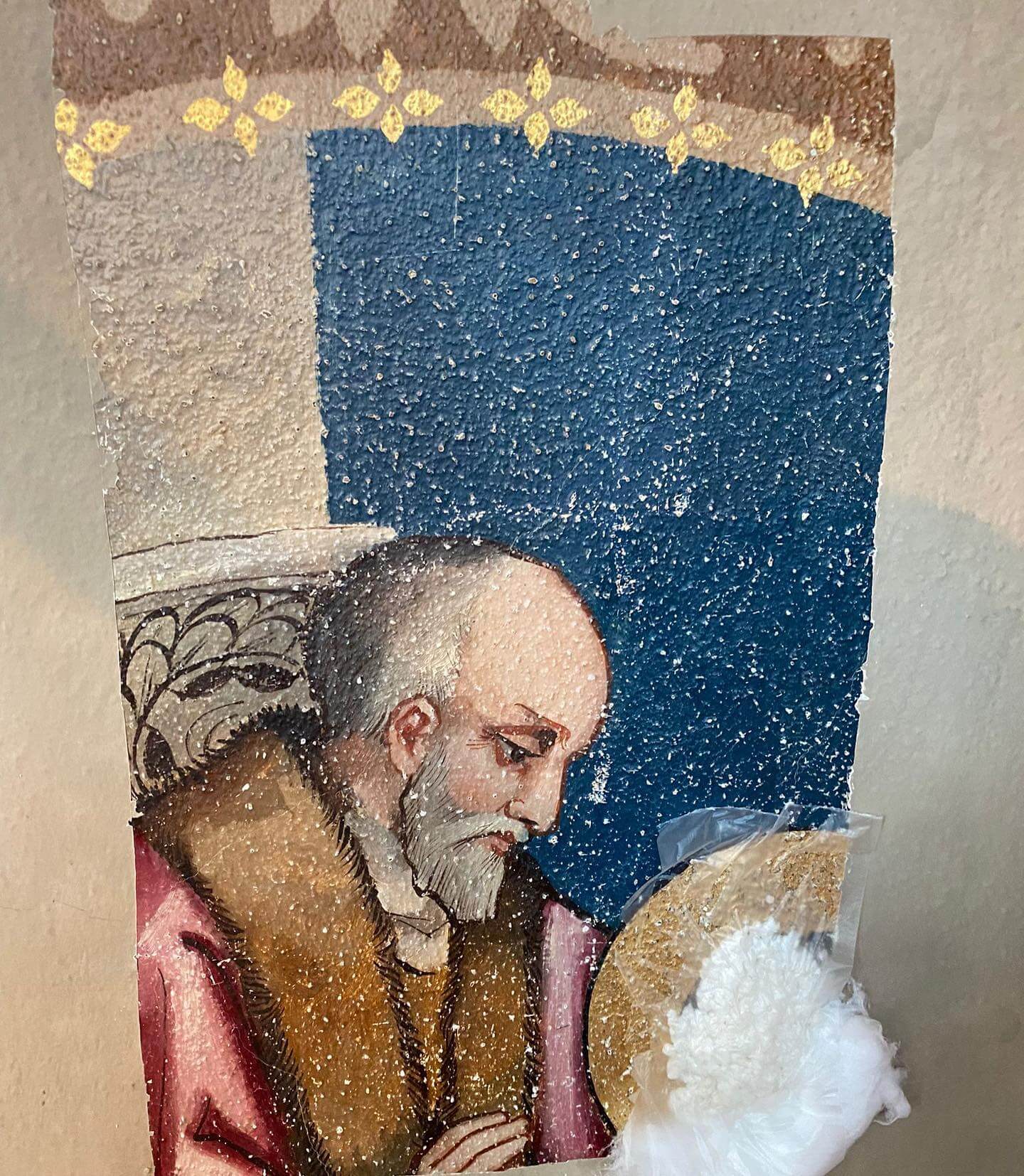
The first scene shows St Aloysius’ first Holy Communion at the hands of St Charles Borromeo on the left. On the right, St Aloysius receives his father’s blessing to renounce his inheritance and join the Society of Jesus.
Around the scenes are IHS and SA monograms, representing the Holy Name of Jesus and “St Aloysius”.
Underneath the layers of grey paint, we discovered there was actually a pretty serious crack in the plaster on this side. It’s not even possible to see where it was now, thanks to the excellent work by the conservators.
The next scene show St Aloysius’ professing his vows as a member of the Society of Jesus. Unusually for a scene from a saint’s life, it depicts Aloysius with his back to us. This highlights his turning his back on the world to serve Christ alone. Jesuits make their vows during Mass directly to Jesus in the Blessed Sacrament just before Communion. A particular highlight of these murals can be seen in the beautiful detail of the acolyte’s candle, where the flame is depicted by a star in gold leaf.
The final scene shows St Aloysius on his death bed aged 23, having caught the plague from those he had been nursing.
As well as the stunning scenes from St Aloysius’s life, this work has unlocked some of the general patterns that continued in other parts of the sanctuary. Notice how the leaf and vine pattern actually continues the mouldings above the reredos statues. It also ties in with the gold decoration behind the tabernacle and crucifix, and the brass railings beside the lecterns, showing us how the original decoration of our sanctuary all came together.
This work enables us now to reconstruct the decoration of the rest of the sanctuary, which has not survived under the modern paint in the same way as these murals, suffering from damp and flaking plaster over the years.
It is astonishing how quickly Cliveden Conservation were able to uncover these paintings that had been lost for 60 years. Thank you to all our generous benefactors who made it possible to begin this work so quickly.
The relatively unknown artist, Gabriel Pippet, was born in Solihull in 1880 where he died in 1962. Influenced by his own family of Catholic artists, he also drew inspiration from the Pre-Raphaelites, the Arts and Crafts Movement, Byzantine decorative arts and Western medieval manuscripts.
Between 1913 and 1917 he became influential in wider Catholic artistic circles, illustrating books and taking commissions for churches. From 1922 to 1933, Pippet undertook his largest commission yet: the design and decoration of mosaics and wood carvings at the church of the Sacred Heart and Saint Catherine of Alexandria, Droitwich. His earliest ecclesiastical work was, however, St Aloysius’ Church, Oxford. From 1905 to 1907 he was engaged by the Jesuit fathers to decorate our Sacred Heart Chapel and the Sanctuary. In 1913, he painted the beautiful Paleo-Christian murals in our relic chapel.
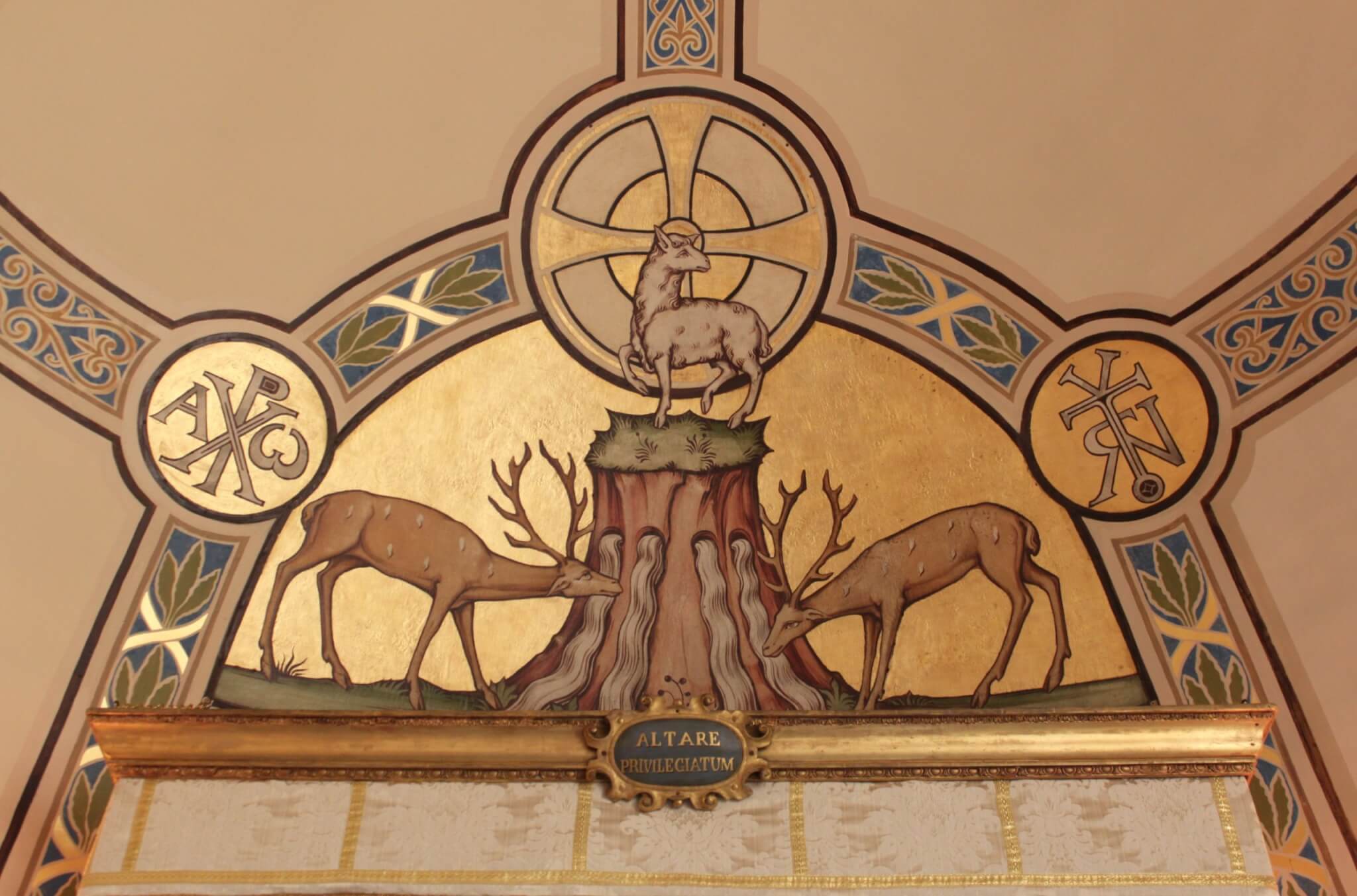
The sanctuary murals are completely uncovered and restored. Thank you to all the donors who made this work possible. Close up photos of each side with explanations to follow.
#oxfordoratory #oratory150
The Church requires all priests to make a spiritual retreat each year — a week away from pastoral work to give some attention to their own spiritual lives, to pray and to rest. Christ took the disciples away from their public ministry to rest (Mark 6:31), and often escaped himself to be alone with his Father (e.g. Matt. 14:23, Mark 1:35).
A week-long retreat in a monastery will not be possible for those who have work, studies or families to take care of. But the busier we are, the more essential it is that we take time in the course of the year to give our relationship with God some more than ordinary attention. In many ways, the Church builds this time into the year for us, by encouraging us not just to attend Mass on Sundays and major feast days, but also to rest from our usual activity on those days and devote the time we save to extra prayer, study and works of charity.
In the fourth century, when the Roman Empire became Christian, the emperors suspended all law courts and businesses from functioning during Holy Week so that all the faithful would be free to spend the week in church. That practice continued in Christian countries even into the nineteenth century. All Christians were given time off to devote the whole week leading up to Easter to more intense spiritual activity.
Lent is a time of preparation for Easter. That preparation takes the form not only of prayer, fasting and almsgiving but also of planning. Without a plan, Holy Week and Easter may pass us by like any other ordinary days. The thought of Easter rapidly approaching should remind us to make some more practical plans for the Sacred Triduum. The full schedule for the liturgies and other devotions taking place that week in church is now available on our website. Do we know what time we will spend in church? Do we know what else we will do in those days? Will we make sure in advance that the house is clean, the shopping is bought and the laundry is done so that we are free to focus on God during those days that he was so especially focused on us and our salvation?
Fr Walter Ciszek, in his book He Leadeth Me, speaks of the retreats he organised for his fellow prisoners in a Soviet prison camp. They managed to spend their days in prayer without any break from their work in some of the toughest conditions human beings have ever faced. Fr Ciszek and his fellow priests made this possible by the rigorous planning they put in ahead of each period of retreat, in order to make the most of the little time they had available to them. It is possible for all of us to grow in our love of God — but we need to plan how we are going to do it.
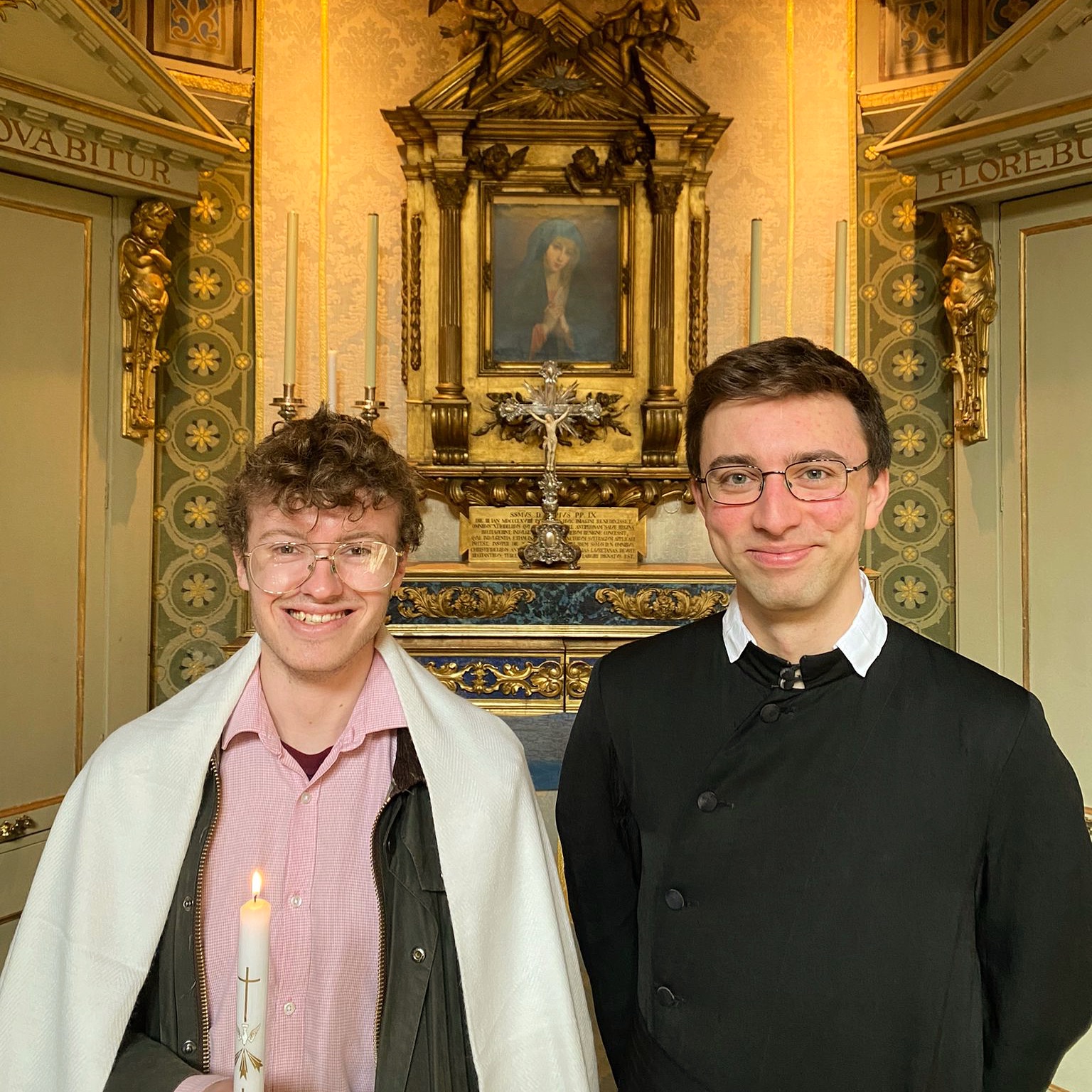
The altar of Our Lady of Oxford came originally from the private chapel of Hartwell de la Garde Grissell on the High Street. Grissell’s chapel became the place where many entered the Catholic Church, and these new Catholics all received their First Communion from this altar. Today, this same altar served as a fitting place to continue a 150 year old tradition. Many congratulations to Edward, who was baptised today, and was confirmed and received his First Holy Communion at Grissell’s altar. #oxfordoratory
We are not quite half-way through Lent, the penitential season, and by now it is not unusual to hear the complaint: “I’ve broken every one of my resolutions.” If that is the case, never mind, just pick up where you left off and start off all over again. It’s the intention that counts.
Naturally, we want to do as well as we can, to be as perfect as can be. However, experience shows us that we are a long way off perfection. But will eating a biscuit in Lent really bar us from Heaven? Of course not. But that is not why we make those Lenten sacrifices — or because eating or drinking less may be good for us for health reasons. We do so because we are disciples of Christ and are seeking to learn from his teaching and to imitate his example.
On the First Sunday of Lent, we read, as we do every year, the account of the Temptation of the Lord in the desert. This year, we heard Mark’s somewhat pared back version of the incident, mentioned, it almost seems, as if in passing. But our minds went back, I’m sure, to the fuller stories in Luke and Matthew’s Gospels, which tell us how Jesus was tempted. It’s not necessary to rehearse them here. All that is necessary is to recall that he was tempted. We learn from his example how to deal with those temptations, and to learn that it is essential and indeed possible to say say “No” to ourselves and not simply to give in to our every whim and desire.
If we have an uncontrolled habit of snacking between meals, or spending hours on social media or endlessly checking our mobile phones, or pouring ourselves a drink (just the one?), we may find ourselves enslaved, unable, or so we think, to free ourselves from whatever addiction it is we are subject to. Lent is a good time to seek our freedom again, and to re-evaluate our relationship with our phones, with food and drink, or Ebay and Amazon. It can be a struggle, and present a real test of our love for God and our self-control. God allows us to be tested not because he does not know how strong we are, but because we do not know. We are all of us tested, tried, by the stresses and pains of life, by the burdens others lay on us, by the ceaseless challenge to respond with love to those whom we find difficult to love. When we succeed in overcoming this or that temptation, we are doing so in his strength, not ours. When we suffer some temptation, we must see it as an opportunity to grow, in holiness and in virtue. Only when we are tempted do we have the chance to triumph. When we choose to try to resist temptation, standing firm, having recourse to the grace of the Sacraments, then every temptation becomes an occasion of virtue.
Every temptation is an opportunity — to be faithful or not. The saintly Curé of Ars, John Vianney, told someone who was struggling with some temptation to imagine Our Lord standing beside him, neither judging nor condemning him as he struggled, but saying, “Ah, so you do love me.” There can be no virtue without temptation. “God is faithful, and he will not let you be tempted beyond your strength, but with the temptation will also provide the way of escape, that you may be able to endure it.” (I Cor. 10:13) As we continue our Lenten journey, let’s keep in mind that in our weakness, the Lord will show himself to be strong and will hear our prayer “lead us not into temptation.”
The prayer of surrender which many use each day, can be a great help: O Jesus, I surrender myself to you, take care of everything. A simple enough prayer to make. Worth trying.