O blessed Virgin Mary, Mother of God, and our most gentle Queen and Mother, look down in mercy upon England, thy dowry, and upon us all who greatly hope and trust in thee. By thee it was that Jesus, our Saviour and our hope, was given unto the world; and he has given thee to us that we may hope still more. Plead for us thy children, whom thou didst receive and accept at the foot of the Cross, O sorrowful Mother. Intercede for our separated brethren, that with us in the one true fold they may be united to the chief Shepherd, the Vicar of thy Son. Pray for us all, dear Mother, that by faith fruitful in good works we may all deserve to see and praise God, together with thee, in our heavenly home. Amen.
We recited the Prayer for England before the statue of Our Lady every Sunday after Benediction.
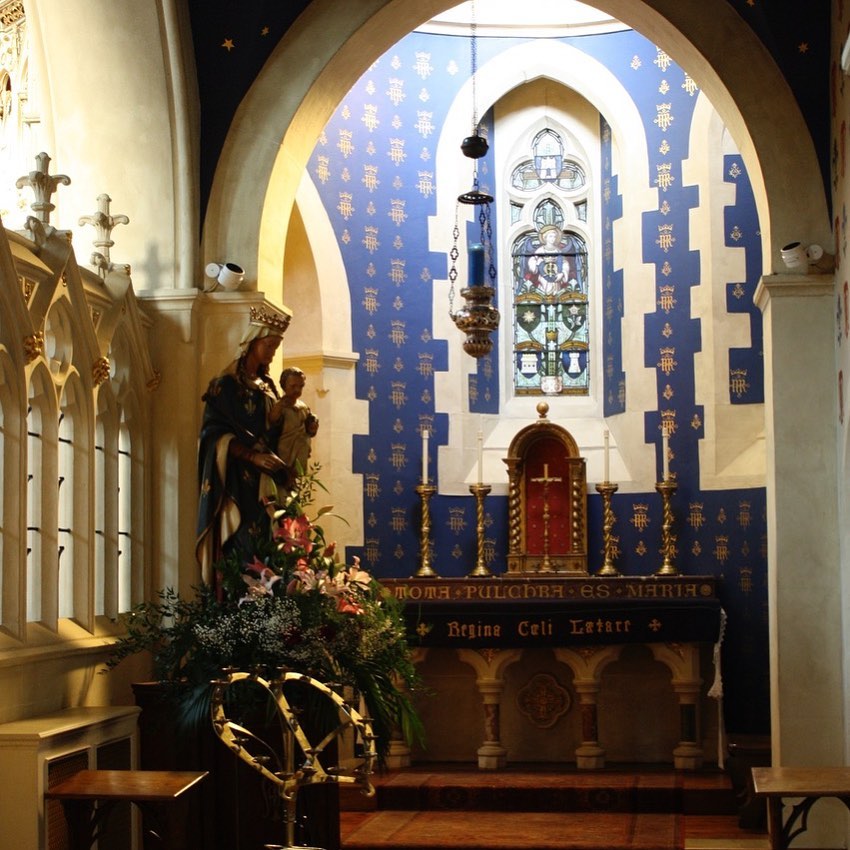
Our virtual church tour to celebrate 150 years of the church continues with the Lady Chapel today. Have you noticed the titles of Our Lady in the stained glass? Read more on our website.
The Lady Chapel is the principal place of devotion in our church to the Mother of Jesus. These side altars are places for private prayer and devotion as well as where priests celebrate Mass outside the regularly scheduled times. The statue of Our Lady of Wisdom was given to the church in 1914 and is by the distinguished firm of Mayer and Co. of Munich. The original altar in this chapel was by Morris and Co. and was of hammered copper and enamel in an Arts and Crafts style. Unfortunately no photographs of this altar exist.
As so often seems to be the case with the history of our church and the faith in our city, the loss of the original altar was simply a pruning that enabled even greater regrowth. The altar you see today — which looks as if it could have been designed for its current location — was originally in the chapel of the Ursuline convent school on St Giles, which then became St Benet’s Hall. The Ursulines and the Benedictines have both left Oxford, but the Mass continues to be celebrated on their old altar.
The chapel was redecorated in 2007, incorporating the monogram of Ave Maria, as well as the fleurs de lys, the traditional symbol of Our Lady’s purity. The window above the altar contains representations of titles given to Our Lady in her litany: Gate of Heaven, Morning Star, Mystical Rose, Ark of the Covenant, Tower of David, and Singular Vessel of Devotion. They are poetic titles, showing how the Virgin Mary, as the first disciple of Christ, free from original sin and totally dedicated to God, leads us to heaven.
St Philip’s Chapel was originally dedicated to St Joseph. (St Joseph was relocated to the church entrance long before the first Fathers of the Oratory arrived!) This photo from the archive was taken before the statue of St Teresa of Avila was installed, or the altar rails, which came from a local convent chapel when it closed. You can also see hints of the marble panels above the arches of the nave that are still there, under the white paint…
“O Jesus Christ, my Lord, with what great love didst thou pass over the painful road which led thee to death; and I, how often have I abandoned thee! But now I love thee with my whole soul, and because I love thee I am sincerely sorry for having offended thee. My Jesus pardon me, and permit me to accompany thee in this journey. Thou art going to die for love of me, and it is my wish also, my dearest redeemer, to die for love of thee. My Jesus, in thy love I wish to live. In thy love I wish to die.“
Stations of the Cross every Friday at 5:30pm during Lent.
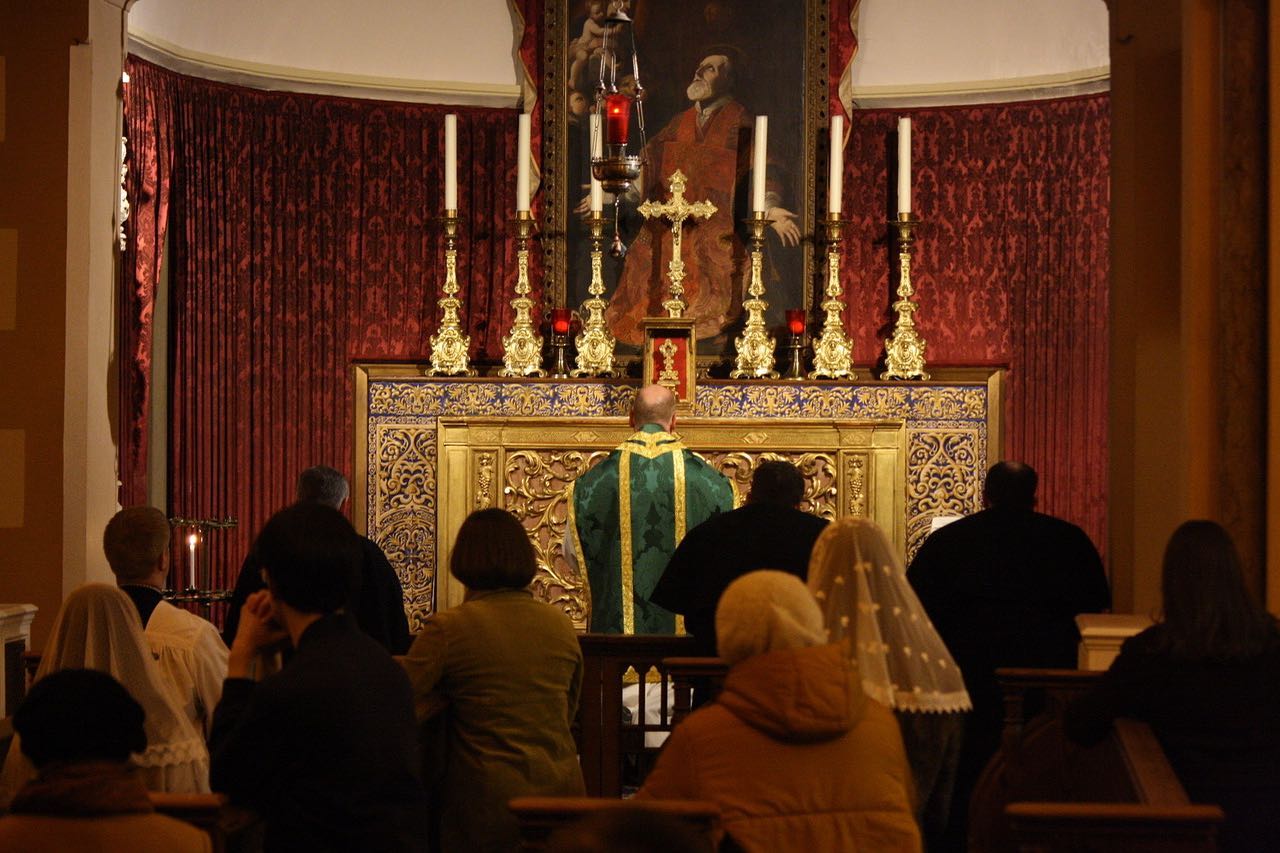
In every Oratory there is place of devotion to our Holy Father, St Philip, who is our patron, spiritual father and a model of holiness and priestly life. He is known as the amabile santo, the lovable saint. His example of evangelical simplicity, as well as his zeal for bringing men and women to know Christ through his compassionate friendship and guidance, is an inspiration to us.
The painting of the saint which hangs above the altar was painted in Rome, a copy of an original by Guido Reni which hangs in St Philip’s rooms at the Roman Oratory. It was painted by Maria Gibberne (1802–1885) as a gift for her friend, Cardinal Newman. The carved, gilt-wood altar frontal is Italian, and was part of the collection of furnishings bequeathed to the church by Hartwell de la Garde Grissell. For St Philip things of beauty were important in the worship of God, the source of all beauty, truth and goodness. They are both an act of reverence in themselves, and draw the heart and mind of worshippers upward to God.
It is quite fitting that the two confessionals are so close by, since it is in the confessional that St Philip did so much to help people grow in holiness:
In those times men lived very remissly in matters of devotion; most people thought it enough to confess once a year. Philip, regarding this as the cause of perdition to a great number of souls, put forward all his industry to induce people to frequent the Sacraments, and other spiritual exercises, but, above all, confession. He was one of the first aided by the holy men already mentioned, who revived in Rome the practice of frequent confession and communion. In order to obtain this object of his desire more easily, he abandoned every other care, and gave himself entirely to hearing confessions. He got a number of good penitents together; and seeing the fruit which he obtained by this means, he was not content to employ the day in the confessional, but gave up a considerable part of the night to it as well. Before sunrise in the morning he had generally confessed a good number of persons in his own chamber; for whose convenience he used to leave the key under the door of his apartments, that they might get in whenever they pleased. When he had retired to the solitude of his room, he still confessed every one who came; but this was not enough for his zeal and charity; if he was at prayer, he broke off instantly; if he was at meals, he rose from table the moment he heard that any one was seeking him in order to confess. When the church was opened at daybreak he went down there, and entered the confessional, and never left it except to say Mass, which he usually did about midday, or for some other cogent reason, always leaving word whither he was gone. If it happened that no penitents came, he remained near the confessional, reading, or telling his beads, or saying office; and sometimes he walked up and down outside the door of the church, expecting people, and that he might be the more readily seen; so that any one could find him with the utmost ease at almost any hour.
In a word, he had such a spiritual relish in hearing confessions, that he said himself, “To do nothing, beyond merely sitting alone in the confessional is an immense pleasure to me;” and this, as well as other sensible heavenly consolations, was bestowed upon him, as he himself declared, in order that he might be able to endure the fatigues caused by the confessional.
From ‘The Life of St Philip Neri, Apostle of Rome’ by Father Pietro Giacomo Bacci
Frequent, regular confession is one of the surest means for growing closer to God. The Church requires us to go to confession and receive Holy Communion at least once a year. Most people can see quite rightly that we should want to receive Communion far more frequently than that, but not everyone has drawn the same conclusion about confession. As we begin this penitential season today, perhaps one of our Lenten resolutions could be to receive this wonderful sacrament of forgiveness every month.
Sunday 2 March Solemn Mass 11:00 8th Sunday of the Year Missa Vidi speciosam Victoria Ego flos campi Clemens Cantate Domino Monteverdi Kyrie, Gott heiliger Geist BWV 671 Bach
Wednesday 5 March Solemn Mass 18:00 Ash Wednesday Missa Emendemus Palestrina Miserere mei Allegri Emendemus in melius Byrd In jejunio et fletu Tallis
Sunday 9 March Solemn Mass 11:00 1st Sunday of Lent Missa Aspice Domine Palestrina Infelix ego Byrd Quid igatur Byrd
Sunday 16 March Solemn Mass 11:00 2nd Sunday of Lent Missa Inter vestibulum Guerrero Inter vestibulum et altare Ceballos Tristis est anima mea Kuhnau
Sunday 23 March Solemn Mass 11:00 3rd Sunday of Lent Missa Aeterna Christi munera Palestrina Ecce nunc tempus acceptabile Gombert Ave Regina caelorum a5 Phillips
Tuesday 25 March Solemn Mass 18:00 The Annunciation of the Lord Missa Dixit Maria Hassler Ave virgo sanctissima Guerrero Ne timeas Maria Victoria Fugue on the Magnificat BWV 733 Bach
Sunday 30 March Solemn Mass 11:00 4th Sunday of Lent (‘Lætare’) Missa Vulnerasti cor meum Morales Rex autem David Ribera Domine, quam multi sunt Purcell Jesus Christus, unser Heiland BWV 665 Bach
Remember, O most loving Virgin Mary, that it is a thing unheard of that anyone ever had recourse to thy protection, sought thy intercession, implored thy aid and wast left forsaken. Filled therefore with confidence in thee, I fly to thee O Mother, Virgin of Virgins. To thee I come, before thee I stand, a sorrowful sinner. Despise not my words, O Mother of the Word, but graciously hear and grant my prayer. Amen.
Our Lady watches over all who enter the Relic Chapel from the ceiling.