Remember, O most loving Virgin Mary, that it is a thing unheard of that anyone ever had recourse to thy protection, sought thy intercession, implored thy aid and wast left forsaken. Filled therefore with confidence in thee, I fly to thee O Mother, Virgin of Virgins. To thee I come, before thee I stand, a sorrowful sinner. Despise not my words, O Mother of the Word, but graciously hear and grant my prayer. Amen.
Our Lady watches over all who enter the Relic Chapel from the ceiling.
Opposite the mural of the Good Shepherd in the Relic Chapel is a saint whose identity is unknown! He is surrounded by symbols that must be clues to his identity. Any ideas?
O Lord Jesus Christ, good Shepherd of the sheep, thou who camest to seek the lost, and to gather them to thy fold, have compassion upon those who have wandered from thee; feed those who hunger, cause the weary to lie down in thy pastures, bind up those who are broken in heart, and strengthen those who are weak, that we, relying on thy care and being comforted by thy love, may abide in thy guidance to our lives’ end. Who livest and reignest for ever and ever. Amen.
Christ the Good Shepherd, one of Gabriel Pippet’s murals from the ceiling of our Relic Chapel.
Our sanctuary murals won a certificate in the 2024 Oxford Preservation Trust awards! On Monday, we welcomed Oxford Preservation Trust members for a special presentation from Fr Benedict and Cliveden Conservation to showcase the conservation work.
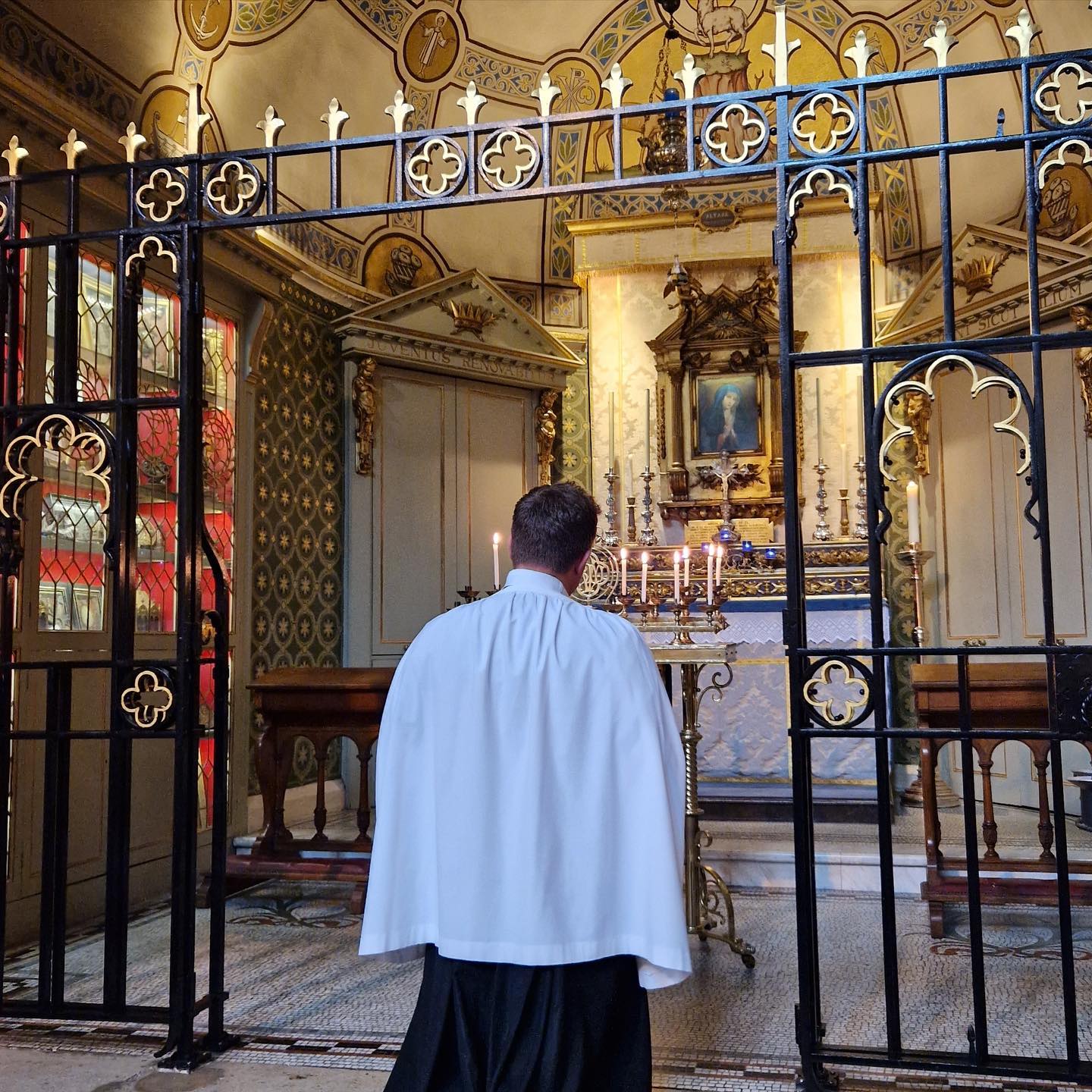
The Relic Chapel is one of the most beautiful spaces in our Church. The furnishings were part of the legacy of an Oxford man, Hartwell de la Garde Grissell, who also received the image of Our Lady of Oxford from Blessed Pope Pius IX in 1869. It is an ancient tradition to enshrine an image of the Blessed Virgin Mary as the special protector of a place and to invoke her aid under the title of that place. Here we invoke her as Our Lady of Oxford and Mother of Mercy, confident that she intercedes with her Son for the protection of all in our city and university.
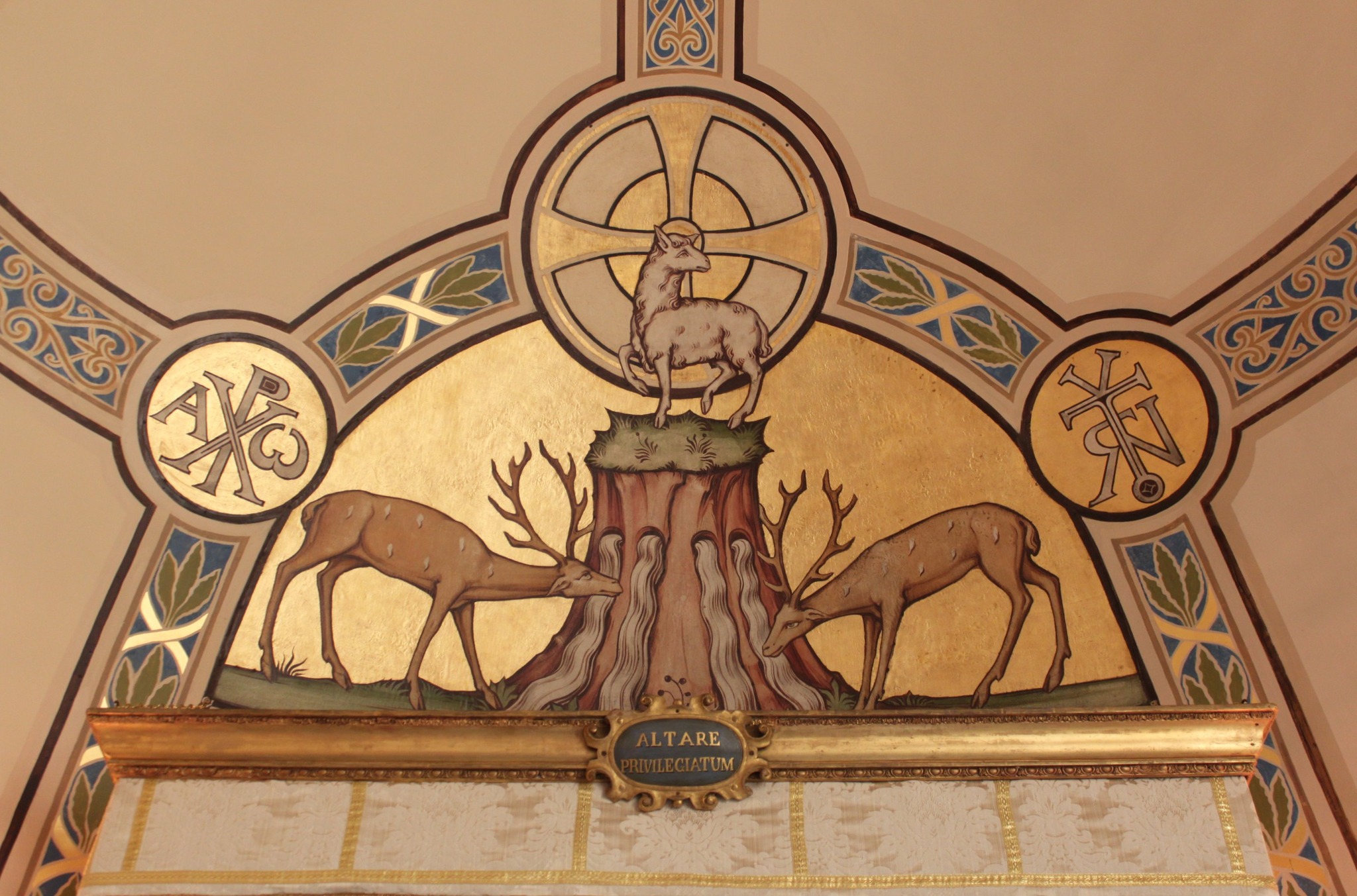
When Grissell died in 1907, he left the contents of his private chapel to the church on condition that a chapel be built to house it all. The font was moved and the chapel redecorated. The wall paintings in this chapel are of early Christian scenes and symbols from the Roman catacombs by the Catholic Arts and Crafts artist, Gabriel Pippet. They were restored in 2009. They depict two deer drinking from the waters of a fountain, evoking the words of Psalm 41: “Like the deer that yearns for running streams, so my soul is thirsting for you, my God.” There are also images of Christ the Good Shepherd, a typical early Christian depiction of Jesus, as well as the Blessed Virgin Mary and Christ child. Other symbols represent aspects of the Christian faith. The peacock represents new life and resurrection; loaves and fish point to the eucharist and the heavenly banquet; and the anchor is an early Christian symbol that symbolises arriving in the divine harbour of peace. Images of martyred saints take up the ancient posture of prayer, and the burning lamps represent faith.
These early Christian images are particularly appropriate since the chapel houses a collection of the relics of many saints, among them a number of the early Christian martyrs who were once buried in the catacombs in Rome.
Relics are reserved here not only for private prayer and veneration, but also to be placed on the altar during the celebration of Mass on solemn feasts. For Christians, the body is the temple of the Holy Spirit and is a sacred thing, to be treated with care and reverence. Since we revere the saints as holy men and women, extraordinary individuals filled with the Holy Spirit, we reverence their mortal remains as having been filled with that same Spirit as holy relics. It is something of a popular myth that the early Christians prayed in the catacombs just to avoid persecution. That may have been true at times, but those early Christians continued to celebrate Mass in the catacombs in time of peace because they wanted to be close to their brothers and sisters who had gone before them. Their bodies are a tangible link to their souls in heaven, and so to heaven itself.
The virtual tour to celebrate the 150th anniversary of our church continues tomorrow with the Relic Chapel. You can follow the weekly instalments on our website or by subscribing to our eNewsletter.
Here is a photo from the archive of the Relic Chapel in 1908, with Grissell’s collection newly installed and the chapel freshly decorated by Pippet.
Our new Grande Oratorio met this morning for the first time, reviving those meetings of prayer, preaching and music that began the Oratory in Rome. The theme of the sermon was taking St Philip as our spiritual guide to heaven. Don’t miss the next Grande Oratorio on Saturday 15 March.
The Oratory in England has a long history of helping people to follow the example of St John Henry Newman, Our Cardinal, and welcoming the home into the “One Fold of the Redeemer”.
Our new members of the Church are confirmed last Saturday.
Near the font we find the shrine to St John Henry Newman, our Cardinal. Newman was a fellow of Oriel College and the Vicar of the University Church but became a Catholic in 1845 having become increasingly dissatisfied with Protestantism. His studies lead him to see that the real “Church of the Fathers” was much richer and wider, and was to be found in the “One Fold of the Redeemer”, the Catholic Church.
Newman expressed with great clarity how complementary faith and reason are to one another, not enemies. He realised that we do not come to faith through argument, but once we have faith we can put it to rigorous examination and find it consistent with reason and our human experience.
John Henry Newman brought the Oratory of St Philip Neri from Rome to England in 1847, and whilst he longed to establish an Oratory in Oxford it was not to be in his lifetime (nor for almost 150 years). This Oratory in Oxford was founded from his community in Birmingham in 1990, and so we are his spiritual children. Newman was declared “Blessed” by Pope Benedict XVI in Birmingham in 2010 when this shrine was erected in his honour. He was canonised as a saint of the Church by Pope Francis in 2019. We seek the intercession of St John Henry that we may see another “second spring” of the faith in our day as he did in his.
“Take this burning light and keep true to your baptism throughout a blameless life. Keep the commandments of God; that when the Lord shall come like bridegroom to his marriage feast you, in company with all the Saints, may meet him in the heavenly courts, and there live for ever. Amen.”
The newly baptised, clothed in white garments are presented with their baptismal candles.