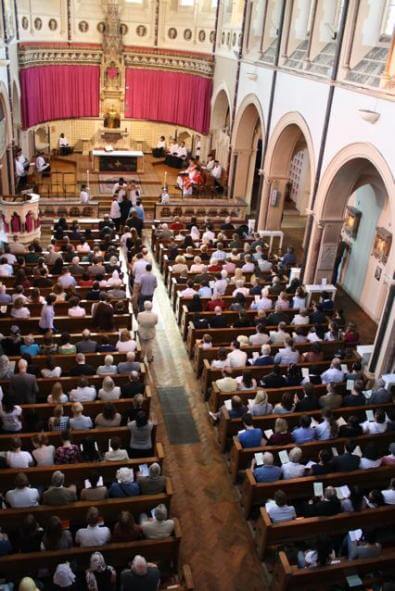
Announcing the Word

THe fourth sermon in our series on the Mass – preached by Fr Jerome Bertram on Sunday 25th September 2011.

The readings at Mass remain unchanged at this stage of the revision of our English texts—save only that we now acclaim “The Word of the Lord” instead of merely stating that “this is the word of the Lord”. In that, we are only now doing what other countries have been doing for decades. There will eventually be a new translation of the Scriptures, but they have not yet stopped discussing which one to use or which style to adopt. The one we use at present does rather show up the difference between the old approach to translation, which was a loose paraphrase designed to be easy to understand, and the new emphasis on being faithful to the Word of God as transmitted to us through the Scriptures.

The Scripture readings are not merely an accidental or preliminary part of the Mass—they are essential. In the description of the very first Mass we hear, “He interpreted to them in all the scriptures the things concerning himself” before “he took the bread and blessed, and broke it, and gave it to them”. (Luke 24:27, 30) From then until now there have always been Scripture readings at Mass to prepare us “to know him in the breaking of bread.” (Luke 24:35) The Catechism of the Catholic Church tells us, “The liturgy of the Word and liturgy of the Eucharist together form ‘one single act of worship’; the Eucharistic table set for us is the table both of the Word of God and of the Body of the Lord.” (CCC 1346) That is why the Church “strongly urges pastors of souls that, when instructing the faithful, they insistently teach them to take their part in the entire Mass”. (V2, Sacrosanctum Concilium, 56)

Which being interpreted means, it is truly necessary to be present for the Readings at Mass, and to listen to them; we must not excuse ourselves from them merely because we find them difficult to understand, or hard to live up to.

In the early Church a series of Sunday readings was chosen for the whole year, usually with an extract from the Epistles of St Paul to go with an extract from the Gospels. The two readings were related in a very subtle way, often quite mystical, and the connection between them was not always obvious on the surface. The selection of readings we use at present was made on a rather different basis. They follow a cycle of three years (beginning in 1969), using the Gospels of St Mathew, Mark and Luke in turn. Because St Mark is shorter, there is a long insertion from St John in the summer of the second year, and the rest of St John is used at Eastertime and on other special occasions. Each Sunday’s Gospel follows on from the Sunday before, though even so, there are still a few passages that are never read out in church, and some Sundays always get lost over the Easter period. The Gospels were originally put together out of short memorable passages (technically called pericopes), and each one is a complete story or parable or teaching, so that the extracts we read make sense on their own. Of the three readings, the Gospel is always the easiest to understand—which may make it an embarrassing challenge to our behaviour!

To go with the Gospel readings, an extract from the Old Testament was chosen as the first reading (except in Eastertide, when it is the Acts of the Apostles). These Old Testament readings usually have a very obvious literal connection with the Gospel passage—for instance this Sunday Ezechiel makes the same point as Our Lord, that a sinner who changes his mind and repents will be forgiven. Unfortunately very few passages of the Old Testament are self-contained pericopes, and often our extracts make no sense at all unless you already know the story. That means that the Church demands much more of us than in the past—we are obliged to get to know the Old Testament, and to read the books from which the first readings are taken, in order to have much chance of understanding the first readings at Mass. The Church has always encouraged lay Catholics to read the Scriptures regularly. St Thérèse of Lisieux used to say that if she had been a man she would have learnt Greek and Hebrew in order to read the Bible in the original languages. She was quite wrong of course—there is no reason at all why women should not learn Greek and Hebrew, and if we have the time and opportunity it is well worth it. Failing that, we can study the Bible in a good translation (the Revised Standard seems to be the best all-round at present) and see how our Sunday first reading fits in. One method might be to look ahead at next Sunday’s reading and then read the preceding and following chapters to find out what the sacred author was intending to say. Another method, perhaps better, is to make a point of reading the entire Bible, from “In the beginning” to “Amen”, a chapter or so every day, over and over again, until we really know it well, and can recognise any passage at once. But that takes time—about four years each round. There is a very great deal of the Old Testament that is never read in church, and much that would be most unsuitable. But the Holy Spirit speaks to us through every page, if we can only hear Him.

The first reading is followed by a extract from one of the psalms. This can be very difficult to appreciate, because of the way it is broken up with a “response” that intrudes from time to time. To be fair, the General Instruction of the Roman Missal does not expect us to use the “response” in the way we always do: unless it is sung, “it should be recited in a manner more appropriate to encourage meditation on the Word of God”. (General Instruction on the Roman Missal, 2001, §61) It is arguable whether speaking the “response” between every verse really does that, and whether it would be better to listen to the psalm being read in a meditative way, or for the entire congregation to recite it together as we do in the Divine Office. In any case, the better we get to know the Psalms outside Mass, the more chance we shall have of being able to use them for “meditation on the Word of God”. The Psalms are the great prayer-book of the Church, and have always formed the basis of the daily prayer of the Church, the Divine Office. Yet if we recite the Office regularly we realise that Psalms vary—some are certainly meant to be sung, and really do have a refrain (e.g. 135) others are long poems on the history of God’s people (e.g. 104-6), others are meditations on God’s word (e.g. 118). They express every mood and feeling, including some we might think inappropriate in prayer (e.g. 57). It is short extracts that find their way into the Mass, either as “responsorial psalms” or as “antiphons”, and it is only through familiarity with the psalms as a whole that we can appreciate them.

The second reading on a Sunday is usually taken from St Paul, but here there is no intention of making a connection with either the first reading or the Gospel. The epistles are simply read through in turn, each Sunday’s second reading following on from the previous week—except that there are many passages omitted. Throughout September we are reading Philippians, the most cheerful of St Paul’s letters. Only by coincidence—or Providence—does the St Paul reading connect with the other two; we have a completely different theme. And we cannot deny of St Paul’s letters that “there are some things in them hard to understand” as St Peter says. (II Peter 3:16) The translation we most often use makes them more difficult again—I still think the version by Mgr Knox is the only one that really makes sense of St Paul in modern English. It is well worth finding a copy and studying St Paul for ourselves, so that when we come to Mass we shall be able to hear the Word of God from him with profit.

Before the Gospel we have an acclamation, usually with an Alleluia chorus: this is supposed to relate to the coming Gospel and prepare ourselves to discern its principal message. This week, for instance, the acclamation reminds us to keep the Word of God, to listen to his voice.

Three Scripture readings, a Psalm and an acclamation add up to a great deal of text, far too much to take in all at one, or to follow if we come unprepared. It is a great help if we prepare for Mass every time by studying the readings, looking them up in our own Bibles to see how they fit in, and using them for our own meditation before we come to church. Even so, we cannot expect to be able to take in the full message of even one reading—consider ourselves well satisfied if we remember and take away with us one verse, a few words, from one of the readings, as a souvenir to feed our meditation for the week to come.
Gloria in excelsis Deo

The third in our series of sermons on the Mass: preached by Fr Dominic Jacob on 18th September 2011:

Last week, you may remember, Br Nicholas helped us to consider the significance and the purpose of the Confiteor, the acknowledgement of our sinfulness and our need of forgiveness. Today, the mood of the liturgy shifts, modulating from the minor key of the Kyrie to the brighter major tone of the Gloria.

Of course, you recognise the opening words as those which heralded the birth of Our Lord at Bethlehem. “Glory to God in the highest, and on earth, peace to people of goodwill.”

Originally included as part of the Midnight Mass at Christmas as early as the 2nd Century, this hymn was sung by the bishop alone; gradually, as the text was expanded, it was given to the priest to chant, and finally, once it developed into the triumphant shout of Praise we know, it came to be said or sung at every festal Mass by everyone. “The angels themselves,” wrote Dom Gueranger, gave the pitch; and the Church, led as she is by the same Holy Spirit, continued the angels words.”

One saint remarked that “we should not seek in the Gloria a logical progression of ideas. It is, rather, an impulsive succession of acclamations and words of praise, that spring forth unplanned from soul. Faith, the freedom of prayer, and a love that knows how to weave all things together; these are the only rules.” (Bl Hyacinth Cormier O.P) I like this concept of spontaneity, but it has to be said that, there is, in fact, a very definite shape or order in the Gloria. There is an Introduction and three parts following, in which God is praised as Trinity.

The introduction includes the Angel’s Song which contains “Our Lord’s plan of redemption, the purpose of which,” Parsch states, “is to restore to God that glory which was outraged by sin, and to bring to man the blessings of Messianic peace.” In this sense, it could be said that we celebrate Christmas – the Incarnation of Christ – at every mass, since the same Holy Child Jesus who was born at Bethlehem comes to our altars, though in the form of bread and wine; his purpose remains the same: Glory to God in the highest and peace to people of goodwill.

The first part of the Gloria is a cry of praise and thanksgiving to God the Father. One writer I consulted (Theodor Schnitzler) likened this to the Triumph accorded Roman Emperors and generals on their return from War. Along the crowd-lined route of the via triumphalis, massed choirs would sing out the titles and glories of these heroes and leaders. More and more titles were called out to them in jubilation as they passed by: an echo of this can easily be seen in the group: “We praise you, we bless you, we adore you, we glorify you. Lord God, heavenly King, O God, almighty Father.” And in addition to praising God, we give thanks too, and not for any good he may have done us, nor for any particular gift he may have given. “We give you thanks for your great glory.” We express our gratitude to the Lord simply for being God and not for any benefit or grace we may have gained from him. It seems an amazing thing to me, reminding us of our duty toward the Almighty, that we should love Him first because He is our God and not for what we may hope to get from Him. Something we ought, perhaps, to remember in our human relationships too.

The second part of the Gloria is addressed to Our Lord and, again, calls to mind God’s plan of redemption. “Redemption is the purpose of his coming, and the purpose, too, of the Mass.” (Parsch)

Note how Jesus is addressed, first by his name, and then his titles of honour: “Lord…Christ, Only Begotten Son, Lord God…Son of the Father” and also by the title given him by John the Baptist: “Lamb of God”, which brings to mind, our reason for being here at Mass, the celebration of the Sacrifice which “takes away the sins of the world”. In the Mass we stand at the foot of the Cross, humbly asking the Lamb of God to take away our sins, to have mercy on us and to receive our prayer. I think that we also stand beside St John on the island of Patmos and share something of his tremendous vision of the Lamb of God, slain but now standing in the presence of God the Father, victorious and worthy of all worship and honour and blessing. “For you alone are the holy One, you alone are the lord, you alone are the Most High, Jesus Christ.” The Victim is also the Victor, for in the Mass we also celebrate the glory of the resurrection, Christ’s triumph over death.

And finally, the Gloria reaches its conclusion, in which brief praise is given to the Holy Spirit “in the glory of God the Father” rather as in the Doxology at the end of the Canon. Both are Trinitarian and praise the mystery of our God who is known as Father, Son and Holy Spirit: creator, redeemer and sanctifier.

The joy of the Gloria, coming so soon after the plaintive Kyrie, reminds us of two vitally important truths about ourselves: Our very real need of redemption and the knowledge that we have been redeemed. Knowing our weakness and our poverty is truly humbling, but our faith in the Redemption won for us by Christ, makes us aware of our Christian dignity as the beloved children of God.

It is said of St Philip, that on the day of his death he celebrated Mass privately with such joy that at the Gloria he began to sing – “and he sang the whole of it with the greatest joy and devotion, and all the rest of the mass he said with extraordinary exultation, and as if singing.” (Bacci)

St Philip was able to do this, because he believed in the power of Christ’s redeeming act – similarly, were we to believe as he did, then not only the Gloria, but our whole Mass, indeed our entire life would be utterly transformed into something of remarkable power and beauty!

Confiteor

The second in our series of sermons on the Mass: preached by Br Nicholas Edmonds-Smith on 11th September 2011:

We saw last week how the liturgical greeting, “The Lord be with you”, “And with your spirit”, is an acknowledgement of the presence of Christ in those who are gathering to celebrate Mass, and in a special way in the Priest himself. In the Scriptures, whenever there is an experience of the presence of God, there is a corresponding experience of unworthiness and incompleteness. Isaiah laments his sinfulness before the Lord, and has to be consoled by an Angel. Ezekiel falls to his face before God. Daniel experiences anguish and terror. Job is silent before the Lord and repents. Peter cries out, “Depart from me Lord, for I am a sinful man”. In the presence of God, we see ourselves as we really are – rather than as we’d like to think we are. It is only in the light of the love of God, that we see how much we need God. St Paul tells us this very clearly in his Letter to the Romans – “God shows his love for us, in that Christ died for us while we were still sinners.” We only know that God loves us because we know that we are sinners in need of love and mercy. We know that God loves us because Christ died on the Cross to save us. We know that God loves us because without him we are incomplete, we are nothing, we are not even fully human. We know that God loves us because we depend on him for everything. Our acknowledgement, then, of our sinfulness and our need for God, is not an obsession with sin and guilt – it is a celebration of the love of God. Confessing sin becomes a confession, a public conviction, of the greatness and the love and the mercy of God.

From that point of view, the Confiteor, the “I confess” – acknowledging our sinfulness and our unworthiness before God, the Angels and Saints, and each other – becomes not only a good thing to do before we proceed with the celebration of Mass, but a prerequisite; not a laudable way to prepare for the Eucharist, but something without which the rest of the Mass makes no sense at all.

How can we give praise and thanks to the Father for all that he has done and continues to do for us – which is what the word Eucharist means – if we cannot see why we need God in the first place? How can we join our sacrifice to that of Christ, cling to the Lord’s cross, and rise with him in his resurrection – all of which we do during the sacrifice of the Mass – if we do not recognise that Christ died to save us from sin? The Mass has no meaning if we are not sinners.

How very different from the sort of picture of human beings presented to us by the secular media, the television stations, the magazines, the advertising agencies. We are told we deserve all sorts of things “Because I’m worth it”; we are given a “Chicken Soup for the Soul”, “I’m ok, you’re ok”, picture of a fulfilled human being – where a hot bath, a pilates class, a walk on the beach makes it all better; where earning money and spending money make us happy; where having sparkling white teeth, a flat stomach, and a massive sense of self-worth are the pinnacle of human perfection. Being a human being means I have the right to do anything I like, as long as it makes me happy and doesn’t infringe on the rights of others to do the same. There is no place for God in that worldview, and certainly no need for redemption. And if there is no place for God, no need for him – if we can be happy and fulfilled without him – then going to Mass is a pretty pointless waste of time.

Notice that in the Confiteor we are not confessing individual sins – that’s what the Sacrament of Penance is for. We are invited by the priest to acknowledge our sinfulness; not so much remembering all the spiteful or greedy or careless things we’ve done or said or thought recently, but admitting that we are the sort of people who always do or say or think such things. We are not obsessing over individual actions or omissions, but acknowledging that we are sinners, we have sinned, and that without God’s grace we’ll go on sinning.

And we do this without the many excuses and explanations with which we so often delude ourselves and others. How often do we do something or say something that we know to be wrong, or hurtful, or dishonest with the excuse, “Well, it’s not that bad really”, or “She deserved it”, or “Everyone else is doing it”, or “The Devil made me do it”. In the Confiteor we beat our breasts and say – not just once, but three times so that we really mean it – “through my fault”! I sin. Me. This person here. And I’m sorry. I am in no position to judge anyone else. I cannot hold grudges against others for the wrongs they do to me. I cannot demand that I’m paid back what I’m owed. I cannot withhold compassion and mercy from other people. Because I am no better than anyone else. I too am a sinner. I too need the love and mercy of God. I too need to be redeemed. Me. This person here.

But confessing our sins is pointless unless we then hear the words of the priest, “May Almighty God have mercy on us, forgive us our sins, and lead us to everlasting life” – and not just hear those words, but know them to be true. We confess our sins because we know that God loves us, forgives us, raises us up, and counts us worthy to stand in his presence and serve him – now during this Mass, and forever in the life to come.

And with your spirit

The first of a series of twelve sermons on the Mass to coincide with the introduction of the new English translation of the Roman Missal.

Preached by Fr Joseph Welch on Sunday 4th September 2011.

“Today we begin a series of sermons spread over twelve weeks to coincide with the introduction throughout the English speaking world of the new translation of the Roman Missal, and all twelve of these sermons will be posted on our website. The new translation is more faithful to the Latin original and is designed to bring out more fully the beauty and the richness of the theology to be found in the words of the Mass itself. And each of these sermons will open up some aspect or other of that theology.

For example, why does the Latin say, Et cum spiritu tuo, “And with your spirit”?

For the most part we probably think that when the priest says, “The Lord be with you” we’re simply responding politely with, “And the same to you, Father”. But in fact this is not at all what we are saying. What we are actually doing is two things:

first, we are acknowledging the grace of Christ present and working in the spirit or soul of the priest in a unique way since his ordination;

and second, we are praying for the priest, asking Our Lord to be truly with him so that he may carry out the sacramental, the supernatural, work that he was called by God to undertake when he was ordained.

Like so much of the new translation this wording is more scriptural than the old response “And also with you”. The new phrase can be found again and again, for example, in the letters of St Paul. In 2 Timothy 4:22 St Paul writes, “The Lord be with your spirit. Grace be with you”. In Galatians 6:18 he writes, “The grace of our Lord Jesus Christ be with your spirit, brethren”, and he concludes his letter to the Philippians with the words, “The grace of our Lord Jesus Christ be with your spirit” (4:23). In these passages the Apostle is not merely wishing his readers well. He is praying – as the priest at Mass prays every time he says, “The Lord be with you” – he is praying that Our Lord will especially bless those to whom he is speaking, and that He, Our Lord, will come and dwell, and act, and reign as King within them, and give them His most powerful help and assistance. He is praying that they may be blessed with all the blessings that come with having Our Lord Himself dwelling, truly living, within them in the form of sanctifying grace.

What a thought! The God of Heaven and earth, the Creator of all things, desires, more than anything else, to come and dwell within the hearts of us all and to make our hearts like unto His, and to draw each one of us more and more deeply into the intimate life of the Blessed Trinity Itself. “With desire,” says Our Lord to His Apostles at the Last Supper, “with desire I have desired to eat this pasch with you.” So great is that desire, and so intimate the union that He desires, that He gives Himself to us and comes to us in the form of Bread so that we may consume Him and receive Him directly into our hearts in Holy Communion.

And because none of us can do any lasting or supernatural good without the aid of God’s grace, without His dwelling within us, we all stand in constant need of this grace, which is why the priest prays, “The Lord be with you” so often during the Mass and, in fact, in all the ceremonies of the Church’s liturgy.

And the priest at the altar is able to make this prayer in a very special way because he, as a result of his ordination, has been consecrated and remoulded, as it were, and become an alter Christus, another Christ. The priest has become, like Christ, a mediator, a go-between, who acts as the means by which God the Father gives grace to the souls of His people. So when he prays, “The Lord be with you”, the priest is, through his sacramental prayers and actions, actually pouring the grace and love of God into the hearts of the people for whom he is praying. And in order to help him do this day by day the people respond with their own prayer, that the Lord may be with his spirit as well.

Through their heartfelt prayer, God’s people pray that the priest may continue to receive and be filled with grace because it is only by grace that the priest can do his work at all. As St John Chrysostom says:

By [the words, ‘And with your spirit’] you are also reminded that he who is there does nothing, and that the right offering of the gifts is not a work of human nature, but that the mystic sacrifice is brought about by the grace of the Holy Spirit and His hovering over all. For he who is there is a man, but it is God who acts through him. Do not attend to the nature of the one you see, but understand the grace which is invisible (PG 50, 458-459).

Where there is a longing for the Lord, the Lord will bestow His grace. And that this longing might be fulfilled, the priest prays constantly for his people, “The Lord be with you”. And in return we pray, “And with your spirit”.

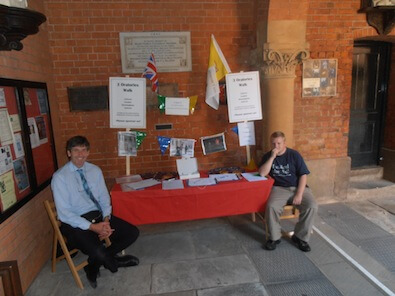
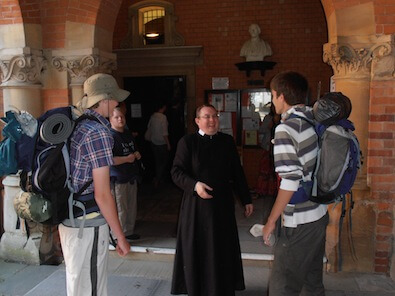
Three Oratories Walkers arrive home safely

1312457386.jpg

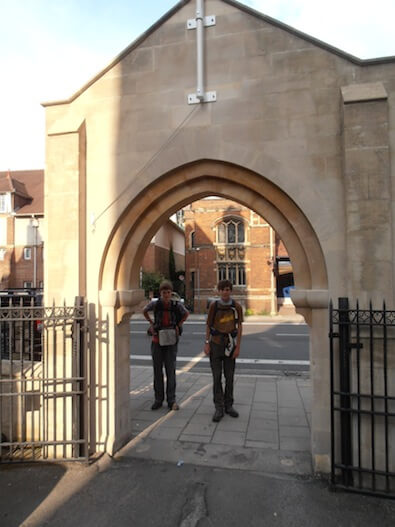
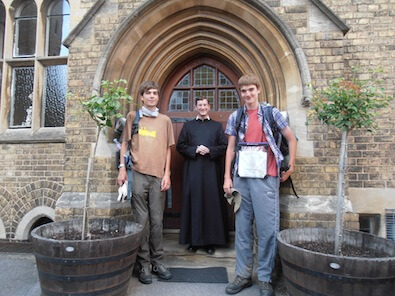
Our brave walkers have arrived home intact, in time for the 6pm Mass on Wednesday, having completed their epic journey in less than two weeks.

1312457590.jpg

Many thanks to all who sponsored them: now is the time to pay up! You can do so either in person, or via the JustGiving.

site.

The boys managed to collect some sponsorship outside both the London and Birmingham Oratories – so thanks too to their parishioners.

1312457862.jpg

1312457734.jpg

Friday Abstinence – Why?

As from the 16th September this year, which will be the anniversary of the Papal Visit, the bishops of England and Wales have decided to restore the practice of Friday abstinence from meat as binding on all Catholics in this country.

Why?

Because it was the day on which Our Lord rose from the dead the first Christians celebrated Sunday, the first day of the week, as the principal Christian day of worship rather than the Jewish Sabbath (Acts 20:7). From that time each Sunday has always been viewed as a mini Easter Sunday. Correspondingly, each Friday has been viewed as a mini Good Friday on which we observe the Passion and death of Our Lord on the Cross. From the earliest days of the Church, Catholics have abstained from flesh meat as part of this observance for two reasons: first, to do homage to Christ who died in the flesh on Good Friday and, second, as an act of penance for our sins.

Although many thought this practice had been abolished in recent years, in fact it has continued to be the norm in the Catholic Church throughout the 20th century and down to the present day. However, in some places – including in England and Wales – the bishops were given authority by the Pope to allow people to substitute some other act of penance instead.

The bishops of England and Wales have decided that abstaining from meat on Fridays should become the norm once again for both of the reasons given above but also for a third reason. When he visited Britain, Pope Benedict called for all Catholics to have the courage and the confidence to take their Faith into the public square. Abstaining from flesh meat on Fridays is a way of marking our Catholic identity and proclaiming, in just one small but distinctive way, that the death of Christ on the Cross is the most important event in human history along with His resurrection on Easter Sunday. We already mark His resurrection by going to Mass on Sunday. Now, once more, we can share a common practice as we mark His Passion and death.

This practice does not mean that we have to eat fish; there are many alternatives to non-meat dishes these days. And if we are already vegetarian we can offer our existing practice up as a penance or undertake some other form of penance instead.

The Catechism of the Catholic Church describes penance as a repentance and a conversion of the heart, an “interior conversion, [which] urges expression in visible signs, gestures and works of penance” (CCC 1430). It is not that we are parading our good works before men; rather, we are worshipping the living and true God with our whole being, body as well as soul, just as the prophet Joel urges us to do in the readings on Ash Wednesday (Joel 2:12-18), and as Our Lord himself teaches us to do – whilst not showing off – in Matthew’s Gospel (Mt 6:1-6).

Let us respond generously, then, to this call from our holy Mother, the Church, to give witness to the Passion and death of our Saviour who died for us that we might live with Him.

Bishop Kenney blesses new School building and launches Motto and Mission Statement

1308936150.jpg

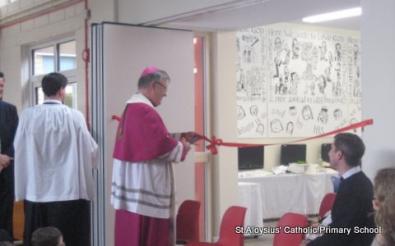
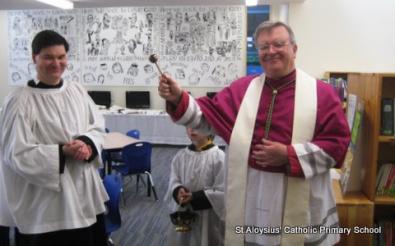
St Aloysius’ School had an exciting day on Tuesday when Bishop William Kenney celebrated our feast day Mass at the Oratory and then officially opened the new courtyard building.

The School Council gave a splendid presentation about the new motto and Mission Statement (see the text of these below) and the music group played beautifully to entertain the guests at lunch.

1308936159.jpg

Our Motto:

“Be ambitious for the higher gifts.”

1 Cor. 12:31

———————–

Our Mission Statement:

Welcome to our school.

At St. Aloysius’ we learn to grow in holiness, to become who we were made to be.

Here we seek to know God, finding Him in all that we learn, and understanding that all that is good, beautiful and true offers us a glimpse of God.

Here we seek to love God, with our hearts, our minds and our souls, meeting Him in prayer and recognising Him in one another.

Here we seek to serve God, making the best use of our gifts to serve those around us. Here, recognising God’s delight in us, and by His grace, we become more fully alive.

———

“A good school provides a rounded education for the whole person. And a good Catholic school, over and above this, should help all its students to become saints.”

Pope Benedict XVI

–

The School has a new website which you can visit here.