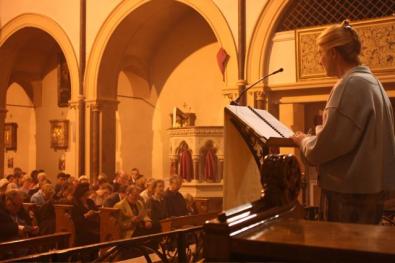
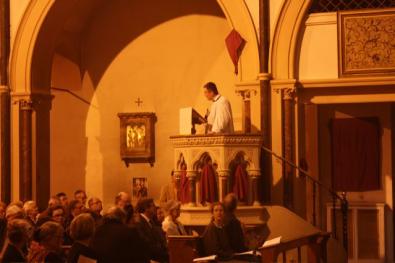
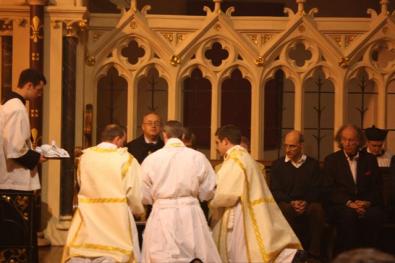
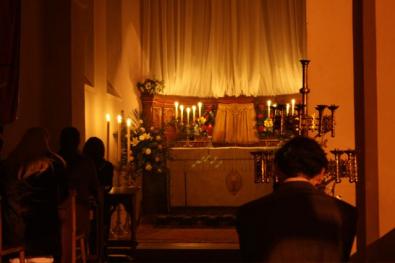
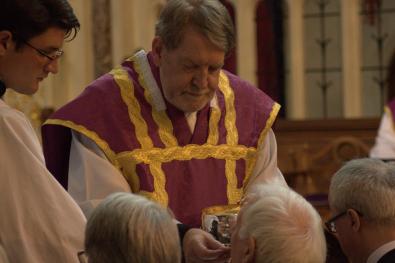
A score of new members of the Ordinariate of Our Lady of Walsingham were received into full communion with the Catholic Church yesterday evening by Monsignor Andrew Burnham. It is appropriate that this should have taken place at the Oratory, since the Ordinariate is under the protection of Blessed John Henry Newman.
These former Anglicans have been receiving catechisis here during Lent, and are now able to participate fully in the Easter Triduum.
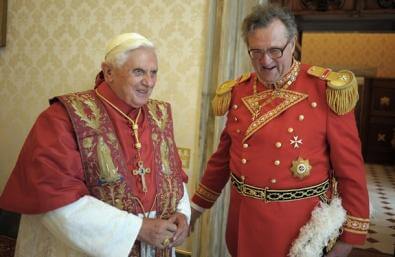
His Most Eminent Highness Fra’ Matthew Festing, 79th Prince and Grand Master of the Sovereign Military Order of Malta, (pictured here with Pope Benedict) has kindly agreed to become a Patron of the Oratory’s Reaffirmation and Renewal Campaign.
Fra’ Matthew sent the following message from the Magistral Palace in Rome:
“I am delighted to be a Patron of the Reaffirmation and Renewal Campaign. The realisation of Blessed John Henry Newman’s vision for an Oratory in Oxford has brought immense blessings not only to the City and the University but to Catholic England as a whole. If these blessings are to continue, the Fathers must have the space to welcome the novices of the future and the means to develop and enhance their distinctive Oratorian missions. I urge you all to support the Campaign.”
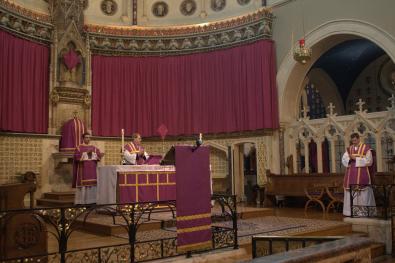
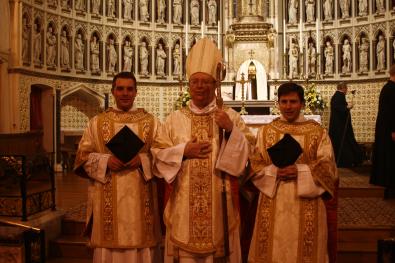
Br Nicholas Edmonds-Smith was ordained deacon by Bishop William Kenney C.P. on 18th March – the Vigil of the Solemnity of St Joseph.
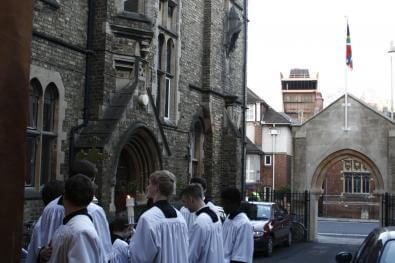
Br Nicholas’s family came over from Cape Town. Here, the South African flag flies from the Oratory arch:
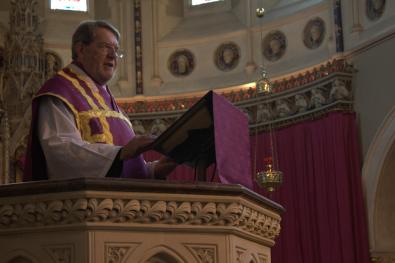
The Gospel – read by Br Edward Van den Bergh of the London Oratory:
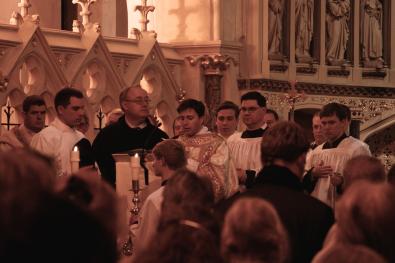
The Litany of the Saints:
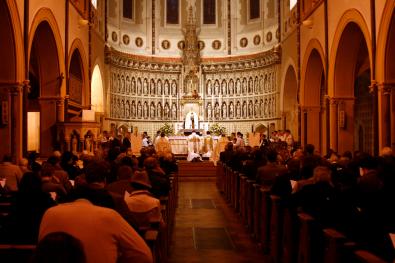
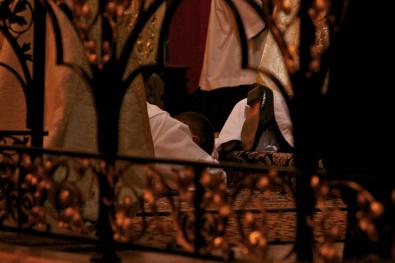
Standing before the Bishop:
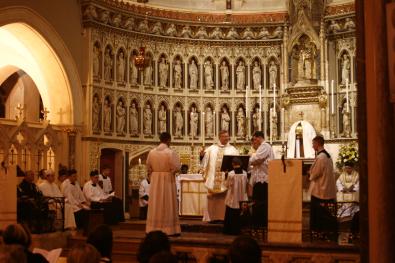
The Laying on of Hands:
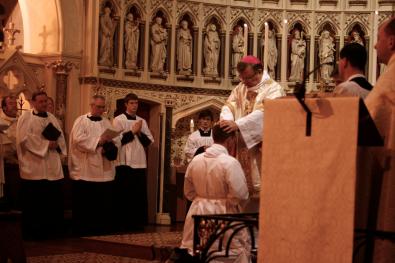
Clothing in the Dalmatic:
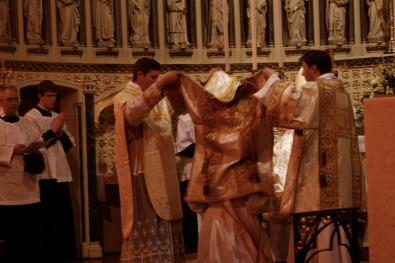
Br Nicholas is given the Book of the Gospels:
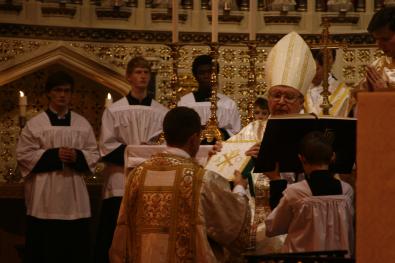
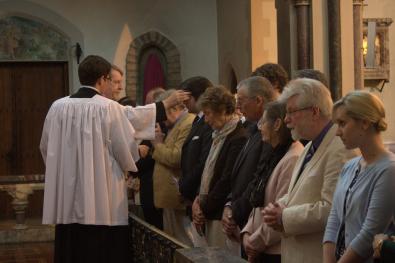
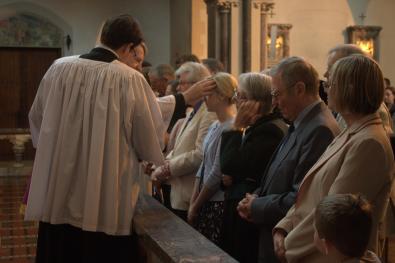
The Kiss of Peace:
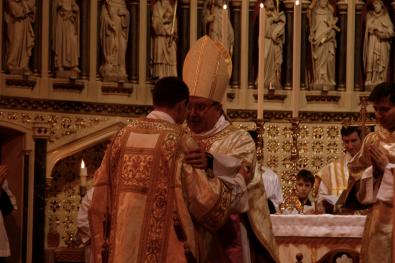
Assisting the bishop at the altar:
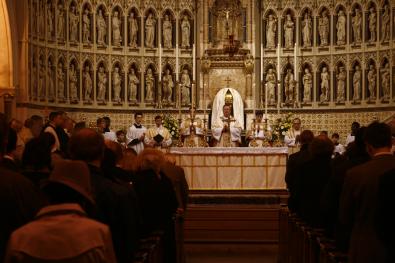
With the Bishop & Br Edward:
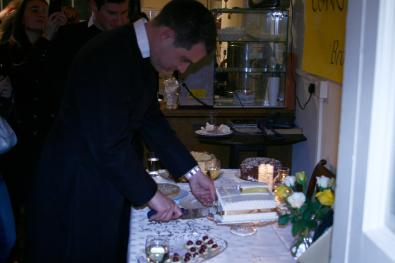
Cutting the cake at the party afterwards:
Photography by Tessa Caldecott
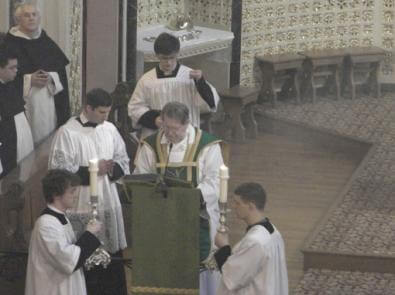
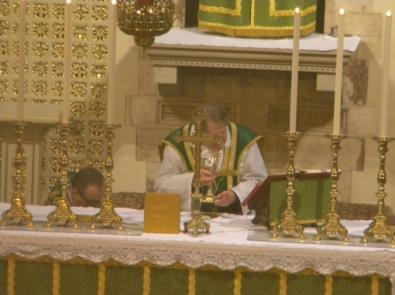
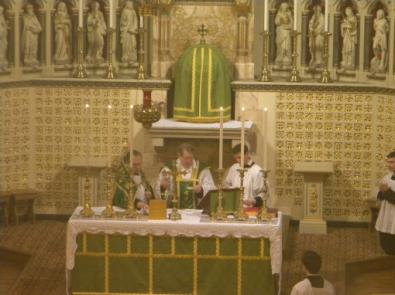
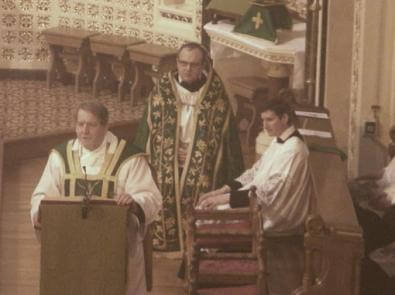
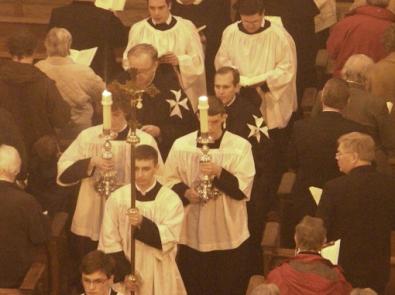
Father Andrew Burnham, former Anglican Bishop of Ebbsfleet, celebrated his First Mass in our church on Sunday, having been ordained priest by Archbishop Vincent Nichols in Westminster Cathedral the day before, along with two other former Anglican bishops who have joined the ‘Ordinariate’ set up by Pope Benedict.
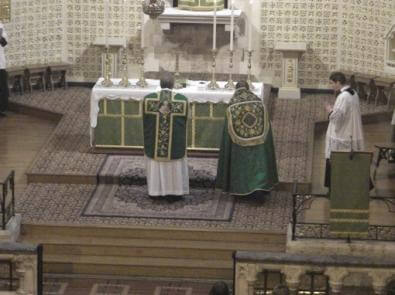
Father Andrew was assisted at the altar by Father Robert. Fr Aidan Nichols, OP preached the sermon, which is reproduced below.
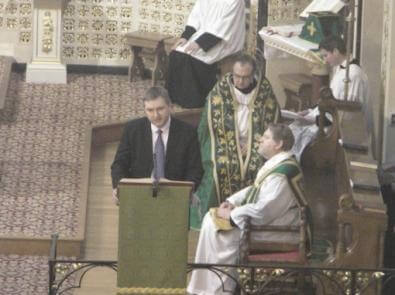
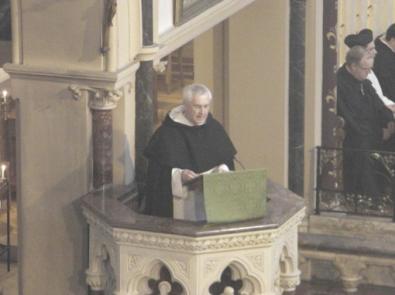
Sermon by Father Aidan Nichols, OP:
We are, at this Mass, on a cusp, or boundary, or threshold. What I have in mind is in the first place the ritual calendar we’re using. We are on the cusp between, on the one hand, the Christmas season, which celebrates the Theophany, the manifestation of God the Word as a human being to other human beings, and, on the other hand, so-called ‘Ordinary Time’, a time which is far from ordinary because it consists in the telling of his story, the story of the public ministry of the Christ as it unfolds in all its dramatic action.
Appropriately, then, today’s Gospel-reading points both backwards and forwards, and its key is the identification of Jesus as the ‘Lamb of God’. Twice, actually, within a few verses of the Fourth Gospel, when the Baptist wants to identify who Jesus is, to locate him (so to say) on the map of salvation geography, these are the words he comes up with. The best explanation of that, I think, is that John the Baptist is rehearsing what it was his cousin told him. At the Baptism, the heavens were opened for Jesus, and in the open heavens he saw… well, what did he see? He saw himself as the Lamb, sent by the Father to make the atoning sacrifice which will reconcile to the Father Israel and all the world, and bring humankind home to the Father’s house. Jesus would go on to comport himself in just this fashion in his public ministry, in the strength of the Holy Spirit whose descent on him in the form of a dove verified what it was, in the opened heavens, that he saw.
The Lamb of God: that is the One we follow, it is how the God-man wishes to be known and loved. He came to make sacrifice for us. That is the impetus that drives his ministry forward till it reaches its climax in the Paschal Mystery of his Death and Resurrection. It is the attitude in which he still stands before the Father, showing the marks of his now glorious wounds. And it is why the continuing sign of that sacrifice – the Mass – is the true centre of the Christian religion.
In the Eucharistic sacrifice, we bring ourselves – all we do and are, all we have done and have been – to be, through purification and transformation, united with the Lamb, Jesus Christ, in his self-offering to the Father. All we did and do, all we have been and are, our life and labour, we should put (so the spiritual writers advise) onto the paten, into the chalice. Bishop Andrew – I’ve known Andrew so long and closely under that description I find it hard to break the habit – is celebrating today his first Mass in full union with the Catholic Church. What does this offering of the gifts mean, then, for him?
What is said of the life and labour of any Christian is said with special force of the apostolic life and labour of an ordained person. ‘What we did and do, what we have been and are’: all Andrew’s former ministerial activity, inevitably, is signalled is these words and so it is now taken up into union with the Lamb’s oblation of himself, taken up in a new way as the sacrificial offering of a Catholic priest in the full, unclouded, indisputable, sense of those words.
What he has done, what he has been: as with all of us, that must mean the faults and failings from whose weight we ask to be relieved through this renewal of the Lamb’s oblation. But is also means the grace-supported actions which we join to the Lamb’s offering not for purification but for further enhancement. In the spring of 1843, Newman wrote to a correspondent, ‘At present… as far as I can analyze my convictions, I consider the Roman Church Communion to be the Church of the Apostles, and that what grace is among us… is extraordinary, and from the overflowing of His dispensation.’ I’ve left out in this citation a phrase in parenthesis for the sake of drawing attention to it now – ‘what grace is among us (which, through God’s mercy, is not little)’. The task before Andrew and the others in the Ordinariate of our Lady of Walsingham is to translate into terms of Christian life, thought and worship, what that ‘not little’ grace has done, in the history of the Church of England – what it is that can be placed on the paten, put into the chalice, not for propitiation, in a spirit of repentance, but for the praise of God’s glory, in a spirit of thanksgiving. And this is the second sense in which we stand now on a cusp or boundary or threshold.
It will entail a very great deal of hard work. It is nothing less than the reconfiguring of Anglicanism by union with the Petrine centre and its criteria of orthodoxy. It is taking up again, in a totally fresh context, the task Newman set himself and his fellow Tractarians in 1837:
‘We have a vast inheritance, but no inventory of our treasures. All is given us in profusion; it remains for us to catalogue, sort, distribute, select, harmonize,and complete. We have more than we know how to use; stores of learning, but little that is precise and serviceable; Catholic truth and independent opinion, first principles and the guesses of genius, all mingled in same works, and requiring to be discriminated.’
And Newman closed:
‘[W]e need peculiarly a sound judgment,
patient thought, discrimination, a
comprehensive mind, an abstinence from
all private fancies and caprices and personal
tastes – in a word, Divine Wisdom.’
We rejoice today for Andrew personally as a long odyssey is completed, but since no share in priesthood is ever conferred for the individual’s satisfaction but only for some wider good, we also have to draw attention to the task that awaits him. Newman spoke of the ‘concentration and adjustment of great Anglican authorities’. Andrew has already begun working on the liturgical dimension of this, entrusted by the Holy See with co-ordinating efforts on that front, in recognition of his outstanding competence in that area.
But there is more than that. There is bringing this new ecclesia particularis, this new ‘particular church’, into the movement for renovating the whole Church which we associate with the mind and heart of Pope Benedict, a movement which respects the Second Vatican Council but places it, by a hermeneutic of continuity, in the great Tradition as a whole. It is a movement towards the fullness of Catholicity, in which the fathers of the Oxford Movement can take effortlessly their place.
So, Father, let me leave you and this congregation with one final citation from the Blessed John Henry, ‘I have a work to do in England’.
Aidan Nichols, O. P.,
16 January 2011
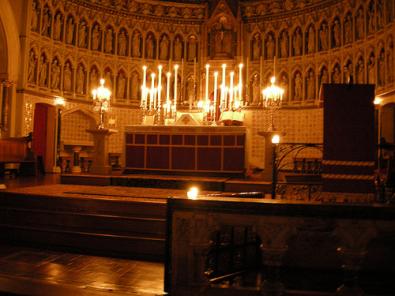
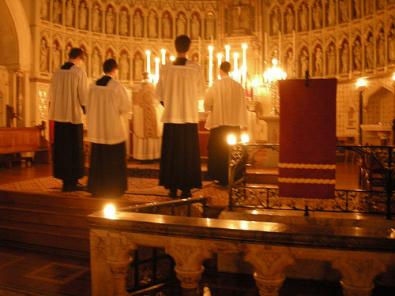
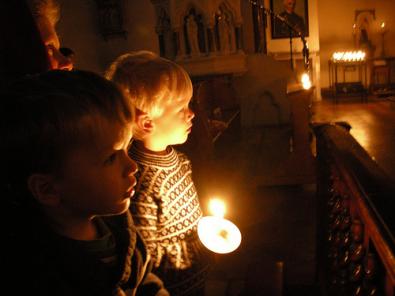
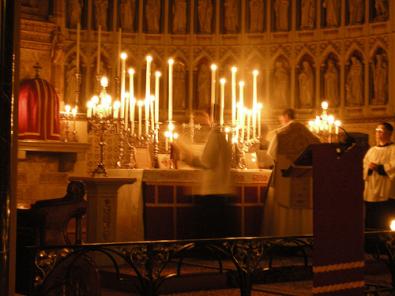
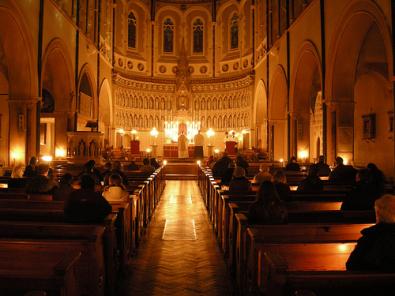
A good number braved the cold and snow for the Rorate Mass at 7am on Saturday 18th December. The Mass was celebrated in honour of Our Lady, with Gregorian chant sung by a small schola, and the church was lit entirely by candlelight.
Photographs by Mike Lord. (from the Latin Mass Society website)
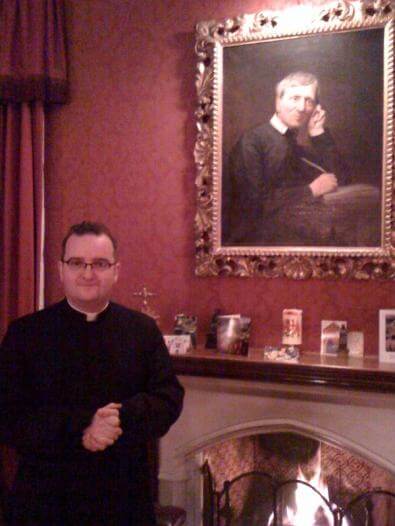
Fr Nicholas Schofield, Parish Priest of Uxbridge, Diocesan Archivist of Westminster and former Brother of the Secular Oratory (when he was an undergraduate at Exeter College) came to preach at the Solemn Mass for the Immaculate Conception. His sermon is reproduced below:
Rejoice, so highly favoured! The Lord is with you.
Whenever I come to Oxford, I try to make a short pilgrimage to the porch of the University Church of St Mary the Virgin. You all know it better than I – jutting out on to the High with its ‘barley sugar columns’, echoing Bernini’s baldacchino in St Peter’s, Rome. Built in 1637, I always think it offers a tantalising glimpse of the sort of architecture we might find across the country had there been no Protestant Reformation, had the English Baroque been Catholicised. The statue of Our Lady in the porch was actually used against Archbishop Laud at his trial in 1641, an example (it was thought) of his dangerous Romanising tendencies and such was the opposition the statue aroused that you can still see to this day the bullet-holes left by Cromwell’s men.
That ‘Virgin Porch’ in the heart of this city seems to sum up the whole history of English devotion to Our Lady and, in particular, to the mystery of the Immaculate Conception, which we celebrate here tonight. Even though the statue dates from after the Reformation, its baroque splendour reminds us of this country’s dignity as Mary’s Dowry, a place where there had long been a devotion to the Immaculate Conception. In fact, one of the earliest mentions of a feast of Our Lady’s Conception comes from an old Winchester Calendar, dating from around 1030. It seems that the Normans initially discontinued the Feast, for they tended to be suspicious of Anglo-Saxon observances. But then a Norman Abbot was saved from shipwreck after promising to establish the feast of the Conception and it henceforth became increasingly popular around the country.
If the magnificence of the ‘Virgin Porch’ reminds us of the English love for Our Lady, then the Cromwellian bullet-holes represent the story of turbulence and destruction, of shrines razed to the ground and images burnt. The Immaculate Conception was, of course, discarded as a corrupt superstition at the Reformation, though it is interesting to also remember that, not yet defined by the Church, the doctrine was vigorously debated in the medieval schools – including Oxford. One historian said that ‘as England has the honour of having first celebrated the festival of Our Lady’s Conception, so have her schools the credit of being the first to defend it scientifically.’ Eadmer of Canterbury, for example, wrote a treatise in support of the doctrine and introduced the famous (though not entirely convincing) maxim: decuit, potuit, ergo fecit – in other words, the Immaculate Conception was possible, because nothing is impossible to God, and fitting, for how could the Mother of God not be Immaculate, therefore it came about, it was accomplished.
So, the Blessed Virgin has been debated by the schoolmen and rejected by the reformers, and yet in more recent times there has been something of a Marian revival. And part of this rediscovery was achieved by that scholarly-looking clergyman who would have been seen scuttling through the Virgin Porch and into the University church during the 1830s – as one of his disciples put it, ‘walking fast, without any dignity of gait, but earnest, like one who had a purpose; yet so humble and self-forgetting in every portion of his external appearance, that you would not have thought him, at first sight, a man remarkable for anything’. His name: Blessed John Henry Newman.
Even as an Anglican, Newman had a strong devotion to Our Lady – ‘in spite of my ingrained fears of Rome, and the decision of my reason and conscience against her usages’, he wrote in the Apologia, ‘in spite of my affection for Oxford and Oriel, yet…I had a true devotion to the Blessed Virgin, in whose College I lived, whose Altar I served, and whose Immaculate Purity I had in one of my earliest printed Sermons made much of’. There’s the amazing thing: that an Anglican in the early nineteenth century could associate the words ‘immaculate’ and ‘Mary’. He refers to a sermon he preached in 1832, the year before the ‘official’ start of the Oxford Movement, where he spoke of Mary as the ‘Second Eve’ and hinted at the Immaculate Conception, though he dared not use such popish terminology. Yet his beliefs were clear: ‘what, think you, was the sanctified state of that human nature, of which God formed His sinless Son; knowing as we do, “that which is born of the flesh is flesh”, and that “none can bring a clean thing out of an unclean?”‘
As a Catholic, Blessed John Henry was more forthright in his views and asked: ‘what is there difficult in this doctrine? What is there unnatural? Mary may be called, as it were, a daughter of Eve unfallen.’ He wrote elsewhere: ‘we do not make her nature different from others. Though, as St Austin says, we do not like to name her in the same breath with mention of sin, yet, certainly she would have been a frail being, like Eve, without the grace of God. A more abundant gift of grace made her what she was from the first. It was not her nature which secured her perseverance, but the excess of grace which hindered Nature acting as Nature ever will act. There is no difference in kind between her and us, though an inconceivable difference of degree. She and we are both simply saved by the grace of Christ.’
Why was Mary preserved from the stain of original sin? Those who come near to God, the source of all goodness and holiness, must be holy themselves. No human being came as near to Him as Mary did. A prophet who acts as His oracle; a mystic who reaches the highest mansion; a priest who consecrates the bread and wine – none of these are as close to God as Our Blessed Lady. As Mother of God she carried the second person of the Trinity in her womb, she became, if you like, a living, walking tabernacle, the new ark of the covenant. And so it was fitting that Mary was prepared in this unique way.
Returning to Oxford’s ‘Virgin Porch’: the statue of St Mary the Virgin remains a discreet but ever maternal presence in the heart of this city, watching no longer the passings of Cavaliers and Roundheads with their pikes and muskets but successive generations of undergraduates, rushing by with their iPods and iPhones. Tonight we turn to her, as patroness of this diocese and patroness of the Oratory. She points us, as ever, towards her Son and reminds us of the primacy of grace, which St Paul calls God’s ‘free gift to us in the Beloved’. Because without grace, Mary would have been nothing; likewise, whatever our talents, we cannot achieve anything without first acknowledging our total dependence on God. Mary was given the highest fullness of His Kingdom. We too are granted wonderful graces, hour-by-hour – of the same kind but not to the same degree. As we honour the unique privileges for Our Blessed Lady, let us become more aware of this invisible life of grace, without which we are vessels of clay and only that. As we prepare for Christ’s coming, let us follow in the footsteps of the Immaculate Virgin – ‘for nothing is impossible to God.’
Fr Nicholas Schofield, 8.xii.2010
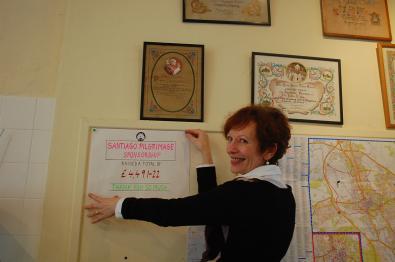
The Women’s Oratory and friends have been working hard to raise sponsorship money for the walk to Santiago in August. Last Sunday they were able to hand over a grand total of £4,491.22. Some further pledges and Gift Aid may still be due to come in. Any other fundraising ideas are always welcome!
Br Nicholas sings the Epistle:
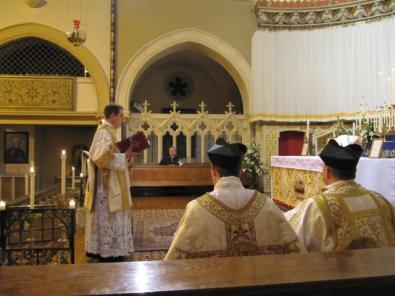
The Gradual:
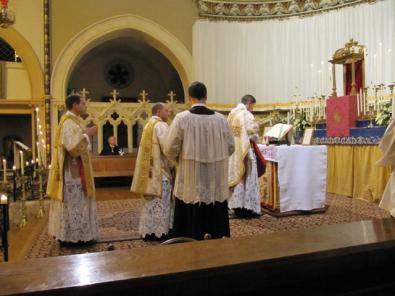
Blessing before the Gospel:
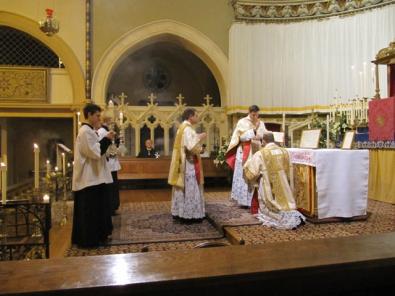
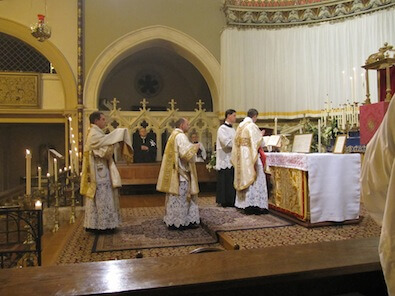
The Canon:
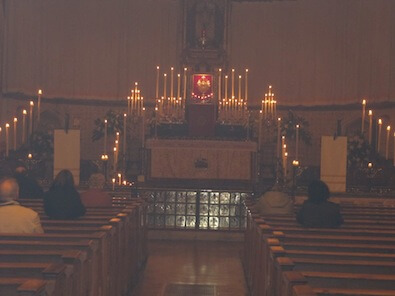
Night adoration of the Blessed Sacrament:
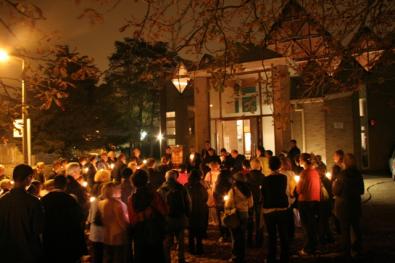
9th October was our Cardinal’s first liturgical feast day. There was a whole weekend of events in Oxford, all of which were attended by large numbers of people.
The Night Walk (pictured above) takes place each year on the evening of 8th October, from the Oratory to the College at Littlemore. It commemorates Blessed Dominic Barberi’s arrival to receive Mr Newman into the “one fold of the Redeemer” on 8th October 1845.
On Saturday 9th October there was a Mass in honour of Blessed John Henry in the Parish Church at Littlemore, and then in the evening, Nigel Cooke of the Royal Shakespeare Company read Newman’s sermon “The Cross of Christ the Measure of the World” to an appreciative congregation in the University Church of St Mary the Virgin, where Blessed John Henry was the vicar.
Finally, on Sunday 10th October, the feast was transferred at the Oratory. There was veneration of the relic after all Masses, and Bishop John Arnold celebrated the Solemn Mass.