Our Father

Fr Dominic Jacob preached this tenth sermon on the Mass on Sunday 6th November:

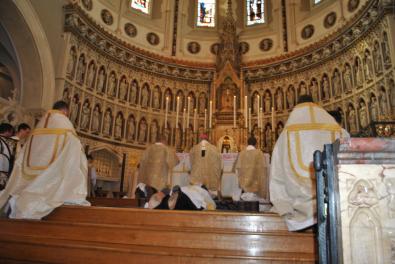
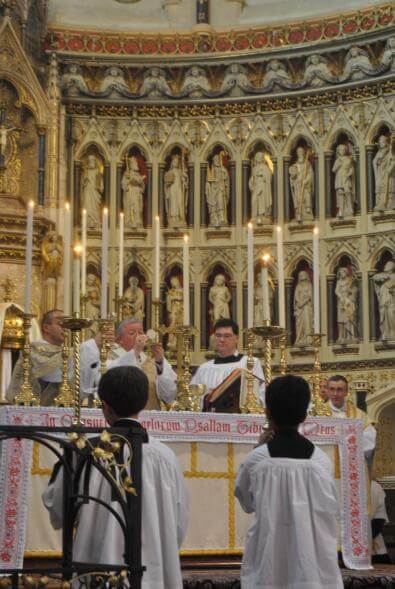
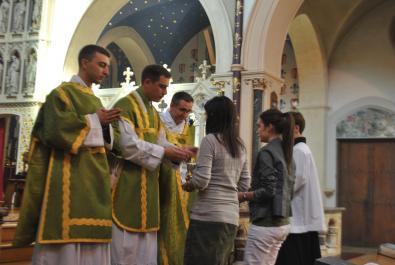
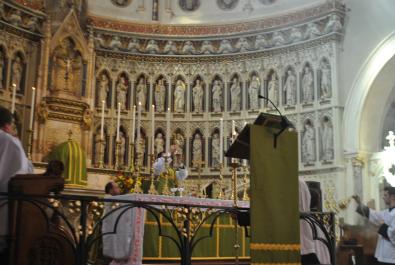
We have reached the end of the Canon, the Great prayer of Consecration, the main focus of the Mass, during which the bread and wine offered at the altar, become the Body and Blood of our Lord. We now move on to the Communion rite.

This begins with the Pater Noster, the Our Father, which St Thomas calls “The most perfect of prayers.” This has always been part of the Mass, but it was not always where it is now, serving as a bridge between the Canon and the Communion, somehow belonging to both, uniting the sacrifice with the Banquet.

It was, Pope St Gregory the Great who had this prayer placed at the end of the Canon, which was the custom in the Greek Church where the prayer was said at that point by all present . One bishop, John of Syracuse, took issue with this innovation in the Roman Liturgy, but Pope Gregory defended his decision vigorously in a letter to the Sicilian bishop: “The Lord’s Prayer,” he wrote, “is recited immediately after the Canon, because it was a custom of the apostles to consecrate the offerings only when this prayer was also recited. It also seems most inappropriate to me, to recite at the sacrifice a prayer which was composed by some scholar, and to omit the recitation of the prayer which our Saviour himself composed, in the sacrifice of His Body and Blood.”

One thing which has been restored in the new edition of the Missal is the more literal translation of the introduction to the prayer. “At the Saviour’s command and formed by divine teaching, we dare to say…” it sounds rather more severe than the cosier introductions we were used to in the earlier translation and not a few have raised the question as to why we “dare” to say the Our Father. It’s a fair question. But the truth is, we have always “dared” to call God our Father. Not, however, in any craven way as though we were terrified of the Lord. Surely it’s about reverence before Almighty God, remembering first that God is God and that here we stand on holy ground. Here, in our presence, the Lord has done something truly awesome in making the Divine Presence a reality in the Sacrament of the altar. More than this – we, who are nothing, have been given through the grace of our baptism, a tremendous privilege: to call God our Father. On this matter, St Peter Chrysologus said: “Our awareness of our status as slaves would make us sink into the ground and our earthly condition would dissolve into dust, if the authority of our Father himself and the Spirit of his Son had not impelled us to cry …’Abba, Father!’…When would a mortal dare call God ‘father’, if man’s innermost being were not animated by power from on high?”

We “dare” to call God father, because Our Lord has told us we should: “When you pray, say this…” Moreover (and I quote the Catechism here) the “power of the Spirit who introduces us to the Lord’s Prayer is expressed… by the beautiful, characteristically Christian expression: parrhesia, straightforward simplicity, filial trust, joyous assurance, humble boldness, the certainty of being loved.” (CCC 2778) So when we pray this prayer, we do so confidently, as a child coming before a father. St Philip once taught an old lady how to pray simply by helping her enter into the Our Father, and think about it clause by clause, beginning with what a marvellous thing it is to have God as our Father. It is important that we meditate on this often.

Another reason why the Lord’s Prayer is such a good bridge to Communion is expressed in its central phrase: “Give us this day our daily bread.” This was understood by early writers such as Origen, Tertullian and St Cyprian as a reference to the Holy Eucharist, “the daily bread which nourishes and preserves the divine life within us.”

But there is another clause in the prayer which lends weight to its being included as part of the preparation for Holy Communion. This is the petition for the forgiveness of our sins and our deliverance from all evil. St Augustine puts it rather neatly: “When, because of human weakness, our minds have conceived something improper, or our tongues have spoken something unjust… these things will be removed through the Lord’s Prayer, when we say: ‘Forgive us our trespasses’, and we may approach without fear and not eat and drink what we receive to our own judgement.”

The first section of the Lord’s Prayer, where we dwell on the nature of God, and implore him to make his presence felt on earth, and the last section, where we dwell on our response to his love, linking the forgiveness he gives us with that we ourselves must show to others, are the two wings that make this prayer so powerful. If you take the wings of a bird apart, you may understand how they work, but the bird will no longer be able to fly. Faith cannot exist without the wings of prayer and there is no better way to make that leap of faith which is so essential to our Christian lives than to speak the language of God himself, using the prayer with which the Son catches us up into the life of the Father, the life of the Kingdom for which our hearts yearn.
Sacrament

Here is the ninth in the series of sermons on the Mass, preached by Fr Nicholas Edmonds-Smith on Sunday 30th October:

For most of us, the sacraments are our primary encounters with the Church, and the primary expression of our Catholic Faith – or rather, those two sacraments – the Holy Eucharist and Confession which we celebrate with varying frequency. The other 5 are more occasional: most of us will have been baptised and confirmed but a long time ago. Some of us are married. Some of us are priests or deacons. Perhaps we have been very ill, or in hospital, and have received the sacrament of the Sick. But Mass and Confession are the two that almost define us as Catholics – they are what Catholic “do”.

Yet it is also true that we tend to think of the sacraments as something peripheral to our faith – peripheral not in importance, and certainly not in practice – but peripheral in that they are “add-ons”, extras to one degree or another. Just look at a catechism or an instruction course – you have all the meaty theology, all the essentials of Christian faith first. Creation, Incarnation, Redemption; the Bible,the Trinity, Our Lord, Our Lady and the saints, the Church. And then you have a chapter on the sacraments. In a sense, the sacraments are separate from what we might regard as the fundamental doctrines of Christianity – which might be why there have always been Christians who have thought it possible to jettison one or more of the sacraments, or change their nature, or abolish the sacramental system altogether, and yet still be orthodox Christian believers.

The sacraments are certainly not mere additions to a system of belief. Rather, the concept of a sacrament, of sacramentality, is absolutely necessary for making sense of most of our doctrines. It is all pervasive. It is a common thread running throughout Christian teaching. For a sacrament is something that reveals and makes present.

Consider Our Lord himself – Christ, through his life and death, through his teaching and miracles, through his very person, reveals God to us. He tells us something about God. He tells us everything about God we’ll ever need to know. But he does more than just reveal Almighty God to us. Christ is the incarnation of the Second Person of the Blessed Trinity, he is God the Son himself made flesh. He brings God to us. Christ, in his humanity, reveals God and makes him present. As he himself says, “To have seen me, is to have seen the Father”. And as St Paul tells us, He is “the image of the invisible God”.

This is the most fundamental doctrine we have: that God became man. And he became Man so that we might know him, that we might love him and serve him. That we might enter into a relationship with him, through faith and through his death and resurrection, both now and into eternity. Christ is, in a sense, the outward sign of an inward grace, an inward spiritual reality – the love of God for mankind – who actually is himself that love. He is a sacrament. He reveals and makes present.

Or look at the Church. We believe that the Church – those billions of believers, united with their shepherds, those alive today, those in heaven, and those awaiting the end of their purification in purgatory – this mystical body is the Body of Christ. It not only teaches us about God and Christ, and rules and guides us with his authority; it is actually the living presence of Christ on earth. It is his Body. It both reveals him to the world, and makes him present. It is His Sacrament. It is the outward material expression of that Spirit of the Risen Lord who binds those who believe to each other and to himself, that we might be caught up into the life of the Trinity, the mystery of the love of the God we cannot see.

And finally, look at the seven sacraments: those outward signs of inward grace, instituted by Christ for our sanctification. It is in these seven moments that the Church most perfectly realises her nature as the Body of Christ. In these seven celebrations, something about God is revealed to us, we are told something of what God is doing, of how he loves us, of what he wants for us. But more than that, God is himself made present. Grace is actually given. They do what they say they do. So that in baptism we are told about the love of God which recreates us in the image of his Risen Son – and then we are recreated. In the sacrament of Penance, God is revealed as a Shepherd who searches out the lost sheep; a loving Father always ready to embrace and forgive us – and we are in that moment embraced and forgiven. Or in the Holy Eucharist, we see that God so loved the world that he sent his only Son, who gave up his life on the cross for our redemption – and then we are given that life through Christ’s actual body and blood, made present through the action of the Holy Spirit in the elements of bread and wine. It is in this Blessed Sacrament that Christ is most perfectly revealed and most really made present. And this so that we might share his life and the salvation he won for us, that we might have grace in our souls and the love of God in our hearts.

Through our participation in the sacraments, above all in the Mass, we encounter Our Lord, and his power working in us. We celebrate our redemption and our union with the Father, and we are given all the graces and blessings, all the spiritual gifts and power we need to live as sons and daughters of God.

But the sacraments are not to stop there. They do not reveal Christ and make him present for ourselves alone. They are meaningless if they do not empower us to go out and reveal him to the world. And not only reveal him, but actually make him present. Because where we gather, he is present. When we act, it is he who acts in us and through us. The sacraments make us into sacraments – the Body of Christ makes us the body of Christ, that we might share him others, that we might show the Love of God and be that Love. The Church most fully IS the body of Christ when we share the body of Christ in the Eucharist. In the sacraments, and especially in the Blessed Sacrament, we become, as the Church, what we are called to be – the visible, material, bodily revelation of Christ in the world. An outward sign to others of an inward grace.

Sacrifice

The eighth sermon in the series of the Mass, preached by Fr Daniel Seward on Sunday 23rd October:

“The cup of blessing which we bless, is it not a participation in the blood of Christ? The bread which we break, is it not a participation in the body of Christ?.”

In the sixteenth century, one of the most controversial debates between Catholics and Protestants was that of sacrifice: is the Mass a sacrifice? Still today you might meet people who say that this idea has no warrant in the scriptures. But sacrifice is essential if we are to understand what we are doing here, and the scriptures themselves show this clearly. Today I shall use just two passages from the New Testament to show this.

If you were a Gentile Christian living in Corinth in the fifties of the first century, you had a problem: in a Greek or Roman city, the normal suppliers of produce to the meat market were pagan temples. The meat that had been offered there to idols was sold in the market and then eaten at home. There was no overt connection between pagan worship and the eating of meat, but the consciences of some Christians were disturbed. Were they themselves guilty of idolatry by co-operating with this trade in sacrificial meat? Were they therefore obliged to be vegetarians, since there was not any other source of meat available to them? St Paul, in his first letter to the Corinthians, dispenses good, sound, practical advice. It is not permitted for Christians to eat meat in the context of a pagan ceremony, but if they have bought meat from the market that may have been offered to idols, they can eat it in good conscience, only they should be careful that in doing so that they did not give the impression that they condoned pagan sacrifice and so lead their weaker brethren astray. What is significant for us is that when Paul goes on to talk about the Eucharist, he explicitly compares it with a pagan sacrifice. The result of taking a meal in which the sacrificial victims of an idolatrous sacrifice were being eaten was to participate in this sacrifice and so become ‘partners’, that is friends or associates of demons. Whereas, in the Christian Eucharist, we share in the Body and Blood of Christ which has been offered to God in sacrifice, the sacrifice of the Cross. When we take part in the Eucharist, we are expressing our status as partners, friends, associates of God by participating in the sacrifice of Christ. So Paul says,

“The cup of blessing which we bless, is it not a participation in the blood of Christ? The bread which we break, is it not a participation in the body of Christ? … Consider the people of Israel; are not those who eat the sacrifices partners in the altar? What do I imply then? That food offered to idols is anything, or that an idol is anything? No, I imply that what pagans sacrifice they offer to demons and not to God. I do not want you to be partners with demons. You cannot drink the cup of the Lord and the cup of demons. You cannot partake of the table of the Lord and the table of demons.”

In this sacrifice Christ Himself is the priest – represented in the Mass by His earthly minister, and He is the pure victim.

The Passover meal, at which Our Lord celebrated the first Mass, was not an historical re-enactment, but a celebration of God’s saving and liberating action now. At the Passover meal, the Jews don’t say, “Tonight we remember when our ancestors were set free”, but “Tonight we are set free from slavery in Egypt”. The one who takes part in the Passover meal becomes a participant in the Exodus from Egypt. What was it caused the angel of death to pass over the Israelites? It was the blood of a lamb, smeared in the form of a Cross upon their doorposts. During the Passover meal there are four cups of wine to be drunk, representing the four promises that God made to Israel at the first Passover: “I will bring you out…I will deliver you…I will redeem you…then I will take you for my people.” The third cup is drunk at the end of the meal when grace is said and relates to the promise to redeem Israel. It is followed by the ‘hallel’, the praise of God, and then by the fourth cup, called the cup of completion. It was at the third cup, at the end of the meal that our Lord gave His Precious Blood to the disciples. The third cup – the cup of blessing – represents the blood of the lamb that the Israelites smeared on their doorposts. Their covenant with God that He would pass over them was sealed by this blood. In the Gospels we read:

“In the same way, He took a cup after supper, and said, “This cup is the new covenant in My blood. Whenever you drink it, do this as a memorial of Me.””

Clearly, our Lord is linking this cup of His blood with the sacrifice of the lamb at Passover. It is certain then, that He means this meal, the Eucharist, to be a sacrifice in an analogous way to the Passover. In St Matthew’s Gospel we read:

“Drink of it, all of you; for this is My blood of the covenant, which is poured out for many for the forgiveness of sins. I tell you I shall not drink again of this fruit of the vine until that day when I drink it new with you in my Father’s kingdom. And when they had sung a hymn, they went out to the Mount of Olives.”

After the third cup should come the drinking of the fourth cup – the cup of completion. It relates to the last of the four promises – “I will take you for my people.” But this fourth cup is not drunk by Jesus and His disciples. In fact He quite explicitly says that He will not drink wine again until He does so in his Father’s kingdom. The Passover meal is deliberately left incomplete. Why is this? It is because it is only the death of Jesus on the Cross the next day that consummates the action of the Last Supper. Our Lord relates the two of them by saying that His blood is to be poured out for the remission of sins. In the Garden of Gethsemane He prays, “My Father, if it be possible, let this cup pass from Me; nevertheless, not as I will, but as Thou wilt.” The cup is the fourth cup of completion which the Son will drink on the Cross. In St John’s Gospel, our Lord cries out from the Cross, “I thirst!” and then is given vinegar on a hyssop stick. When He has drunk this He says, “It is finished!” – or consummated or completed. This is the fourth cup of completion, drunk upon the Cross.

“Do this in remembrance of Me” This word ‘remembrance’ or ‘memorial’ or simply ‘memory’ can be confusing when we use it in English, because we use these words simply to mean recalling something in the past. If I remember something, it is usually something that no longer exists, but the Passover meal made the events of the Exodus present there and then to the participants – “Tonight God frees us from slavery.” So when the Lord says, “Do this as a memorial of Me”, He means that whenever we eat this bread and drink this cup, we are proclaiming His death – we are making His death present to us. A covenant is not simply a contract between two people – it is a sacred blood bond between two people involving the exchange of life – “I am yours and you are mine”. This is why a covenant has to be sealed with blood, to show the reality of this commitment. Participation in the new Covenant of the Eucharist means then that Christ gives Himself to us, and we must give ourselves to Him. The Eucharist is a Sacrament of total self-giving – Our Lord does not give Himself to us in any measure, or only partly. He holds nothing back, because He gives Himself. It is because Christ unites Himself totally with us, that we are enabled to unite ourselves with Him – to follow Him through the veil to the holy of holies.

The new English translation of the Missal re-emphasizes such words as sacrifice, oblation and offering to remind us of the importance of this scriptural concept of sacrifice. This is also why the Church is rediscovering her ancient practice of the priest and people facing together towards the altar, to show that the Mass is not a simple meal around the kitchen table but a sacrificial offering to the Father of the one sacrifice made by Christ on Calvary. It is offered for our good, to the praise and glory of His name and for the good of all His holy Church – for the living and the dead. From this follows the sacrifice that we make of our time to assist worthily at the Mass, from this follows the sacrifice of our lives in the Lord’s service, to which the Mass invites us.

The Offertory

The seventh in the series of sermons on the Mass, preached by Fr Joseph Welch on Sunday 16th October, during the Forty Hours’ Devotion:

And so we come to the seventh in our series of Sunday sermons on the Mass, and turn our attention to the Offertory, very appropriately during this weekend of our Forty Hours devotion.

To understand the Offertory, indeed to understand the whole Mass, we have first to be reminded that the Mass is not primarily something that we do. The Mass is, first and foremost, something that Christ does. The Mass is the supreme act of homage and adoration offered by Christ, the Son of God, to His Father, and carried out in humble obedience; an act of expiation to make amends for our sins, and of propitiation to appease the wrath of God because of the injustice of our sins; an act of thanksgiving for all that God has bestowed upon mankind; and an act of supplication, appealing to the Father for all that sinful man yet needs. These are the four ends of the Mass: adoration, satisfaction for our sins, thanksgiving, and supplication.

All of these four ends were accomplished on Calvary when Christ, in dying on the Cross, offered Himself to the Father on behalf of sinful mankind.

The Mass and Christ’s offering on Calvary are, then, one and the same thing. The Mass is simply the continuation in time of that offering on Calvary.

So when we come to Mass, we come, not primarily to get something out of it, but to accept Our Lord’s invitation to join in His act of adoration, His offering of Himself, to the Father. In other words, we come primarily not to receive but, like Christ arriving on Calvary, to give. And the offertory is the moment in the Mass where this point is, perhaps, most apparent.

At the offertory, the pure and unblemished bread is offered up in preparation for its becoming the Lamb of God sacrificed on the altar of the Cross. But it also represents us. In the bread, offered up to the Father by Christ in the person of His priest, is also offered all that we bring to the Father: our adoration and praise, our thanksgiving for all the gifts He has given us, for all of our joys, our hopes and our aspirations and our longings. But alongside these joys we bring, too, all our sufferings, all that weighs us down or troubles us, our anxieties, our ills, our loneliness, our confusion, our despair, and, in addition we bring to God all those for whom we wish to pray. Even our sins are brought to Him as we beg forgiveness and sanctification.

As the priest raises the patten at the offertory we should, in our mind’s eye, place on that patten alongside the bread, all that we have come to give to the Father, asking Our Blessed Lord, the mediator between we sinful creatures and our sinless Creator, to offer it to the Father on our behalf, and to purify our gift from any selfish or vested interest with which our prayers may be tainted.

Then the priest mixes wine and water: a tiny drop of water is comingled with the wine in the chalice. That tiny drop of water, which signifies our smallness, our limitedness, our humanity, is dropped into the vast richness of the wine, the vastness of God’s greatness and mercy, the richness of His grace and His love. Once that drop of water is poured into the wine it is, as it were, lost, no longer detectable, because God’s infinitely merciful love absorbs us into His being, into a share of His life, sanctifying and making divine that which is sinful and human. Like the drop of water in the wine, we become lost in God’s love.

The chalice too, then, is offered up by Christ in the person of His priest on our behalf but, once more, we, in our mind’s eye, place within that chalice all that we have brought to the Father, asking our beloved Lord to offer it to Him.

Here then, at the offertory especially, we see how the Mass is primarily something which Christ does. And we? What is our role? Are we merely spectators? Certainly we, as it were, get caught in the updraft of Christ’s offering to the Father; we get caught on the coat-tails of Christ’s upward movement. But our gift of self is taken up by Christ precisely because we have responded to His call like Mary the sister of Martha, and like Our Lady herself.

When Our Lord went to Bethany after Lazarus has died, Martha rushed to her sister Mary and said, “The Master is here and calls you”. Mary rose quickly and went to Him (Jn 11:28,29). So in the Mass our Master calls to us, and we, rising from our places, hasten to Mass to join in His life-giving work.

And just as God courted the chosen virgin of Nazareth, who surrendered herself entirely to her Lord, and was promptly overshadowed by the coming of the Holy Spirit; so, too, God woos us, invites us to surrender ourselves to Him. We do so in the offertory of the Mass, and we, too, are overshadowed by the Holy Spirit as the greatest Gift known to mankind descends from heaven upon the altar in the hands of the priest, and we become one with Our Lord in Holy Communion.

Let us pray, then, that both the priest’s sacrifice and ours, which we offer up in unison, may be acceptable to God the Father almighty.

The Gospel

6th sermon in the series on the Mass, preached by Fr Anton Webb on Sunday 9th October 2011, Feast of Blessed John Henry Newman of the Oratory.

“All scripture is inspired by God and profitable for teaching, for reproof, for correction, and for training in righteousness”. [2 Tim. 3:16]. The Church has taken these words of St Paul to Timothy to heart in devising the Lectionary we use in the Mass. The Lectionary, or the Book of Readings, ensures that after every three years, practically the whole of Holy Scripture has been read in church over the course of weekday and Sunday Masses.

If those words of St Paul are true for all the books of the Bible, they are especially true of the Gospel. In Ordinary (green) Time, the selected passages of the Sunday Gospel are sequential, although with some gaps because these other passages are appointed for other seasons or weekdays in the year, particularly St John. Over a three year period, Matthew is assigned to the first year (A), Mark and chapter six of John the second (B), and Luke the third (C). The First Reading from the Old Testament at Sunday Mass is non-sequential: it is picked to reflect in some way the Gospel of the day. So, in the Liturgy of the Word, prominence is given, by this arrangement, to the Gospel.

This prominence is also reflected in the way we hear the Gospel read. For the other readings we sit but for the Gospel we stand. There may be a procession with the Book of Gospels; we turn to face where it has been placed to be read; it may even be incensed. The priest of deacon seeks a special blessing so that they may worthily proclaim the Gospel. When it is about to be read, we trace with our thumb the sign of the Cross over our forehead, mouth, and heart. This is a prayer that we may ponder what we hear in our minds, proclaim it with our lips in daily life, and treasure it in our heart.

Why do we give such heightened reverence to the Gospel? It is, of course, because it treats directly of the words and actions of Jesus. The Old Testament foreshadows Him; the Acts of the Apostles and Epistles are concerned with the time after His coming, but the Gospel concerns itself from the moment “the Word became flesh and dwelt among us” [Jn. 1:14] to when He “was taken up into heaven, and sat down at the right hand of God.” [Mk 16:19]. It encapsulates the whole of His earthly life, cataloguing for us the most significant events. Notice, by the way, that there is only one Gospel, since there is only one Lord and Saviour of us all. That is why the reading is introduced as “from the Holy Gospel according to Matthew/Mark/Luke/John.” The Gospel is simply written from four different angles.

The Gospel is not about Jesus in the sense of a biography of the life of a figure from the past. The Gospel, rather, is Jesus in the sense that He lives and reigns and acts among us now for our salvation. It is the proclamation of the One who was, who is, and who shall be for ever. St Paul, in his opening chapter to the Ephesians, preaches what he calls “the word of truth” and “the gospel of…salvation” [Eph. 1:13]. For him they are the same thing. Our Lord in His own person is the Word of Truth and the Way to Salvation when he proclaims of Himself, “I am the way, and the truth, and the life; no one comes to the Father, but by me.” [Jn 14:6]. So an encounter with the Gospel goes beyond printed text to being truly an encounter with the Lord, and an invitation to be led by Him to His Father’s kingdom.

How persuasive and powerful is the Word of God! In the Book of Genesis, God says, “Let there be light”, and there was light. The Almighty decrees, and immediately it is accomplished. “He sends out His word to the earth and swiftly runs His command.” [Ps. 147:15]. And so the words of the Word made flesh, enshrined in the Gospel, have especial impact. He comes into Galilee, saying, “Repent, and believe in the Gospel.” [Mk 1:15]. Immediately, simple fishermen drop their nets, leaving their family ties and livelihoods to follow Him. In the synagogue at Nazareth, all eyes are fixed upon Him [cf. Lk 4:20] as they “wondered at the gracious words which proceeded out of His mouth”. [Lk 4:22]. “They were astonished at His teaching, for He taught them as one who had authority, and not as their scribes.” [Mat. 7:28, 29].

Acceptance of Christ’s Gospel, that is, the call to turn to Him and His Kingdom, is truly life-changing. That is one reason why Our Lord often uses examples connected with marriage to describe His kingdom, such as in today’s reading from St Matthew. In marriage, two people become one. They will never be with their separate friends and family in quite the same way ever again. It is a new beginning, a new life. So it is with the new life in Christ. Circumstances change dramatically: “the last shall be first, and the first last.” [Mat. 20:16]. But one is also transformed interiorly through faith and the sacraments. So St Paul says somewhere that the follower of Christ “becomes an altogether new creature.” [Gal. 6:15 J.B.].

According to Blessed John Henry Newman, whose Feast Day it is today, “This has been the real triumph of the Gospel, to raise those beyond themselves and beyond human nature, in whatever rank and condition of life, whose wills mysteriously cooperate with God’s grace, who, while God visits them, really fear and really obey God… It has made men saints, and brought into existence specimens of faith and holiness, which without it are unknown and impossible.” [Parochial and Plain Sermons, Vol IV, Serm 10].

Despite the arresting words of Christ and His extraordinary invitation to His heavenly marriage banquet, many refuse to believe His Gospel. We may feel this particularly keenly in our own land where the practice of the Christian Faith is a mere flicker of its former brilliance. Have we failed? Has our hope grown weak? That certainly is a temptation. Spreading the Gospel was always going to be difficult, and many saintly pastors of souls shine out in the Church—among them our own Blessed John Henry—for their courage in the face of adversity, for their love in the face of indifference. In showing to an heroic degree God’s love to the people in their charge, they embodied in themselves the Gospel proclamation. They, in a sense, became the Gospel. In the spirit of St Paul, they were so “affectionately desirous of you [that] we were ready to share with you not only the gospel of God but also our own selves, because you had become so dear to us.” [1 Thess. 2:8].

Newman remained strangely positive in the face of the infidelity of the age, pointing out that the Gospel never claims for itself universal acceptance it. While it is certainly true that God “wants all men to be saved and to come to the knowledge of the truth” [1 Tim. 2:4], our Lord’s message is that by no means all people will accept the truth. For example, in our Lord’s comparison [Mat. 22:1-14] of the king’s giving a feast for his son’s wedding, those first invited “would not come” [Mat. 22:3], despite having been summoned twice. Our Lord concludes by saying that “many are called, but few are chosen” [Mat. 22:14]. I shall leave you with our Blessed Cardinal’s own words on the matter: “It is no triumph…for unbelievers that the Gospel has not done what it never attempted. From the first it announced what was to be the condition of the many who heard and professed it. ‘Many are called, few are chosen.’ ‘Broad is the way that leadeth to destruction, and many there be which go in thereat. Strait is the gate and narrow is the way which leadeth unto life, and few there be that find it.’ Though we laboured ever so much, with the hope of satisfying the objector, we could not reverse our Saviour’s witness, and make the many religious, and the bad few. We can but do what is to be done. With our utmost toil we do but reach those for whom crowns are prepared in heaven.” [Parochial and Plain Sermons, Vol IV, Serm 10].

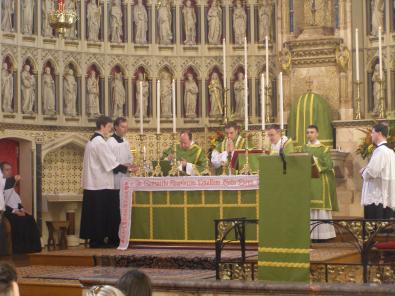
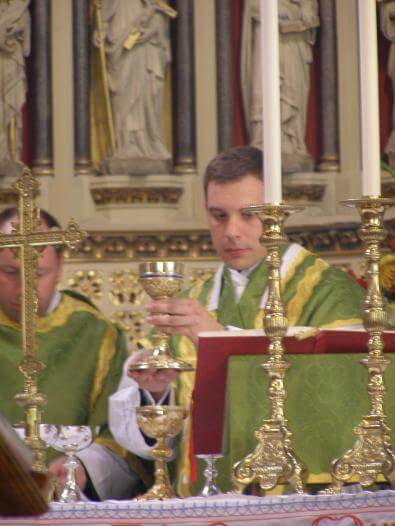
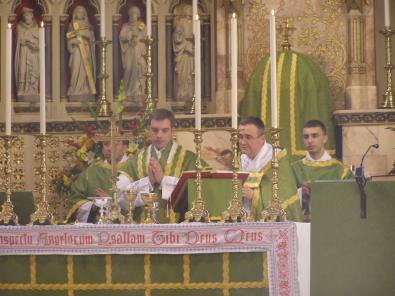
Ordination and First Mass of Father Nicholas

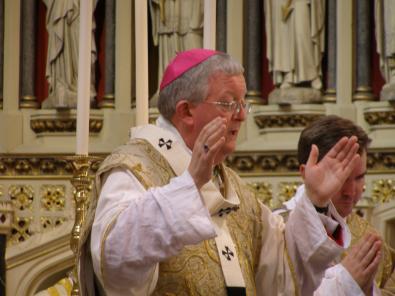
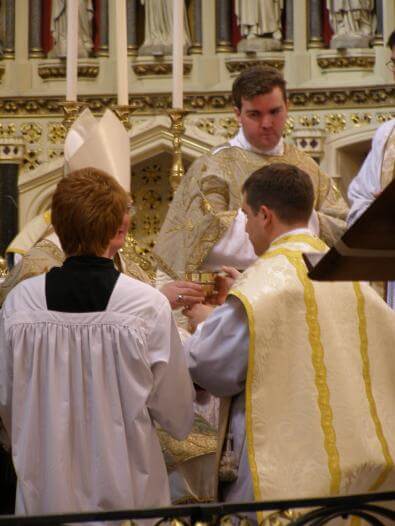
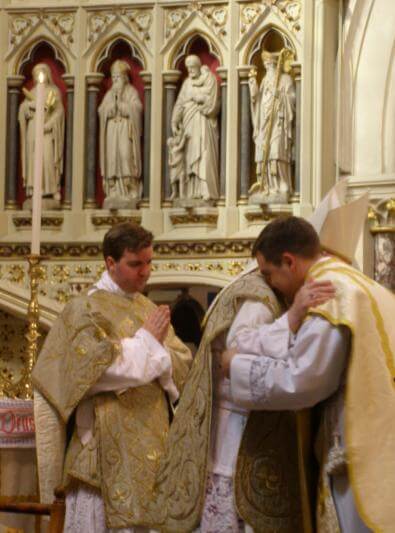
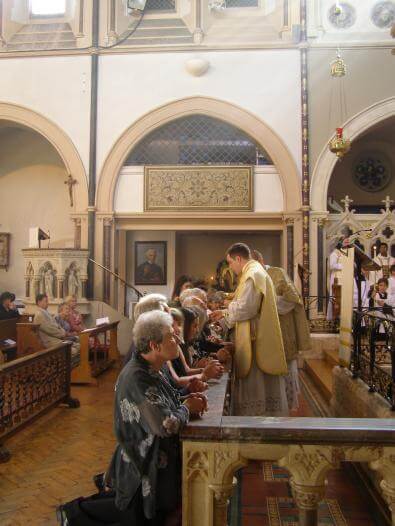
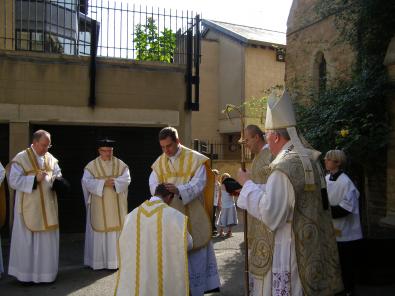
Father Nicholas Edmonds-Smith was ordained priest by His Grace the Archbishop on Saturday 1st October, the feast of St Thérèse of Lisieux.

Beautiful sunny weather before entering the church:

1317653730.jpg

The Archbishop addresses the candidate:

1317653565.jpg

Br Nicholas stands before the Archbishop:

1317653366.jpg

His Grace sings the prayer of Ordination:

1317653242.jpg

The handing over of the chalice and paten:

1317653068.jpg

The Kiss of Peace:

1317652896.jpg

Holy Communion:

1317652793.jpg

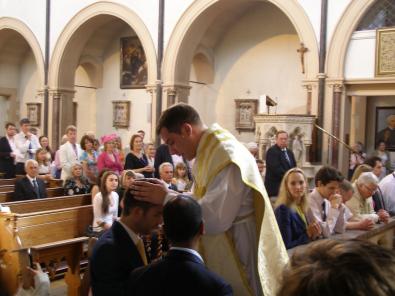
First Blessings:

1317652616.jpg

1317652441.jpg

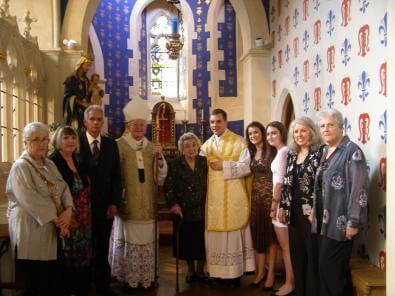
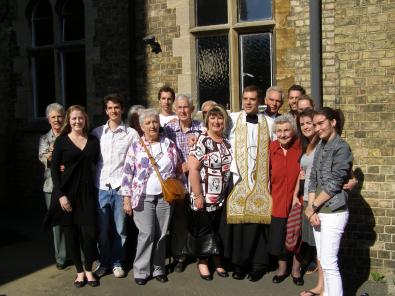
His Grace the Archbishop with Fr Nicholas and his family, who came over from Cape Town for the occasion:

1317652272.jpg

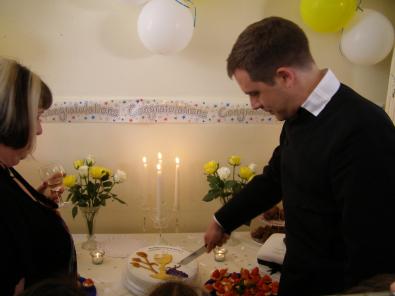
Fr Nicholas with his mother, cutting the cake in the Parish Centre:

1317652032.jpg

The offertory at Fr Nicholas’s First Mass on Sunday 2nd October:

1317651765.jpg

1317651647.jpg

The Eucharistic Prayer:

1317651565.jpg

Here Fr Nicholas with his family after the first Mass:

1317651446.jpg

1317653757.jpg

Photography by Tessa Caldecott

The Priesthood

The fifth in the series of sermons on the Mass. Preached by Fr Daniel Seward on 2nd October 2011, at the first Mass of Fr Nicholas Edmonds-Smith.

What we are to witness today in this first Mass is the revelation of the purpose of the whole of creation. When we ask why it was that our Lord chose bread and wine as the forms which would become His Body and Blood, we might think that it is simply because these were the staple foods of His time. This is true, but it looks at the question from the wrong end of the telescope. It is more true to say that grapes and wheat were created by God from the beginning so that they might be changed by us into wine and bread, and so that they might then be offered in the Eucharistic sacrifice of the Mass.

In the same way then, Father Nicholas, in responding to God’s call to the priesthood, is fulfilling the whole purpose of his own creation. Why were any of us created? So that we might participate in the Holy Mass. Why are we physical as well as spiritual beings? So that the Lord might become our food. Man was created for worship. The magnificence of the Universe, the beauty of the natural world, the rich possibilities of the human spirit; all of these point towards the Mass, which the Second Vatican Council described as the “source and summit of the Christian life” and we can say that it is also the source and summit of all life.

Tertullian said that all creation gives worship to God – in the animal kingdom by instinct. So he says that the birds pray by flying through the sky in the form of a cross. The psalmist says,

“The young lions roar for their prey and ask their food from God.”

But only human beings in the physical creation are able consciously to give praise and thanks to God. One could say that we are able to do so on behalf of all creation, so that man is not only the steward, but also the priest of creation. What we offer or sacrifice to God comes from His own goodness, and it is just and right that we should praise Him by offering Him of His own. The scriptures show the unfolding of this human duty of sacrifice from the time of Cain and Abel onwards, when Abel’s offering was acceptable to the Lord.

Israel was chosen by God out of all the peoples of the world not for its own sake only, but rather as a priestly nation for the sake of all others. A higher standard was expected of the chosen people precisely because they had had the Lord revealed to them. “For what great nation is there that has a god so near to it as the Lord our God is to us, whenever we call upon Him?” (Deut. 4:7) Still, the prophets foretold a time when all the nations would stream to worship the Lord upon His holy mountain.

One of these prophecies – that of Malachi – is referred to in the third Eucharistic Prayer of the Mass, and its significance is brought out much more clearly in the new English translation:

“You never cease to gather a people to yourself, so that from the rising of the sun to its setting a pure sacrifice may be offered to your name.”

That is our purpose as Christians: to offer that pure sacrifice. Padre Pio once said that the earth could no more exist without the Mass than it could without the sun. Who knows how many disasters are averted, how many invisible graces are won, how many souls are saved unaware by each and every Mass that is celebrated? Someone once calculated that the consecration of the Eucharistic species takes place every eight seconds somewhere in the world. Each time we offer the Mass, we make present on earth the one, eternal sacrifice of Calvary. Without the Mass, the Cross would simply remain an event of history. By our offering of the Mass, as the new Israel, the priestly people of God, Christ is made present, and His life, death and resurrection can be applied for the salvation of humanity.

It is important that each of us is conscious of our vocation as members of the Church in our participation in the Mass – and from among God’s people, priests are chosen to be the instruments by which Christ is brought to earth. We can see the exalted purpose the priest has: higher than any archangel, greater than that of Moses, Elijah or King David: his words take bread and wine out of existence and replace them with the Creator of the Universe; at his command sin is forgiven; by his ministry souls are ushered into eternal life. All this should lead us to have a high regard for the sacrament of Holy Orders. St Francis de Sales (of the Oratory) used sometimes to have a vision of his Guardian Angel, but we are told that after his ordination, the angel would never go through a door before him!

But we should not confuse the office with the person. Of all the causes of recent scandals and problems in the Church, one of the greatest is the vice of clericalism. Our reverence for the priesthood should not lead us to think that Father is (necessarily!) always right or that he is subject to different rules from others. The priest is an instrument, a channel through which God’s grace flows. It is not his personal goodness that makes the sacraments work, but only the objective fact of his ordination. This is why the liturgy is governed by the rubrics, so as to remind us that the priest is not a master but a servant. We should not come away from Mass conscious of the personality of the priest who celebrates, rather, it is the person of Christ in whose person the priest acts that is the only important factor. This is why, as Pope Benedict says, there is no room whatever for creativity in the liturgy. Every word, every gesture, should come from the Roman Missal. The Holy Father writes:

“What the priest does at that moment, in the eucharistic celebration, is to serve, to fulfil a service to God and a service to humanity. The cult [that is, worship] that Christ rendered to the Father was the giving of himself to the end for humanity. Into this cult, this service, the priest must insert himself.”

If we were to think of the priesthood as a job that needed certain abilities, then we would make a mistake. If it were simply a question of being able to communicate, dealing with people, administering a parish and so on, then we would say that anybody who had these qualities could be a priest. But actually the Lord does not choose us because of our merits any more than He selected those twelve illiterate men from Galilee because they were the best qualified. Rather, He calls us so that He might work through us, and so that His life, death and resurrection might become apparent in us. This is why priests are celibate, since their lives must be given wholly to Christ, and why they are of necessity male, since they act in persona Christi, as icons of the humanity of the Son of God.

But remember that this is nothing to do with power and privilege, but of service – or at least that is how it should be. Today we pray for Father Nicholas as he celebrates his first Mass, that he may be conformed entirely to the mystery of the Eucharist. St Thérèse of Lisieux, on whose feast day Fr Nicholas was ordained yesterday, saw her vocation as a Carmelite as to pray for priests: “Alas! how many bad priests there are, priests who are not holy enough…Let us pray, let us suffer for them.”

We know that a bad priest can do incalculable harm – St John Bosco said that the walls of Hell are lined with birettas – but only because a priest has the capacity to do infinite good: truly infinite because it is the power of Christ Himself that acts through him. No wonder that St Thomas Aquinas says that a priest needs two Guardian Angels.

So we must thank the Lord that the call has been heard, and pray for those who may shut off the doors of their hearts to His knocking and so go away sad like the rich young man of the Gospel. Let us also ask that those who have already united themselves to the Lord at the altar may imitate Him in their lives, so that graces may be multiplied and all may come to love that God who acts through the anointed hands of His creature.

New novice clothed

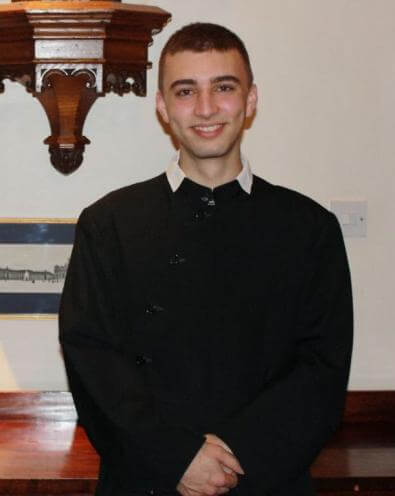
Please pray for Brother Oliver Craddock, who was clothed in the habit of St Philip this evening.

1317329628.jpg

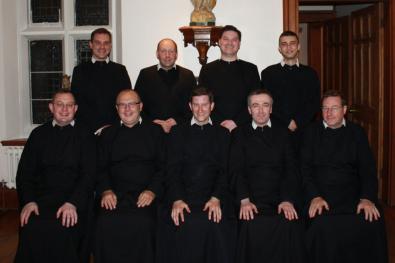
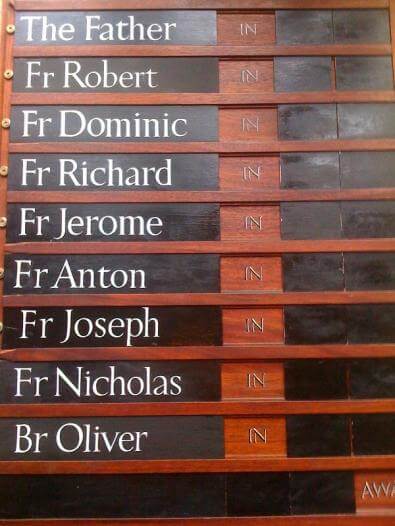
There are now nine members of the Oratorian community here, which means that the house is now completely full, with some members condemned to living in the basement. All the more important then that we should press ahead with the building of our accommodation. We are currently in the process of putting the project out to tender. Anyone who can help to fund this vital work – please get in contact!

1317328719.jpg

1317327833.jpg