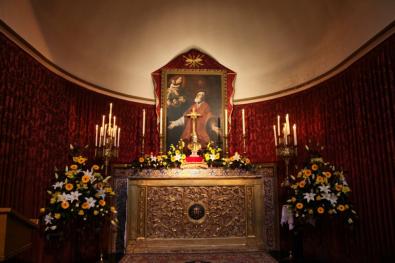
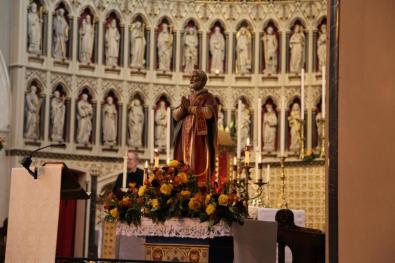
Solemnity of our Holy Father Saint Philip

1338193062.jpg

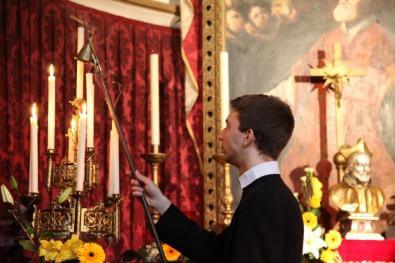
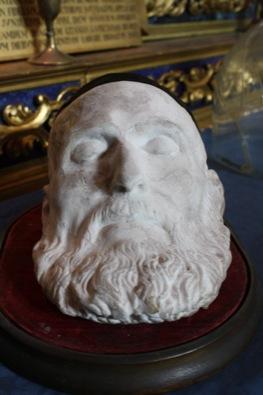
Monsignor Marcus Stock, General Secretary of the Bishops’ Conference of England and Wales, came to preach at the Solemn Mass on St Philip’s Day. Below is his homily, in which he describes how in the summer of 1990, a few days before the arrival of the first Fathers of the Oratory, he discovered two long forgotten treasures: a cast of St Philip’s death mask and St Philip’s own copy of Blessed Jacopone da Todi’s Laude.

I feel a keen affinity with the Oxford Oratory, for in the summer of 1990, for a couple weeks, I had the privilege of living here to celebrate Mass and provide pastoral care to the parish until the first Oratorian Fathers for the new community arrived. A day or two before I left, I was wandering around the church and found myself in the chapel on the right as you enter at the far end of the church which contained the font and reliquary cupboards. The shelves of the upper cupboards were clearly empty and most of the lower cupboards. But one of the lower ones was locked. I must confess that my curiosity got the better of me and, with a little knowledge gained from a youth ill-spent, I picked the lock and opened the cupboard.

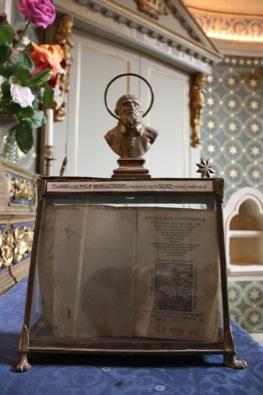
Inside the cupboard there were two main objects both within glass containers. One object had a glass dome covered in dust which obscured the object within. The other was a rectangular glass-sided reliquary which contained, what looked like, a very old book.

I cleaned off the dust from the first object with the glass dome – and what greeted my eyes both startled and amazed me. For looking out at me was the unmistakable face of St Philip Neri. It was a copy of his death mask. I recognized it straight away from the ones that are on his effigy, containing his relics, in the chapels dedicated to him in both the Chiesa Nuova in Rome and the Birmingham Oratory.
1338195340.jpg

The second object I will come back to later!

Four hundred and sixty-eight years ago, on the eve of Pentecost in 1544, at the age of 29, Philip Neri a devout young layman who had moved from his home in Florence to work first for a relative near Monte Cassino and then as tutor in Rome, was praying in the Catacombs of Saint Sebastian, on the Via Appia.

I am sure that many of you will already know, from your knowledge of the life of St Philip, of the remarkable event that took place on that occasion. During his prayer, St Philip had a vision of a globe of fire which entered his mouth, and descended into his heart. This spiritual ecstasy was accompanied by the physical expansion of his heart and he experienced a feeling of overwhelming joy.

By providence, today, as well as celebrating the Feast Day of St Philip, we are also on the eve day of Pentecost.

It was in the silence and stillness of prayer that the Heart of God spoke to the heart of St Philip. Cor ad cor loquitor, ‘heart speaks to heart’, an experience that another, future, great and holy man of the Church, Blessed John Henry Newman, was to discover too as the source of his joy. It is to St Philip’s experience of spiritual joy, as the fruit of Pentecost, to which I would like us to turn our thoughts and devotion this morning.

In the first reading of our Mass today, St Paul sets before the Philippians one of the great, but perhaps too infrequently expressed, gifts of the Holy Spirit and qualities of the Christian life:

“Rejoice in the Lord always; again I will say, Rejoice. Let all men know your forbearance. The Lord is at hand. Have no anxiety about anything, but in everything by prayer and supplication with thanksgiving let your requests be made known to God. And the peace of God, which passes all understanding, will keep your hearts and your minds in Christ Jesus.”

When St Paul wrote these words he was in prison in Rome and would have been aware that he was almost certainly facing the possibility of execution. Similarly, he knew that those Christians in Philippi faced all kinds of dangers and persecutions as they set out on their journey of faith. But Paul still proclaims, with words that flow out of his own heart – Rejoice!

St Paul was teaching the Philippians, and us, that Christian joy is not dependent upon the immediate and ever changing circumstances of our lives but on the continual presence of Christ dwelling in our souls and living in our hearts. It is a joy which springs from the indwelling of Christ in the soul through the gift of the Holy Spirit. It is a joy which is nurtured in a state of mind and in an orientation of the heart.

St Paul goes on to explain how this nurturing of mind and heart is achieved:

“Finally, brethren, whatever is true, whatever is honourable, whatever is just, whatever is pure, whatever is lovely, whatever is gracious, if there is any excellence, if there is anything worthy of praise, think about these things. What you have learned and received and heard and seen in me, do; and the God of peace will be with you.”

Here, St Paul is recommending more than just positive thinking. When he talks about what they have ‘received’, the precise term he uses means to accept a ‘fixed tradition’. This then is about living-out the apostolic faith which St Paul has handed on to us. By doing this, the gift of God’s love will live within us.

It is the apostolic faith which unites us to the teaching of Christ himself and through Christ unites to each other and to the knowledge and love of the Father. In the Gospel we heard Christ pray:

“Father, may they be one in us, as you are in me and I am in you… I have made your name known to them and will continue to make it known, so that the love with which you loved me may be in them, and so that I may be in them.”

St Philip Neri lived out that apostolic faith and passed it on in an exemplary way. Indeed, it is the example that each Saint gives to the Church, a confirmation that the apostolic faith we have received can be a source of deep spiritual peace and joy.

As a result of St Philip Neri’s life of service, meeting the spiritual and charitable needs of many people within the Eternal City, we recall that like St Paul he too came to be called an Apostle – the ‘Apostle of Rome’. The name Apostle is apt when we also remember that what distinguished the first Apostles was that the fire of Pentecost was for them a personal experience. St Philip too received a personal experience of the Holy Spirit in the globe of fire which entered his heart and bestowed on him the gift of spiritual joy, the fruit of Pentecost.

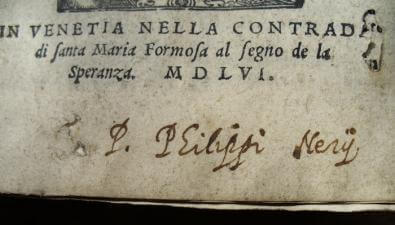
When St Philip went to Rome he took with him some books which he had kept with him from his young days in Florence. One of these books was the Laudi, or spiritual canticles, of Blessed Jacopone de Todi.

The second object I found in that reliquary cupboard? Well it was that very book.
1338195360.jpg

Living in the last half of the 13th Century, Jacopone, nicknamed ‘Crazy Jim’ in his day, was a Franciscan poet and song writer, who was known to break into song whenever he felt in distress or in trouble. Noted as St Philip was for his strange behaviour on occasions, we can well see how the spiritual canticles of Blessed Jacopone da Todi may have had a significant influence on him and why the singing of laude formed an essential part of those meetings in the Oratory built above the Church of San Girolamo della Carità, the beginning of the Congregation of the Oratory.
1338195314.jpg

After finding that ancient book of Jacopone da Todi and the death mask of St Philip in the reliquary cupboards, I placed them on the altar of the church and sang that great hymn of praise to God, the Te Deum.

Knowing as I did that within a few days, the first of the Oratorian Fathers would be arriving, I wished to give thanks to Almighty God, knowing that it was His providence that would bring them here to this church and that St Philip would be here waiting to greet them.

Mindful though of the Vigil of Pentecost on this day’s eve, it is with one of ‘Crazy Jim’s’ spiritual canticles that I wish to bring our thoughts and devotion to a point of convergence as we prepare to receive Christ’s presence among and within us through the Sacrifice of the Mass. The canticle expresses well the ecstasy of spiritual joy in God’s presence, the same joy which St Paul and St Philip Neri manifested in their saintly lives and in the care of those to whom they were called to serve:

“O Love, divine Love, why do You lay siege to me?
In a frenzy of love for me, You find no rest.
From five sides You move against me,
Hearing, sight, taste, touch, and scent.
To come out is to be caught; I cannot hide from You.
If I come out through sight I see Love
Painted in every form and colour,
Inviting me to come to You, to dwell in You.
If I leave through the door of hearing,
What I hear points only to You, Lord;
I cannot escape Love through this gage.
If I come out through taste, every flavour proclaims:
“Love, divine Love, hungering Love!
You have caught me on Your hook, for you want to reign in me.”
If I leave through the door of scent
I sense You in all creation; You have caught me
And wounded me through that fragrance.
If I come out through the sense of touch
I find Your lineaments in every creature;
To try to flee from You is madness.
Love, I flee from You, afraid to give You my heart:
I see that You make me one with You,
I cease to be me and can no longer find myself.
If I see evil in a man or defect or temptation,
You fuse me with him, and make me suffer;
O Love without limits, who is it You love?
It is You, O Crucified Christ,
Who take possession of me,
Drawing me out of the sea to the shore;
There I suffer to see Your wounded heart.
Why did You endure the pain?
So that I might be healed.”

St Philip Neri….. Pray for us
1338192989.jpg

1338193076.jpg

A new performance of the Dream of Gerontius

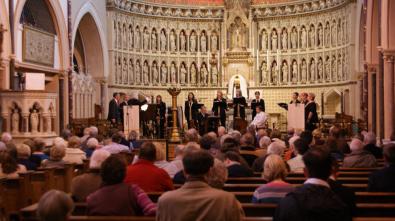
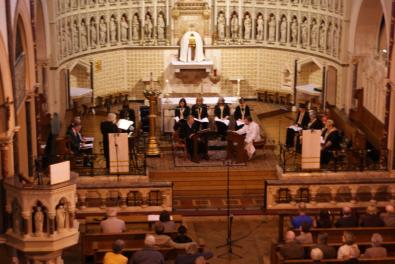
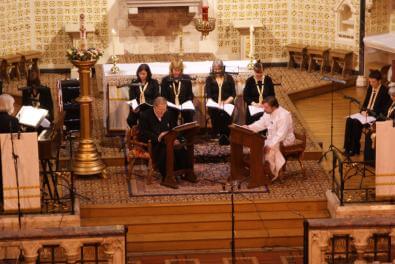
On Saturday 12th May there was a performance of Julien Chilcott-Monk’s setting of Blessed John Henry Newman’s “Dream of Gerontius”. “Vox Angelica” performed the choral parts, accompanied by an exotic assortment of percussion. Robert Hardy read the part of the Soul, with Neil Nesbit playing the Guardian Angel. Newman’s poem tells the story of Gerontius, who is in his last agony and is then conveyed by his angel to judgement, before willingly being taken away to be purified in Purgatory.

One of the nineteenth century’s greatest religious works, a copy was found on the person of General Gordon at his death. The work emphasizes the justice and majesty of God, but still more His mercy in cleansing us of sin in Purgatory. Julien Chilcott-Monk’s music contains many references to Gregorian chant and brought out the passing of time, which leads us to judgement.

The performance raised over £1,000 for our “Reaffirmation and Renewal” Campaign. 1337536591.jpg

1337536566.jpg

1337536537.jpg

Solemn Mass for the English Martyrs

Friday 4th May was the feast of the English Martyrs – those 284 beatified or canonised men and women who gave their lives for the unity of the Church and for the Holy Sacrifice of the Mass during the years of persecution in England.

Here are some pictures of the Solemn Mass celebrated in honour of their feast:

1336658602.jpg

1336658676.jpg

1336658785.jpg

Photos courtesy of the Latin Mass Society

Canonical Visitation

1336050596.jpg

The Very Reverend Father Felix Selden of the Vienna Oratory, Apostolic Delegate of the Holy See to the Confederation of the Oratory, conducted a canonical Visitation of our house on 1st and 2nd May 2012.

Every Congregation is usually visited once in the six year term of the Apostolic Visitor. Now that he has been to Oxford, Fr Visitor has been to all but four of the eighty-two houses of the Oratory in the world, since his election in 2006.

Father Felix has long been a friend of our community, and we were delighted to welcome him, together with Fr George Bowen of the London Oratory, who acted as Secretary to the Visitation.

1336050605.jpg

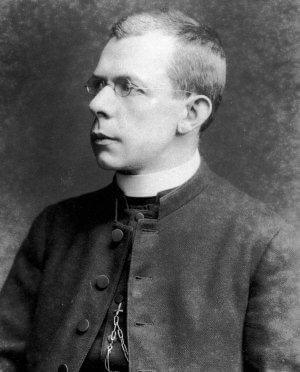
Priest received at St Aloysius’ died on the Titanic

1334436306.jpg

Today marks the centenary of the tragic sinking of the Titanic. Among the many who lost their lives was Fr Thomas Byles, parish priest of St Helen, Chipping Ongar, Essex. The son of a Congregationalist minister in Yorkshire, Thomas Byles was received into the Church here at St Aloysius’, while he was an undergraduate at Balliol College. He was baptised “sub conditione” on 23rd May 1894 by Fr Joseph Martin SJ. Francis “Sligger” Urqhuart was his sponsor. After his priestly studies at Oscott, Ware and the Beda College, he was ordained in Rome in 1902. Initially he served at Gunnersbury, where he was one of the 5 founding members of the Catholic Missionary Society, being sent as Missioner to Ongar in 1905.

He was making the crossing to New York to celebrate the wedding of his brother William and his fiancée from Brooklyn.

A number of witnesses attest to his serenity and calmness amid the chaos- hearing confessions, giving blessings and doing what he could to comfort the terrified women and children into the lifeboats and it is said twice refused a place in the lifeboat. He was last seen gathering a group of men around him and leading them in the Rosary.

More information may be found at fatherbyles.com.

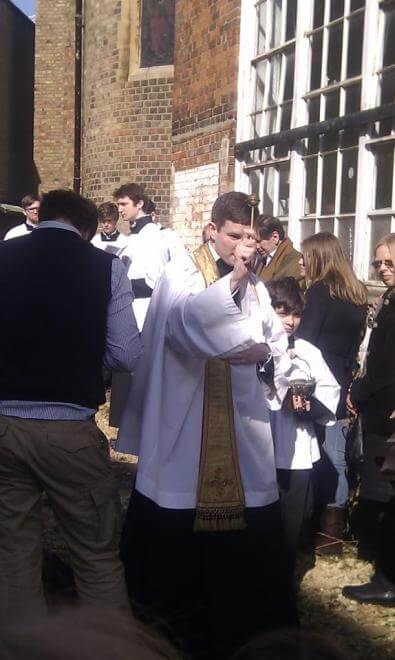
The blessing of the Building Site

1331500737.jpg

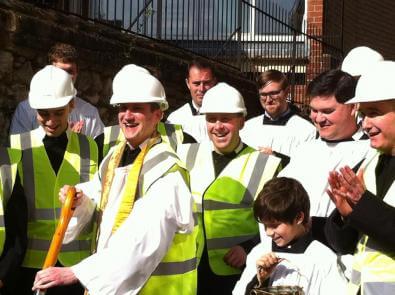
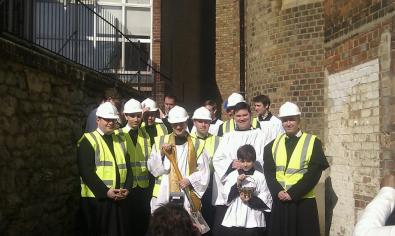
After the High Mass today, the building site was blessed and the first footings of the new accommodation building dug. 1331501347.jpg The site manager from Stepnell, Dave Taylor, was on hand to supervise the digging. 1331501003.jpg
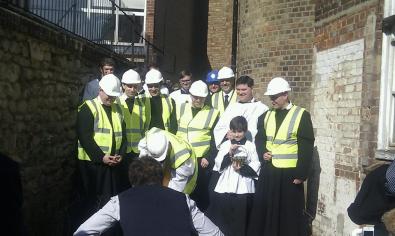
As you can see, the Fathers are taking Health and Safety very seriously! 1331501892.jpgWe pray that all will proceed without incident, and that by August we will raise the necessary funds to bring this project to its completion.
Stepnell Ltd begin work on Monday 12th March. This work will add five new rooms for the Oratorian community, a new parish office, bar and kitchen, and the new library and G K Chesterton archive.

Blessing

Here is the last of the series of sermons on the Mass – preached by Fr Joseph Welch on Sunday 20th November, the feast of Christ the King.

“Thy kingdom come; Thy will be done on earth as it is in heaven.”

And so we come to the last in our series of twelve sermons on the Mass, and indeed to the last part of the Mass: the blessing and the dismissal.

The Mass, of course, begins with the Sign of the Cross, a gesture we make so often that we become, perhaps, somewhat blasé about it, making the sign hurriedly without thought or devotion, forgetting that the Sign of the Cross is not merely a perfunctory gesture to introduce and conclude other prayers; it is a prayer in itself and a very profound one at that.

Firstly, when we make the Sign of the Cross, we are acknowledging that we believe that there is but One God, yet three Persons in this One God; three Persons who share the same divine nature, and between whom there is no essential difference, only the distinction of their relationship one to another. It was in the name of this One God, these three Persons, that we were baptized. By being baptized we came to share the very life of that One God; and that share of God’s life, given to us in the form of sanctifying grace, is the fundamental principle, the very basis and the moving force, of our entire life as Christians. God’s grace was infused into our souls, and at the same time we entered into His life.

Secondly, when we make the Sign of the Cross, we are acknowledging the Cross on which the second Person of that Trinity died. Our Lord offered Himself to the Father, on our behalf, and within the bond of the love of the Holy Spirit. The Cross is the deepest and most admirable expression of what Our Lord Jesus Christ, true God and true Man, has done for us. It is the very means by which our sins are forgiven, by which we are redeemed from the consequences of those sins, and by which we are saved from the grasp of the devil whose disorder and deceit is conquered, and whose power, in the shape of death, is overcome. With the Cross a new order was established, the Kingdom of God, and with it the universal kingship of Christ, a kingdom for the coming of which we pray every time we say the Our Father. Because God created the world in which we live, He and He alone has the right to hold sway over the nations; His laws, and His alone, may rightfully govern the societies in which we live. Any law passed by man that contradicts the Law of the Creator is offensive to God and serves to interrupt the coming of God’s Kingdom here on earth.

Thirdly, each time we trace the Sign of the Cross on ourselves, we place ourselves very firmly under the Cross by which divine order was restored; we acknowledge God’s right to govern our lives; and we submit with a humble and generous heart to His will, asking Him to order our lives for the sake of the salvation of our souls as well as for the building up of His kingdom of peace here on earth. And when we make the Sign of the Cross together within our families at home, or when we have our homes blessed, we are placing our families under the protection of that same Cross, and asking Our Lord to guide our every thought, word, and deed.

But the Sign of the Cross within the Church’s liturgy does more than this. The two Signs of the Cross, at the beginning and at the end of the Mass, encompass within their embrace the whole sacrificial action which they signify. Lifting our minds and hearts to God at the start of the Mass, the Sign of the Cross serves to help us meditate on the beloved Trinity from whom all life comes; and the blessing at the end of Mass summarizes the fullness of Our Lord’s sacrifice of love, the shedding of His blood in expiation and propitiation for our sins. During the Mass, God pours grace upon grace into the hearts of those present and of those for whom the Mass is being offered. With the final blessing, those graces are sealed within our hearts, as it were, by the Sign of the Cross, the Cross from which those graces flow, and we are blessed “in Christ with every spiritual blessing in the heavenly places” (Eph 1:3).

The word blessing comes from the Latin word benedicere, to speak well or to speak good things. When we speak good things to someone we might be simply wishing them well; but because “the Word of God is living and active” (Heb 4:12) then any word spoken by God actually brings about what that word signifies. So when we receive God’s blessing from the hands of a priest, all the goodness of the heavenly places are truly heaped upon us, and we are made sharers in the spiritual blessings of the Mass, sharers in the blessings of Christ’s great act of redeeming love.

Then comes the dismissal: in Latin, Ite, missa est. “Go, this is the dismissal.” In English, to be dismissed sounds rather as though we are being disposed of somewhat summarily. But, of course, the word comes from the Latin, mitto, “I send”. Having received grace upon grace, and having had blessings heaped upon us, Our Lord sends us forth, just as He did His first disciples, to bear those graces and blessings out into the whole world in order to help with His divine mission of converting the world, of bringing sinners to repentance, and of establishing His universal kingship here on earth and in the hearts of every man, woman, and child, so that both heaven and earth may be governed by His law of love, so that the will of God may be done on earth as it is in heaven.

Holy Communion

Here is the penultimate sermon in the series on the Mass, preached by Fr Jerome Bertram on Sunday 13th November:

“Do this in Remembrance of Me”.

It is in Holy Communion that we are made one with Our Lord, and through Him, we are one with everyone else who is united to Him; thus we are united to those who have died, and brought into communion with those we lament. That it why we celebrate Mass and receive Communion for the dead.

Immediately before we receive Holy Communion we reap the most obvious benefit of the new translation: the brief exchange turns out to consist of direct quotations from Scripture: “Behold, the Lamb of God, behold Him who takes away the sins of the World”, words in which St John the Baptist first pointed out Our Lord (John 1:29). We have been calling on the Lamb of God to have mercy on us, and grant us peace, and now He is here, we can see Him! Then we hear, “Blessed are those called to the supper of the Lamb”, from near the end of St John’s Apocalypse (19:9), for our Holy Communion is a “Pledge of future Glory” (St Thomas Aquinas, antiphon for Vespers of Corpus Christi). And we reply in the words of the Centurion in the Gospel, “Lord, I am not worthy that you should enter under my roof, but only say the word and my servant shall be healed.” (Matth. 8:8) Yes, there is one word different: we pray for my soul to be healed. Holy Communion is a remedy for the soul, the heart, the mind – it is not primarily a remedy for the body, we have another Sacrament for that. We come to Holy Communion to be cleansed from sin, to be strengthened in virtue, to be united with each other into the One Body of Christ which is His Church.

But how should we receive Communion? Here we enter delicate ground, for there is nothing so divisive as the Sacrament which unites us. We must tread carefully, saying nothing more than the truth, and invoking charity and understanding as we try to avoid the peril on either side. The peril, that is, of breaching Charity.

When we approach the Altar rails, we come in procession up the centre of the church, to express our respect for the Altar and the Sacrifice, and we return by the side-aisles, so that those approaching and those returning do not obstruct each other. As we all know, there are two modes of receiving Holy Communion in the Western Church. Recently the Holy See renewed permission for Catholics in England to receive Communion in their hands, and standing, while reminding us that everyone is free to kneel along the altar-rail, and to receive on the tongue. As the Instruction prefaced to the new Altar Missal says, “individual members of the faithful may choose to receive communion while kneeling. However, when they communicate standing, it is recommended that the faithful bow in reverence before receiving the Sacrament.” (General Instruction of the Roman Missal (GIRM), §160, English /Scots version, CTS Altar Missal 2011, p. 69. In Australia the faithful must bow.) The Instruction continues to state that the Faithful communicate “either on the tongue, or, where this is allowed, in the hand, the choice lying with the communicant.” (GIRM, §161)

For nearly the whole history of the Latin Church, receiving on the tongue, and kneeling, has been the only authorised posture, with obvious exceptions such as those ill in bed. (Standing Communion has long been the tradition of the Greek Church, although the laity never receive in the hand, but open their mouths wide for the deacon to pour in the leavened Host soaked in the Precious Blood.) There is one single reference in the writings of the Church Fathers to the manner of receiving Communion in the hand, and it is worth quoting in full:

“Approaching therefore, come not with thy wrists extended, or thy fingers open; but make thy left hand as if a throne for thy right, which is on the eve of receiving the King. And having hollowed thy palm, receive the Body of CHRIST, saying after it, Amen. Then after thou hast with carefulness hallowed thine eyes by the touch of the Holy Body, partake thereof; giving heed lest thou lose any of it; for what thou losest, is a loss to thee, as if it were from one of thy own members. For tell me, if anyone gave thee gold dust, wouldest thou not with all precaution keep it fast, being on thy guard against losing any of it, and suffering loss? How much more cautiously then wilt thou observe that not a crumb falls from thee, of what is more precious than gold and precious stones?”

Thus far St Cyril of Jerusalem, writing in 347or 348 AD. (Catechetical Lectures, lect. xxiii, 21, from A Library of Fathers of the Holy Catholic Church[translated by J.H. Newman], Oxford 1838, p. 279.) It is obvious that St Cyril believed and taught that what we receive truly is the Body of the Lord, and must be welcomed with enormous respect: we can hardly do less, though his curious instruction on touching the Host to our eyes should, I think, be quietly forgotten. We receive the Host in both hands, we do not “take” it. In many cultures it is important always to use both hands when accepting a gift – and we should not forget that it is often considered offensive to receive something in the left hand. When visiting other countries we should be aware of that!

The Instruction concludes, “As soon as the communicant receives the Host, he or she consumes the whole of it.” (GIRM, §161) We do not wander away clutching the Body of Christ, but receive Him eagerly into ourselves, under the roof of our mouth.

Many prefer the ancient tradition of receiving the Host directly into the mouth, as Blessed Mother Teresa of Calcutta did: “Her adoring attitude, gestures such as genuflections – even on both knees in the presence of the Blessed Sacrament exposed, and that well into old age – her postures such as kneeling and joining hands, her preference for receiving Holy Communion on the tongue all bespoke her faith in the Eucharist.” (Mother Teresa, Come be my Light, New York 2007, p. 213) We should open our mouth, and bring the tongue forward onto the lower lip (not sticking right out!) and allow the Priest or Deacon to place the Host gently on the tongue. The earliest unmistakeable allusion to receiving Communion on the tongue is in the Passion of Saints Perpetua and Felicity, an African document dated 203 AD, a good bit earlier than St Cyril, showing that practice varied in different regions. (Passio Sanctarum Martyrum Perpetuae et Felicitatis, §4, in A. Gallandus, Cong. Orat., Bibliotheca Veterum Patrum, Venice 1766, Vol. II, p. 175.) It has certainly been the universal custom in the Latin Church for well over a thousand years, possibly longer, and is still, of course, the norm at the Old Mass (the “Extraordinary Form”). When the Bishops after Vatican II considered changing the custom, they voted overwhelmingly against it (597 in favour of Communion in the hand, 1,233 against it). The Pope afterwards decided to permit it – this is called “collegiality”. (Austin Flannery, Vatican Council II, the Conciliar and Post Conciliar Documents, Leominster 1981, p. 151) In some countries it is not permitted: common courtesy demands that we should observe the local practice and not try to impose our own preference. But in the same way common courtesy demands that we should not be aggressive in demanding the right to kneel and receive on the tongue in a church where everyone else is standing and receiving on the hand: it is never a good thing to be “singular” or to draw attention to ourselves!

The other choice we have to make is whether to receive Communion also from the Chalice. This again is something new in the Western Church: from the very beginning we know that Christians often received in one Kind only (Luke 24:30, Acts. 2:46, 20:7). From the beginning they knew that Our Lord is received whole and entire, Body and Blood, Soul and Divinity, whether we receive only the Host, or (in case of sickness) only the Precious Blood. It is only the sign that is more complete when we receive in both Kinds, and only for that reason that it is recommended in the new Instruction. (“Holy Communion has a fuller form as a sign when it takes place under both kinds.” GIRM §281, p. 91.) You should approach in procession, make the gesture of reverence required, and take the Chalice firmly in both hands to drink a little before handing it back to the Deacon or Priest.

For those who find difficulty in swallowing gluten, it is perfectly correct to receive from the Chalice only (although we do have low-gluten Hosts if you ask us before Mass) – you receive the entire Lord, Body and Blood, Soul and Divinity from the Chalice as from the Host. Conversely, if you have a cold or any other infectious condition, or if you have reason to believe your immune system is weakened, it is prudent and charitable not to approach the Chalice until you are cured.

Our belief that both bread and wine are truly changed into the Body and Blood of Christ, entire and undivided, is termed the Doctrine of Concomitance: if we truly believe in the Blessed Sacrament, then we know that to receive in either kind is sufficient. In fact the Instruction in the new edition of the Missal urges us priests to “take care to ensure that the faithful who participate in the rite or are present at it, are made aware of the Catholic teaching on the form of Holy Communion … that Christ, whole and entire, and the true Sacrament, is received even under only one kind … that the Church … has the power to lay down or alter whatever provisions, apart from the substance of the Sacraments, that she judges to be more readily conducive to reverence for the Sacraments and the good of the recipients, in view of changing conditions, times, and places.” (GIRM 282, p. 91) The Church has the power and the duty to make sure that there is no misunderstanding, or lack of respect for Our Lord in the Sacrament. Practices have changed, and may change again, but we may not consider our own present practice to be better, more correct, or more spiritual than the practices followed in the time of St Francis or St Thérèse of Lisieux. Charity, as always, is the supreme law.