150 Years of Grace

On 23 November 1875, Bishop Ullathorne, Bishop of Birmingham celebrated a Solemn Pontifical Mass to bless and open the Church of St Aloysius, Oxford, in the presence of Cardinal Manning and a packed congregation. This Saturday, Archbishop Longley will celebrate a Solemn Pontifical Mass to mark 150 years since that occasion, in the presence of Cardinal Radcliffe and, we hope, a packed congregation.

Anniversaries are always “Janus-like” events, when we look back with gratitude at the past and look forward to hope and trust to the future. And there is much for which to be grateful. The building of our church on the Woodstock Road marked a coming-of-age for the Catholic community in Oxford, after centuries of difficulty. In penal times the Mass and sacraments had to be celebrated in secret, by faithful priests — many of them martyrs — and courageous laypeople at great risk to their lives. With the lessening of restrictions, Catholic worship was conducted with discretion and in small chapels, lest the always-volatile public mood take against them again. When the legal position of Catholics finally permitted the building of the first large church in Oxford since the Reformation, this had to be set back from the road, behind houses and shopfronts, in case it offended Protestant sensibilities. But with the opening of St Aloysius, Catholics could once more celebrate their faith in public, and have a beautiful building in which to pray, to celebrate the sacraments and to visit their Lord in the Blessed Sacrament.

Our church was built and adorned to be a fitting House of God in the city. Holy Mass has been celebrated in private houses and in pubs, outdoors in stadiums or parks, even on beaches. But churches, set aside for God and the things of God, remind us that he is “other”. He is so much greater than anything we can imagine or experience. He is all holy — not only present in us and to us at every moment, but also infinitely above and beyond us. And so we come before him in special sacred spaces, buildings that are themselves holy places, set aside for prayer. Here we come into his presence not to relax or exercise or work or shop or chat, but to worship him. “Truly this is the House of God, this is the gate of heaven” (Gen. 28:17).

But, as St Bernard reminds us, a church is also the house of the people of God, the family home of his children. Our church of St Aloysius has witnessed so many “family” moments — from the commemoration of events of national and ecclesiastical importance and the Requiems of the great and the good, to the funerals of young soldiers who died in the various hospitals around Oxford during the two World Wars, to the baptisms, confirmations, weddings, and funerals of our parishioners. The number of Masses celebrated in our church since it opened number in the hundreds of thousands, baptisms and weddings in the tens of thousands, and we estimate that two million confessions must have been heard here over the years. So many moments of joy. So many heartfelt prayers. So many tearful requests to Our Lady or her Son during the illness of a loved one or before a stressful exam. So much to be thankful for to God.

Our gratitude for our own church should also make us remember all those Christians who still have to celebrate Mass in secret, who face persecution for their faith, or whose own church buildings have been devastated through war or arson, the evil of human sin and hatred. We are so fortunate here, and blessed, and filled with gratitude, but we must remember to pray in solidarity with our brothers and sisters in Christ.

St Paul teaches us that we are God’s building, God’s temple, and that God’s Spirit dwells in us (1 Cor. 3:16). The Church of St Aloysius, built and loved by generations before us, is the outward visible sign in stone, brick, wood and marble; we are the “living stones” of our parish and we look forward in joyful hope to the many years of grace to come — so many more Masses and sacraments, more heartfelt prayers, more family moments. May God bless us, and may Our Lady, St Philip, and St Aloysius continue to pray for our parish.

Where, O Death, is your sting?

Since by man came death, by man came also the resurrection of the dead. For as in Adam all die, even so in Christ shall all be made alive.

—1 Cor. 15:21–22

We set November aside to pray for the dead. We remember our own loved ones, our departed family members. But remembering is not always easy. When someone we love dies, even if we have been expecting it for a long time, it is a tremendous loss for us. Dying is something as natural as going to sleep at night, and yet losing someone cuts us to the core — never again will you share that little in-joke which only that person understood, never again will you share a meal, or find them waiting to ask about your day when you get home from work. 

Our love for those who have died remains with us forever, and it is all too easy to get overwhelmed the that sense of loss, even though our faith gives us that great gift of hope in the Resurrection. Our Lord, who himself is the Resurrection and the Life, wept at the death of his friend Lazarus. Our Lady’s faith in her divine Son knew no bounds, and yet a sword of grief pierced her heart when she saw him put to death. 

Is there one who would not weep,
Whelm’d in miseries so deep,
Christ’s dear Mother to behold?

But even while we are still grieving, Christ’s own death and Resurrection gives us hope. Even though the sin of the First Adam causes us to die, and our souls to be separated from our bodies, the New Adam brings us redemption — “death is swallowed up in victory”. Our grief, therefore, is not just pointless anguish. At Requiem Masses, we hear that “Life is changed, not ended;” so it is with our love for those who have gone before us. Our love for them is now focussed on the most important thing we can do for them: praying that God may bring them to dwell in his love in Heaven, as he promised to Abraham and his seed. 

November might seem like a morbid time of year, so focussed on death, even despite our hope in the Resurrection. We have All Souls, Remembrance Sunday, and so many other Requiem Masses besides — it can seem like a whole month of mourning every year. But we must not forget how the month begins: with the feast of All Saints. In a single feast we commemorate all those glorious saints who are already rejoicing at the Wedding Feast of the Lamb in Heaven — and then we spend the rest of the month praying that God might make some more people into saints. 

As we pray for our departed brothers and sisters, let us also remember that God is calling us to be saints, too. Let us pray for a good and holy death for ourselves, so that, set free from our sins, we may merit to be co-heirs with Christ to eternal life. 

King of Majesty tremendous,
Who dost free salvation send us,
Fount of pity, then befriend us!

Fr Rupert has just published a new book. ‘I wait in the night’ is the first English translation of the journal of Jacques Fesch, a moving story of conversion:

“In a frank and sometimes brutally honest way, these pages tell the story of the hope that has come to a young man in a five-by-two-metre cell while he waits to be executed for a murder he committed in the course of a robbery.

“This is not a Damascus experience, but the slowly dawning realisation of the love of God for all his children. It is a story of mercy, forgiveness, and redemption. There, in the dark solitude of death row, Fesch found light. That light was carried by his family, the prison chaplain, a monk who befriended him, and a lawyer who cared for his soul as much as his case. But above all, he found the light in his own encounter with Jesus Christ.”

Available now in our bookshop and online: https://tinyurl.com/i-wait-in-the-night

Join us for a book launch at 12:30 this Sunday 16 November in Cafe Neri.

View on Instagram

O God, to whom it ever belongs to show mercy and to spare: look favourably on the souls of your servants, and forgive all of their sins: that, with the chains of mortality having been broken, they may merit to pass on to life. Through our Lord Jesus Christ, your Son, who lives and reigns with you in the unity of the Holy Spirit, God, for ever and ever. Amen.

Solemn Requiem for the Fallen on Remembrance Sunday.

View on Instagram

Requiem for deceased Fathers and Brothers of the Oratory last night.

O God, bestower of pardon and lover of man’s salvation, we implore your clemency that you would grant the brethren of our congregation who have departed from this world, through the intercession of Blessed Mary, ever Virgin, and of all your Saints, to attain unto the fellowship of everlasting happiness. Through our Lord Jesus Christ, your Son, who lives and reigns with you in the unity of the Holy Spirit, God, for ever and ever. Amen.

View on Instagram

Ordinary enough to imitate; Christ-like enough to make it worthwhile

There are two ways in which we can fail to appreciate the significance of the martyrs. The first is the view that they are so much greater than us that they have nothing to teach us and we have no chance of imitating them. When we have considered Blessed Salvio in the past, we saw how his careful and meticulous work and prayer led him to sanctity, thus presenting him as an example for our imitation. Today, I would like to consider the other barrier to our appreciation of his sanctity.

It is all too easy to lose sight of Blessed Salvio as an Oratorian, a bishop, or even a Christian. In a modern view of history, he can very easily become another statistic in the analysis of a highly political war. One of thousands of bishops, priests and religious killed in a war during which hundreds of thousands lost their lives. To oppose this view of martyrs as statistics on one side of a table segregated by political affiliation, we must focus on their defining feature: conformity to Christ. In particular, conformity to Christ in a death like his. This is something which we see very clearly in Blessed Salvio.

When he realised that he was putting his friends in danger by hiding with them, Blessed Salvio gave himself up to the local authorities saying: “I am the Bishop of Lerida and I place myself under your protection.” There is no doubt that he knew that martyrdom would follow this course of action, but his words reveal something about Bishop Huix’s idea of his identity. He was a bishop and it was his role to be a public figure and to stand up for the Faith and to die for it if necessary after the example of Our Lord. It was the role of the civil authorities to provide him with protection, but the fact that they failed in their duties did not mean that he was willing to give up his. He was not a partisan in a political conflict, but a bishop who was living out his priestly identity after the pattern of Christ and, like Christ, died because his identity was ignored in the darkness of secular struggles.

That Christ-like identity shines through even more clearly at his death. Without concern about himself, Blessed Salvio’s attention was fixed on the salvation of his fellow priests who were facing martyrdom together with him. He allowed his mental anguish to be prolonged and received additional physical suffering, being shot in his right hand in an effort to stop him from absolving his flock. But that did not stop him and he continued to absolve them with his left hand as a good shepherd who overcomes obstacles to care for his flock and helps them to reach paradise, where he himself is headed, no matter the cost to himself. Again, if his aims were political, they would have ended at his death, but because he was serving God, his work lasts forever.

Therefore, let us imitate the meticulous growth in sanctity that strengthened Blessed Salvio in his martyrdom, and celebrate his feast remembering that he was both ordinary enough for us to imitate him and Christ-like enough to make that imitation worthwhile.

Huix-ing the Voices that Discourage Us

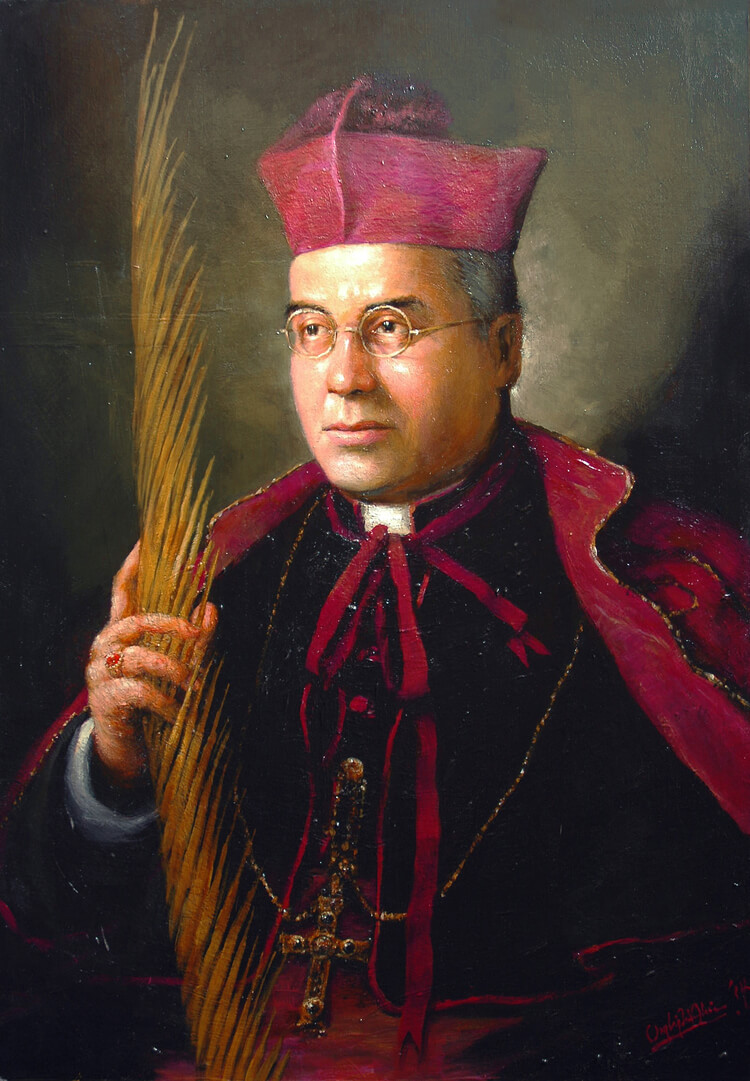
In recent years our Oratory has grown and grown in devotion to our Oratorian martyr whom we celebrate on 6th November: Blessed Salvio Huix (pronounced something like ‘hush’ — hopefully that makes sense of the title). The altarino with his portrait painted by Alvin Ong in 2014 is placed just round the corner from the entrance to our church on the Gospel side and it is encouraging to see how many people pray there, silently and in trust, asking for the intercession of our first beatified martyr. Our church receives a constant stream of visitors, tourists and faithful alike, and our Spanish visitors are always surprised and delighted to discover one of their own martyrs in that little corner of Oxford which is forever Ibiza (or Lleida, where he was also bishop and where he was martyred).

Reflections in previous years have told the now familiar story of his martyrdom: “in the tumult of the Spanish Civil War, his palace was attacked by the socialists and he found refuge in the house of his loyal servants. To save those who sheltered him he handed himself over to the Republicans and was imprisoned. On 5 August 1936 he and twenty other prisoners were taken to the municipal cemetery and forced to dig their own graves. Bishop Huix was offered his freedom if only he would renounce his faith; rather he requested to be the last to die so he could assist his fellow victims as they went to their deaths. One of the socialists grew furious and shot him in his right hand so that he could no longer bless; he continued to do so with his left hand instead. He was killed by a shot to the head.”

But Bishop Huix would almost certainly have been considered for the glories of the altars even without his martyrdom. In all the portraits and photographs we have of him what shines forth is his fundamental goodness and his kindness. There are many formal portraits of him as provost of Vic and later as bishop; in these we can see the seriousness with which he approached the heavy burden of responsibility that God had laid upon his shoulders in calling him to be a shepherd of God’s people. Yet there are also photographs of him in more unguarded moments — happily smiling, radiating a real Philippine joy. This serious commitment to the Lord and the joy he found in his life with his Master came from one place: prayer. Blessed Salvio led a life of extraordinary mortification and spent many hours in prayer each day. He had learnt very early that we can do nothing without God.

We do, naturally, know him principally for his martyrdom. His loyalty, his faith, his courage in that moment when he was called to imitate Christ in laying down his life for his flock. Years before he had prayed:

Now, most loving Father, I also place myself on the altar of sacrifice and I beg you to deign to receive the total offering that I make of myself, of my soul with all its powers and of my body with all its senses; everything is a gift and a gift that I have received from your infinite generosity; I return it to you as a token of gratitude and homage, protesting here, in the presence of the angels that surround this altar, that I do not want to use your gifts except if it is in accordance with your most holy will.

God accepted his offering. Would we I wonder have that same courage? As we celebrate the English martyrs, and others too from further away lands, in so many days of the liturgical year, I often ask myself what I would do. Would I, on a cold day, have the courage and the conviction to put myself into the hands of the enemies of our Faith, to be dragged through the streets, through a baying crowd…? Would I have the warmth of heart to love God, even whilst standing on a cold scaffold within sight of the instruments that would take to death? Or would I run away, would I give in, would fear conquer anything else in me?

None of us can say of course. But we can hope and we can trust. The life of Blessed Salvio teaches us that every day is a day to lay down our life for Christ. Not always before guns and ropes, but before those less visible enemies: discontent, selfishness, murmuring, self-will, sin… Like Blessed Salvio we need to get on our knees and pray each day to know and to trust and to love the Good Lord who laid down his life so that we might live with him. When we do doubt, when we are afraid, perhaps we will ask the prayers of Blessed Salvio, that we too may take God seriously, and like him, that we may trust and hope, and find our joy in allowing ourselves each day to hear the quiet but encouraging voice of the source of all courage.

The blessing of graves at the local cemetery on All Souls’ Day.

Eternal rest grant unto them, O Lord. And let perpetual light shine upon them. May they rest in peace. Amen.

A plenary indulgence for the Holy Souls can be gained today by visiting any parish church or public oratory and reciting the Our Father and the Creed.

Every day from 1 to 8 November inclusive, you can gain a plenary indulgence for the Holy Souls by visiting a cemetery and praying for the departed.

Pope Francis also granted that a partial indulgence for the Holy Souls can be gained on any day of the year by reciting the Salve Regina in front of the image of Our Lady of Oxford.

View on Instagram