
Congratulations to Br Vincent, who completed his noviciate today.

Prayers outside St John Henry Newman’s former church at Littlemore, en route to the College where he was received into the “One Fold of the Redeemer” on this night in 1845. Wonderful to be joined by so many pilgrims, including Dominicans from Blackfriars and the Sisters of the Spiritual Family the Work.
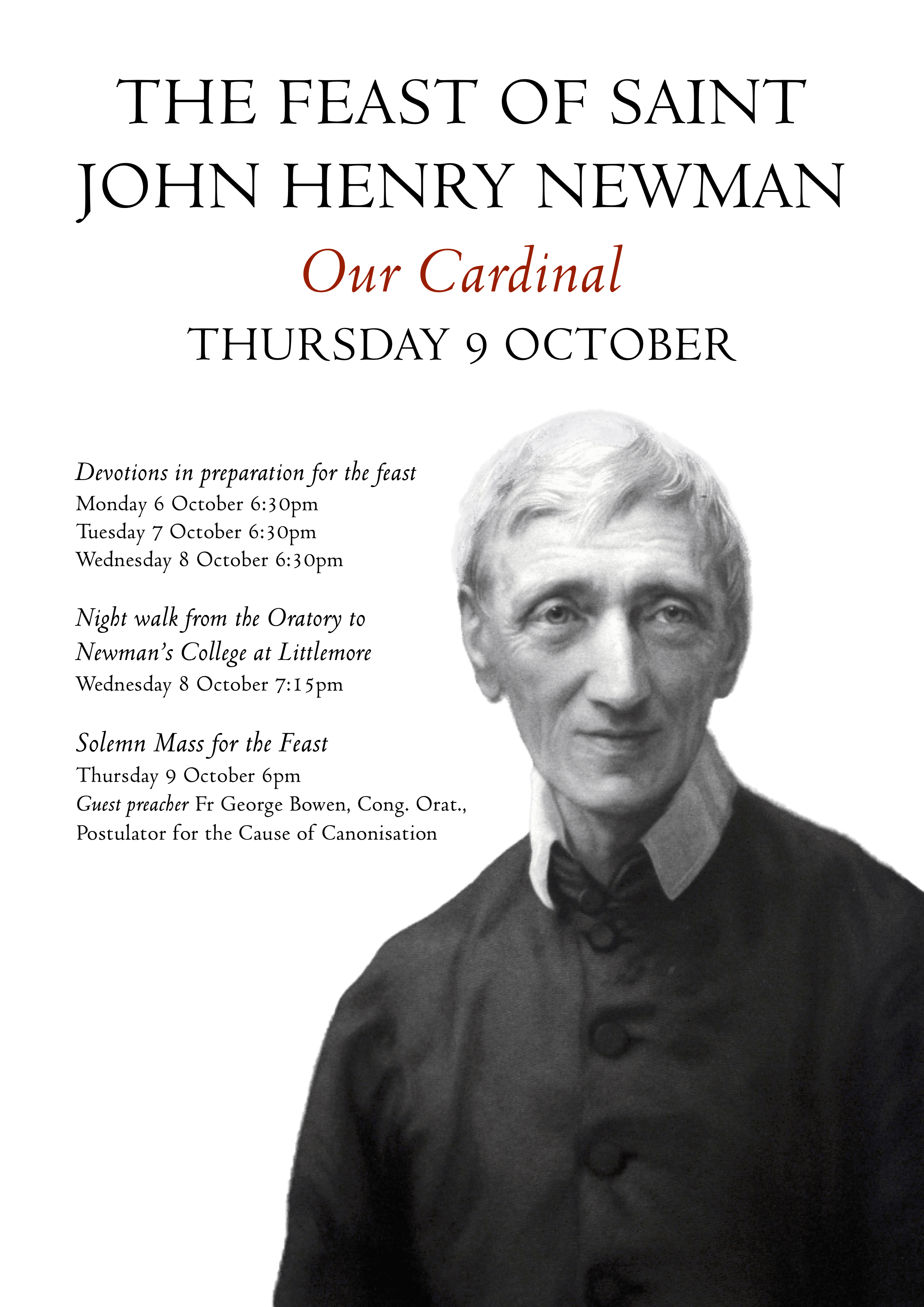
These words were preached by Monsignor Ronald Knox at the Birmingham Oratory in 1945 to commemorate the centenary of Saint John Henry Newman’s conversion. For most Saints we celebrate their feast day on the date they died — their heavenly birthday. Saint John Henry Newman died on 11 August, a date already impeded by the feast of St Clare, and so 9 October was chosen, the date on which he was received into the Catholic Church at Littlemore by Blessed Dominic Barberi.
But why is the conversion of Newman so important? Principally because it is a profound witness to the truth. Newman was a man of great learning and influence, and was a respected Anglican clergyman, preacher, and academic. But his studies, particularly of Church History and the Church Fathers, led him to realise that the fullness of truth was in the Catholic Church. His journey to Rome is perhaps best summed up by his now famous maxim, “To be deep in history is to cease to be Protestant.” Monsignor Knox says of Newman’s conversion, “Truth stood before him, fully embodied, and he gave way.” After his conversion, Newman suffered insults and slander for being received into what he called “the one true fold of the Redeemer.” He reminds us that the search for truth may demand sacrifice, but ultimately leads to joy and peace in Christ.
In the world today, where truth seems to be increasingly relativistic, where everyone can have their own “truth”, it is easy to become despondent and ask with Pilate, “What is truth?” But we know that truth, the Truth, is a person: Our Lord Jesus Christ. Our Lord himself tells us, “I am the way, and the truth, and the life. No one comes to the Father except through me.”
This is certainly what Newman firmly believed to be true. In his hymn written after his conversion taken from The Dream of Gerontius, Newman expresses his conviction that the Catholic Church is the Church founded by Our Lord, holding the fullness of truth:
And I hold in veneration,
for the love of him alone,
Holy Church as his creation,
and her teachings as his own.
When Monsignor Knox preached at the Birmingham Oratory, the Hierarchy considered Newman’s conversion such a pivotal moment for the Church in our country that they gathered to celebrate the centenary of that historical event. How much more ought we to celebrate the ninth of October, now not as a historical event, but as the feast of a Saint, and soon of a Doctor of the Church. We ask the prayers of Our Cardinal for the Oratories in England and for the conversion of our country.
St John Henry Newman, pray for us!
Sunday 5 October Solemn Mass 11:00
27th Sunday of the Year
Missa Vulnerasti cor meum Morales
Salvator mundi II Tallis
Laudibus in sanctis Byrd
Prelude in C BWV 547 Bach
Thursday 9 October Solemn Mass 18:00
St John Henry Newman, Our Cardinal
Missa Gaudeamus a6 Victoria
Beati quorum via Stanford
Beatus vir Monteverdi
Cantique in C Major, Op. 3 Elgar
Sunday 12 October Solemn Mass 11:00
28th Sunday of the Year
Missa Nasce la gioia mia Palestrina
Derelinquit impius Tallis
O salutaris hostia a6 Byrd
Fugue in G minor BWV 578 Bach
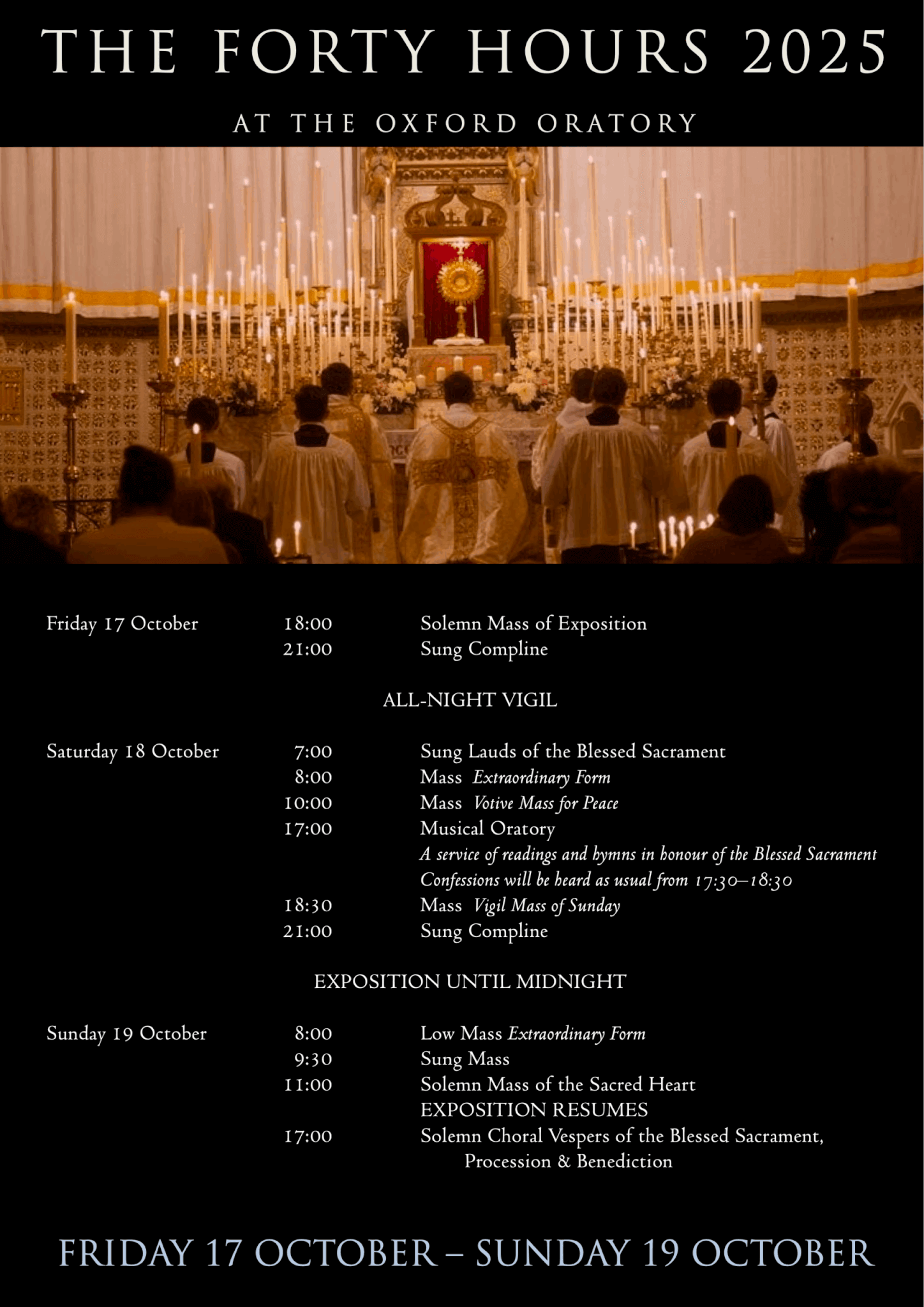
Friday 17 October Solemn Mass 18:00
Forty Hours: Solemn Mass of Exposition
Mass for four voices Byrd
Sacerdotes Domini Byrd
Quotiescunque manducabitis Byrd
O salutaris hostia Sumsion
Sunday 19 October Solemn Mass 11:00
Forty Hours: Votive Mass of the Sacred Heart
Mass for five voices Byrd
Tribue Domine Byrd
Te deprecor Byrd
Solemn Vespers 17:00
Forty Hours: Vespers of the Blessed Sacrament
Invitatory Gastoldi
Pange lingua Guerrero
Magnificat Quinti Toni Hassler
Tantum ergo Sumsion
Adoremus Allegri
Nun Danket Alle Gott Karg-Elert
Sunday 26 October Solemn Mass 11:00
30th Sunday of the Year
Missa Beata Maria Virgine Victoria
Quemadmodum desiderat cervus Lassus
Caro mea vere est cibus a6 Palestrina
Offertoire sur les Grands Jeux Couperin

This coming Sunday, were it not a Sunday, would be the feast of St Luigi Scrosoppi of the Oratory, who is perhaps best known around the world today as the patron saint of football. His example of devotion and trusting faith in God’s help, however, has much more to teach us than how to understand the offside rule.
The Oratory had been in Udine for 175 years before St Luigi was born, and his vocation there was certainly inspired in part by his older brother Carlo, eighteen years Luigi’s senior, who joined the Oratory and was ordained there in 1809. Nevertheless, neither brother had an easy journey in their vocations. In 1810, Napoleon, who had crowned himself King of Italy five years earlier, ordered the suppression of the Udine Oratory and seized its property. Fr Carlo, with nowhere else to go, returned to his family. Fifteen years later, his younger brother Gianbattista would follow him into the priesthood; two years after that, in 1827, St Luigi himself was ordained.
Living in such uncertain times, St Luigi learned to rely entirely on God’s providence. Together with his brother Carlo, he ran an orphanage in Udine. But in those troubled times, as the numbers of children in their care increased, the donations they received to support the children decreased. In response, St Luigi took to the streets to beg alms from passers-by. When the orphanage became too small, he took a donkey and a cart and travelled around the countryside to beg for building materials and for help with the labour. After a cholera epidemic, he founded a “House for the Destitute”, to accommodate girls who had been left as orphans. He founded a Congregation of Sisters to help him in his work, the Sisters of Providence.
This emphasis on Divine Providence was the cornerstone of St Luigi’s life, but his deep faith that his Lord would give everything he needed did not stop him making great personal sacrifices. After the fall of Napoleon, it became possible to restart the Oratory in Udine, which he quickly joined. The intervening decades had not been kind to the buildings, however, and they were almost derelict. So St Luigi sold his own family home to pay for the cost of restoring them. Twenty years later, the Piedmontese conquest of Italy saw the Udine Oratory suppressed again, and the property confiscated and sold. St Luigi bought back what he could. In spite of all the great difficulties he encountered, he persevered in following St Philip’s example to his death.
The example which St Luigi set, whether to the Fathers of the Oratory, the Sisters of Providence or the children they cared for, was one of total reliance on Our Lord for everything they needed. In good times, it is almost too easy for us to forget how essential God’s help is for us. In bad times, we can think that God has forgotten us. St Luigi by no means had an easy life — having seen his beloved Oratory suppressed by invading powers not once, but twice, we could probably forgive him if he had ended up doubting God’s help! But St Luigi always remained faithful to the Lord. Whenever one project met an obstacle, he found a new way to serve the needy. His constant care was to help the poor in any way he could, so that both he and they might be able to find joy in their true homeland in Heaven with Christ.
Because of his great work with destitute children and young people, he was declared patron saint of football, regardless of whether or not he had played himself! Perhaps, however, there is something teaching here. “Football’s coming home” — but so are we. As our Holy Father St Philip reminds us, “At last, we must die, and give an account of our lives.” When we do, and we face our Almighty Judge and render our account, may we — by his grace — be able to show a life lived full of trust in God’s providence for us, after St Luigi’s example, and so come home ourselves, to our Heavenly homeland.

Interested in becoming Catholic? Our weekly classes exploring the Catholic faith begin on 16 October. We already have a good number of people signed up — come and join them!
These classes are for anyone thinking about becoming a Catholic — even if you haven’t made a firm decision yet. They are also for Catholic adults who are preparing for the sacrament of confirmation.
Register for the classes here: tinyurl.com/oratory11025
Learn more about the process here: tinyurl.com/oratory4924
Today is the feast of the chief Marian shrine in our country: Our Lady of Walsingham. And so it is a good day to think about our country’s relationship with the most holy Mother of God. Every Sunday, after Benediction, we recite the Prayer for England, which is addressed to Our Lady:
O blessed Virgin Mary, Mother of God, and our most gentle Queen and Mother, look down in mercy upon England, thy dowry, and upon us all who greatly hope and trust in thee. By thee it was that Jesus, our Saviour and our hope, was given unto the world; and he has given thee to us that we may hope still more. Plead for us thy children, whom thou didst receive and accept at the foot of the Cross, O sorrowful Mother. Intercede for our separated brethren, that with us in the one true fold they may be united to the chief Shepherd, the Vicar of thy Son. Pray for us all, dear Mother, that by faith fruitful in good works we may all deserve to see and praise God, together with thee, in our heavenly home. Amen.
We call England Our Lady’s Dowry not because of any special connection she had with our country during her earthly life, but in the hope that she will show that special kind of favour to us that a mother is able to show to each of her children in turn, without showing favouritism to one at the expense of another.
This is a prayer full of hope — not vague optimism, but the quiet confidence that comes from being placed into the hands of one who gave herself entirely to God. “Our Saviour and our hope” gives his Mother to us “that we may hope still more.” Hope is more than wishful thinking. It is a confidence in the promises of God, and Christ has promised us the special intercession of his Mother. So on this feast, we pray through the intercession of Our Lady that all may come to share in the hope that her Son gives to us.
