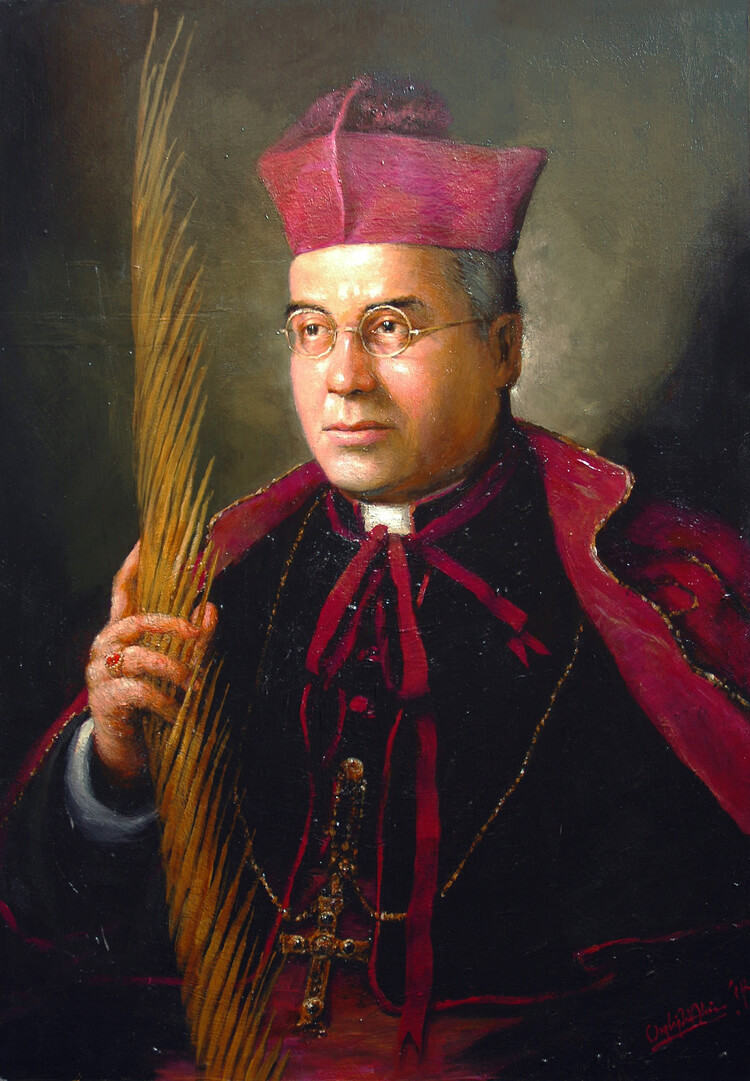
There are two ways in which we can fail to appreciate the significance of the martyrs. The first is the view that they are so much greater than us that they have nothing to teach us and we have no chance of imitating them. When we have considered Blessed Salvio in the past, we saw how his careful and meticulous work and prayer led him to sanctity, thus presenting him as an example for our imitation. Today, I would like to consider the other barrier to our appreciation of his sanctity.
It is all too easy to lose sight of Blessed Salvio as an Oratorian, a bishop, or even a Christian. In a modern view of history, he can very easily become another statistic in the analysis of a highly political war. One of thousands of bishops, priests and religious killed in a war during which hundreds of thousands lost their lives. To oppose this view of martyrs as statistics on one side of a table segregated by political affiliation, we must focus on their defining feature: conformity to Christ. In particular, conformity to Christ in a death like his. This is something which we see very clearly in Blessed Salvio.
When he realised that he was putting his friends in danger by hiding with them, Blessed Salvio gave himself up to the local authorities saying: “I am the Bishop of Lerida and I place myself under your protection.” There is no doubt that he knew that martyrdom would follow this course of action, but his words reveal something about Bishop Huix’s idea of his identity. He was a bishop and it was his role to be a public figure and to stand up for the Faith and to die for it if necessary after the example of Our Lord. It was the role of the civil authorities to provide him with protection, but the fact that they failed in their duties did not mean that he was willing to give up his. He was not a partisan in a political conflict, but a bishop who was living out his priestly identity after the pattern of Christ and, like Christ, died because his identity was ignored in the darkness of secular struggles.
That Christ-like identity shines through even more clearly at his death. Without concern about himself, Blessed Salvio’s attention was fixed on the salvation of his fellow priests who were facing martyrdom together with him. He allowed his mental anguish to be prolonged and received additional physical suffering, being shot in his right hand in an effort to stop him from absolving his flock. But that did not stop him and he continued to absolve them with his left hand as a good shepherd who overcomes obstacles to care for his flock and helps them to reach paradise, where he himself is headed, no matter the cost to himself. Again, if his aims were political, they would have ended at his death, but because he was serving God, his work lasts forever.
Therefore, let us imitate the meticulous growth in sanctity that strengthened Blessed Salvio in his martyrdom, and celebrate his feast remembering that he was both ordinary enough for us to imitate him and Christ-like enough to make that imitation worthwhile.


