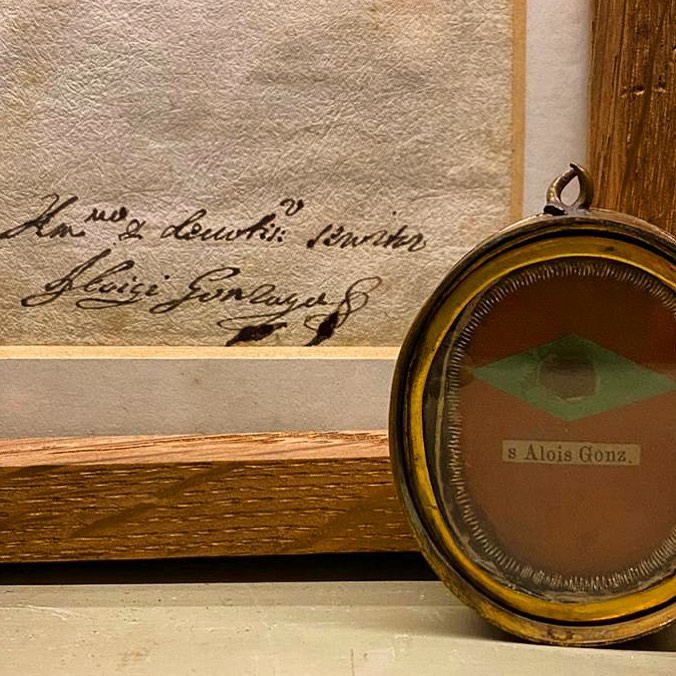
Happy feast of St Aloysius!
Two relics of his are displayed this month in our relic chapel, including a letter bearing his signature.
#oxfordoratory
Happy feast of St Aloysius!
Two relics of his are displayed this month in our relic chapel, including a letter bearing his signature.
#oxfordoratory
Today we celebrate the great solemnity of the patron of our church: St Aloysius Gonzaga of the Society of Jesus. St Aloysius is, together with St Gabriel Possenti, patron of young people, students, and seminarians and thus was a natural choice as patron for our church in this university city. He is also the patron of our parish school and we entrust to his loving intercession all our children who are able to learn the love of God from his example. We have his shrine in the chapel of Our Lady of Oxford, his statue is there on the reredos, and his initials guide our eyes towards his heavenly home as we look up at the sanctuary ceiling. Our patrons are important — St Aloysius has been given to us in this parish by God, through his Church, to watch over us in a particular manner, to intercede for all those who live and worship here, and to encourage us in our own quest for holiness.
Born the eldest son of the Marquis of Castiglione, St Aloysius seemed destined for a life of political intrigue and secular affairs, but, as with St Ignatius before him, it was the lives of the saints that really captivated him and placed in his heart the desire to strive for something better. This was not some childish caprice; he had seen the reality of life at court with its violence, frivolity, and degradation of human dignity, and desired not only to turn his back on it, but to embrace with all his heart a life given wholly to God. He began in earnest, adopting severe penances and teaching the local children their catechism. Hearing about the missions of St Francis Xavier, he set his heart on becoming a Jesuit — much to the horror of his family.
Eventually, having not overcome family opposition but at least its concrete obstacles, and having renounced his rights of inheritance, he entered the Jesuit novitiate in Rome in 1585. He had much to learn and much to which to adapt himself, but whatever he had to do he simply did it with all his heart — trusting in the sure knowledge that God was at work. Would he have met St Philip in Rome? Concrete evidence is hard to find, though these two saints of Rome are often depicted in art. We know they had mutual friends and these no doubt would have told them of Rome’s Third Apostle and of the holy Jesuit novice. One can imagine St Aloysius on a novitiate walk popping in to the Chiesa Nuova to see Mister Father Philip whom all Rome spoke of and revered or of St Philip blessing a crowd of passing Jesuit novices and knowing the heart of one of them that would see them both in glory.
St Aloysius’ real work in Rome was that which St Philip had embarked upon at the beginning — the care of the sick and the destitute. When plague broke out he volunteered to go with the other novices to pick people off the streets, to wash them, to prepare them for the sacraments and care for their souls. At first, he admitted to his director St Robert Bellarmine, this revolted him, but he soon learnt to see the image of Christ in these people, and to love them, not only in caring for them, but in seeing Christ in them. Never one to enjoy good health, Aloysius himself fell ill of plague, and died at the age of 23 on 21 June 1591, just a few years before St Philip’s death.
When we look at images of St Aloysius we normally see a rather pale young man who looks like so many other sickly young saints, distinguished perhaps only by the great ruff that he wears about his neck. But he was more than that. He was a young man who bothered about God and thus about other people. He was not yet in his mid-twenties, when he had discovered that real freedom comes from serving God with all ones heart; that Christian love has to be lived in the real, strength-sapping, heart-breaking, service of others; that there is joy in taking people off the streets, washing them, bandaging their wounds and restoring them to the dignity that is theirs as children of God.
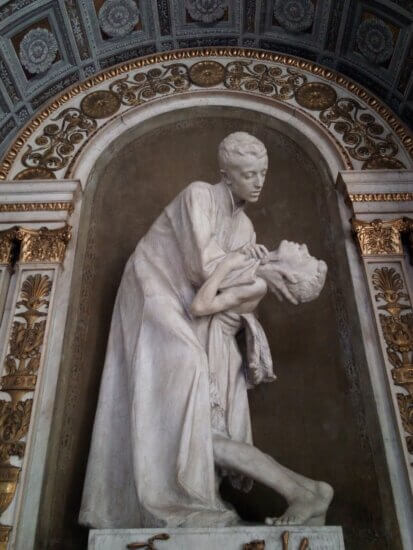
The image attached to these words is a depiction of St Aloysius in Milan in the Chiesa di Santa Maria presso San Satiro. The saint looks rather weak and malnourished, but what strength he has is used to hold up a man who is either dying or dead, with St Aloysius pressing the Cross to him and holding the man’s head up with his hands. The look on St Aloysius’ face is one, simply, of love — of love for God and neighbour, and of joy found in bringing the love of God to others. How much this young man, St Aloysius, still has left to teach us…
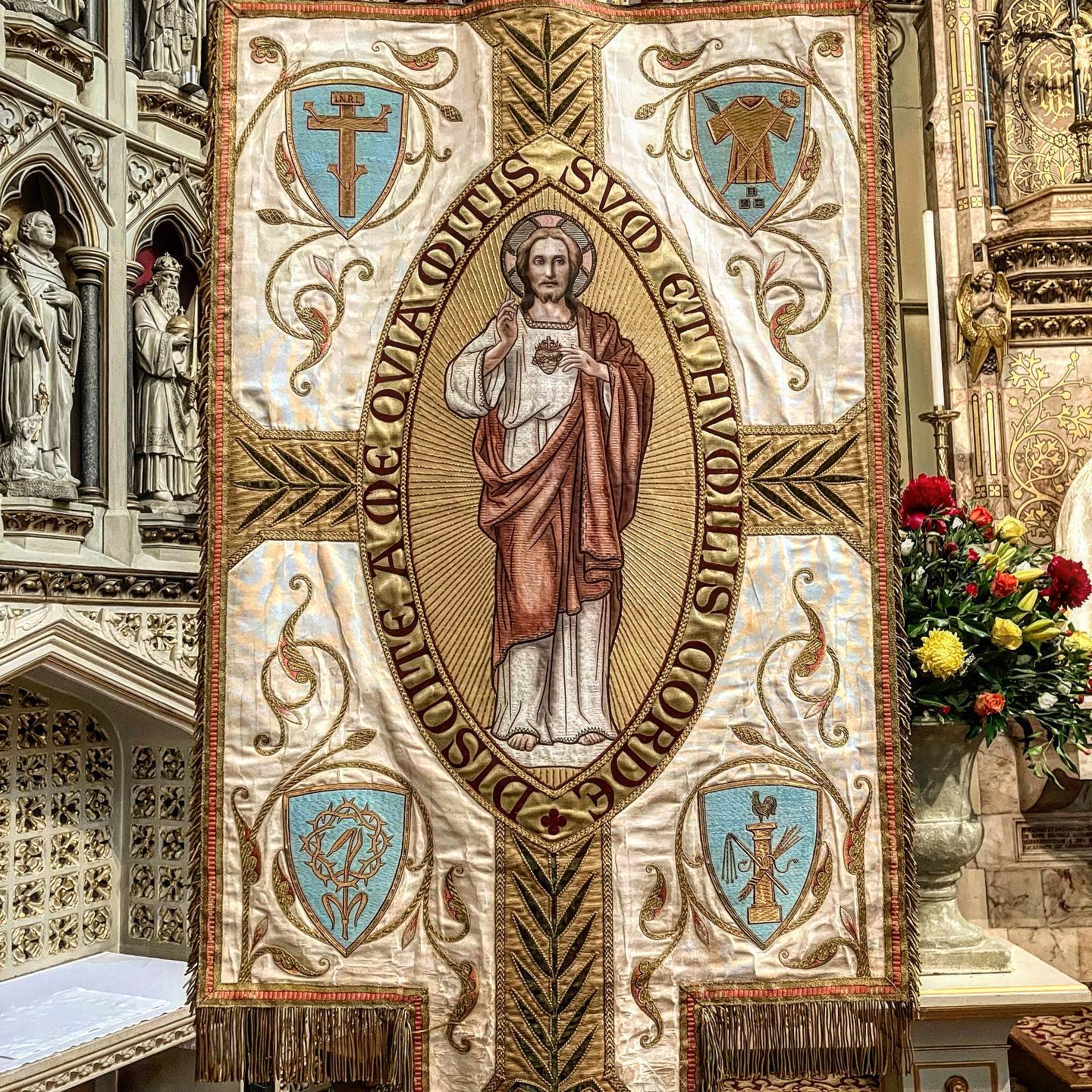
Heart of Jesus, all-holy! Fountain of all blessings, I adore thee, I love thee, and with a lively sorrow for my sins, I offer thee this poor heart of mine. Make me humble, patient, pure, and wholly obedient to thy will. Good Jesus, grant that I may live in thee and for thee. Protect me in the midst of danger; comfort me in my afflictions; give me health of body, assistance in my temporal needs, thy blessing on all that I do, and the grace of a holy death. Amen.
#oxfordoratory
Sunday 4 June Solemn Mass 11:00
The Most Holy Trinity
Kyrie Mundy
Missa Euge bone Tye
Libera nos Sheppard
Honor, virtus et potestas Tallis
Sunday 11 June Solemn Mass 11:00
Corpus Christi
Missa Pange lingua Josquin
Lauda Sion Palestrina
Oculi omnium Byrd
Friday 16 June Solemn Mass 18:00
The Most Sacred Heart of Jesus
Missa Dormendo un giorno Guerrero
Improperium Palestrina
Sancte Deus Tallis
Sunday 18 June Solemn Mass 11:00
11th Sunday of the Year
Missa Brevis in F Op.117 Rheinberger
Benedicam Dominum Victoria
Salve Regina Poulenc
Wednesday 21 June Solemn Mass 18:00
St Aloysius Gonzaga
Missa O quam gloriosum Victoria
Justitiae Domini A Scarlatti
O bone Jesu Anchieta
Sunday 25 June Solemn Mass 11:00
12th Sunday of the Year
Missa Repleatur os meum Palestrina
Perfice gressus meos Lassus
Homo quidam fecit coenam magnam Mouton
Thursday 29 June Solemn Mass 18:00
St Peter and St Paul
Missa Petre ego pro te rogavi Lobo
Petre ego pro te rogavi Guerrero
Janitor caeli Ortiz
Love is a funny thing. Materialists will tell us that it is purely the result of a series of electro-chemical responses in the brain, and yet others will tell us that it is the result of fate, the conspiracy of the alignment of the planets or the times we find ourselves in. The heart has long been understood as the centre of a person, a place of knowledge as much as will. It makes us do unreasonable things like acts of unwarranted kindness and altruism and by the edge of its blade we can be hurt in ways that we just can’t speak about. And yet none of these express what love is in itself — only God does that.
On Friday we venerate the Heart of our Lord as the symbol of his human love in which God’s divine love is revealed to us. In most of the prayers to or the meditations on the Sacred Heart, even those very ancient prayers, the woundedness of our Lord’s heart comes to the fore. That heart pierced with a lance and bruised with outrages and blasphemies is a stark and realistic image of the extent to which Christ loves us. Christ, who is the image of the unseen God, the Icon of the Father, shows us precisely what God’s love for us looks like. And it looks like a heart pierced and bruised on account of our sins, yet burning with ardent love for you and for me. This divine love is not for softies.
The time when we celebrate this feast is very fitting. We have come to the end of the Church’s celebration of the mysteries of our redemption: the Passion, the Cross, the Resurrection, the Ascension, Pentecost, the Feast of the Blessed Trinity and Corpus Christi. But today we commemorate the divine-human love which motivated them all. In adoring the Sacred Heart, we adore the totality of Christ’s saving work — it represents the way in which God holds nothing back from us. And in order to share his divine life with us, he reaches down into the very depths of our life, even — and especially — where it is painful, difficult to speak of, hidden. By taking it all and joining it to himself, he scoops us up, he enables us to become like him. By sharing our life, and by sharing our pains, he heals us, he sanctifies us, and he strengthens us.
It is also true that his heart welcomes us precisely so that we might become like it. The whole thrust of our Christian life is that we might be conformed to our Saviour, that we might resemble him, and in this sense, in the life of faith, we should ask ourselves continually whether our heart resembles his. His Sacred Heart is both the example and the cause of our becoming like him. His love is attractive. The more we consider the love with which Jesus acted, and spoke and gave of himself for us, the more we can begin, by his grace, to imitate him — it is truly the school of Christian perfection.
And we begin in that school by prayer. When St John Henry Newman, our Cardinal, chose his motto, he looked to St Francis de Sales’ Treatise on the Love of God. The phrase he chose and paraphrased, Cor ad Cor loquitur represents for us the central mystery of the prayer that can begin to transform us. St Francis de Sales wrote:
Truly the chief exercise in mystical theology is to speak to God and to hear God speak in the bottom of the heart; and because this discourse passes in most secret aspirations and inspirations, we term it a silent conversing. Eyes speak to eyes, and heart to heart, and none understand what passes save those who speak.
We may be no great shakes at the spiritual life, or prayer, or we may feel that excelling in virtue is beyond us, but if we can in the simplest of ways open our poor heart to his Sacred Heart, and speak to him as to a friend, if we can entrust our lives to him and ask him devoutly and sincerely to shape us after the model of his Heart, then our Christian life will be all the more graced.

The Corpus Christi procession concluded with Benediction at the University Chaplaincy. #oxfordoratory

The numbers caught the attention of the local media:
#oxfordoratory

Children scattered flower petals before the Blessed Sacrament all the way. #oxfordoratory

