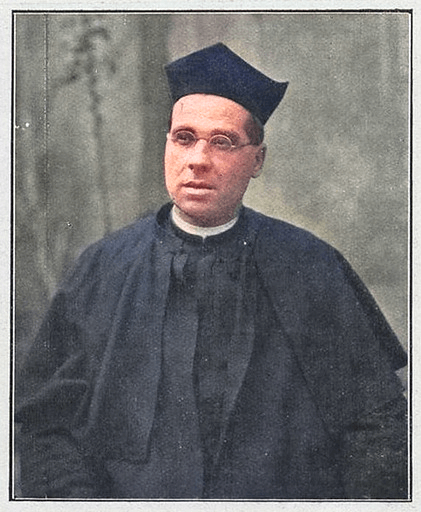
Blessed Salvio Huix

We celebrate today the first of the sons of Saint Philip to shed his blood for Christ. St Philip had a great desire for martyrdom and that is why he is so often depicted wearing red vestments, as is done on the feast days of martyrs. Yet Saint Philip was not to be the great missionary martyr he once longed to become but was called to spend his life in Rome, faithfully administering the sacraments and preaching the word of God. It would in fact be over 300 years after the Saint’s death that an Oratorian would be martyred for love of Christ and his Church. 

The courageous bishop, Salvio Huix-Miralpeix, who led his flock faithfully up to the point of death, entered the Oratory in Vic at the age of 30 in 1907, having been ordained a priest four years earlier. In 1927 he was appointed Bishop of Ibiza where he remained for eight years until he was translated to Lerida. Just over a year later he was martyred. On 5 August 1936, at the beginning of the Spanish Civil War, he and twenty other prisoners were made to dig their own graves. Blessed Salvio asked just one favour from his murderers, that he would be the last to be executed so that as each prisoner was shot he could bless them. His life as a bishop and the details of his martyrdom are well-recorded, but what about those twenty years in his small Oratorian community in Vic?

We are blessed here in Oxford to have a large collection of writings and letters of Blessed Salvio, amongst which are his pensaments y proposits dels dies de retiro (“thoughts and intentions of retreat days”) recorded each month from December 1904 to September 1935. Each entry contains a short focus of prayer and reflection for his monthly retreat day. They give us a glimpse into the life and prayer of Blessed Salvio as an Oratorian novice, as Provost of his community and as a bishop.

Some entries from the first year of his noviciate are translated here:

10 June 1907 — First month of life at the Oratory
I will implore with special interest and fervour the help of God with the ‘Deus in Adjutorium’ and of the Most Holy Virgin Mary with the ‘Sub tuum praesidium’.

12 August 1907
I will enter the confessional with great recollection, and with intention, and with the heart raised to God.

11 November 1907
I will be more careful to hear Holy Mass with devotion.

15 June 1908
Every day in prayer: an act of humility, one of contrition, one of trust and one of resignation and conformity to God’s will.

We see here in just these few short extracts how Blessed Salvio tried to model his life on the example of Saint Philip: regularly hearing confessions, celebrating Mass with great devotion and praying at all times, with a particular love for Our Lady. His desire to accept the will of God in his life is a model of perfect humility for us all. His holy life is a shining example of a true son of Saint Philip and a holy shepherd of Christ’s flock. Blessed Salvio ended his earthly life by gaining the palm of martyrdom, joining his suffering and death with that of Our Lord. In our world where the Faith is evermore under persecution may he be an example of courage in adversity, and through his intercession may Christians persecuted for their faith be given strength. 

From November 1908 onwards, he also lists in his Pensaments a saint he has taken as his particular patron for that month. What is quite apparent is how often he chooses the saints and beati of the Oratory. Unsurprisingly Our Holy Father St Philip is listed many times, but so too are Saint Francis de Sales, Blessed Antony Grassi, Blessed Juvenal Ancina and Blessed Sebastian Valfrè. These great men who fashioned their lives after that of St Philip are there for us too, to be taken as our special patrons. Happily we now have the great privilege of adding to that list of Blessed Salvio’s patrons, Blessed Salvio himself. 

Blessed Salvio Huix, proto-martyr of the Oratory, pray for us.

November Music

Friday 1 November Solemn Mass 18:00
All Saints
Missa Euge bone Tye
Justorum animae Stanford
Os justi Bruckner
Placare Christe servulis Dupré

Saturday 2 November Solemn Mass 10:00
All Souls
Requiem a8 Lobo
Versa est in luctum Lobo

Sunday 3 November Solemn Mass 11:00
31st Sunday of the Year
Mass in the Dorian mode  Howells
O quam gloriosum Victoria
Adoramus te Christe Monteverdi
Allegro Vivace (Symphony No. 5) Widor

Friday 9 November Solemn Mass 18:00
Solemn Requiem for deceased
Fathers and Brothers of the Oratory
Officium Defunctorum a4 Anerio
Ego sum resurrectio Hassler

Sunday 10 November Solemn Mass 11:15
Solemn Requiem for the Fallen
Officium Defunctorum a6 Victoria

Sunday 17 November Solemn Mass 11:00
33rd Sunday of the Year
Missa Tertia, Octavi toni Croce
Hortus conclusus Ceballos
Ardens est cor meum Dering
Prelude, Fugue and Chaccone in C Buxtehude

Sunday 24 November Solemn Mass 11:00
Christ the King
Piccolomini Messe Mozart
Attollite portas Byrd
Siderum rector Byrd
Nun danket alle Gott Karg-Elert

All Saints and All Souls may now be over, but the lamps still burning before their statues remind us that our friends in heaven haven’t stopped praying for us.

O blest communion! fellowship divine!
We feebly struggle, they in glory shine;
Yet all are one in thee, for all are thine.
Alleluia, alleluia!

And when the strife is fierce, the warfare long,
Steals on the ear the distant triumph-song,
And hearts are brave again, and arms are strong.
Alleluia, alleluia!

The golden evening brightens in the west;
Soon, soon to faithful warriors cometh rest:
Sweet is the calm of Paradise the blest.
Alleluia, alleluia!

But lo, there breaks a yet more glorious day;
The Saints triumphant rise in bright array:
The King of glory passes on his way.
Alleluia, alleluia!

From earth’s wide bounds, from ocean’s farthest coast,
Through gates of pearl streams in the countless host,
Singing to Father, Son, and Holy Ghost.
Alleluia, alleluia!

#oxfordoratory

View on Instagram

“Therefore he made atonement for the dead, that they might be delivered from their sin.” (2 Maccabees 12:45)

All priests can say three Masses on All Souls, to give the faithful departed as much help as possible. All the faithful can assist the Holy Souls not just through prayer, but also through special indulgences granted by the Church in November. Every November, there are opportunities to obtain plenary indulgences for the Holy Souls in purgatory by: (1) visiting a church on 2 November and praying the Our Father and Creed; (2) visiting a cemetery and praying for the faithful departed on any of the days between 1 and 8 November (it is possible to obtain an indulgence each day this is done). As with all plenary indulgences, it is also necessary to go to confession, receive Holy Communion, pray for the Pope’s intentions and be detached from all sin.

Today the Fathers offered fifteen Masses for the Holy Souls.

#oxfordoratory

View on Instagram

Holiness is not boring

If you enter our church and look at our sanctuary you will see a bunch of eccentrics — the images of the saints, of course. Our Lady and St Joseph are quite respectable, but if you came across John the Baptist in the street, you would probably cross over to the other side when you saw him. Then there’s St Cuthbert who, when he wasn’t walking around carrying St Oswald’s head, would be standing in freezing cold water up to his waist. And that’s only the stained glass. Half of the statues show the saints proudly carrying the weapons that were used to kill them. There is St Charles shown as he walked the streets of Milan with a noose around his neck. There are hooded monks and veiled nuns oblivious to the world around them, lost in heavenly contemplation.

We have a tendency to think of the saints as weirdos, as exceptions, as special people. They’re not like us. As Saint John Henry Newman said so incorrectly about himself, “I have nothing of the saint about me.” We think that sainthood is something beyond our reach. But God has made each and every one of us in order for us to be saints. Sainthood is an invitation to people “from every nation, race, tribe and language.” (Rev. 7:9) Our Holy Father St Philip wanted all of his spiritual children to become saints. Not canonised saints — we should love to be unknown. And as Blessed Dominic Barberi said, that’s too expensive. But we should all be saints nonetheless. Because a saint is quite simply someone who is in heaven.

Those saints on our sanctuary are all different. And the fact that they’re slightly weird shows also that they are not boring. So many people make the mistake of thinking that being holy has to make us dull. But to be focused on getting to heaven does not mean we have to abandon our unique personalities and become clones of each other. We need many saints to show us that there are many ways of following Christ to heaven — in fact, as many different ways as there are people. There will be some saints that we relate more too, that we have more in common with, who inspire us on the way. But when you do reach heaven, you will be the first person to get there by exactly your path. And you will arrive in the spot that God has prepared before all eternity precisely for you. And nothing about that idea is boring.

Judgement

Judge not, that you be not judged. For with the judgment you pronounce you will be judged, and with the measure you use it will be measured to you. Why do you see the speck that is in your brother’s eye, but do not notice the log that is in your own eye? Or how can you say to your brother, “Let me take the speck out of your eye,” when there is the log in your own eye? You hypocrite, first take the log out of your own eye, and then you will see clearly to take the speck out of your brother’s eye.

Matthew 7:1-5

How well we know these arresting words of our Lord. And arresting is what they are meant to be: quite literally they should stop us in our tracks, causing us to pause and take a brief look at ourselves and see how we measure up in their light. For the truth is, we do judge other people, and sometimes quite harshly, pouring forth pronouncements from a lofty position of our ‘rightness’, often fuelled by indignation and rage. When we do this, we fail signally to listen to the voice of Jesus trying to make his voice heard over our anger, urging us to take note of our own failings and sins, which are sometimes greater than those which have made us so angry. Christ wants to compare the speck in our brother/sister’s eye with the log in our own. The warning is that what we mete out to others will be ladled out to us in return. Remember the beatitude: “Blessed are the merciful, for they shall be shown mercy.” It is important to keep this promise in mind when we are tempted to be merciless!

It was a method of our Lord to make his teaching vivid by using the language of metaphor or proverb. Think of some of his sayings, such as: “If a man strikes you on one cheek you are to turn to him the other,” or the teaching which bids us pluck out the eye or cut off the foot or hand that offends or causes us to sin. Are these meant to be rules applicable to all occasions, or are they sayings embodying a principle? The principle here is that love is to be so absolute, so demanding upon us, that no limit can be placed on its manifestation.

So the words of Jesus that we are not to judge anyone also embody an important principle, but they do not lay down a universal rule. On occasion, he himself passed judgement. He judged St Peter when he tried to deflect him from the Passion; he judged Herod as “that fox”; he had some pretty harsh words for the Pharisees, those “whited sepulchres” and blind leaders. Remember too, how he told us to “judge righteous judgements” (John 7:24). Furthermore, the Lord gave to his Apostles and to his priests the function of “binding and loosing” the sins of penitents in the sacrament of Reconciliation (John 20:23).

Jesus’ command not to judge is given to us in the context of the parable of the speck and the log, a timely warning that not one of us may judge another until we have first examined or judged ourselves — until we have allowed the Holy Spirit to search out the secret places of our heart and purge us of our own guilt and sin. This is something which might be inferred from the direction given by Jesus to the men who so eagerly readied themselves to stone the adulterous woman in John 8: “Let him who is without sin, cast the first stone.” A thorough examination of conscience would surely restrain us from extreme or harsh condemnation of another, and if our position in society calls upon us to make a judgement, we should do so in a spirit of meekness, understanding and love, in accordance with the truth. When our Lord commands us to refrain from judging, he would have us bear in mind our imperfections, our tendency to pass judgements that are not helpful, proceeding from motives of bitterness or jealousy or wounded pride.

None of us can pronounce a final judgement on another. That prerogative belongs to God alone, for it is only to him that “all hearts are open and all desires known.” Besides, we aren’t always in full possession of the facts nor can we fully comprehend the motives of another person’s actions. In truth we can sometimes get it wrong. St Paul tells us that we cannot even judge ourselves (1 Corinthians 4:3). If we do, it is likely that our judgement will fall far short of that given by God in his merciful and just love. Maybe we should simply leave the business of judgement to the Lord, committing ourselves and all others into the hands of him who judges righteously.

Our Forty Hours’ Exposition has begun. Come and spend an hour with Our Lord anytime between now and midnight tomorrow or Sunday afternoon. This is a special opportunity for us to intercede for all the many needs of the Church, the world, our city, friends and family, as well as handing over all our own problems to Jesus and his most Sacred Heart. Or just come and spend some time with him. He is waiting for you!

#oxfordoratory

View on Instagram