O God, come to my aid

Saint Philip teaches us that whenever we are in temptation, we should pray to God, saying, “O God, come to my aid, O Lord, make haste to help me.”This advice comes from Saint John Cassian’s Collation On Prayer, where he reflects on this verse from the Psalms.

Cassian promotes its use for all occasions. He says that it “meets every emotion that can affect human nature and can be suitably adapted to every state of life.” Whatever moment we find ourselves in—yes, in temptation, but also in joy, in sorrow, at work or at rest—we can always use this short prayer. For Cassian, making use of this psalm verse throughout the day is the surest way of fulfilling Saint Paul’s command to “pray at all times.” 

Cassian says that these words should “follow you throughout the day.” Saint Benedict took this advice literally, mandating in his Rule that “O God, come to our aid; O Lord, make haste to help us” be said first at each Hour of the Divine Office. Saint Gregory the Great eventually extended this practice across the Roman Church. Since then, each hour of the Divine Office has begun with this verse, and you may have heard it sung at the start of Vespers in our own church. 

Saint Philip says that we ought “always to have some little prayers ready, and to be darting them up to heaven frequently during the day.” The short psalm verse recommended by Cassian can become one of those ‘darts’ we shoot into heaven. Even in the midst of a hectic day, we can raise our minds and hearts to God, who strengthens us in all we do.

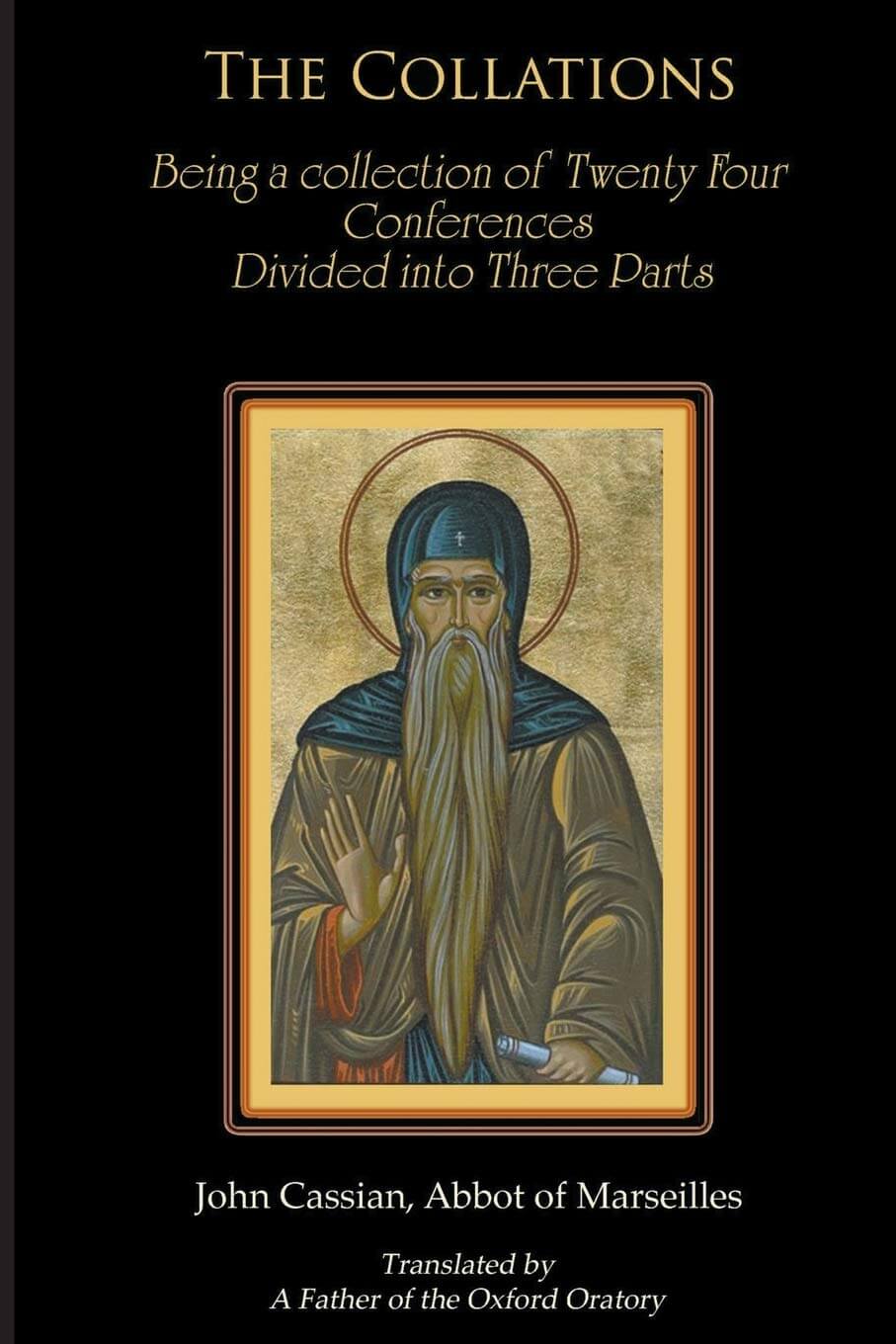
The Collations of St John Cassian are among the oldest and most influential books of Christian spirituality. The book is presented as a series of conversations between Cassian, his friend Germanus, and the great monks of the Egyptian desert, preserving the wisdom of men who had devoted their lives entirely to the pursuit of holiness.

The reflections over the coming weeks are based on ideas found in the Collations. There is no need to read them to follow each reflection, but the work is available, in an excellent modern translation by our own Fr Jerome, from our bookshop in person and online.
Building Works Week 1

The scaffolders arrived on Monday to begin their construction behind the apse of the church. It is a real technical challenge: the scaffolding has to reach all the way to the roof level in a very narrow area. Access is tight, with equipment either being brought through the parish centre or lifted over the wall from Somerville. Understandably, it will take another week before the scaffolding is finished and repairs can begin to damaged walls, windows and drainpipes. This week, there will also be some exploratory works on the sanctuary to find out what secrets are hidden beneath the floor, but usual service should continue in church without interruption.

View on Instagram

The Wisdom of the Desert

The Collations of St John Cassian are among the oldest and most influential books of Christian spirituality. The book is presented as a series of conversations between Cassian, his friend Germanus, and the great monks of the Egyptian desert, preserving the wisdom of men who had devoted their lives entirely to the pursuit of holiness.

St Philip knew the Collations well. It was his textbook for the Oratory. Many of his own familiar counsels can already be found there. Yet he also warned that beginners should approach it with caution.

The danger, we might suppose, is that these desert fathers encourage impossible standards of fasting and prayer. There is certainly plenty of both. Cassian is, after all, a monk writing down the wisdom of other monks for the benefit of…monks. Yet what shines through the Collations is something rather different: not a glorification of extreme penance, but rather sensible advice and a profound understanding of human nature.

Even our natural limitations are viewed not as obstacles to spirituality, but as a kind of safety feature. Because while our fervent spiritual desire for the glory of God is meant to make us want to eat less, sleep less and pray more, our physical limitations — our bodily weaknesses — prevent us from overdoing it. Spiritual desire overcomes our temptations to physical excess, but bodily weakness prevents temptations to spiritual excess — both to our benefit.

In this wisdom, charity always takes first place over all other considerations, so that hermits are warned not to fast so strictly that they don’t have food to eat should they need to show hospitality to a visitor. Holiness is measured less by extraordinary interactions with angels and demons than by patience, humility and victory over one’s own faults.

Beneath the surface of this monastic advice lie refreshing insights into human nature. Perhaps that is why this wisdom of the desert still sounds so fresh. The circumstances of life may have changed enormously, but human nature has changed remarkably little. Prayer amid discouragement, perseverance amid temptation remain the concerns of every Christian, whether living in a fourth-century Egyptian monastery, sixteenth-century Rome or a twenty-first-century family home. Over the coming weeks we will be sharing some of the insights from the Collations that have nourished Christians for sixteen centuries. We hope that the wisdom of the desert will prove just as fresh to us today.

The Collations, in an excellent modern translation by our own Fr Jerome, are available to buy from our bookshop in person and online.

What does it mean to be a saint?

The first couple of weeks in August are filled with the feasts of some wonderful saints — but what makes them special?

Today we celebrate St Jane Frances de Chantal, foundress of the Visitandine nuns and a dear friend of the (first) Oratorian Doctor of the Church, St Francis de Sales. She was an extraordinary woman, who was a devoted wife and mother to a large family. When her husband died, she finished raising her children herself, and she could easily have been excused for spending the rest of her life in comfortable retirement. But no — she dedicated the second part of her life to the service of God, founding her order to enable other women at her stage of life to find a place in religious life.

Just recently, we celebrated St Dominic, the great founder of the Dominican Order. He saw the need in the Church of his day for powerful preachers to bring people who had fallen away back to devotion to God, and he got up and did something about it. His Order spread across Europe even within his lifetime — he personally sent the first friars to preach in England from his deathbed — and, more than eight hundred years on, his legacy still remains. His sons, now spread throughout the whole world, are still preaching the Good News to people who need it.

Yesterday we celebrated another holy foundress, St Clare, who was one of St Francis’ closest followers from the beginning of his ministry in Assisi, and founded the women’s branch of the Franciscan family. She was faced with great adversity — her unbreakable commitment to poverty set many against her new order. But she saw a need for this new, radical form of religious life in the Church, and her vision has borne fruit in the order that still bears her name today, the Poor Clares.

A few days ago we celebrated St John Vianney, the holy Curé (parish priest) of Ars. He, too, is remarkable — but he is not remarkable for founding a new order or leaving some lasting legacy behind him. He is remembered for his extraordinary devotion to the very ordinary. He arrived in a small village parish, and simply did his duty — preaching, hearing confessions, celebrating the sacraments — but he did it with extraordinary devotion to God and to his people. Soon, people travelled across France to make their confessions to him, such was his reputation for holiness — but he got that reputation simply through dedicated service to his little parish.

All the saints, in their own way, were extraordinary people. They served God extraordinarily well. They were extraordinarily holy. But is that what makes a saint?

The consequences of answering “Yes” are rather uncomfortable. Am I an extraordinary person, an extraordinarily holy person? Perhaps you, my dear reader, are — someone has to be! But I think most of us, really, aren’t. We try our best — we say our prayers, we come to Mass when we can, we try to go to confession regularly — but we don’t really measure up to a Clare, or a John Vianney, or a Jane Frances. So if their extraordinariness is what makes them saints, is saintliness — life with God in his heavenly kingdom — really for us? Is it something beyond our reach?

Our answer, of course, has to be “No”. Christ came to call everyone to himself — Jew and Gentile, rich and poor — and he extends the invitation. He is the King of the wedding feast, who shares his table with anyone who will come. He doesn’t demand extraordinary things of us, only that we go where he calls us. In the Divine Office, the Church celebrates her saints — but it also tells us what it is to be a saint. One of the responsories on some saints’ feasts is this: “The Lord loved him, and adorned him; he clothed him with the stole of glory.”

Read it carefully — it’s not “He loved the Lord”, but “The Lord loved him”. Yes, we need to do our best at loving God. We do need to come to Mass, to say our prayers, to follow his commands and confess our sins when we fail in them. But that isn’t what makes us saints. Becoming saints is, in fact, completely beyond our power. And yet, even though we can’t possibly do it ourselves, it’s what we are all supposed to do. And so: what does it mean to be a saint? It means to love God, yes — but so much more than that, it means that God loves you.

A start to the building work — at last!

After several years of talking about our proposed building works, we are very pleased to announce that they are finally about to begin.

On Monday 17 August, work will start on essential repairs to the exterior of the apse of the church (the area behind the sanctuary). Over the next four months, the contractors will repair damaged pointing, brickwork and masonry, restore the windows and stained glass, and carry out repairs to the gutters and rainwater pipes.

Much of this work has become increasingly urgent after many years of exposure to the weather. Some of the bricks are crumbling; there are gaps where there shouldn’t be; and not a few trees are beginning to grow out of gutters very high up. Some of you might have seen the Fathers gazing at the stained glass during heavy rain: it’s not just piety, but observing the water coming through the holes in the stained glass! This should soon become a thing of the past.

Scaffolding will be erected around the outside of the apse over the next two weeks. The church will remain open, but please be aware that access might be restricted at times, especially when heavy equipment and materials are being unloaded from the road. Masses and confessions will continue as normal. There may inevitably be some additional noise during the working day outside of Mass times.

This is the first stage of a much larger programme of works to repair and restore our church. The more exciting work will begin in September, with the restoration of the sanctuary and the installation of the new high altar. We will be launching our fundraising appeal and sharing much more about those plans over the coming weeks.

For now, though, after a very long period of planning, permissions and preparation, we are delighted simply to be able to say: the work is beginning!

View on Instagram

Change

It is a joke we have heard so many times of course: “How many Oratorians does it take to change a lightbulb? [adopt incredulous voice:] Change?!” Well, call us old fashioned, and we hope you do, but there is something in our DNA that makes us rather cautious of change. That is not because we are old stick in the muds but because, in this ever-changing world, there is much to be said for stability. Oratorians take no vows — we do not solemnly vow to stay in one place like monks or nuns, but we do try to, or rather we pray for the grace always to want to. An Oratory is St Philip’s house. Our vocation is not to a theoretical ‘Oratorianism’ but it is to these men, this place, these people who come to us, and all of whom we seek to serve and to love according to the spirit of St Philip: to help everyone to find that stability and holy contentment that comes from a life fixed on Christ, whatever else might change.

St Philip bequeathed to us a love of place. You remember how he only moved to the Chiesa Nuova when commanded so to do by the pope. It is for us to cultivate a love not only of 25 Woodstock Road, but of Oxford. It is so wonderfully fitting therefore that our church is where we venerate the Holy Mother of God under her title of ‘Our Lady of Oxford’ — that reminder that heaven is very interested indeed in what goes on in this little pocket of Mary’s Dowry. It is such a beautiful thing to meet people who come back to venerate her after years away from Oxford, their lives so changed but still so wonderfully confident in her motherly care and protection. Whatever else might change, heaven does not. St James reminds us of this so splendidly: “Every best gift, and every perfect gift, is from above, coming down from the Father of lights, with whom there is no change, nor shadow of alteration.”

Just the other day on the radio there was a programme describing the ‘problem’ of summer. It is for so many people a long-awaited break, which one idealises all the year, only then to find it doesn’t quite measure up to all our expectation — the change in routine rather throwing people off centre. Amidst our holidays and relaxations we can sometimes rather miss our usual routines, especially of prayer. St Catherine of Siena advised us to: “Build yourself a cell in your heart and retire there to pray.”

Having that knowledge of the presence of God, wherever we may be, whatever we are doing, whomsoever we are with, keeps us fixed on him who does not change — a sort of spiritual mobile home, if you will. That helps us with the bigger changes of life too, for they too will come. Careers begin and end; friends come and go; our health changes; those we love are taken from us; and even the places we thought we should never leave may one day have to be left behind. There is only one thing that endures through every season of life: Jesus Christ, “the same yesterday, today and for ever.” If our hearts have learnt to dwell with him, then no change can ultimately rob us of our peace. It is as the motto of the Carthusians has it: Stat crux dum volvitur orbis, “The Cross stands while the world turns.”

That was really the key to St Philip’s extraordinary serenity. He delighted in all that was familiar: familiar streets, familiar faces and familiar prayers, and he desired to make the things of God familiar to people too. He did not make an idol of routine. Rather he treasured all those things that so help us to cling to Christ. We stay, not because nothing should ever change, but because love deepens in perseverance. This is why our Cardinal, who wrote “To live is to change, and to be perfect is to have changed often”, was not contradicting this love of stability. He was speaking of the continual conversion of the heart. The more firmly we are rooted in God, the more he is able to change us from within.

Although perseverance does not sound very exciting, it is precisely there that we find our peace. In that we must pray to love faithfully the place and the people God has entrusted to us, and those amongst whom he has placed us — without always imagining that happiness lies somewhere else, with another crowd, just around the corner or else on the other side of the world. So too we must ask God for the grace to build that little cell within our hearts where we may always meet the Good Lord, where we may work out our conversion — that refuge of prayer, which is always there for us to retreat into. Then, whether our lives are marked by great changes or by quiet constancy, we shall find ourselves able to rest in the love of the One who changes not.

August Music

Sunday 2 August Solemn Mass 11:00
18th Sunday of the Year
Mass for Four Voices Tallis
Precatus est Moyses Palestrina
Ego sum panis vivus Palestrina

Sunday 9 August Solemn Mass 11:00
19th Sunday of the Year
Missa Brevis Palestrina
Exsultate justi Viadana
O quam suavis Vivanco

Sunday 16 August Solemn Mass 11:00
The Assumption of the Blessed Virgin Mary
Missa Vidi speciosam Victoria
Assumpta est Maria Palestrina
Salve Regina Howells

Sunday 23 August Solemn Mass 11:00
21st Sunday of the Year
Missa brevis Gabrielli
Hortus conclusus Ceballos
Ave verum Mozart

Sunday 30 August Solemn Mass 11:00
22nd Sunday of the Year
Missa Quarti toni Victoria
Super flumina Babylonis Palestrina
Salve Regina Esquivel

Don’t overreact!

It can be very easy to picture a saint as one who weeps over every small sin and feels very far away from the perfection to which God calls us. Some saints seem to do precisely that, and our own St Philip used to walk through the streets of Rome lamenting, “I have never done any good.” But then again, it was the sixteenth century, and that just seems to be what Italian saints did at the time.

Because St Philip also had very sensible things to say about not overreacting to our failings, noting that we can sometimes be so upset after a fall, that we do more damage than was caused by the original fault.

It’s certainly a pattern that can be seen in the confessional. A person sins, and from an apparent piety, falls into a deep awareness of his or her sinfulness. But it leads to a despair of ever being holy, and an “I might as well carry on” attitude that leads to even worse things. That sorrow can’t have been genuine contrition then, if its fruit is further sin.

This is something St Paul identifies. There are two kinds of sorrow that sin produces: “For godly grief produces a repentance that leads to salvation and brings no regret, but worldly grief produces death.” (2 Corinthians 7:10)

There are times when we think we must give in to the feelings of sorrow that come upon us when we call to mind our sinfulness. But this is not the kind of sorrow for our sins that God asks of us. After all, God never commands anyone to feel guilty, but to repent! True sorrow means changing our ways, not moping.

Perhaps the most damaging reaction to sin is to give up prayer. It is true that sin makes us less motivated to pray (and with no other information, we should be able to tell from this effect alone which actions are not good for us). But to think that God does not want to hear from us when we have sinned is rather dangerous. If we are not worthy to pray after sin, does that mean that, until we sinned, we were worthy? That God did want to hear from us…because we were so good that he had no choice? False humility always contains in it some extraordinary pride.

The solution to all of this is simple: don’t overreact! Instead, no matter our weaknesses, we must carry on trying to serve him who did not come to call the righteous but sinners to repentance.

Mary Magdalene, Apostle to us All 

Mary Magdalene occupies a vitally important place in the Gospel accounts: present by the Cross when the men had fled, first at the tomb while it was still dark, and first to see the Risen Lord. Whatever her past difficulties may have been, the Gospels are less interested in cataloguing her sins than in showing us what Christ did with her: he freed her, and she followed him to the very foot of the Cross when all but his Mother and the Beloved Disciple had fled. Her whole identity in Scripture is defined not by what she once was, but by the completeness of her deliverance and the fidelity it produced. In her we see, more clearly than in almost any other figure, the pattern of Christ’s mercy: total forgiveness met by total devotion.

John’s account of Easter morning is succinct and exact. Mary comes to the tomb early in the morning, finds it empty, and runs — not to hide herself in her grief and confusion, but to tell Peter and John what she has found. When she returns, she stays at the tomb weeping, refusing to leave even after the men have seen and gone home. It is in that refusal to leave, that willingness to stay in unresolved grief, that the Lord meets her. He does not appear to the disciples in hiding, not to Peter in his guilt, or indeed the Beloved Disciple, but to Magdalene in her steadfast loitering at a grave. Seeing him through her tears, she supposes him to be the gardener until he says her name. One word — “Mary” — and in that instant, she recognises him, not through argument or evidence but through being known and called by a familiar voice.

Then comes the command: Go and tell. She is commissioned before the eleven are even gathered, sent by the risen Christ himself to announce what she has seen. He is risen! Consequently, the Church, without sentimentality, but with theological precision, has named her Apostola Apostolorum — Apostle to the Apostles. The first to announce the Resurrection, the central fact of the faith, was a woman who had nothing to offer but having stayed, and having seen.

What she gives us today, I think, is less a model of penitence than a model of fidelity even when she failed at that moment to understand what had happened. She had no doctrine of resurrection to reach for — that would come later, worked out by Paul and the councils. She had only the fact of her having been there, her refusal to abandon the tomb even when there seemed nothing left to do but weep near it. That is a spirituality available to anyone: you do not need to have resolved your grief, or fully understood your loss, in order to remain faithful, clinging on to the naked idea of God.

For those who do pastoral work — walking with the bereaved, the doubting, the ones sitting bewildered outside an empty place in their own lives — Magdalene is a patron of exactly that kind of waiting. She did not need to have her theology sorted before Christ used her as a witness. She needed only to stay, and to listen for her name.

Her feast, raised in 2016 to the rank of an Apostle, rightly honours what the authors of the Gospel already knew: that the first messenger of Easter joy was a woman who had simply refused to leave the tomb, and who had known, in her own life, the full measure of Christ’s merciful compassion.

“I will give you rest.”

“Come to me all who labour and are heavy laden, and I will give you rest. Take my yoke upon you, and learn from me…and you will find rest for your souls.”

The University students have gone down, schools are about to break up, already Oxford is filling up with teenagers on summer school programmes. Some of us may be getting ready for a sunny holiday in the South of France, or a staycation in St Ives, but all of us are looking forward to the slightly slower pace of life that summer brings — a time to breathe freer, to relax, to spend time with friends and loved ones, to rest.

Our Lord’s words in this past Sunday’s gospel are both remarkable, and remarkably apt for the beginning of July: “I will give you rest…You will find rest”. Why does Jesus choose rest — not peace, or hope, or joy, or salvation — why is rest the thing he recognises his disciples need the most?

The Lord sees in his followers a hive of activity and business, a burdensome application, that is ultimately fruitless. They are so busy pursuing goals, enacting projects, developing schemes, working hard, always scurrying around doing things, but somehow those things never seem to produce fruit, never bring satisfaction, never end, because there is always another project, another scheme, another activity to be taken up. They even make hard work of faith, of their relationship with God, which involves so many commandments and rules, hoops to be jumped through; it all looks like so much effort. If Christ were to come back to earth tomorrow he might feel much the same. In spite of all the gadgets and the gizmos, and labour-saving devices, we seem to be as busy and as harassed as ever. Ordinary everyday life seems to be such hard work.

Seeing us harassed and dejected the Lord says: “Come to me.” Enough with all this fruitless business, all this frantic activity, “Come to me, and you will find rest.” That rest contains everything else we need: joy, peace, hope, salvation. The rest that he offers us is not just a sort of temporary suspension of activity, a glorified coffee break before plunging back into all the frantic doing. The rest he offers us is much more than just a summer break from activity for a limited time, it is something positive, it is something good and beautiful and beneficial in itself.

The rest that Jesus offers is a step out of what has become the reality of daily life into another reality, another way of being. Just as he takes his disciples away from time to time to a lonely place simply to be with him and to pray with him, he invites us all to come to him and rest with and in him.

Christ’s rest is the Sabbath rest. On the sixth day, after his work of creating was done, God saw that all is very good, and the next day, the Sabbath, he rested. In his rest, God looked at his creation and at himself: not just as a break from work, but in love for what he has made, a delighting in all things. He is like an artist who creates something beautiful and then steps back to look at it, to enjoy and appreciate it. The rest Christ calls us to, the rest of being with him, is meant to draw us into a deeper knowledge and understanding of who we are, of where we are, of what we are, of the world around us, and of who this God is who loves us so much. It is not a break from activity designed to make us better workers; it takes us deeper into God and into ourselves to make us better people.

“Come to me, and I will give you rest.” We make of our lives such a business; we even make of our lives of faith such a business. We have so many things to do — often good and important things, but we will never really understand or appreciate them unless we listen to the Lord’s call, and meet him in stillness and peace, unless we rest in him, and learn from him.