
Not bad for a temporary altar!
This altar arrived yesterday, kindly loaned to us by the Fathers of the London Oratory. It will allow Mass to continue in the church while work takes place in the sanctuary.
Work begins this week to restore the High Altar to its original position. Thank you to everyone who has responded so generously to our appeal: £10,311 has been donated in the first week alone.
Read the work: oxfordoratory.org.uk/restoration
Help us to put it all back: oxfordoratory.org.uk/putitback
#puttingitallback
Seeking greater holiness
Our Holy Father Saint Philip was often reluctant to allow his disciples to seek greater perfection by joining religious orders. What would he have made of two monks who had set out on a long journey in order to grow in holiness and then decided that the way to do this was to leave their monastery? He warns us: “Men should not change from a good state of life to another, although it may be better, without taking grave counsel.” The first resolution that Cassian and Germanus made was a good one. They found that the monastery they were in was lukewarm and needed its holiness to be reignited. So, they went in search of that holiness in order to bring some back. They intended to transform their present life, rather than abandoning it.
Mistakenly, they assumed that one could be satiated with holiness. They thought that they would top it up and that would carry them through the drudgery of their ordinary life. That’s not how holiness works. It’s not something we can fill up on and then it’s there sustaining us. We have to live it rather than possess it. When they found real holiness in the desert, it is little wonder that Cassian and Germanus would proverbially sell everything and buy this pearl of great price. The question is whether they could have brought that holiness back or not?
Given the haste with which they returned to the desert, it seems that they could not achieve that perfection where they were. The universal call to holiness means that a carpenter can find holiness in his workshop, and the mother with her children. It does not mean that anyone should settle for mediocrity. Once one has committed to any vocation, he should carry it out with the greatest possible perfection. Thus, Cassian and Germanus did take grave counsel and did consider their resolution carefully. Ultimately, they saw that they had to follow God’s Will and that lay in the desert. We should be cautious about change, but as Our Cardinal said: “To live is to change, and to be perfect is to have changed often”.
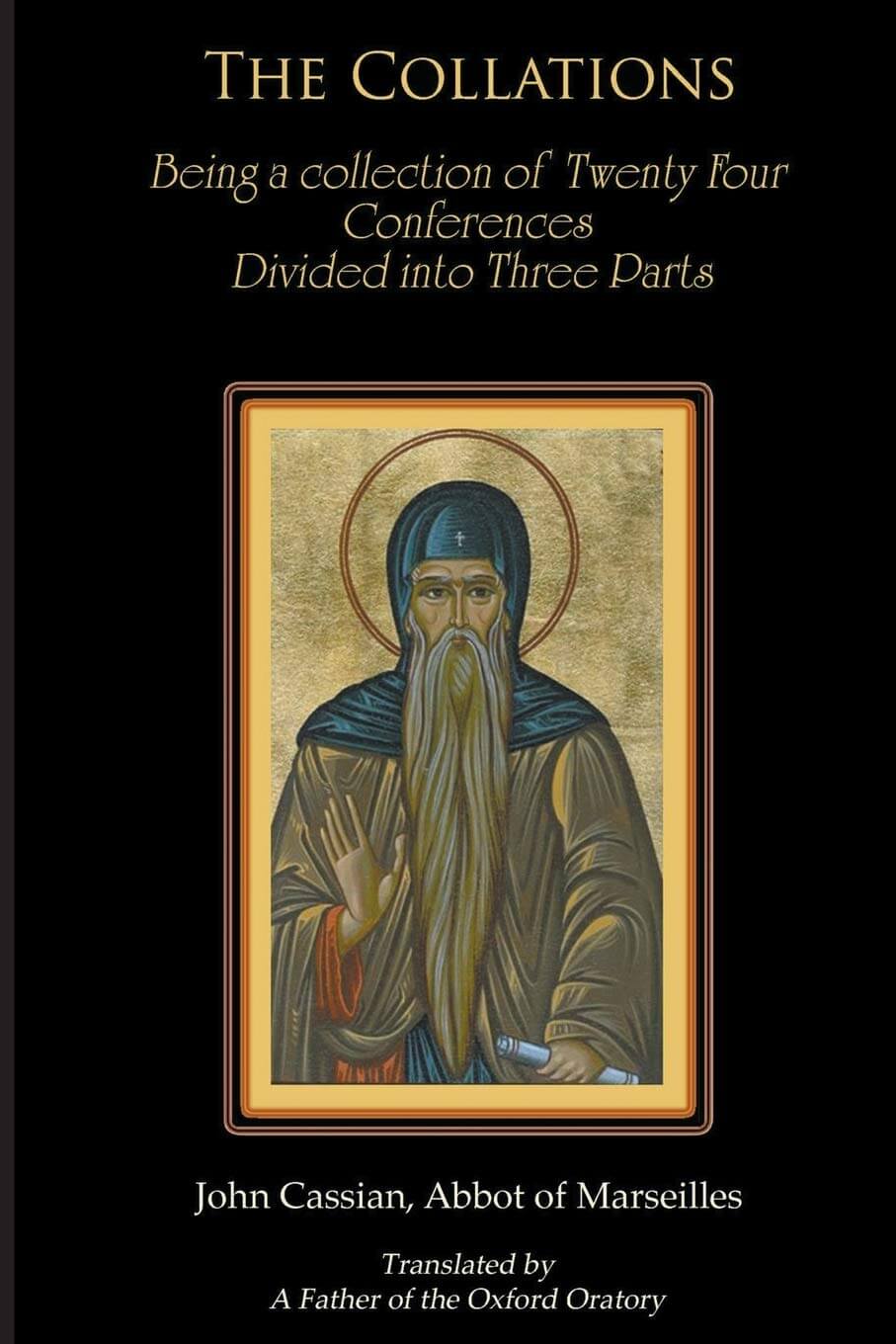
The Collations of St John Cassian are among the oldest and most influential books of Christian spirituality. The book is presented as a series of conversations between Cassian, his friend Germanus, and the great monks of the Egyptian desert, preserving the wisdom of men who had devoted their lives entirely to the pursuit of holiness.
The reflections over the coming weeks are based on ideas found in the Collations. There is no need to read them to follow each reflection, but the work is available, in an excellent modern translation by our own Fr Jerome, from our bookshop in person and online.

On Saturday, Fr Rupert led a Men’s Oratory trip to the grave of Hartwell de la Garde Grissell in Mickleham.
Grissell was one of our greatest benefactors: he left the entire Relic Chapel and its contents to our church in his will! He served as papal chamberlain to three popes, and was one of the founders of the Oxford University Newman Society.
O God, giver of pardon and loving author of our salvation, grant, we pray you, in your mercy, that, through the intercession of Blessed Mary, ever-Virgin, and all your Saints, the benefactors of our community, who have passed from this world, may attain a share in eternal happiness. Through Christ our Lord. Amen.
We’re putting it all back

Our church is not as it should be, and it’s time to do something about it. We’ve already made a start on repairing the apse. The scaffolding is now visible through the sanctuary windows and repairs will begin this week. But the most dramatic works are about to take place inside.
We are restoring the High Altar to its original position. The original High Altar was chopped up and moved forward in 1966. Sadly that means we can’t simply reuse the remaining stone of the current altar, because there isn’t enough of it left. But it gives us the opportunity to put something back that is even better. A full description of the works is available here: oxfordoratory.org.uk/restoration
Work on the sanctuary will start in the week beginning 21 September and is scheduled to take six months. Taking out the current altar means that we will no longer be able to use it! The entire sanctuary will be screened off just in front of the altar rails, so work can proceed without having to close the church. We will begin setting up a temporary sanctuary in front of the screen this week. We will try to keep everything running as normal as much as we can, but there will be some disruption from the works.
Weekend Masses and confessions will all carry on as normal, as will the 7:30 and 6pm weekday Masses. However, from 21 September, the Monday–Friday 10am Mass, confessions and rosary will all be suspended for the time being. We hope to resume them as soon as possible, even while work continues in church, and particularly on the biggest feast days.
We are raising £3.3m to pay for the apse repairs, the High Altar and the restoration of the sacristy. We’re already 37% there. By the time you’ve donated, we’ll be even closer.
Generations before us built this church, enriched it and handed it on. We now have the opportunity to restore what has been lost, repair what has deteriorated, and leave St Aloysius ready to serve generations still to come.
Help us to put it all back: oxfordoratory.org.uk/putitback

“Blessed are the pure in heart”
Perhaps one of the most familiar passages in the Gospels is Saint Matthew’s account of Our Lord’s Beatitudes. Among them we find, “Blessed are the pure in heart, for they shall see God.” (Matthew 5:8) Saint Paul also reminds us that our vision of God will one day be complete: “For now we see in a mirror dimly, but then face to face.” (1 Corinthians 13:12)
The Catechism breaks purity of heart into three categories: charity, chastity, and love of truth. All three of these are important, but I think we tend to associate the word ‘purity’ primarily with chastity. It can sometimes seem like chastity is the pinnacle of Christian perfection because people are often most ashamed of sins against chastity. However, charity and love of truth are clearly as important too. Saint John Cassian, in his Collation On Chastity, reminds us that “charity and chastity are so closely linked that one cannot be possessed without the other.” Charity is the guiding principle of all the virtues, and so when we practise charity, chastity (and all the other virtues) will naturally follow.
Saint Philip offers similar advice about chastity. He says that “one of the most efficacious means of keeping ourselves chaste is to have compassion for those who fall through their frailty, and never to boast in the least of being free, but with all humility to acknowledge that whatever we have is from the mercy of God.” Saint Philip reminds us then that we should remain humble and love our neighbour if we wish to foster the virtue of chastity. Through acts of charity, we become pure in heart and so hope to see God face to face.
The Collations of St John Cassian are among the oldest and most influential books of Christian spirituality. The book is presented as a series of conversations between Cassian, his friend Germanus, and the great monks of the Egyptian desert, preserving the wisdom of men who had devoted their lives entirely to the pursuit of holiness.
The reflections over the coming weeks are based on ideas found in the Collations. There is no need to read them to follow each reflection, but the work is available, in an excellent modern translation by our own Fr Jerome, from our bookshop in person and online.
Constant communication with God
Cassian gives us good advice about how to prepare for prayer. All of the renunciations of a monk are aimed at helping to do this, but they are not enough. Despite seclusion and poverty, the monk can still be distracted by worldly desires. We do not have the same detachment as a monk. Therefore, how can we hope to observe sufficiency in our lives when we have so many things, and stop material concerns from distracting us?
Getting rid of our things is not the answer, since material concerns can affect even a monk who owns nothing. Cassian suggests grounding the mind in peace, and that peace comes from joy. If we have joy that permeates our life, then we may have material interests, but not concerns that capture our mind and prevent us from prayer.
It is quite natural that different prayers will come to us at different times. If we have material business to do, then we should carry that to prayer with us. We should not become so engrossed in material concerns that we are unable to pray about them because we cannot disengage from them for a moment.
We find great help in short, frequent prayers. These are so short that they do not have time to be disturbed, yet lift our mind to God. The relationship which they build with God means that, when we come to pray for longer, we are able to do so without distraction from material concerns. We are united less to them than we have become united to God through our frequent prayers.
Our life must be ordered in a way that is amenable to prayer. The point of religion is sanctification. That comes through Christ and through prayer that is a constant communication with God. We do this in different ways: Christ was healing at one time, teaching at another, praying vocally at yet another. Yet, we are never interrupted by any union greater than that which we have with God.
The Collations of St John Cassian are among the oldest and most influential books of Christian spirituality. The book is presented as a series of conversations between Cassian, his friend Germanus, and the great monks of the Egyptian desert, preserving the wisdom of men who had devoted their lives entirely to the pursuit of holiness.
The reflections over the coming weeks are based on ideas found in the Collations. There is no need to read them to follow each reflection, but the work is available, in an excellent modern translation by our own Fr Jerome, from our bookshop in person and online.
September Music
Sunday 6 September Solemn Mass 11:00
23rd Sunday of the Year
Missa Vidi speciosam Victoria
Tribue Domine Byrd
Te deprecor Byrd
Tuesday 8 September Solemn Mass 18:00
The Nativity of the Blessed Virgin Mary
Missa Quarti toni Victoria
Beata es Virgo Maria Byrd
Salve Regina a5 Lassus
Sunday 13 September Solemn Mass 11:00
24th Sunday of the Year
Missa de la Batalla escoutez Guerrero
Laudibus in sanctis Byrd
Caro mea Guerrero
Sunday 20 September Solemn Mass 11:00
25th Sunday of the Year
Missa Euge bone Tye
Ego flos campi Clemens
Salve Regina Howells
Sunday 27 September Solemn Mass 11:00
26th Sunday of the Year
Missa Tertia octavi toni Croce
O Domine Jesu Christe a6 Victoria
Portio mea White

Building Works Week 2
The scaffolding is still going up behind the apse — nearly at the top now. Meanwhile, we’ve been uncovering the secrets of the sanctuary, to find out what really is underneath the floor and decide how the foundations for the new altar will be built. More news on the altar works coming soon.