A Brief Guide to Holy Week

Ten days ago, Lent entered an even more serious time, the season of Passiontide. This is when we began to shift from our earlier focus on our sinfulness and Christ’s time in the desert to his approaching Passion and Death. The statues and images in church have been veiled in purple as a sign of our sorrow. The cross will be solemnly revealed on Good Friday; the other images will return dramatically on the night of Easter.

Holy Week began with Palm Sunday, when we remember Christ’s entry into Jerusalem and wave palm branches ourselves. Historically, this was the principal day on which Christ’s death was recalled, and so the whole of the Passion was also proclaimed, and our joy turned very quickly into sorrow.

The Sacred Paschal Triduum covers Maundy Thursday, Good Friday and Holy Saturday. During these three days, the liturgy takes on a very special form, helping us to recall all the events of Christ’s life and death in that same period. The Church now removes anything left that might be too joyful: even the holy water is taken away, and the bells are silenced and replaced with wooden rattles.

On Maundy Thursday, only one Mass is permitted, in the evening, in memory of the Last Supper and the institution of the Eucharist. Once again, our joy at these wonderful gifts takes a sudden turn at the end of Mass, when we recall Christ’s betrayal by Judas. The Blessed Sacrament is carried in procession to another altar, known as the altar of repose. There is a custom of staying to pray silently (or “watching”) with Jesus, recalling his agony in the garden, and his request that the apostles watch with him at least for an hour. The other altars of the church are stripped bare, preparing us for Good Friday, and reminding us of Christ being stripped and flogged by the Roman soldiers.

When we enter the church on Good Friday, we should be shocked to see not only all the images veiled, but now also all the altars stripped bare, and the tabernacle empty. The church is desolate, except for the altar of repose, where the Blessed Sacrament remains from the night before. This is the one day of the year that Mass is not celebrated. Instead, the Liturgy of the Passion takes place at 3pm, the hour that Christ died. Everything is restrained. There is less music. We begin in silence. The liturgy starts with a physical expression of our sorrow — there are no prayers of the Penitential Rite, but everyone falls to the floor as a sign of mourning. We hear the Passion again, and there are solemn prayers for the needs of the Church. Then the Cross is unveiled, and all are invited to come forward and kiss the Cross as a sign of our love for Christ who died upon it. The Blessed Sacrament is brought from the altar of repose and Holy Communion is given. By the end of the liturgy, though, the Church is truly empty: for once, the Blessed Sacrament is not present.

Holy Saturday is in many ways a day of nothingness and waiting. The main liturgy is the celebration of the Easter Vigil that night. Although once the sun has set, this is in fact no longer Saturday, but the beginning of Sunday, according to the ancient Jewish reckoning. The Vigil begins outside, where the Easter fire is lit and blessed. Then the Paschal Candle is prepared and blessed. The candle represents Christ’s body: at the moment it is lifeless. Five nails are inserted into it. Then it is lit from the fire. The fire is a symbol of the life of God, the Holy Trinity, returning to Christ’s body, raising him from the dead. The candle is carried into church and smaller candles are lit from it, showing that we share in the life of the Risen Christ. The deacon sings a long hymn of praise for all the works of God we celebrate on this night. Easter is not only the anniversary of Christ’s rising from the dead, but of the Passover too, since Christ died as the Paschal lambs were slain on Good Friday. We recall the events of the Old Testament that foreshadowed Christ’s Passover. Then as we draw to the end of our vigil, the lights go on, the organ sounds, the statues and images are seen again for the first time in two weeks, and the choir sings the Gloria, which we haven’t heard on a Sunday since Lent began. Then the joyful word Alleluia also returns, and the Easter Gospel is proclaimed. Baptismal water is blessed, ready to share this new life with all those who will be baptised in the coming year. Then everything returns to normal — only with even more than usual joy.

Ingrediente Domino in sanctam civitatem, Hebræorum pueri resurrectionem vitæ pronuntiantes, cum ramis palmarum: Hosanna, clamabant, in excelsis. Cum audisset populus, quod Jesus veniret Jerosolymam, exierunt obviam ei. Cum ramis palmarum: Hosanna, clamabant, in excelsis.

As the Lord entered the holy city, the children of the Hebrews proclaimed the resurrection of life. Waving their branches of palm, they cried: Hosanna in the Highest. When the people heard that Jesus was coming to Jerusalem, they went out to meet him. Waving their branches of palm, they cried: Hosanna in the Highest.

#oxfordoratory

View on Instagram

Our novices lead the Rosary after the 10am Mass each day. Though today will be the last Rosary for a little while, since it is will be replaced by Stations of the Cross on Monday to Wednesday of Holy Week.

#oxfordoratory

View on Instagram

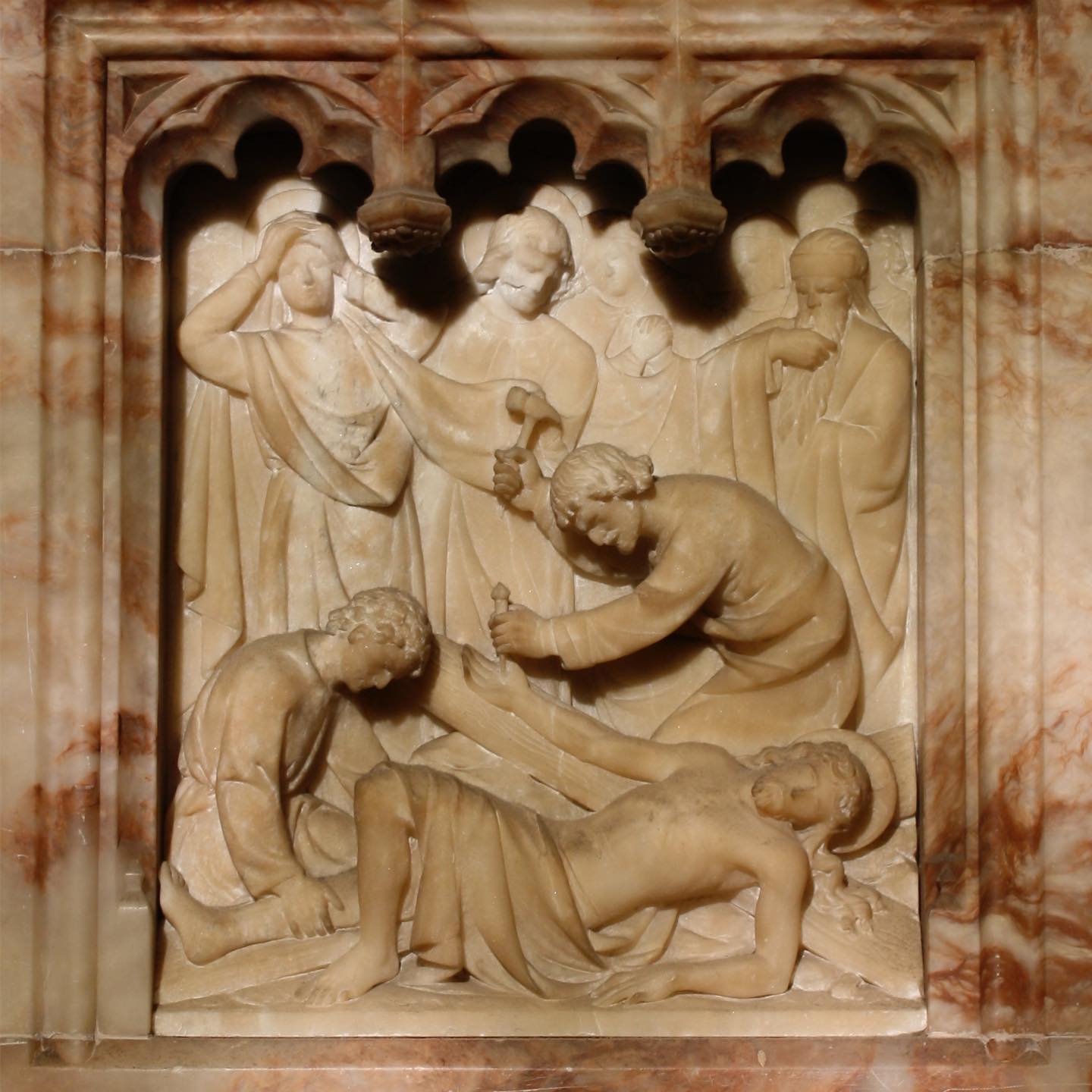
150 Years of St Aloysius’ Church: (10) The Stations of the Cross

It does not take a lot of imagination to realise that everything in our church — all the images and statues, the candles, the altar, etc. — everything points to what is central in our Faith, and that is the Incarnation. Every word preached in our pulpit, the confessions uttered and absolutions granted, the baptisms and marriages, and our funerals too, even the conversations with friends in the forecourt and Café Neri, all are they, all point to, all happen because of that fundamental Truth that the Word became flesh and dwelt amongst us — and dwells amongst us still in the Blessed Sacrament in the tabernacle of our church. That is why Christianity is fundamentally different to all other religions — our proclamation is not primarily what God taught, but what God did; that the redemptive work of Christ has fundamentally changed what it is to be human.

And that is what we realise when we mediate upon the Stations of the Cross. Our set of Stations, carved in alabaster by Basil Champneys, came to us from the former convent of the Holy Child Sisters. They are marvellously lit from behind and on cold dark nights they remind us of how Christ is the Light which shines in the darkness, and who cannot be overcome — not even by death. We pray those Stations each Friday in Lent at 17:30, and on Monday, Tuesday and Wednesday of Holy Week, we will pray them too at 10:30 each morning.

The Stations provide us with the opportunity to follow Christ from the Judgement Hall of Pilate, through every step of his Passion, until his Body, broken and pierced for us, is laid in the Garden Tomb and all come sorrowfully away. The Stations are based on the path of the Via Dolorosa in Jerusalem — the path trod by Christ himself to his Cross. Saint Helena, an Essex girl and daughter of old king Cole, is credited with identifying locations in Jerusalem, including the site of the crucifixion and burial, leading to the construction of the Church of the Holy Sepulchre. She spoke to the Christian community there, learning their traditions and all that they had received concerning the location of the Holy Places.

The precise route of the Via Dolorosa as we know it today was not firmly established until the medieval period when the Franciscans were granted custody of the Christian holy places in Jerusalem and then formalised the devotion associated with the Stations of the Cross. They organized processions and established specific stations along a route that pilgrims could follow, meditating on the sufferings of Christ. But of course, as now, not everybody could go up to Jerusalem, and so the Stations began to be erected in parish churches and other locations, far from Jerusalem, but enabling anyone to follow behind Christ and to meditate on his Passion, wherever in the world they may be.

There is a prayer to Our Lady of Sorrows which captures what we seek in making the Stations of the Cross:

Obtain for us the grace to hate sin,
  even as he hated it in the agony in the garden;
to endure wrong and insult with all patience
  as he endured them in the judgement hall;
to be meek and humble in all our trials
  as he was before his judges;
to love our enemies
  even as he loved his murderers, and prayed for them upon the Cross;
and to glorify God and to do good to our neighbour,
  even as he did in every mystery of his suffering.

April Music

Sunday 6 April Solemn Mass 11:00
5th Sunday of Lent
Missa Quarti Toni Victoria
Circumdederunt me Vivanco
Lamentations I Tallis

Sunday 13 April Solemn Mass 11:00
Palm Sunday
Pueri Hebræorum Victoria
Ingrediente Domino Malcolm
Missa brevis Palestrina
Christus factus est Bruckner
Improperium Palestrina
Vadam et circuibo Victoria

Wednesday 16 April Tenebræ 20:00
Tenebræ in Cœna Domini
Tenebræ Responsories Gesualdo
Benedictus Victoria
Christus factus est Anerio

Thursday 17 April Solemn Mass 20:00
Maundy Thursday
Missa Bell’ Amfitrit’ altera Lassus
Ubi caritas Duruflé
Dominus Jesus in qua nocte Palestrina
Pange lingua Victoria

Friday 18 April Solemn Liturgy 15:00
Good Friday
Christus factus est Anerio
St John Passion Victoria
Popule meus Victoria
Crucifixus a8 Lotti
Versa est in luctum Lobo
O vos omnes Casals
Crux fidelis King John IV of Portugal
Quomodo cantabimus Byrd

Saturday 19 April Easter Vigil 21:00
Holy Saturday
Missa Laetatus sum a12 Victoria
Christus resurgens Allegri
Dum transisset Taverner
Chorale Improvisation sur ‘Victimae Paschali Laudes’ Tournemire

Sunday 20 April Solemn Mass 11:00
Easter Sunday with orchestra of period instruments
Coronation Mass Mozart
Victimae Paschali Laudes M Haydn
Regina cæli Mozart
Hallelujah Handel
Organ Concerto in F major Op. 4 No. 5 Handel

Solemn Vespers 17:00
Deus in adjutorium Croce
Haec dies Sheppard
Magnificat tertii toni Vivanco
Ecce vicit leo Philips
O salutaris hostia Elgar
Tantum ergo de Séverac
Regina Caeli Howells
Prelude and Fugue in D ‘Halleluja’ Franz Schmidt

Sunday 27 April Solemn Mass 11:00
2nd Sunday of Easter
Missa Victimae paschali laudes Animuccia
Dic nobis Maria Bassano
Surrexit Pastor bonus Lassus
Alleluyas Preston

A watercolour of our church presented by St John Henry Newman in thanksgiving for the hospitality he received when he preached on Trinity Sunday 1880.

When asked by his bishop ‘What are the laity?’ Newman responded: ‘the Church would look foolish without them.’ His gift rather illustrates the point.

We have nearly completed the tour of our church in our weekly reflections, which you can find on our website, or sign up to our e-newsletter to receive them straight to your inbox.

#oxfordoratory

View on Instagram