
Congratulations to Fr Rupert, who completed his noviciate today, the feast of Our Lady of Oxford.
Congratulations to Fr Rupert, who completed his noviciate today, the feast of Our Lady of Oxford.
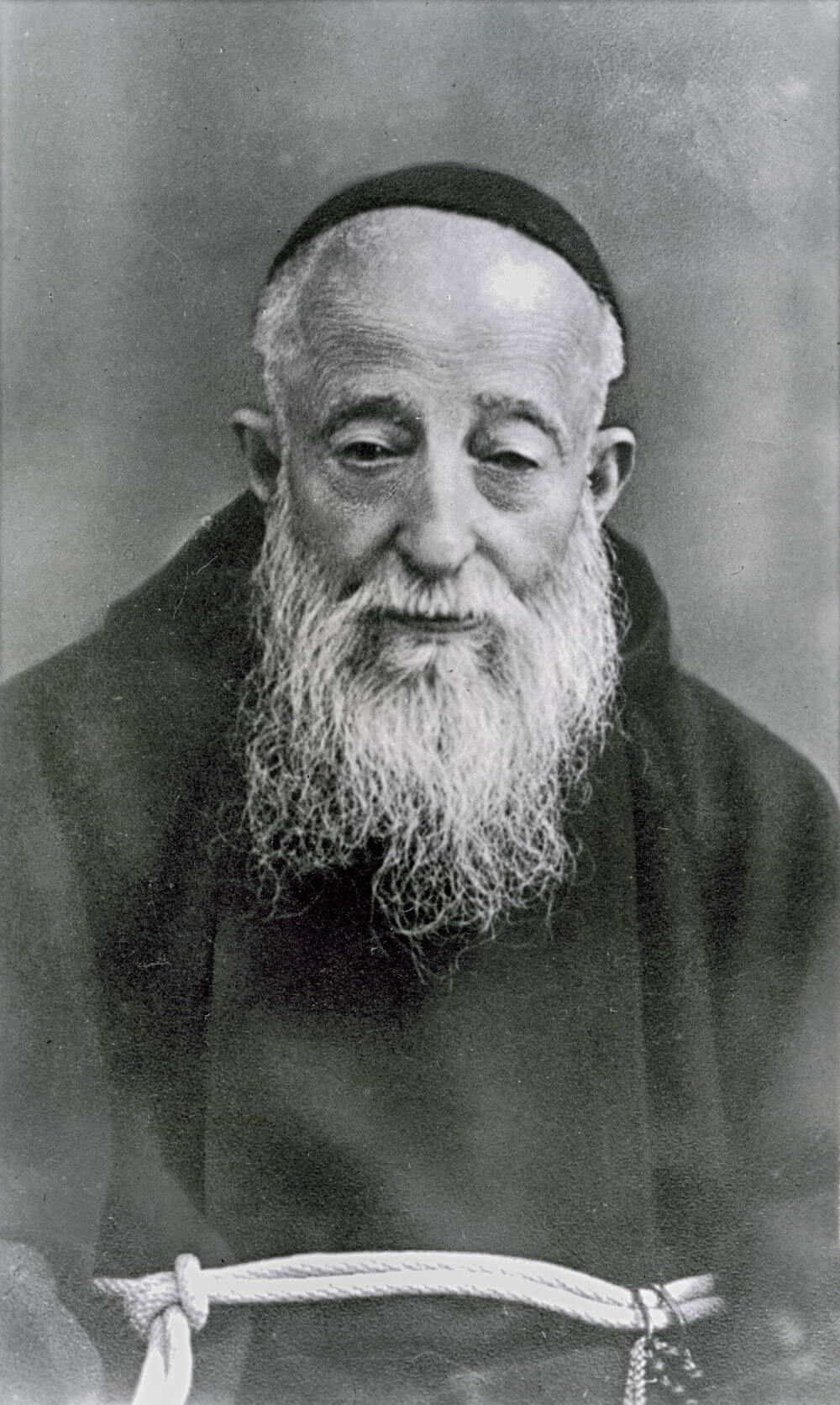
It is always good to learn about the saints, especially those who are more obscure, yet whose lives reveal so much about the Lord and his workings in the Church and the world.
Born in 1866 in the coastal town of Herceg Novi, in present-day Montenegro, Leopold Mandić was a sickly child, who remained frail and often unwell throughout his life. His small stature, poor health, and speech impediment might have rendered him an unlikely candidate for the priesthood, yet the Lord chooses whoever he wills, and sanctity does not depend on natural strength but grace. As St Paul reminds us, “power is made perfect in weakness” (2 Cor. 12:9). In his bodily fragility, Leopold bore a spiritual strength that would be poured out for the good of souls, mostly in the sacrament of reconciliation for over four decades.
Fr Leopold’s dream had been to work for the unity of the Eastern and Western Churches in his native Balkans, rather as our own St Philip had longed to join St Francis Xavier in his missionary endeavours in Asia. But, as Philip had been told that Rome was to be his Indies, Leopold too, was thwarted in his desire, his superiors assigning him instead to the Capuchin friary in Padua. There, he spent the last 40 years of his life, mostly within the tiny confines of his confessional cell. As Pope St John Paul II noted at his canonization in 1983: “He was a man of hope, a man of the future, a man of unity, above all in the Church.”
That man spent twelve to fifteen hours a day hearing confessions. To those who met him, his confessional seemed not merely a stuffy little room, but a gateway to divine mercy. As Paul VI observed of him:
“He gave himself to everyone; he was always ready to receive the sinner, to comfort the afflicted, to encourage the faint-hearted.”
Leopold’s greatness lay not in grand gestures but in faithful repetition of one act: the absolution of penitents. He lived and breathed reconciliation. In this he might truly be said to be a patron of confessors, and indeed, Pope John Paul II would later name him as such.
As penitents knelt before him, often hesitantly, they encountered not judgment but healing. He was known for his gentleness, even being criticised by some for being too lenient. Yet he would reply:
“I am only an instrument. It is God who forgives. Have no fear.” On one occasion, he pointed to the figure of our Lord on the Crucifix and exclaimed: “It is he who died on the Cross for sinners, not we! It is he who pardons, it is he who absolves. He the Shepherd of the flock.”
Like St Philip, Father Leopold believed that mercy, not severity, converted hearts. Both these pastors knew that the Church is tender towards penitents and, while she is severe towards sins, she is loving towards sinners.
There is an Oratorian resonance in Leopold’s hidden life. He was not prominent in public ministry — a speech impediment made it impossible for him to preach — yet he fulfilled his calling perfectly in one place, in quiet obscurity. In this he reminds us of Thomas à Kempis’s dictum, which St Philip took up with zeal: Amare Nesciri – love to be unknown. St Leopold embraced obscurity joyfully, even saying: “We hide everything, even what may appear to be a gift of God, so as not to make it an instrument of profit. To God alone be all honour and glory! If it were possible, we should pass over the earth like a shadow that leaves no trace.”
The Oratorian tradition has long understood the importance of availability: being ready to serve, to sit in the confessional, to listen. Like St Philip Neri, who preferred a small room and a large heart, Leopold’s little cell of reconciliation became the threshold of eternity for thousands.
Throughout his life, Leopold cultivated a profound devotion to Our Lady. He would entrust each penitent to her care, saying: “Have confidence. The Madonna will help you.”
When bombings in World War II destroyed much of his friary and its church, Fr Leopold’s confessional cell miraculously remained intact. It is not difficult to imagine the hand of the Madonna over that spot. For Leopold had said: “The Madonna will see to it that this little place of mercy is spared.”
His devotion to the Blessed Virgin was not mere sentimentality. It was the source of his confidence, the fire behind his mercy, the explanation for his hope. He knew Our Lady as Mater Misericordiae, the Mother of Mercy, just as the Church names her in the Salve Regina. He invited others to her, trusting that her maternal heart would lead souls home.
In this, too, he stands close to St Philip, who placed every penitent under the care of the Virgin and who himself loved to spend time in contemplation before Barrocci’s beautiful painting of the Visitation in the Oratory church in Rome.
Though Leopold was never permitted to return to his homeland, he never ceased to pray for the unity of East and West. His sufferings, disappointments, and obedience were offered for the reconciliation of the Orthodox and Catholic Churches. Today, when the Church again experiences wounds of division, his intercession is more timely than ever.
John Paul II said at his canonization: “In this humble son of St Francis, the Lord has given his Church a prophet and minister of spiritual reconciliation.”
Leopold becomes for us a patron not only of confession, but of ecclesial healing, of the slow and hidden work of bringing people back into communion — not through polemic, but through prayer and patience.
In a time that prizes visibility and achievement, St Leopold reminds us of the grandeur of hidden fidelity. He did not seek recognition. He simply stayed at his post — day after day, hour after hour — waiting for sinners. And he welcomed them with joy and tremendous kindness.
His life is an answer to the question: What does God do with the weak? He uses them to show that mercy is stronger than sin, and that “he who humbles himself shall be exalted” (Lk 14:11).
May his life renew in us the confidence to live quietly, serve humbly, forgive readily, and serve as instruments of reconciliation.

To continue the celebrations of our church’s 150th birthday, we have just republished Fr Martindale’s history “Catholics in Oxford”. Available now from our bookshop, in person and online: https://tinyurl.com/catholics-in-oxford (Now with reduced shipping costs!)
First published in 1925, Catholics in Oxford by Fr C.C. Martindale SJ is a vivid and engaging account of the Catholic revival in Oxford. This centenary edition commemorates both the original publication and the 150th anniversary of St Aloysius’ Church — the parish at the heart of that revival, now home to the Oxford Oratory.
Fr Martindale traces the often dramatic and moving history of the Church in Oxford, from the era of the Reformation martyrs through to the Jesuit missions to the city; how Oxford very nearly became Catholic again more than once; and on to the remarkable Catholic resurgence in the 19th century that led to the building of St Aloysius.
A fascinating read for anyone interested in the return of the Catholic faith to England, and especially for those who know and love the city and characters Fr Martindale describes.
The prophet Elijah is on the Church’s mind at the moment. The readings of the Divine Office have been working their way through his story in the first book of Kings. Today’s feast reminds us of him. ‘Our Lady of Mount Carmel’ was the name of the chapel where the first Carmelite hermits lived and prayed under Our Lady’s patronage and after the example of the prophet Elijah. It had been on Mount Carmel that Elijah had his great contest with the prophets of Baal: ‘You call on the name of your god and I will call on the name of the Lord; and the God who answers by fire, he is God.’ (1 Kings 18:24) Naturally, it was Elijah’s prayer that was answered, though not after he had spent a good amount of time mocking the false prophets.
His success brought enemies, notably the queen, Jezebel, whose prophets Elijah had defeated. So Elijah ran away to safety, finding himself on Mount Horeb, the mountain of God. There he encountered the Lord, who was not in the wind, earthquake or fire, but the still small voice.
‘What are you doing here, Elijah?’ the Lord asked, and Elijah replied: ‘I have been very jealous for the Lord, the God of hosts; for the people of Israel have forsaken thy covenant, thrown down thy altars, and slain thy prophets with the sword; and I, even I only, am left; and they seek my life, to take it away.’
The great prophet Elijah was feeling a bit sorry for himself, and unjustly so. ‘I’m so miserable,’ he says, ‘I’m the only prophet left, it’s just me, only me, me me me me.’
And that’s simply not true. When later on Elijah hands over to Elisha, there is a whole crowd of faithful prophets to witness the event. Not only is Elijah not the only faithful Israelite left, he’s not even the last prophet. True, he alone stood up to the prophets of Baal on Mount Carmel. And yes, a lot of people seem to have it in for him. But it’s not all as bad as he makes out. And so God gives him a bit of a metaphorical kick and tells him to pull himself together and do some work.
Sometimes that’s what we need too. But we can avoid getting into that state in the first place if we remember that, like Elijah, it’s not really as bad as we might make out, because it isn’t all about us. Elijah had worked great miracles because God was with him. Then he was down and feeling sorry for himself because he thought he was all alone and his life was under threat. But clearly, God was looking after him, otherwise he wouldn’t have worked those miracles and got himself into so much trouble in the first place.
Elijah had reached a half-way point in the spiritual life, when things begin to get a bit tough, when his life wasn’t quite as he expected it to be, and he was tempted to give it all up and turn back. If we ever feel like that, we should remind ourselves that, like Elijah, it was God who brought us this far to begin with. And like Elijah, he won’t abandon us when we need him most.
On Friday we will celebrate the feast of St Benedict, father of western monasticism. Benedict is also the first, and for some time the only, patron saint of Europe. He was given this title because in the turmoil of the dark ages following the fall of the Roman Empire, when so much culture, learning and faith was threatened by the turmoil of political upheaval and social change, it was the monks and monasteries that followed his Rule who preserved Western civilisation until it could flourish once again. So much of what we take for granted today — from classical learning to farming methods, science and technology to theology and philosophy, schools, universities, even modern economic theory and banking systems — comes from the diligent work of monk-scholars, monk-farmers, monk-teachers. Benedict’s search for God led him to flee the corrupt city to build new communities in the hills and countryside, where nothing was to be preferred to the work of God, but where every human skill and talent was harnessed in his service.
A few years ago, some Catholic commentators proposed a new Benedict Option. Looking at the political upheaval and social change in our contemporary world, increasingly dark and godless, they proposed that the time had come for Catholics to flee to the hills once more. This option seeks to build strong Christian communities behind closed doors and high walls, where the world cannot penetrate, to preserve our faith and our culture until better days to come. This is a very tempting solution to a very pressing problem: how are we do deal with a society in which our voice is increasingly shut out? How can we change a world that seems set on a path to ruin? Pull up the drawbridge and wait until it is over.
That is an exaggeration of a very nuanced position, of course, and a disservice to the genius of Benedictine monasticism.
As Abbot Cuthbert reminded us in his St Philip’s day sermon, there are many similarities between Benedict and St Philip, between monasticism and Oratorianism. St Philip, like St Benedict, loved stability of place, valued the early Fathers of the Church, and stressed the importance of the liturgy. St Philip’s approach, however, was not to flee the world but to live in the midst of it and engage with it, using every tool of learning and culture to lead souls to God. Philip went out to the public squares and market-places, into the palaces of the wealthy and the powerful, with his simple message: “When shall we begin to do good?” Benedictines transformed and cultivated the whole landscape of the Christian world; Philip converted its very heart.
One of our own parishioners wrote an article describing the Oratorian Option, a way of facing the contemporary world in the spirit of St Philip. This option does not reject the world but perseveres in it, quietly, gently, but effectively continuing to evangelise it from the inside out, through preaching and the sacraments, using all that is good, true and beautiful of human culture to turn hearts back to God.
The Benedict or Oratorian Options are not, of course, the only available ones as the Church continues her mission today. There is room too for the Franciscan Option of radical detachment and poverty, or the Jesuit Option of zealously undertaking any work for the greater glory of God, or the Carmelite or Carthusian Option of being the beating powerhouse of prayer in the Church. There are as many options as there are charisms — in fact, as many options as there are Christians. The one Body of Christ is made up of many different members, each with its own work, each a necessary part of the whole. As long as we are faithful to our own vocations, in the particular times and places where we find ourselves, preferring nothing to Christ, we can be sure of his promise: civilisations may fall, political systems may crumble, learning may be lost, bombs may drop and evil legislation may be passed, but the gates of hell will never prevail against the Church.
Sunday 6 July Solemn Mass 11:00
14th Sunday of the Year
Missa Brevis Palestrina
Hortus conclusus Ceballos
Salve Regina Palestrina
Sunday 13 July Solemn Mass 11:00
15th Sunday of the Year
Missa Quarti Toni Victoria
Beati omnes qui timent Dominum Purcell
Salve Regina Poulenc
Sunday 20 July Solemn Mass 11:00
16th Sunday of the Year
Mass for Four Voices Byrd
Exultate justi Viadana
Ave verum Byrd
Sunday 27 July Solemn Mass 11:00
17th Sunday of the Year
Mass for Four Voices Tallis
Tota pulchra es Vals
Ave Maria L’Heritier
Of the many relics we are blessed to have here at the Oratory there is one which is very rarely seen at all. It is visible after the stripping of the altars on Maundy Thursday and at other times during the year when the altar cloths are changed, but otherwise it is always covered. The altar of Our Lady of Oxford was part of the bequest of Hartwell de la Garde Grissell and had stood in his private chapel on the High (at number 60) before being moved to our church at his death. In the mensa of the altar was set a portion of the altar from the house of Saint Pudens the Senator, upon which St Peter the Apostle celebrated the Mass. It is a beautiful connection between our church, this house of Saint Philip Neri, Apostle of Rome, and the Prince of the Apostles. In former times a copy of the bronze statue of St Peter in the Vatican Basilica also graced our church — of which only part now remains (wouldn’t it be wonderful to have such a statue again!). It was Cardinal Baronius of the Roman Oratory who popularised the devotion of kissing the feet of the statue of St Peter, now very much worn away by the pious devotion of pilgrims.
In Rome, away from the Vatican Basilica which stands above his tomb, there is another place of devotion to St Peter, where the Via Ardeatina branches off the Appian Way, we find the church of Santa Maria in Palmis, also known as Chiesa del Domine Quo Vadis. This chapel commemorates the tradition that, as St Peter was fleeing Rome at the height of Nero’s persecution of Christians, he met the Risen Lord who was walking in the direction of the Eternal City. Peter asked the Lord ‘Domine, quo vadis?’ — Lord, where are you going? — and received the answer ‘I go to Rome to be crucified again’. Peter understood, turned around and went back to Rome there to die for Christ, crucified upside down on the Vatican Hill. As he returned, St Peter must have thought of those long-off days beside the Sea of Galilee where he was first called to be a fisher of men; of all he had been through in his following of Christ, of those moments of wonder and of difficulty, of restoration and of resurrection. Once, when Christ preached the doctrine of the Eucharist, it had been made clear that some would find the narrow way to be too much of a challenge, too much of a demand — and it was Peter who affirmed to the Lord that whatever the Way might ask of them, it was the only one to lead to Heaven: “Lord, to whom else would we go? You have the words to eternal life.”
This transitory life of earth, this training ground for Heaven, will often find us asking ourselves ‘Where are we going?’ or ‘What are we doing?’ Like St Peter, we might sometimes wonder what the Lord is asking of us; we may struggle to make sense of what the following of Christ means for us, or perhaps find ourselves endlessly wondering what the Lord has in store for us. Yes, Peter had his difficulties. Indeed, he did not always find the courage to follow the Lord. But before all he confessed the Faith, and followed Christ to the very end. The only real answer to the question of where we are going — where we hope to be heading — is Heaven. That is the only direction we can ever hope for our life to take, the only way, difficult though it sometimes may be, on which we dare to tread. St Peter returned to Rome to die because he knew that through martyrdom he would find his Friend again, and for ever — never to be parted from him. That is the joyful hope that we must live in, knowing that all things pass away, except for the love of God in which we hope to live for ever. Whatever questions we might have about our path, our own life, we find our confidence, our hope, and the measure of our worth in belonging to Christ, in hoping always for Heaven.
The Protestant pastor Dietrich Bonhoeffer, who was imprisoned and died because he stood against the crowds of anti-Semites of a previous generation, wrote a beautiful poem from prison entitled ‘Who am I?’, asking those searching questions which come to us all. He concludes:
Who am I? They mock me, these lonely questions of mine.
Whoever I am, thou knowest, O God, I am thine!
The rock we cling to is Peter, that firm faith which gives us the happy hope of Heaven. Wherever life takes us, the only place we want to go is there.

For the feast of the Sacred Heart, another picture from the archive, this time showing the decoration of the walls much more clearly.