OYA by Zoom

“When the going gets tough, the tough get praying”
Prayer in Times of Distress

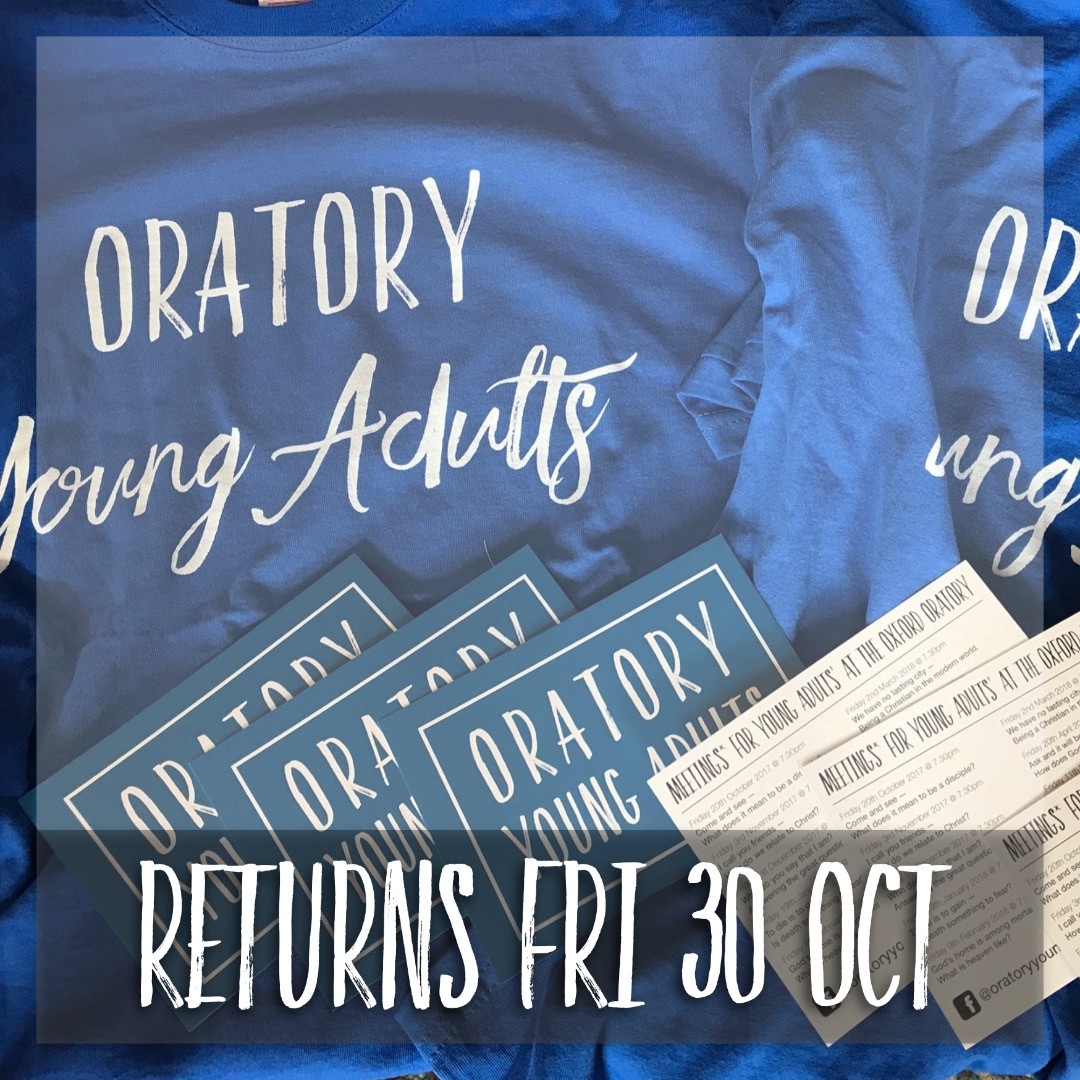
Prayer is something we should rely on when things get tough. In times which are distressing, or when we are knocked off course, turning to prayer should be our first reaction, and with good reason. God is there to help. Join us later today for our first meeting for young adults of this season. We can’t wait to welcome you.

Today’s meeting will now be via Zoom only.

We had hoped to start meeting in person again, but that is not yet possible as Oxford prepares to move into the next tier of local restrictions.

We’ll be starting at 8pm and finished by 9pm. We’ll jump straight into the introduction as soon as we’re ready. We’ll use the breakout room feature of Zoom so that everyone can discuss the questions in small groups as we would normally. Then through the wonder of technology, everyone will be transported back to the main meeting for the final talk.

There will still be the usual prayers at the end (without the singing!), but we won’t have the period of silent prayer in front of the computer screen — that’s best left till later.

We look forward to seeing you all, wherever in the world you may be at the moment!

“It is generally better to give the body rather too much food than rather too little; for the too much can be easily subtracted, but when a man has injured his constitution by the too little, it is not so easy to get right again.” — St Philip. #oxfordoratory

View on Instagram

‘You will not leave my soul among the dead’

Since the clocks changed last weekend, it is suddenly getting darker much earlier. Winter is definitely on its way. And knowing that those long winter nights can become oppressive, the Church, like any good mother, tries to cheer us up. And so she invites us to think about death.

It’s not just because the evenings are dark in November that we think about the faithful departed. And it’s not just the faithful departed that we are thinking about. The month of the Holy Souls begins with the celebration of All Saints. That should be our starting point too. When we think about death, it should be through the lens of the glory of heaven. Yes, death itself is always a tragedy, a consequence of original sin, and ‘the last enemy to be defeated.’ (1 Cor. 15:26) ‘Death was never of God’s fashioning; not for his pleasure does life cease to be.’ (Wis. 1:13) But death is not an end in itself. Death, for those who are united to Christ in this life, is a gateway to that heavenly life with the One who made us for himself.

Prayer for the faithful departed is an expression of that same hope — there is only one way out of Purgatory! And yet many of us may still feel great sadness as we call to mind those we pray for.

Not all weeping proceeds from unbelief or weakness. Natural grief is one thing, distrustful sadness is another, and there is a very great difference between longing for what you have lost and lamenting that you have lost it. (St Ambrose, De excessu fratris)

Christ himself was disturbed by the thought of death. St John tells us that he was ‘troubled in spirit’ (Jn 13:21). He says to his disciples, ‘My soul is very sorrowful, even to death.’ (Matt. 26:38; Mk 14:34). He sweats blood during his agony in the garden, when he prays to be released from the death he knows he is about to undergo. So Christ shows us that death is evil. It is acceptable to be scared by it, but we mustn’t let it get in the way of our journey to the Father. ‘Now is my soul troubled. And what shall I say? “Father, save me from this hour”? No, for this purpose I have come to this hour. Father, glorify your name.’ (Jn 12:27–28)

Christ has conquered death. That doesn’t remove the fear, but it helps us to deal with it. Someone who is not frightened by death clearly doesn’t understand what it is. It’s like holding a poisonous snake and saying you’re not scared of it — clearly you don’t know what it’s capable of. But if we admit that death is something scary, then we truly can be courageous in the face of it. Courage is not the absence of fear that comes about through ignorance. Courage is confronting something scary with a good reason for hope. And we have God-given hope, because Christ has conquered death, and is holding the door to heaven open for us.

And so my heart rejoices, my soul is glad; even my body shall rest in safety.
For you will not leave my soul among the dead, nor let your beloved know decay.
You will show me the path of life,
the fullness of joy in your presence, at your right hand happiness for ever. (Psalm 15)

Helping the Holy Souls

During November, there are always additional opportunities to obtain plenary indulgences for the Holy Souls in purgatory by: (1) visiting a church on 2 November and praying the Our Father and Creed; (2) visiting a cemetery and praying for the faithful departed on any of the days between 1 and 8 November (it is possible to obtain an indulgence each day that this is done). As with all plenary indulgences, it is also necessary to go to confession, receive Holy Communion, pray for the Pope’s intentions and be detached from all sin.

This year, the Holy Father has made it easier to obtain these indulgences, in light of the global restrictions, as follows: (1) Any one day in November can be chosen to visit a church and pray the Our Father and Creed. (2) Any eight days (which do not need to be next to each other) may be chosen to visit a cemetery and pray for the faithful departed. It is also possible for this to be a ‘mental’ visit to a cemetery.

In addition:

The elderly, the sick and all those who for serious reasons cannot leave home, for example owing to restrictions imposed by the competent authority for the time of pandemic, in order to avoid numerous faithful crowding into sacred places, will be able to achieve the Plenary indulgence provided that, spiritually uniting with all the other faithful, completely detached from sin and with the intention of complying as soon as possible with the three usual conditions (sacramental confession, Eucharistic communion and prayer according to the intentions of the Holy Father), in front of an image of Jesus or of the Blessed Virgin Mary, recite pious prayers for the dead, for example Lauds and Vespers of the Office of the Dead, the Marian Rosary, the Chaplet of Divine Mercy, other prayers for the faithful departed, or occupy themselves in the prayerful reading of one of the Gospel passages proposed by the liturgy for the dead, or perform a work of mercy by offering up to God the pains and sufferings of their life.

Trying to pray

Speaking with a number of people, both parishioners and other friends, I have been struck by how more than a few have said how difficult it was to pray during the time of lock-down. Quite a few admitted that they had thought that with nothing much else to do, there would have been ample time and scope to pray more, but as the days and weeks progressed, they had felt less and less inclined to pray at all. Most had found this inability to spend time comfortably with the Lord distressing. Why was this, they asked. It’s not an easy question, because, as with most things in life and in matters of faith, one size does not fit all. Each climbs to heaven by his or her particular stairway. Although we travel together as God’s people, this journey of faith is essentially deeply personal.

‘Prayer is the raising up of the heart and mind to God’, as the old Catechism assured us. I always rather liked the late Cardinal Hume’s tweaking of this classic definition of prayer, as ‘trying to raise our hearts and minds to God.’ This seems to express our common experience rather better.

For some of us, prayer is a matter of the Morning Offering and an Our Father, Hail Mary and Glory be before bed, with aspirations and other occasional prayers thrown heavenward, during our busy day. Faced with more ‘free’ time to fill, we are left wondering what on earth to say. The time we have mentally put aside for extra prayer, yawns ahead, empty and uninviting. We cast around for ideas, which are soon exhausted and give up in disgust, defeated.

So, what do we do? Should there be another lock-down, how can we try to avoid too much floundering in prayer? Well, maybe we can’t, not completely, though we might remember something St Catherine of Siena said: ‘the art of prayer is that there is no art,’ and ‘every time and place is a time and a place for prayer.’ Of course, prayer in front of the Blessed Sacrament is undoubtedly the best place to pray, but if we are unable to get to a church, then we should find a quiet place and make, so to speak, our domestic oratory there.

St Francis de Sales advised those who found prayer impossible: ‘if you can’t pray, then pray.’ It may not seem very satisfactory, but it is still talking to the Lord who doesn’t require us to be raconteurs, regaling Him with stories and lengthy explanations about the situations and people for whom we are trying to offer some sort of prayer. He knows all we need and desire before we ask, but, all the same, He does like to be asked.

The key is perseverance. We must keep in mind the One with whom we are wanting to be in conversation. We must desire God. Only then, will we persevere in our efforts to pray. Remember Robert Bruce and his spider!

There will always be dryness, distractions and fatigue, but by putting one foot in front of the other, so to speak, we can keep going and shall find the Lord, who seems so elusive, as if playing hide-and-seek with us, but who does, I believe, wish to be found.

Meanwhile, plan to pray and make time to do so. Don’t look for results or try to manufacture emotions. Ultimately, prayer is a discipline and jolly hard work, but as all the saints, living and dead, know, it is well worth the effort. So, let’s keep trying to pray, no matter how badly we may feel we do it, and rather than praying for ourselves, let’s continue to pray for one another.
November Dead List

Each week in November, we set aside a day that all Masses are for the repose of the souls of those names included in our November Dead List. To enter the names of your loved ones on this list, you can collect an envelope available from the back of church and return it with a list of names and an offering. Alternatively, you can submit names and your offering online. Click here to make your offering and type the names of those you want us to pray for in the box that says ‘Add a note’.


Giving explained

We rely on your generous support to keep our church open. The traditional cash collection isn’t possible at the moment, so we’ve recently introduced some new ways of giving. This is a guide to how they work.

If you are a UK taxpayer, the gift aid scheme allows us to claim back from the government the tax you already pay on your donation. If you give us £4, the government gives us an extra £1. To do this, we need to be able to link your gift with your name and your address. The way we do this depends on your donation method, but we can still claim gift aid however you choose to give. It also ok if you’re registered for gift aid with another charity — there is no limit to how many charities you can register with for gift aid.

Contactless Giving

Our new contactless donation box is really easy to use. All you have to do is tap the screen with a contactless credit or debit card, and the Oratory will receive £5. If you want to, you can adjust this amount by touching the number and following the on screen instructions.

To claim gift aid on these donations, go to donor.swiftaid.co.uk/register and fill in your details. Swiftaid stores your card number securely so that whenever you donate using our contactless terminal, they recognise who you are and process the gift aid for us. No card numbers are ever passed on to the Oratory, either by the contactless terminal or by Swiftaid. That’s why, even if you have already registered for gift aid with us, you will still need to register with Swiftaid online to gift aid your contactless donations.

Standing Order

If you want to give the same amount regularly, this is the easiest way to do it. We don’t have to pay any fees on money we receive in this way. Pick up a standing order form from church (or request one from us), fill in your details and return it to us. If you are a taxpayer, all you need to do is complete the gift aid section at the bottom of the form. You can choose exactly how much you want to give, and whether you want to give weekly, monthly or annually. We process the form and send it to your bank. You’re in complete control, and you can cancel or change your standing order at any time by contacting your bank in the usual way.

Online Donations (PayPal)

You can make card donations online at oxfordoratory.org.uk/donate. You don’t need to be registered with PayPal to do this, but having a PayPal account should speed up the process. To gift aid your donation, all you need to do is tick the gift aid box. You can make a one-off donation, or you can set up a regular recurring donation by following the on screen instructions.

Cash collections

There isn’t a collection at the usual place during Sunday Masses at the moment, but a collection is taken at the door as you leave. There are collection boxes at the back of church that can be used during the week too. If you are a UK taxpayer, please put your offering in a gift aid envelope available at the back of church. Use a white envelope if you are just visiting, or complete a gift aid form and use a brown gift aid envelope, which saves you filling out all your details every time you give.