Pointing to Christ

The Gospel readings for the Sundays of Advent, in both forms of the Roman Rite, feature that great man of the Advent Season, St John the Baptist, the Forerunner, the voice crying in the Wilderness, “Prepare the way of the Lord!”

St John is one of those great figures we meet in the Scriptures who continues to speak to us today as forcefully and as effectively as they did when they walked this earth. He is a type, a figure, a model, a pattern. He is someone in whom some of the great biblical themes and ideas converge; they take on a name, a face and a voice; and then they re-echo down through the ages. John is the great herald of the Messiah, and a mirror for seeing ourselves. He is the last and greatest of the prophets who proclaims the coming of the Lord, and is the first to announce that the Lord is here.

One striking thing is surely this: just how, from his mother’s womb, he is completely turned towards Christ. His own birth anticipated Christ’s, and so did his death. His whole life’s work, with the silent preparatory years in the desert, was to prepare a people fit for the Lord, and to make straight his path. He was the new Elijah sent to prepare for Christ’s coming. He is his herald, and the last in the line of Israelite prophets, the one in whom hope for the messiah becomes most explicit. Whereas the prophets could only point to the Messiah with their words and their faith, St John could point with his finger at the Lamb of God. And the climax of his mission was to baptise Jesus and so reveal him to Israel and beyond as the Son and Servant of God. He is all prophet, nothing but prophecy. He embodies all that Israel was ultimately about: the coming of the Christ. And more than that, he gives us the meaning of what it is to be human. Christ is the light, the source and centre of the universe and of human history. And we are all called to reflect that light, to turn to that light, and to allow ourselves to diminish so that we can be more that light than not. 

This is the great truth John brings every generation. Turn to Christ, look at him, welcome him, “Behold” him. When Herod beheaded John, he thought he had silenced that inconvenient voice for ever. But two thousand years later, it is ringing out around the world, thousands of times every day, every time Mass is celebrated: Behold, the Lamb of God. 

St John the Baptist’s mission was to prepare for the first coming of Christ. The Church’s mission, and ours, is to prepare for the second coming — and in fact for any and every coming of Christ into this world. This is why hermits and monks and contemplatives, waiting for God in the wilderness, have always cherished John the Baptist as a special patron. But also why many active Orders in the church — men and women religious who have nursed the sick, served the poor, taught the children — have likewise taken John as their patron. John reminds us to see and point out Christ when he comes to us in those in need, when he is suffering in those who suffer. He reminds us to see and point out how Christ can act in us and through us — how Christ can come into the lives of others through our words and deeds.

John calls us to live while pointing to someone greater than ourselves. To be happy to decrease, to feel poor, to be imprisoned metaphorically or even really, as long as Christ can increase and enrich and act freely around us. To be a voice that only wants to speak what is true, good, and kind, a passing voice at the service of the eternal Word. To prepare the Way of the Lord, and to announce his coming.
Current Church Opening Times

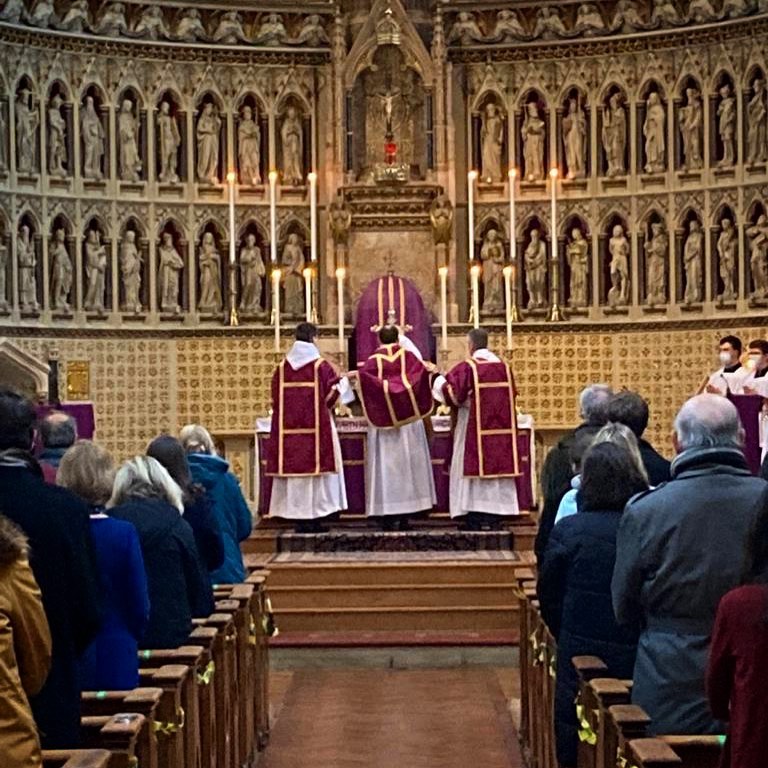
We are open for public Mass, confessions and private prayer.
Services in bold are also streamed on our YouTube channel.
No booking is required to attend any Masses, but a booking system will be in place for Christmas Eve and Christmas Day.

The current schedule is as follows:

Mass
Sunday 8:00 (EF), 9:30 (Sung English), 11:00 (Sung Latin), 12:30, 18:30
Mon–Fri 7:30, 10:00, 18:00
Saturday 10:00, 18:30 (Sunday Vigil)

Confessions
Mon-Fri 20 minutes before each Mass
Saturday 9:00–10:00; 17:30–18:30
Under our temporary safety measures it is not yet possible to hear confessions on Sunday.

Other services
Vespers & Benediction Sunday 17:00
Exposition of the Blessed Sacrament Saturday 17:30–18:30

The church is open Sundays 7:30am–7:30pm; Monday–Friday 7am–6:30pm; Saturday 8am–7:30pm.

Walter Hooper RIP

Of your charity please pray for the repose of the soul of Walter Hooper, who died on 7 December 2020, aged 89.

Eternal rest grant unto him, O Lord,
 and let perpetual light shine upon him.

December Music

Sunday 6 December Solemn Mass 11:00
Advent II
Missa Conditor alme siderum Animuccia
Deus tu convertens Palestrina
Conditor alme siderum Palestrina

Monday 7 December Solemn Vespers 18:30
The Immaculate Conception
Ave maris stella Victoria
Magnificat octavi toni Bevan
O salutaris hostia Laloux
Tantum ergo de Séverac
Alma redemptoris mater Victoria

Tuesday 8 December Solemn Mass 18:00
The Immaculate Conception
Missa Vidi speciosam Victoria
Virga jesse floruit Bruckner
Vidi speciosam Victoria

Sunday 13 December Solemn Mass 11:00
Advent III (‘Gaudete’)
Mass IX Plainsong
Gaude et lætare Sweelinck
Audivi vocem de cælo Tallis

Sunday 20 December Solemn Mass 11:00
Advent IV
Missa Dixit Maria Hassler
Rorate cæli Byrd
Dixit Maria Hassler

Friday 25 December Solemn Mass at Midnight
Christmas Day — Midnight Mass
Missa ad præsepe Malcolm
O magnum mysterium Lauridsen
In dulci iubilo Prætorius

Friday 25 December Solemn Mass 11:00
Christmas Day — Mass during the day
Messe solennelle Vierne
Christe redemptor omnium Martin
Hodie Christus natus est Sweelinck

Sunday 27 December Solemn Mass 11:00
Feast of the Holy Family
Missa O magnum mysterium Victoria
O magnum mysterium Victoria
Quæramus cum pastoribus Mouton

Cycles and Opportunities

Sometimes life can just make us feel like we are going round in circles. We have the same routines each day, the same breakfast cereal, catching the same bus at the same time every day. People too can become predictable and sometimes it is all too easy to guess how this or that one will react or answer a question. And sometimes, just sometimes, all this can seem very tedious. We wonder ‘Will things ever change?’ and ‘Will our dreams ever come true?’ For others, of course, anything that breaks the cycle and takes us out of our routine can be uncomfortable, and leaves us feeling somewhat vulnerable. We like our routine and the predictability of it. We know our place and we can fulfil what is expected of us.

In the ancient world the widespread view was that history was cyclical. The natural cycle of life and death, of the changing seasons and the repetition of work and society led to the notion that history moves in great cycles. In one sense, there would be no need to worry as it would all come right again. In the time of our Lord, the Jews, who practised sacrificial worship in the Temple, were no different. Each day, and on great feasts, sacrifice would be offered to God in thanksgiving or to atone for the sins of the people. These sacrifices, the worship of God in the Temple in Jerusalem had a cosmic function — they kept the cycles of History moving from the place which was the very centre of the earth, the best place to meet God.

For Christians, a different reality dawned the moment an angel, those astonishing creatures of pure light, paid a house-call to a Virgin betrothed to a man named Joseph of the House of David. That angel was on the most important of errands, and although he had a question to ask this young woman, and although she was free to do as she pleased, she had been waiting her whole life for this extraordinary visitor, and had waited her whole life to say ‘yes’. This wasn’t part of any cycle, and it certainly hadn’t happened before. In the space it took to blink after saying the word, ‘yes’, God’s extraordinary plan was enacted in time, and a new course was taken. God himself had broken into the created world so gently and pitched his tent among us.

The Liturgical Year can feel very much like the cycles the ancient people maintained. Advent comes around again and again, and with it Christmas, and then the rest. But one day, of this we can be certain, there will be no more Advents in this world, but rather the babe-king we await will have come with clouds descending and it will be marvellous.

Rather than as cycles, it is often better to think of these times as opportunities. All along life’s journey God presents us with opportunities again and again to grow in love of him and others to prepare us to be with him in blessed happiness forever. Perhaps it is a return to the sacraments after an absence, perhaps it is the little push we need to make our confession or perhaps it is simply the little nudge in our heart to pray. And we should snap them up when they come since each of these little moments is a breaking in of the divine into our heart and soul, if we would only let him pitch his tent there.

Our Advent preparation is a time of making ready, of accepting God’s graces which draw us ever closer to him, which fit us for heaven. Perhaps if we do, even those routines each day can become moments of realising that God is with us in it all. The County Fermanagh poet, Patrick Kavanagh, had the gift of seeing God in the ordinary, and how this very season on which we have embarked with its penance and prayer can make even the banal things a place where we are ready to meet our God:

We have tested and tasted too much, lover —
Through a chink too wide there comes in no wonder.
But here in the Advent-darkened room
Where the dry black bread and the sugarless tea
Of penance will charm back the luxury
Of a child’s soul, we’ll return to Doom
The knowledge we stole but could not use.

And the newness that was in every stale thing
When we looked at it as children: the spirit-shocking
Wonder in a black slanting Ulster hill
Or the prophetic astonishment in the tedious talking
Of an old fool will awake for us and bring
You and me to the yard gate to watch the whins
And the bog-holes, cart-tracks, old stables where Time begins.