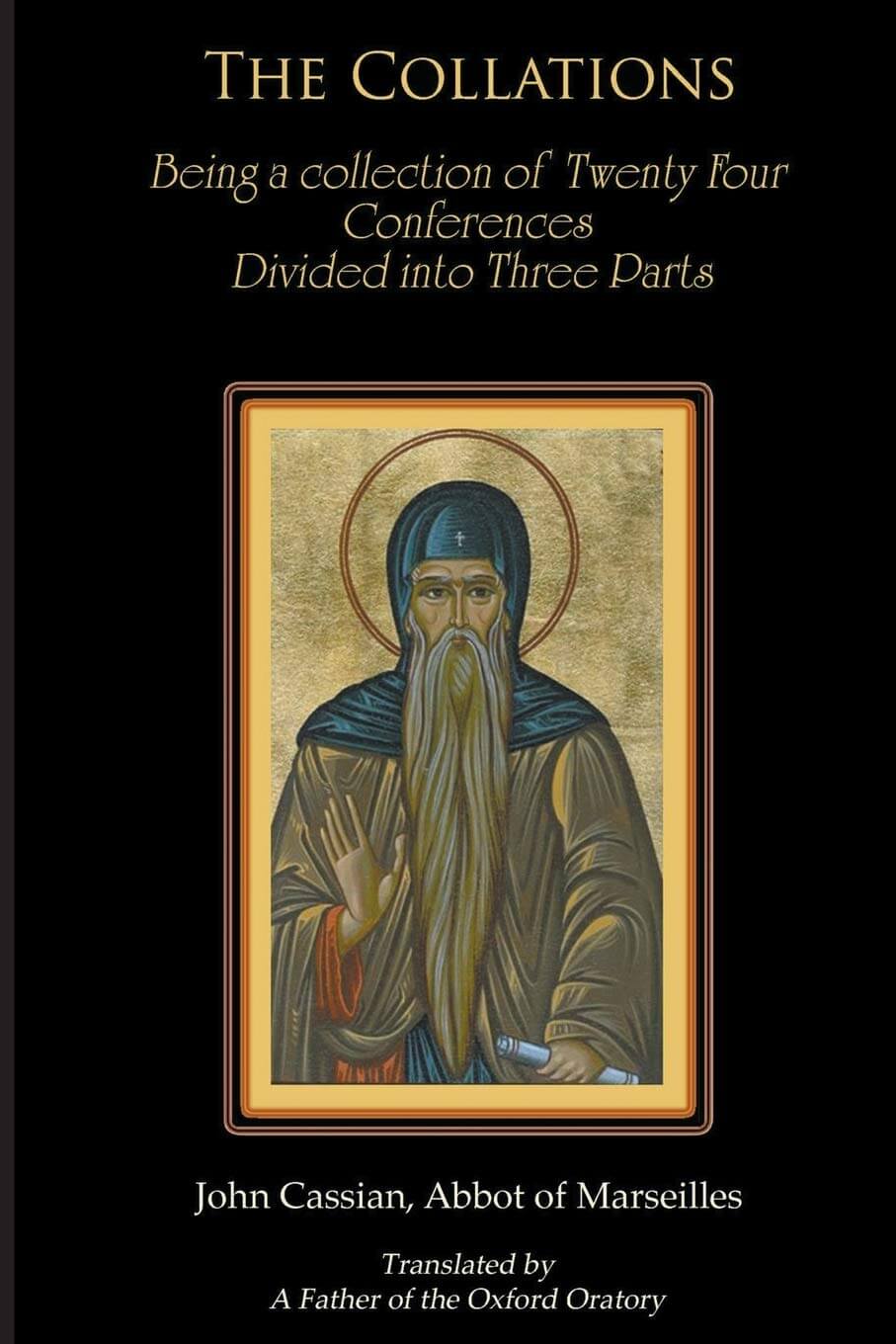
In his Collation On Being Sinless, Saint John Cassian reminds us that even the Christian who is most advanced on the road to perfection cannot stand before God claiming perfect innocence. The closer a soul draws to God, the more clearly it perceives its need for mercy. Cassian writes, “Clear sight yearns to see even further; the more blameless our life, the more we find to reproach ourselves with.” This insight echoes the words of Saint Paul: “For I do not do the good I want, but the evil I do not want is what I keep on doing.” (Romans 7:19) The saints are not those who are completely sinless, but those who become more aware of how much they need Christ.
This is why Cassian’s teaching on Holy Communion is so important. Some Christians of his time avoided receiving Holy Communion frequently because they believed themselves unworthy. Cassian, however, firmly rejects this approach. He says that “we should be more and more eager for Communion to heal the soul and purify the spirit.”
The Eucharist is not a reward for the sinless; it is medicine for those in need of God’s mercy. Christ himself declares, “Those who are well have no need of a physician, but those who are sick.” (Matthew 9:12) We do not receive Holy Communion because we have conquered sin completely. Instead, we approach the altar because without Christ we cannot have any hope of conquering sin at all.
Cassian warns that infrequent Communion can sometimes hide spiritual pride. Someone may begin to imagine that they must become worthy before approaching Christ. But no one becomes worthy except by the grace of God. We are reminded of this at every Mass when we make the words of the Centurion our own, “Lord, I am not worthy that you should enter under my roof.” (Matthew 8:8) And so, Cassian teaches us that awareness of our sins should never drive us away from Christ. It should lead us more quickly to the altar, where the Lord gives himself as the remedy for our frailty and the food of eternal life.
The Collations of St John Cassian are among the oldest and most influential books of Christian spirituality. The book is presented as a series of conversations between Cassian, his friend Germanus, and the great monks of the Egyptian desert, preserving the wisdom of men who had devoted their lives entirely to the pursuit of holiness.
This is the last of our reflections based on ideas found in the Collations of St John Cassian, but there is plenty more wisdom from the desert to be found in the original work. It is available, in an excellent modern translation by our own Fr Jerome, from our bookshop in person and online.
Business as usual.
Work is now under way in the sanctuary, but the life of the church carries on in front of it.
Thank you to everyone who has continued to support our restoration and building project. Last week we received a further £47,685 bringing us to 39% of our £3.3 million target.
Follow the work: oxfordoratory.org.uk/restoration
Help us to put it all back: oxfordoratory.org.uk/putitback
Sunday 4 October Solemn Mass 11:00 27th Sunday of the Year Missa O quam gloriosum Victoria Vir erat in terra Palestrina Homo quidam fecit coenam magnam Mouton
Friday 9 October Solemn Mass 18:00 St John Henry Newman, Our Cardinal Missa Missa Bell’ Amfitrit’ altera Lasssus O doctor optime Guerrero Beatus vir Monteverdi
Sunday 11 October Solemn Mass 11:00 28th Sunday of the Year Missa Pange lingua Josquin Ardens est cor meum Dering Nigra sum sed formosa Victoria
Sunday 18 October Solemn Mass 11:00 29th Sunday of the Year Missa Brevis in D Mozart Cantate Domino Guerrero Salve Regina Palestrina
Sunday 25 October Solemn Mass 11:00 30th Sunday of the Year Mass for five voices Byrd Ad Dominum cum tribularer Ceballos Adoramus te Christe Monteverdi
Newman tried to found an Oratory in Oxford…we got there eventually.
In this painting, Our Cardinal kneels before Our Lady and the Christ Child. Christ is holding a stone, ready to throw it at him. But St Philip intercedes for his spiritual son and Our Lady reaches out to restrain the Christ Child’s arm. The Oxford skyline is visible in the background.
Curious theology perhaps, but a prophetic painting: the stones represent the many obstacles that frustrated Newman’s attempts to found an Oratory in Oxford during his lifetime. His dream was finally realised in 1990, more than a century after his death, and some years after this painting. The painting is by George Warner Allen and titled ‘The Continual Building of the Church’. It hangs in our Sacred Heart Chapel.
This is “Newman Week” at the Oratory, with his first feast day as a new Doctor of the Church on Friday. There will be a triduum of devotions in preparation for the feast from Tuesday to Thursday at 6:30pm. On Thursday at 7:15pm, we will set off on our traditional pilgrimage through Oxford sites associated with Our Cardinal, ending at the College in Littlemore, where he was received into the Church by Blessed Dominic Barberi on 8 October 1845.
We will celebrate the feast on Friday with a Solemn Mass at 6pm, at which Fr Dominic Robinson SJ, Catholic chaplain to the University of Oxford, will preach.
Even a saint like Cassian cannot avoid faults and imperfections, but he can show us how to avoid anxiety. He lists the various minute lapses which a holy man may fall into and underlines that they are not mortal sins. Instead, he says that they are the ways in which a just man falls seven times a day. If his criteria are applied, we should admire the just man for falling fewer than seventy-seven times a day!
King David does not say that the just man will not fall, but when he shall fall he shall not be bruised. Cassian adds that he will be upheld and restored by the Lord’s hand. Due to the speed with which he rises, he will retain his state of righteousness. It is only human to make mistakes, after which we can arise stronger. We must not allow them to cause us anxiety. It will not help but rather harm us in our spiritual progress. The spiritual life takes time to grow and anxiety will not speed anything up. Just as one good day doesn’t make someone virtuous, one fall doesn’t make him bad. It should neither discourage nor make him anxious.
However, Cassian doesn’t tell us simply to accept our falls. He points out that they may be the result of shortcomings, laxity, or the attacks of the devil. Just as we can’t let everything disquiet us, so we shouldn’t accept all of our faults as a given and step back to watch them unfold.
The answer is a balance and moderation. We notice and recognise our faults, our natural weakness, and our shortcomings. Yet we do not allow them to disquiet us. We must not become complacent or assign a fault that arises from laxity to human frailty. Equally, we can’t beat ourselves up about it whatever its origin. Gently and steadily we undertake the road to virtue. We don’t expect never to fall. Nevertheless, by the help of grace, we get closer every day to the perfection that we see in Our Lord and his Blessed Mother.
The Collations of St John Cassian are among the oldest and most influential books of Christian spirituality. The book is presented as a series of conversations between Cassian, his friend Germanus, and the great monks of the Egyptian desert, preserving the wisdom of men who had devoted their lives entirely to the pursuit of holiness.
The reflections over the coming weeks are based on ideas found in the Collations. There is no need to read them to follow each reflection, but the work is available, in an excellent modern translation by our own Fr Jerome, from our bookshop in person and online.
“A time to break down, and a time to build up;
a time to weep, and a time to laugh.” (Ecclesiastes 3)
Our sanctuary currently looks rather sad. The bare altar is a view we are more used to on Good Friday than at the end of September. And while the Fathers are overjoyed to be starting work on a project that has been six years in the making (and talked about for 30!), there is still a sadness here.
Altars are meant to be permanent things. It’s why the destruction of the original altar was such a tragedy. It’s why there is a sadness in tearing down its replacement, even when we know it will be replaced with something greater.
An altar remains while generations come and go, standing as a witness to all that happens in its sight. We think of all those married at our altar, and buried from it; the baptisms, receptions and confirmations that it has seen. Ordinations too — half of the Fathers were ordained at this altar and celebrated their first Masses on it.
So this is a time for a little sadness, and for giving thanks to God for all that this altar has witnessed.
There hasn’t been quite as much visible progress this week as we’d hoped for, but invisible progress has been made on the exterior! The temporary sanctuary is now all set up, and we are ready for the builders to move inside.
For those wondering if we’re going to talk about nothing but altars and building works for the next six months, don’t worry! The work of the Oratory continues in Oxford, and there will be lots of other exciting things to share in the next few weeks.
In his Collation On the Purpose of Penance, Saint John Cassian gives us a short list of fruitful penances through which the forgiveness of sins is obtained: acts of charity, forgiving others, improvement of life, performing works of mercy, almsgiving, and even copious tears. All of these are perhaps best summed up in the Lenten practices of prayer, fasting and almsgiving. “Prayer is good when accompanied by fasting, almsgiving, and righteousness.” (Tobit 12:8)
But when we think of penance, we probably think of the confession of our sins. As we read in the Psalms: “I said, ‘I will confess my transgressions to the Lord,’ and you forgave the iniquity of my sin.” (Psalm 32:5) Christ instituted the Sacrament of Confession to be the means by which we can be restored to God’s grace and obtain the sure forgiveness of our sins. Our Lord’s call to penance does not consist primarily in outward weeping in sackcloth and ashes but in interior conversion—the conversion of the heart. God’s grace calls us to return to him and he gives us the strength to begin anew.
Regarding confession, Saint John Cassian warns us not to dwell on past sins. We may be tempted to dwell unnecessarily on past sins even when we have confessed them. To brood over sins once committed and now forgiven is bound to corrupt our minds and hearts with the thought of sin, and therefore restrict our efforts to grow in virtue. We can’t possibly concentrate on growing in virtue if our minds are always filled with vices. We must always place our trust in Our Lord who told us plainly “if you forgive the sins of any, they are forgiven.” (John 20:23)
The Collations of St John Cassian are among the oldest and most influential books of Christian spirituality. The book is presented as a series of conversations between Cassian, his friend Germanus, and the great monks of the Egyptian desert, preserving the wisdom of men who had devoted their lives entirely to the pursuit of holiness.
The reflections over the coming weeks are based on ideas found in the Collations. There is no need to read them to follow each reflection, but the work is available, in an excellent modern translation by our own Fr Jerome, from our bookshop in person and online.
Ever wonder what Our Lady sees when she looks down from heaven?
Here’s the view from her stained glass window.
Fixing this hole is one of many repairs needed to the apse of our church.