Angels’ Protection

The saints — holy men and women — are held up before us by the Church for a double purpose: as an example, and as intercessors for us in heaven. But with the angels, it doesn’t make sense for us to even attempt to imitate them. They are completely different beings from us. They are pure spirit. They have never had bodies and never will. They exist outside of time, and don’t know what it’s like to experience change or growth as we do.

The angels then are commended to us by the Church in the first place for us to ask their intercession, especially to ensure our safety from dangers both spiritual and physical.

The people of Israel needed precisely such protection on their way out of Egypt. They were promised: ‘Behold, I send an angel before you, to guard you on the way and to bring you to the place which I have prepared,’ (Ex. 23:20) and God told them to ‘listen carefully to his voice’ (v.22). The voice of God had previously terrified the Israelites when the whole people heard it at Mount Sinai:

Now when all the people perceived the thunderings and the lightnings and the sound of the trumpet and the mountain smoking, the people were afraid and trembled; and they stood afar off, and said to Moses, “You speak to us, and we will hear; but let not God speak to us, lest we die.” (Ex. 20:18–19)

The voice of the angel is meant to be less intimidating. God does not want to scare us. He wants us to picture him as our heavenly Father, and we are more willing to do that if he is not playing the part of an overprotective parent. We might make a comparison between God sending his angels to look after us, and parents asking one child to keep an eye on another, rather than being seen to interfere themselves.

If God did intervene directly in our lives all the time, with great sounds from heaven and a voice breaking through the clouds, we might begin to question our freedom. But if the angels get on with quietly protecting us in the background, we don’t feel quite so infantilised.

That so many of the angels spend time running round after us should not mean that we underestimate them. Christian artists of the last 500 years have a lot to answer for in representing angels as chubby babies, decorative in a painting but not much use in a fight. The descriptions of angelic beings in the scriptures are terrifying, and draw on images of mythical beings carved by the ancient Assyrians. If you want an idea of what the Israelites thought angels looked like, visit the monumental hybrid creatures that once guarded the Assyrian city of Nimrud and are now on display in the British Museum. When God chose to describe angels through his prophets, he drew on images such as these, which would have been familiar to the people of Israel from their neighbours. Of course the bodiless angels don’t really look like these monsters. Without bodies, they can’t look like anything. But God caused his prophets to picture them in this way in order to convey the sense of immense spiritual power that angels wield. Today’s feast is a day to thank God that such power is used for our benefit.

Some more about prayer

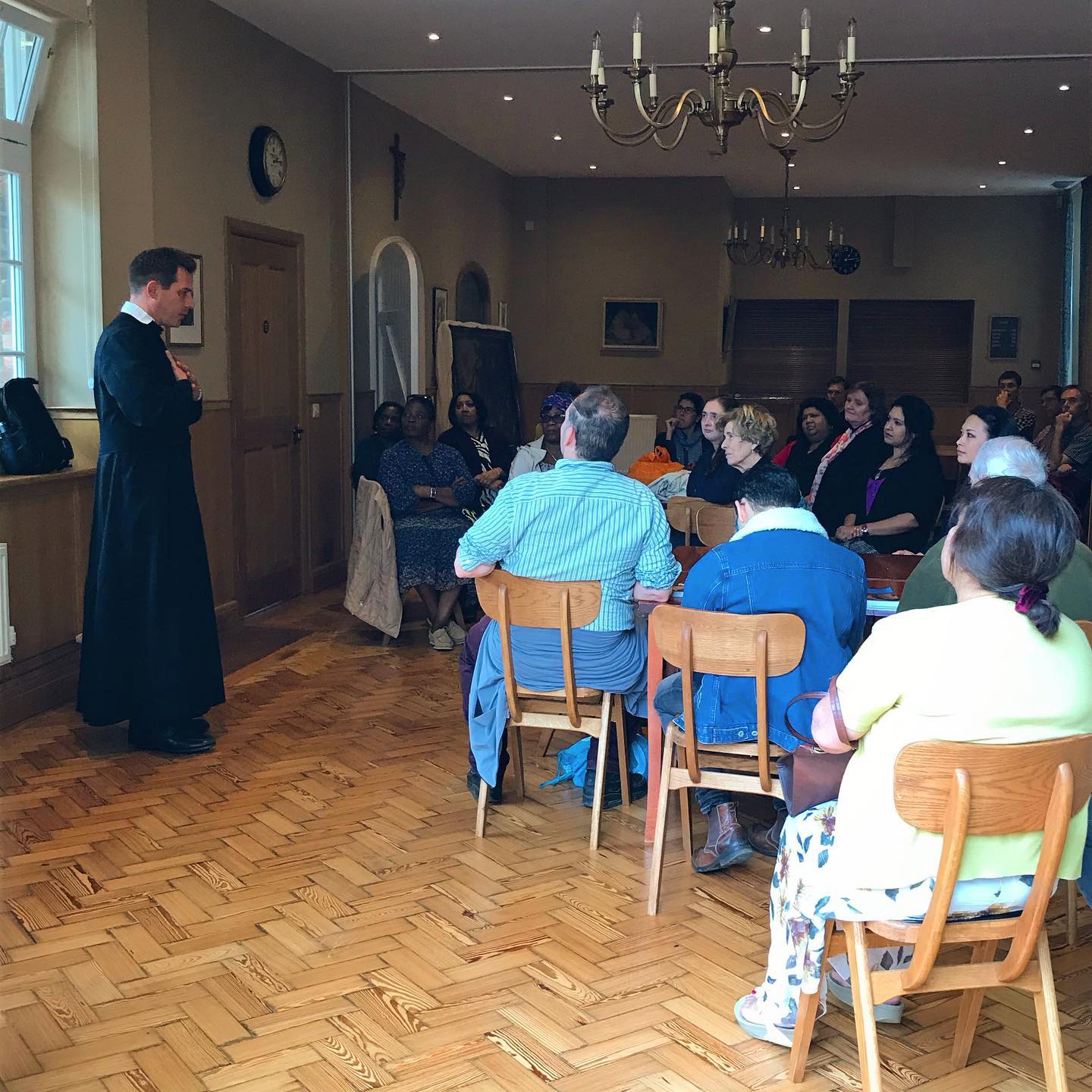
Much has been written about prayer and while it is helpful to read about it (to a degree at least), it is not the same as praying. However, spiritual writers often have useful tips or anecdotes which they serve up to us as an encouragement to persevere, especially when the whole exercise seems futile or just plain dull. And these we need when we find ourselves totally floored by our efforts. “But I don’t feel anything when I pray?” we say. And our confessor, falling back on his last line of defence usually runs along the lines of: “Ah, you mustn’t judge by the feelings.”

But what else — we ask — have we to judge by? It is a question which touches every part of the interior life (and a good few of the exterior too) so it’s well worth giving a thought to it. I am presumably hot when I feel hot, in need of food, sleep, exercise and so on, when I feel I want or need these things. Similarly, I trust my feelings in other situations, such as when I am in love, in a temper or whatever. Why should I not trust my feelings when it comes to prayer? I suppose because prayer isn’t governed in quite the same way: it is not about physical or mental activity. It engages the soul. It is conversation with God. Grace is at play here.

Is there any way in which our feelings can measure the success or failure of this exercise? There isn’t a thermometer to gauge how our prayer time went, whether it was successful or not. So how do we examine it in order to assess the quality? We may, for example, have been praying intensely for someone for whom we have a deep affection. We felt good about it — but was it a better prayer than say that which we have forced ourselves to make for someone who bores us or whom we dislike? The good feelings we had, when we prayed for our friend or loved one, might simply indicate that we enjoyed thinking about them. The prayer which we made ourselves offer may well have been the ‘better’ prayer.

The truth is, there is only one person who can see exactly what is happening in our prayer, and that is the Lord. It might even be said that the less we see of it the better. We don’t practise prayer simply for our own benefit. We pray in order to please God. Seen this way, I don’t suppose it really matters much how we feel about it — which might perhaps sound rather a strange observation. God, I am certain, is pleased by our sincere efforts to pray, however unsatisfactory they may feel to us. “The art of prayer,” says St Catherine of Siena, “is that there is none.” Our problem is that we try to make it so, when we should be aiming to become like the little child our Lord speaks of, artless, open, spontaneous and loving, if we are to enter the Kingdom of God. Not looking at ourselves, nor seeking for an effect or to impress God with our elevated and beautiful thoughts. One modern spiritual writer once remarked (rather shockingly to us maybe) that there is more sincerity and truth in an exasperated “God almighty!” than in the most perfectly sung “Alleluia!”

The thing is to keep at it whether we feel like praying or not, trying to keep in focus the fact that God is seeking us more intently than we are seeking Him. Last year, I read Lawrence Durrell’s novel The Dark Labyrinth, in which a group of travellers find their way into a kind of garden of Eden high up in the mountains, from which there is no way out, since the caves through which they had come had become impassable, the roof behind them having collapsed. Twenty-One years later, the sole survivor, an old lady, had made her peace with her situation. She had settled down to her isolation in her beautiful prison, high up, surrounded by mountains and had come to realise that although she was completely isolated, she was not alone. And this realisation came through her being still — which is vital to prayer. “There’s no positive way. It’s rather a negative business — becoming still enough to be receptive to it. You can’t seek for it, but if you prepare for it it will come and settle on you like an Emperor moth. In fact, not ‘seek and ye shall find’ as the Bible says, but ‘prepare and ye shall be found’.” Perhaps, since it was our Lord who told us to seek, we might yet go out to meet Him, who comes in search of us. This is what we call prayer.

Organ Scholar

We are looking for an organ scholar to work with our Director of Music and choir, starting from November. This is an exciting opportunity for a suitably skilled organist to contribute to the vibrant musical life of the Oxford Oratory, while gaining experience of the traditional Catholic liturgy and sacred music performed to the highest standards. Full information is available here. Applications must be received no later than Friday 15 October.

The Sign of the Cross

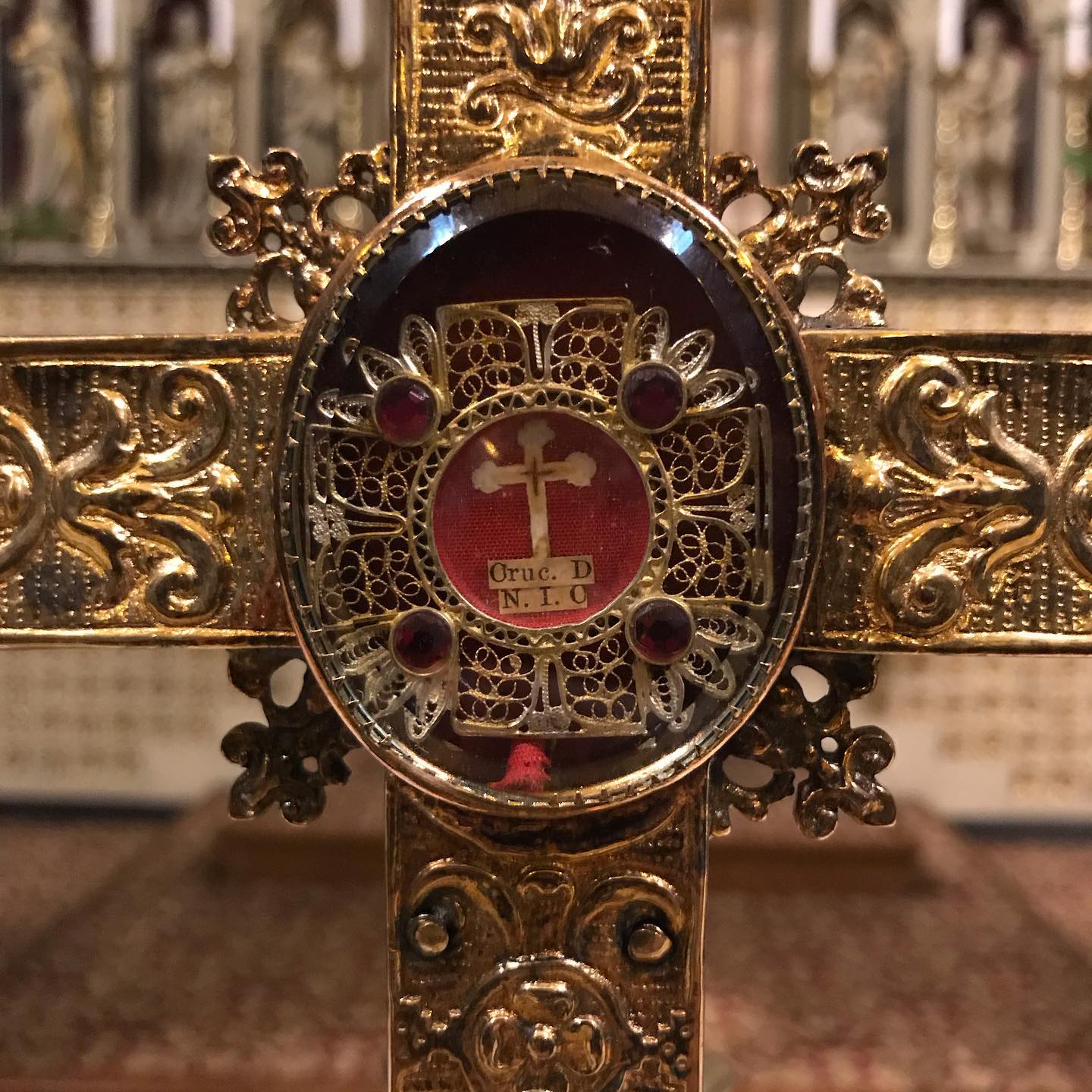
The one symbol most often identified with the Lord and his Church is the cross. Yesterday we celebrated the Exaltation of the Holy Cross. This feast has its beginnings in Jerusalem and the dedication of the church built on the site of Mount Calvary in 335, after the finding of the True Cross by the Empress St Helena. But the meaning of the cross is deeper than any city, any celebration, any building. The cross is a sign of suffering, a sign of human cruelty at its worst. But by Christ’s love shown in the Paschal Mystery of his Passion, Death and Resurrection, it has become the sign of triumph and victory, the sign of God, who is love itself.

Christians have always looked to the cross in times of suffering. One of the most striking images after the atrocity of 9/11 in New York was that of a cross, formed by two iron beams — by providence, more than coincidence — which towered over the scene of wreckage and carnage. That cross stood as a sign of hope and strength in the midst of unbelievable tragedy. People in concentration camps, in prisons, in hospitals, in any place of suffering and loneliness, have been known to draw, trace, or form crosses and focus their eyes and hearts on them. The cross does not explain pain and misery. It does not give us any easy answers. But it does help us to see our lives united with Christ’s. It helps us to see Christ standing with us, suffering with us, and to know that we will rise with him.

We often make the Sign of the Cross on ourselves. We make it before we pray to help fix our minds and hearts on the Lord. We make it after prayer, hoping to stay close to him. In trials and temptations, the cross is a sign of strength and protection. The cross is the sign of the fullness of life that is ours. At Baptism, too, the Sign of the Cross is used: the priest, parents, and godparents make the sign on the forehead of the child. This sign made on the forehead is a seal, a sign of belonging. By the Sign of the Cross in Baptism, Jesus claims us as his own so that he can share his life with us.

Today, let us look to the cross. Let us make the Sign of the Cross and know we bring our whole selves to God — our minds, souls, bodies, wills, thoughts, hearts — everything we are and will become. Let us “lift high the cross” above the evil and suffering in this world, and claim back the world for Christ.

Ave crux, spes unica — Hail, O Cross, our only hope!

O Saviour, thy Cross is worshipped by men and angels. Angels and men carry it in their hands and sing hymns of praise because it has brought peace to all the world. Restrain war and contention; draw together all peoples who in the one Church pay honour to it, recognise its majesty, and with uplifted voices cry: Holy, holy, holy art thou, O Lord, who by thy Cross hast saved mankind from perdition. To thee be glory forever and ever. Amen.

Prayer used in veneration of the relic of the Cross after all Masses today.

#oxfordoratory

View on Instagram