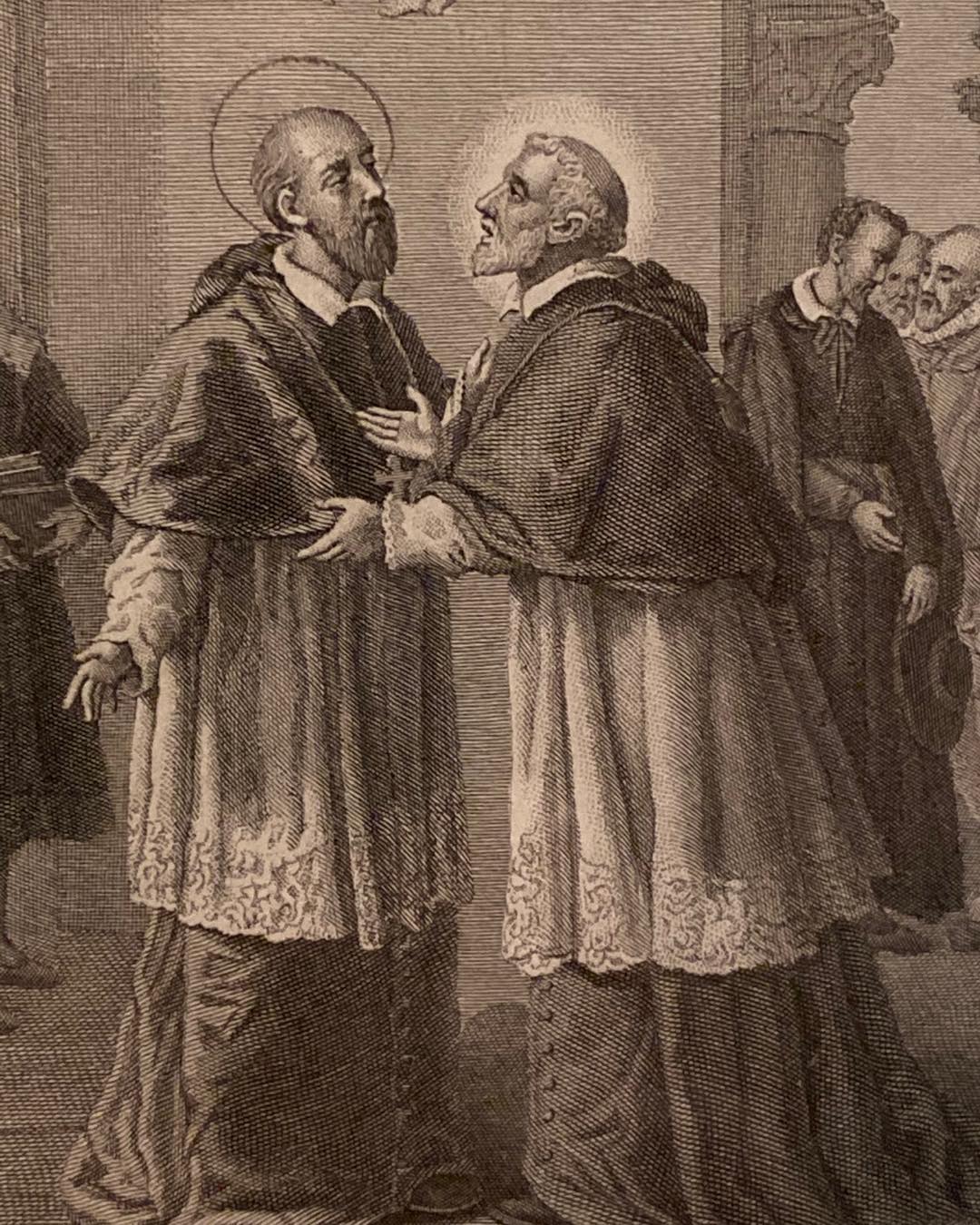
Blessed Sebastian Valfrè (1629–1710) was a holy priest, well-known for his pastoral works throughout Turin. He was respected in hospitals, where he regularly visited the sick, and consoled them with his presence, the sacraments and by preaching the word of God. He was recognised in the marketplaces for his public preaching. His most beloved work, however, was that of teaching the catechism to large groups of children at midday on Sundays — a duty he began soon after joining the Oratory in Turin and continued for most of his life. In all these works he saw Our Holy Father Saint Philip as the model of the perfect priest. Blessed Sebastian’s perseverance in his priestly works was a true mark of his sanctity.
However, the sanctity of Blessed Sebastian also arose from his struggles to conform himself to Saint Philip. Saint Philip was gentle and kind, whereas Blessed Sebastian was said to be harsh and short-tempered. Saint Philip could easily immerse himself in deep prayer at any time and would often spend hours in an ecstatic state. Blessed Sebastian, on the other had, was said to have found it hard to concentrate and could not easily engage himself in mental prayer — but his soul would always find peace and focus at the point of consecration during Mass. Although these difficulties made him suffer interiorly, Sebastian’s Christian joy in the spirit of Saint Philip was in constant evidence in his life in the Oratory.
These struggles did not affect Blessed Sebastian’s faith in any way. In fact, his life has become a model of perseverance and a great source of hope, offering many examples of the strength of his faith. Sebastian, who had a great devotion to the Shroud of Turin and would visit it every Friday, was entrusted with the delicate task of repairing it in 1694. With great reverence and care, he worked to mend the Shroud, seeing in this labour an act of love and devotion to the suffering Christ. “The Cross received the living Jesus and gave him back to us dead; the Shroud received the dead Jesus and restored him to us alive.” Blessed Sebastian knelt for hours as he did his work, speechless, with tears flowing down his cheeks as a testament of love.
Blessed Sebastian was aware of his imperfections. He also allowed himself to be led by the gentle spirit of Saint Philip, overcoming his personal difficulties to the extent that other people considered him to be another Saint Philip. It was his will to do the will of God despite his personal struggles and he succeeded by having Saint Philip as his patron and defender, as his guide to the port of eternal bliss. May we be able, like Blessed Sebastian, to acknowledge our imperfections and seek the guidance of Saint Philip in overcoming them.
On Friday, we will celebrate the feast of the great Counter-Reformation Bishop of Geneva and Doctor of the Church, St Francis de Sales. He founded an Oratory at Thonon, on the shore of Lake Geneva, after having met St Philip in Rome and having been inspired by his work there. Sadly for St Francis, he was not able to stay there for very long, because he succeeded to the Bishopric of Geneva upon his predecessor’s death three years later. As Bishop, he laboured to bring the people entrusted to his care back to the Faith — Geneva was, of course, the centre of the Calvinist world.
When we think of the Counter-Reformation, we might think of great institutions founded to fight heresies, like the Society of Jesus or the Inquisition — but St Francis’ efforts were quite different. He preached the Word of God simply and engagingly, drawing people in with the sweetness of our Faith. Nowadays, he is often known as the Doctor of Charity, precisely because the foundation of his approach was to preach that love of God which has no end. He worked hard to bring everyone, from all walks of life, closer to God, following St Philip in teaching the faithful how to dedicate themselves to God in the midst of their ordinary lives.
We might imagine the challenges of our own times to be very different to those faced by St Francis more than four hundred years ago, but, in fact, his example is essential for us as Catholics today. It is so often said that polite conversation does not include money, politics or religion — such things are surely far too personal to be spoken about in public! St Francis de Sales shows us that this need not be the case. Our Faith is not something to be embarrassed about: it is something we must share with others, and there is only one way to share it. We do not need expertise in theology or rhetoric — all we need do is, like St Francis, to talk to our friends, our family, our neighbours — to anyone who will listen — about the love that Our Lord Jesus Christ has for each and every one of us.
This week we celebrate the feast day of Saint Joseph Vaz, known as the Apostle of Sri Lanka, who was both a Son of St Philip and a great missionary. The idea of an Oratorian missionary may seem rather strange to us. Usually, Fathers of the Oratory are thought of as “fishers and not hunters” of souls, quietly winning individuals for Christ. After all, Saint Philip had a deep desire to travel to India to preach the Gospel, but was told by the holy monk Agostino Ghettini that St John the Evangelist had appeared to him and said that it was the will of God for Philip to remain in Rome and that “Rome was to be his Indies”. In humble submission to the will of God, he never once left the city for the rest of his life.
Almost a century later, Saint Joseph Vaz spent his whole life travelling around those very Indies that Saint Philip had renounced, converting thousands of people to the Catholic Faith.
There were great miracles that accompanied his missionary work. To give just one example: in the region of Kandy, the rainy season failed one year and there was a severe drought. The staple food of the people was rice, which they were unable to grow. Magicians had offered sacrifices to the devil and the aid of Buddha had been called upon, but still the rain did not come. The King then called upon Father Vaz to pray for rainfall since “he preaches that his is the true God”.
Having erected an altar in a prominent place in the town, Father Vaz prayed that the people may be saved from famine. As he was praying, rain fell for several hours until all of the reservoirs of the town were full again, though the altar at which the Saint was praying remained completely dry. This miracle wrought a huge conversion amongst the people of Kandy and many were baptised. The King, astonished at so great a miracle, allowed Father Vaz to travel wherever he wished in the surrounding regions, which he had so far not been able to do and this was hugely advantageous to his mission.
Impressive miracles such as these were nevertheless no replacement for the chief tools of his apostolic work: prayer, administering the Sacraments and preaching. Here we see what made his missionary work distinctly Oratorian.
Fr Francesco Agnelli of the Savigliano Oratory reminds us that there is no vocation “more sublime than the one to which the sons of St Philip are called; for their vocation consists in three things, the highest and holiest which adorn Holy Church: prayer, the administration of the sacraments, and feeding the people with the daily Word of God. Even the Apostles themselves were not called to a nobler end.”
From letters of Saint Joseph Vaz towards the very end of his life, we get a sense of the particularly Philippine approach on which he modelled all of his missions. The Saint, writing in December 1710 to one of his great comrades in Sri Lanka, Fr Menezes, to hand over his duties as Vicar General and as Superior of the Oratorians, says: “Take no attention of the fact I am still alive; I cannot celebrate Mass nor hear confessions; what therefore is life to me?” And again one week later, on the eve of his death, he writes: “I will pray as long as my strength lasts, for I am no more good for anything else.”
The Saint’s priorities could not be laid out to us more clearly. He had a great love of the Holy Mass and even when he was no longer able to say Mass, he still received Holy Communion every day. When he was too weak to preach Christ to the people of Sri Lanka, he did not cease to turn to God in prayer for their souls.
We may not be called to preach the Gospel in far-flung lands but we are each called to spread the message of Jesus Christ, not by any heroic means but by performing well the daily duties of our state of life. The example of Saint Joseph Vaz, himself following the pattern of Saint Philip, gives to us the means to achieve this: prayer, frequent reception of the Sacraments and study of scripture. May we, through the intercession of St Joseph Vaz, be attentive at prayer, deepen our love for the Holy Mass and meditate more fervently on the Word of God. St Joseph Vaz, pray for us!
Prayers at the crib as part of our popular children’s Epiphany procession and Benediction.
Our celebration of the feast of the Epiphany of our Lord is very special, because it marks the point at which we come into the story. We, the Gentile world, are called into friendship with the Lord, called to share in the joys of God’s kingdom. For us, life is about seeking Christ, and doing so in the spirit of the Magi would seem to be an excellent way of going about it. Like them, we embark on a spiritual journey marked by faith, perseverance, humility and surrender. The Wise Men’s story teaches profound lessons about what it means to search for the Divine with a sincere heart. First, consider how they set out on their journey guided only by a star. They had no idea where it would lead them or what exactly they would find, yet they set off, curious and eager to see where the star would lead. Seeking Christ often requires us to step into the unknown, trusting in his guidance even when the way ahead isn’t exactly clear. We might ask ourselves if we are willing to trust God’s direction in our lives, even when it challenges our comfort or understanding?
The journey of the Wise Men was long and arduous and even dangerous, yet they persisted in it, deeply committed and determined to find the Christ Child. Are we persistent in our search for Jesus, even when the way is hard, tedious or dangerous? Do we seek him in prayer, the Scriptures, in the Sacraments and in the humdrum circumstances of everyday life?
St Matthew tells us that when the Magi found the Holy Child Jesus in Bethlehem, “they fell down and worshipped him”. What an odd sight that must have seemed! Despite their importance and status, they humbled themselves before the infant King. Do we approach Jesus with humility? Do we recognise the wisdom of surrendering ourselves to him, acknowledging our need for his grace and mercy?
Then they offered their gifts of gold, frankincense and myrrh, each with their symbolic significance, representing the Magi’s recognition of Jesus as King, God and Redeemer. What about us? What gifts do we bring? Our time, talents, love and service? And what of the sacrifices we can make to honour him fully?
And having made their offerings to Jesus, those men left Bethlehem and returned to their homes “by a different way”, thereby avoiding any further contact with Herod, lest he discovered the child’s whereabouts and did him harm. Their return journey was characterised surely by joy and grace. Their encounter with Christ and his family, must surely have had a transforming effect. They went back with renewed purpose. How has our encounter with Christ changed us? Are we willing to take new paths in life? Are we willing to let the Lord transform our lives?
To seek the Lord Jesus in the spirit of the Magi is to live with hearts open to his light and love. It involves embracing the onward journey with courage and with faith, offering our best and trusting that he will lead us into a deeper communion with God.
Blessed be the Holy Child Jesus now and for evermore.
On the feast of the Epiphany, we bless chalk and use it to bless our houses, by writing 20+C+M+B+25 over the door.
Bless, O Lord, this chalk and grant salvation to the human race. May all who cause the names of your holy magi Caspar, Melchior and Balthasar to be inscribed above their doors be blessed by the invocation of your most holy name, enjoy health of mind and body, and experience your strong protection for their souls. Through Christ our Lord. Amen. #oxfordoratory
Sunday 5 January Solemn Mass 11:00 Epiphany Missa Pastores quidnam vidistis Clemens Reges Tharsis Byrd Magi veniunt ab oriente Clemens Épiphanie Litaize
Sunday 12 January Solemn Mass 11:00 Baptism of the Lord Missa vulnerasti cor meum Morales Tribus Miraculis Palestrina O admirabile commercium Josquin Nöel Étranger Daquin
Sunday 19 January Solemn Mass 11:00 2nd Sunday of the Year Mass for five voices Byrd Alma redemptoris mater Victoria Videntes stellam Lassus Praeludium in E minor Bruhns
Sunday 26 January Solemn Mass 11:00 3rd Sunday of the Year Missa “Puisque j’ay perdu” Lassus Dextera Domini Palestrina O sacrum convivium Tallis Fugue in G minor BWV 542ii Bach
Fr Nicholas had the wonderful opportunity in November to spend Thanksgiving in Tennessee, with great friends of the Oratory. While we don’t have a similar day in this country when we stop to consider everything and everyone for which we are thankful, the Church does end the civil year with such a reflection, singing the Te Deum to thank God for the many blessings he has bestowed on us. There was much to be grateful for during 2024 in the life of our parish and Oratory family, with so many signs of God’s work in his Church.
In February, our work with adults entering the Church caught the attention of the press at home and internationally. Having previously instructed all converts on a one-to-one basis, at the end of 2023 we found that we had to launch a series of catechism classes for adults. The first of these finished in February, and was a joyful celebration not just for the new eight new Catholics, but also for all their new friends in the parish who came to welcome and support them. A second class began as the first finished, and we welcomed seven more new Catholics into the Church in June. Not everyone’s journey of faith quite runs to the schedule of the classes, of course, and there have been many more baptisms and receptions throughout the year, as well as welcoming home a number of baptised Catholics who had not been brought up in the faith. A third class began in October: please pray for all those preparing to received the sacraments in February 2025. Another class will begin as that one ends — if you know anyone thinking about becoming a Catholic, now is the time to send them our way.
Last year we baptised 41 new Christians and welcomed Constance, Benjamin, Miguel, Kieran, Jessica, Sally, Benoît, Zachary, Edward, Luke, Abel, Maybelle, Joseph, Isabella, Francisco, Faye, Anthony, Vivien, Rosamund, Amara-Rose, Julian, Ashwiny, Alexis, Héloïse, Meriel, Lucia, Olive, Emelia, Daniel, Amari, Timothy, Eleanor, Gregory, Patrick, Liam, Tomas, Maite, Elise, Julian, Ema and Alessandra into the family of the Church. Jenni, Fiona, Joshua, Kevin, Melanie, Charlie, Seth, Angela, Andrew, Guy, Yasmin, Benedict and Virginia were received into full communion in the One Fold of the Redeemer. 22 couples began their married lives together at the Oratory this past year, tied with 2023 for the most weddings in our church in a year: please pray for Jon and Sarah, Conor and Emily, Clifford and Stephanie, Jonathan and Beatrice, Clément and Faye, Matthew and Caitlin, Anthony and Angela, Dominic and Caoimhe, Callum and Olivia, Jonathan and Katherine, Joshua and Matilda, Bryce and Martha, Leandro and Lisa, Marc and Sorcha, Patrick and Philippa, Tomas and Simona, Ronan and Shannon, Taylor and Emily, Casey and Virginia, Omar and Claudia, Bryce and Bethany, and William and Celine.
Our average Mass attendance — worked out by counting everyone at Mass on four weekends in September/October — was 950, and there were many weekends when our attendance exceeded 1000. This is one of the highest in the Archdiocese, and is the product of the love and faith of our parishioners. It is also testimony to the hard work of many: the Fathers and Brothers, our choirs and music director, our sacristan, altar-servers, flower arrangers, church cleaners, greeters, Cafe Neri volunteers, Oratory Outreach and Porters. We are always in need of new volunteers for the Cafe, the Lodge and church cleaning, so if you are able to help please speak to one of the Fathers or Brothers. These are all such important ministries, and we are immensely grateful to all who have given up their time in service of our community.
On the music front, we began the year with a concert by the Schola Cantorum of the London Oratory School, launching their CD Sacred Treasures of Venice. In February there was a performance of John Stainer’s The Crucifixion by our own Oratory Choir under the direction of Rory Moules, our Director of Music. We are blessed to have outstanding singers and musicians, who have continued to build on our reputation for fine liturgical music — something often commented on by those who attend Mass here or follow us on the livestream.
We started an online shop to further diversify our income and provide an opportunity for people world-wide to purchase our own publications, cufflinks, lapel badges and tote bags, and a selection of other books and devotional items chosen by the Fathers. The Oratory Prayerbook remains a best seller, joined this year by a matching edition of the maxims of St Philip arranged for each day of the year. You can visit the shop at https://shop.oxfordoratory.org.uk/
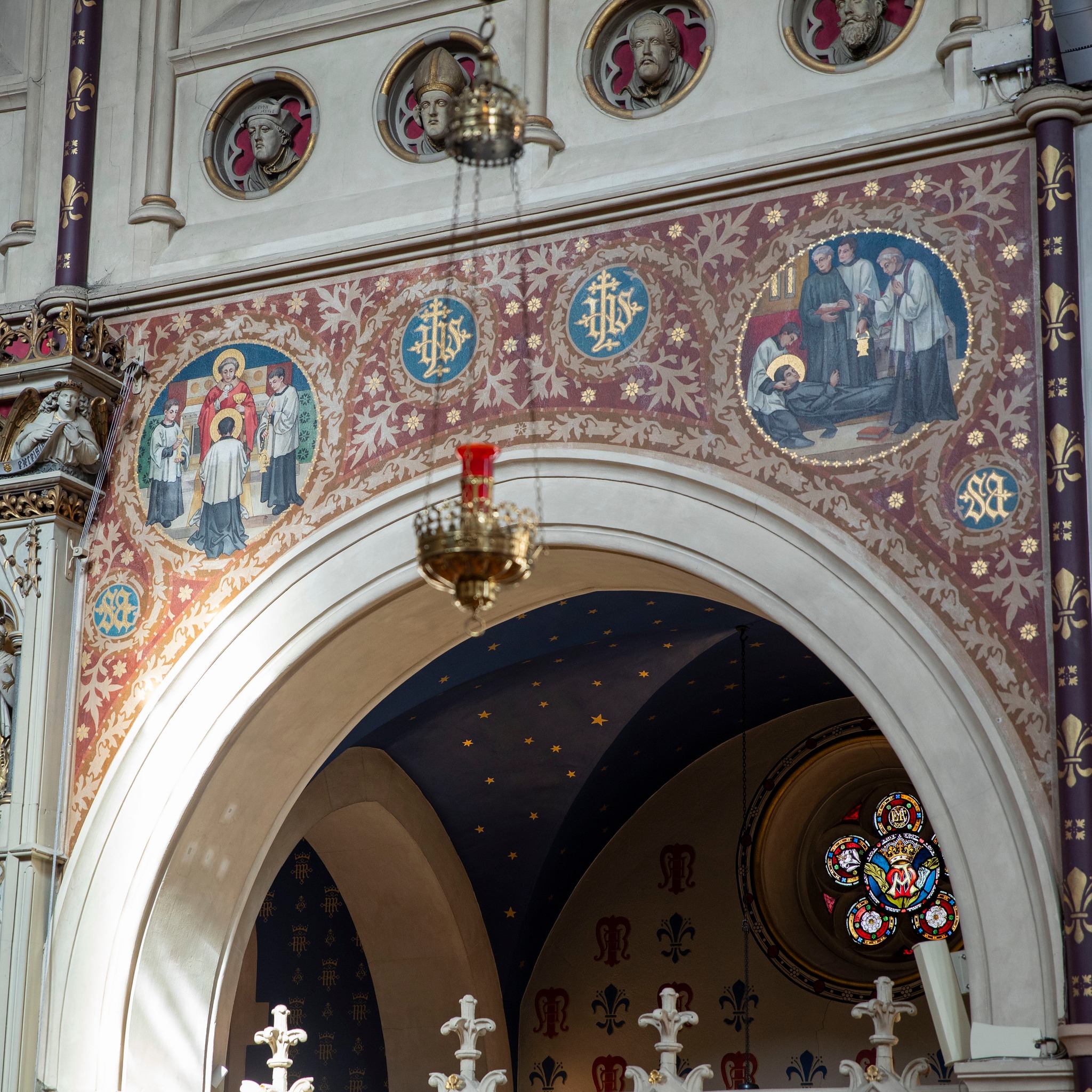
As part of the renovation and restoration of the Oratory church we employed Cliveden Conservation to uncover the murals of the life of St Aloysius in the sanctuary, painted by Gabriel Pippet when the church was first built, and covered over in the 1940s. The murals turned out to be in much better condition than originally feared, and look as good as new. This work was made possible by the generosity of parishioners and friends, and we quickly raised the £20,000 needed. The information gathered from the process of uncovering will inform the future phases of the restoration of the once-colourful interior decoration of our church. Cliveden Conservation also made some repairs and restoration to the Relic Chapel, which suffered damage during the very wet weather, and gave it a much-needed clean. We hope to start more extensive renovations this year, as the plans are in their final stages and the fundraising campaign is almost ready to be launched.
The most obvious improvement made to our church this year has been a new microphone system, with vastly better sound quality both in church and on the livestream. We were able to purchase and install this system through the very generous donation of American friends, who came in November to see the results for themselves.
2024 was something of a bumper year for American visitors to the Oxford Oratory, as we welcomed 7 different pilgrim groups from the USA, including a group from Arlington, Virginia, with their Bishop Michael Burbidge, who were celebrating the 50th anniversary of the founding of their diocese. We had pilgrims from Italy, Spain, and Germany, and visitors from the Oratories of New York, Nancy, and the Bournemouth Oratory-in-Formation. Over 750 people visited the Oratory during the Oxford Open Doors Weekend, many of whom had never been inside our church before. We welcomed the new Apostolic Nuncio to Great Britain, Archbishop Miguel Maury Buendía, to celebrate Mass and preach on St Philip’s Day. A particular highlight of the year was the visit of The Archbishop of Toledo, Spain, and thirty of his priests, who celebrated Mass in our church on Easter Thursday. The priests were all under ten years ordained and all from the same diocese, so it seems that the so-called vocations crisis is certainly not a universal phenomenon, even in Europe.
There is certainly no vocations crisis in the Oratory, as with the clothing of Br Thomas Nimmo in the habit in September we now have five men in the noviciate. Three of our brothers continue their priestly studies with the Dominicans at Blackfriars, and we are grateful to the Jesuit Fathers for a grant that covers their tuition. St Philip had close friendships with the Dominicans and Jesuits in Rome, so it is wonderful that we are able to maintain those friendships here in Oxford. An important event in the Oratorian Confederation took place in October, when Fathers from all the Oratories in the world convened in Rome for our six-yearly General Congress. This was an important opportunity to renew old friendships and make new ones, and the hard work of revising the General Statutes that govern our Institute was accomplished with much Philippine good humour.
Our parishioners and visitors have always been eager to help needy causes and charities, and past year we gave charitable donations from the Poor Box to OxPAT, the Santa Maria Education Fund, the Oxford Companions of the Order of Malta, the Order of Malta Volunteers and Life. Our crib collection raised £1,044 for Aid to the Church in Need; the Mission Appeal for the Kiltegan Fathers collected £1,479; and we were able to send 232 gift parcels to the Operation Christmas Child Christmas shoebox appeal. Our Lent Project for 2024 was for Let the Children Live!, a Catholic charity in Colombia. The founder, Fr Peter Walters preached an inspiring appeal, and the total raised was another record-breaking £4,764. Closer to home, we launched our own charitable team Oratory Outreach, which has run successful collections for the Oxford Food Bank each month. Oratory Outreach also helped to host the Companions of the Order of Malta Easter and Christmas lunches here at the Oratory for the homeless and less fortunate, and we continued to serve as the Companions’ base of operations for the twice weekly evening soup and sandwich runs.
Sadly 2024 also broke the record for the number of funerals, although the demography of central Oxford is such that we still have far fewer than other similar parishes. We said goodbye to a number of familiar faces, members of our parish for many years, commending to God’s mercy: Joy Finnigan, Patrick Lavelle, Norah Harris, Anna Baker, Madeline Dandridge, John Wilson, Linda Bond, Paulette Eeley, Aidan Mackey (our oldest parishioner, at 101 years), Desmond Sullivan, Monica Kaye, Pauline Power, Prof. Ian Shipsey, Prof. Richard Pring, and Evelyn Watkin, who died aged sixteen after a 22 month battle with cancer. We also celebrated the Requiem Mass of Fr John Hunwicke, a retired Ordinariate priest and well-known blogger. Fr Hunwicke was ordained priest in our church in 2012, after decades of ministry in the Church of England, and latterly courageously taught Latin to some of the Fathers. May the souls of all the faithful departed, through the mercy of God, rest in peace.
2025 is a Holy Year of Jubilee, when the whole Church once again experiences the mercy and forgiveness of God in a special way through events in Rome and in dioceses throughout the world. A Jubilee Year is an opportunity to forgive debts and start afresh, and to recognise what needs to change in our own lives and in the world to bring about the reign of Christ. But every new year gives such an opportunity, as every year is a year of grace, of joys, sorrows and celebrations. 2025 is also the 150th anniversary of the opening of our church, which we mark later in the year. And so the life of the Church goes on, and we continue to dedicate ourselves, our Oratory and our parish to the Lord and his blessed Mother, trusting always in the prayers of our Holy Father St Philip and of St Aloysius our Patron.
He was checked in his transports by the churches ringing out the lustiest peals he had ever heard. Clash, clang, hammer, ding, dong, bell; bell, dong, ding, hammer, clang, clash! Oh glorious, glorious! Running to the window, he opened it, and put out his head. No fog, no mist. Clear, bright, jovial, stirring, cold—cold, piping for the blood to dance to—golden sunlight; Heavenly sky; sweet fresh air; merry bells—oh glorious, glorious! “What’s today?” cried Scrooge, calling downward to a boy in Sunday clothes, who perhaps had loitered in to look about him. “EH?” returned the boy, with all his might of wonder. “What’s today, my fine fellow!” said Scrooge. “Today!” replied the boy. “Why, CHRISTMAS DAY” “It’s Christmas Day!” said Scrooge to himself. “I haven’t missed it.”
Those lines from Dickens’ A Christmas Carol remind us that we haven’t missed it. Today is Christmas Day, and a dawn like no other, except perhaps the dawn that rises in the Easter garden, as it will again some months from now. In reality those two dawns are only one: the child we kneel before this day was born for that — to live in our flesh, to teach us the way to Heaven, and to give then that self-same life so as to open the gates of Paradise to those who would be led by a Child.
At dawn on Christmas Day is celebrated the second Mass — that of the Shepherds. Those men of the hill country of Judah who began their shift of flock-watching as they had on any other day, and then the angels came with the celestial choir and they hasten to Bethlehem and found the promised Messiah, not leading an army but as God-made-man, Emmanuel forevermore, the Almighty in all the vulnerability of a baby. The Introit of this Mass makes plain the glory of what the shepherds beheld:
A light shall shine upon this day: for the Lord is born to us: and he shall be called Wonder-Counsellor, God-Hero, Father-Forever, Prince of Peace: of whose reign there shall be no end.
We have the shepherds before the crib now, contemplating in wonder the babe and his Mother, no doubt with the angels’ words ringing still in their ears, these moments which they would forever recall. The Gospel of the Mass does not leave them there — we find them then going out and rejoicing and telling all the people of Bethlehem of the joy of this dawn. When God comes to any heart it cannot keep that joy to itself.
Today is Christmas Day, a day like none other. Please God we will find ourselves before the crib this day, to behold the child come to set us free, and with all the many cares and requests for ourselves and our world that we bring to him, let us linger a moment longer and consider that God came down from Heaven, for us, and let us not forget to tell him, simply, ‘thank you’.
Yea, Lord, we greet thee, born this happy morning;
Jesus, to thee be glory given!
Word of the Father, now in flesh appearing!
O come, let us adore him,
Christ the Lord.