Sermon for the Immaculate Conception

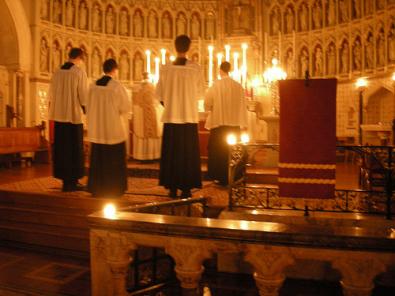
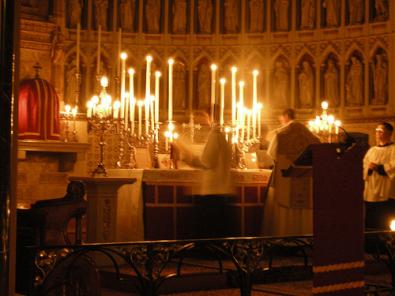
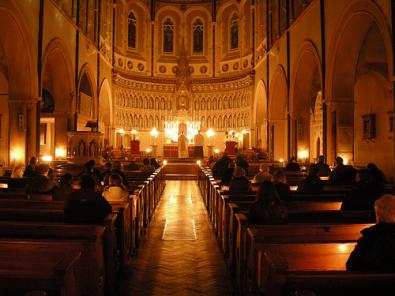
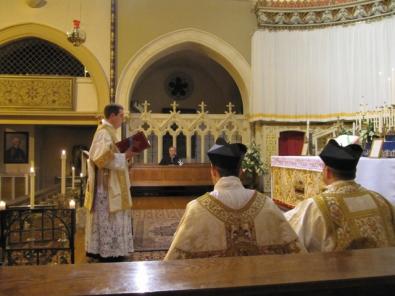
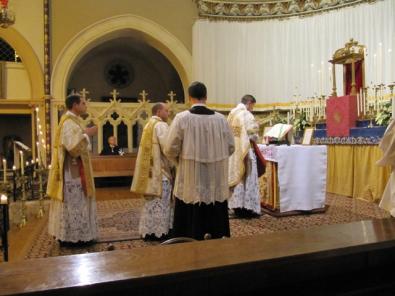
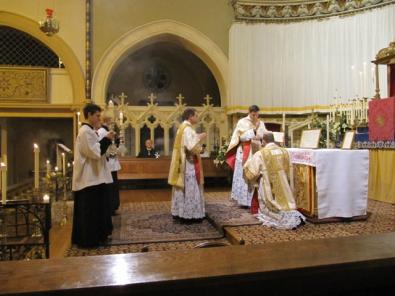
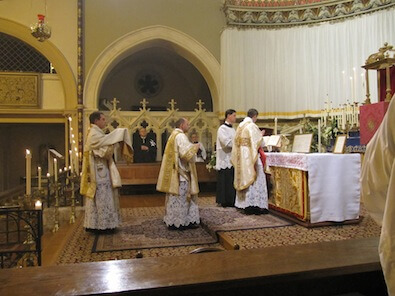
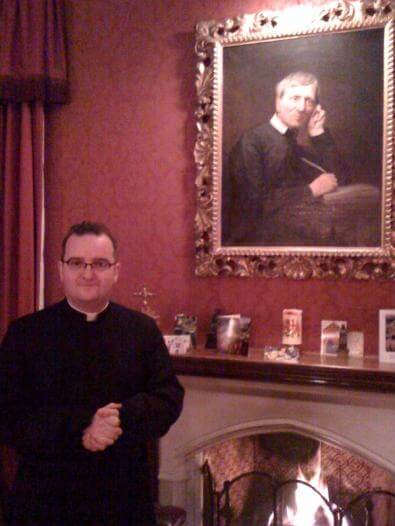
Fr Nicholas Schofield, Parish Priest of Uxbridge, Diocesan Archivist of Westminster and former Brother of the Secular Oratory (when he was an undergraduate at Exeter College) came to preach at the Solemn Mass for the Immaculate Conception. His sermon is reproduced below:
1291904280.jpg

Rejoice, so highly favoured! The Lord is with you.

Whenever I come to Oxford, I try to make a short pilgrimage to the porch of the University Church of St Mary the Virgin. You all know it better than I – jutting out on to the High with its ‘barley sugar columns’, echoing Bernini’s baldacchino in St Peter’s, Rome. Built in 1637, I always think it offers a tantalising glimpse of the sort of architecture we might find across the country had there been no Protestant Reformation, had the English Baroque been Catholicised. The statue of Our Lady in the porch was actually used against Archbishop Laud at his trial in 1641, an example (it was thought) of his dangerous Romanising tendencies and such was the opposition the statue aroused that you can still see to this day the bullet-holes left by Cromwell’s men.

That ‘Virgin Porch’ in the heart of this city seems to sum up the whole history of English devotion to Our Lady and, in particular, to the mystery of the Immaculate Conception, which we celebrate here tonight. Even though the statue dates from after the Reformation, its baroque splendour reminds us of this country’s dignity as Mary’s Dowry, a place where there had long been a devotion to the Immaculate Conception. In fact, one of the earliest mentions of a feast of Our Lady’s Conception comes from an old Winchester Calendar, dating from around 1030. It seems that the Normans initially discontinued the Feast, for they tended to be suspicious of Anglo-Saxon observances. But then a Norman Abbot was saved from shipwreck after promising to establish the feast of the Conception and it henceforth became increasingly popular around the country.

If the magnificence of the ‘Virgin Porch’ reminds us of the English love for Our Lady, then the Cromwellian bullet-holes represent the story of turbulence and destruction, of shrines razed to the ground and images burnt. The Immaculate Conception was, of course, discarded as a corrupt superstition at the Reformation, though it is interesting to also remember that, not yet defined by the Church, the doctrine was vigorously debated in the medieval schools – including Oxford. One historian said that ‘as England has the honour of having first celebrated the festival of Our Lady’s Conception, so have her schools the credit of being the first to defend it scientifically.’ Eadmer of Canterbury, for example, wrote a treatise in support of the doctrine and introduced the famous (though not entirely convincing) maxim: decuit, potuit, ergo fecit – in other words, the Immaculate Conception was possible, because nothing is impossible to God, and fitting, for how could the Mother of God not be Immaculate, therefore it came about, it was accomplished.

So, the Blessed Virgin has been debated by the schoolmen and rejected by the reformers, and yet in more recent times there has been something of a Marian revival. And part of this rediscovery was achieved by that scholarly-looking clergyman who would have been seen scuttling through the Virgin Porch and into the University church during the 1830s – as one of his disciples put it, ‘walking fast, without any dignity of gait, but earnest, like one who had a purpose; yet so humble and self-forgetting in every portion of his external appearance, that you would not have thought him, at first sight, a man remarkable for anything’. His name: Blessed John Henry Newman.

Even as an Anglican, Newman had a strong devotion to Our Lady – ‘in spite of my ingrained fears of Rome, and the decision of my reason and conscience against her usages’, he wrote in the Apologia, ‘in spite of my affection for Oxford and Oriel, yet…I had a true devotion to the Blessed Virgin, in whose College I lived, whose Altar I served, and whose Immaculate Purity I had in one of my earliest printed Sermons made much of’. There’s the amazing thing: that an Anglican in the early nineteenth century could associate the words ‘immaculate’ and ‘Mary’. He refers to a sermon he preached in 1832, the year before the ‘official’ start of the Oxford Movement, where he spoke of Mary as the ‘Second Eve’ and hinted at the Immaculate Conception, though he dared not use such popish terminology. Yet his beliefs were clear: ‘what, think you, was the sanctified state of that human nature, of which God formed His sinless Son; knowing as we do, “that which is born of the flesh is flesh”, and that “none can bring a clean thing out of an unclean?”‘

As a Catholic, Blessed John Henry was more forthright in his views and asked: ‘what is there difficult in this doctrine? What is there unnatural? Mary may be called, as it were, a daughter of Eve unfallen.’ He wrote elsewhere: ‘we do not make her nature different from others. Though, as St Austin says, we do not like to name her in the same breath with mention of sin, yet, certainly she would have been a frail being, like Eve, without the grace of God. A more abundant gift of grace made her what she was from the first. It was not her nature which secured her perseverance, but the excess of grace which hindered Nature acting as Nature ever will act. There is no difference in kind between her and us, though an inconceivable difference of degree. She and we are both simply saved by the grace of Christ.’

Why was Mary preserved from the stain of original sin? Those who come near to God, the source of all goodness and holiness, must be holy themselves. No human being came as near to Him as Mary did. A prophet who acts as His oracle; a mystic who reaches the highest mansion; a priest who consecrates the bread and wine – none of these are as close to God as Our Blessed Lady. As Mother of God she carried the second person of the Trinity in her womb, she became, if you like, a living, walking tabernacle, the new ark of the covenant. And so it was fitting that Mary was prepared in this unique way.

Returning to Oxford’s ‘Virgin Porch’: the statue of St Mary the Virgin remains a discreet but ever maternal presence in the heart of this city, watching no longer the passings of Cavaliers and Roundheads with their pikes and muskets but successive generations of undergraduates, rushing by with their iPods and iPhones. Tonight we turn to her, as patroness of this diocese and patroness of the Oratory. She points us, as ever, towards her Son and reminds us of the primacy of grace, which St Paul calls God’s ‘free gift to us in the Beloved’. Because without grace, Mary would have been nothing; likewise, whatever our talents, we cannot achieve anything without first acknowledging our total dependence on God. Mary was given the highest fullness of His Kingdom. We too are granted wonderful graces, hour-by-hour – of the same kind but not to the same degree. As we honour the unique privileges for Our Blessed Lady, let us become more aware of this invisible life of grace, without which we are vessels of clay and only that. As we prepare for Christ’s coming, let us follow in the footsteps of the Immaculate Virgin – ‘for nothing is impossible to God.’

Fr Nicholas Schofield, 8.xii.2010
Women’s Oratory presents cheque for the Campaign

1288956352.jpg

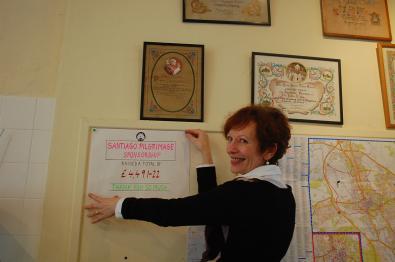
The Women’s Oratory and friends have been working hard to raise sponsorship money for the walk to Santiago in August. Last Sunday they were able to hand over a grand total of £4,491.22. Some further pledges and Gift Aid may still be due to come in. Any other fundraising ideas are always welcome!

Blessed John Henry’s first feast day

1287573562.jpg

9th October was our Cardinal’s first liturgical feast day. There was a whole weekend of events in Oxford, all of which were attended by large numbers of people.

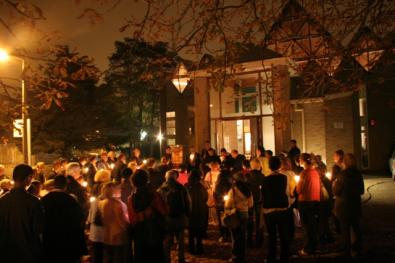
The Night Walk (pictured above) takes place each year on the evening of 8th October, from the Oratory to the College at Littlemore. It commemorates Blessed Dominic Barberi’s arrival to receive Mr Newman into the “one fold of the Redeemer” on 8th October 1845.

On Saturday 9th October there was a Mass in honour of Blessed John Henry in the Parish Church at Littlemore, and then in the evening, Nigel Cooke of the Royal Shakespeare Company read Newman’s sermon “The Cross of Christ the Measure of the World” to an appreciative congregation in the University Church of St Mary the Virgin, where Blessed John Henry was the vicar.

Finally, on Sunday 10th October, the feast was transferred at the Oratory. There was veneration of the relic after all Masses, and Bishop John Arnold celebrated the Solemn Mass.

Holy Father’s Audience address (Wednesday 22 September)

1285668676.jpg

Dear Brothers and Sisters in Christ,

As you know, I have just returned from my first Apostolic Journey to the United Kingdom, and I wish to send my affectionate greetings to all those I met and those who contributed to the visit through the media during four days, which have begun a new and important phase in the long-standing relations between the Holy See and Great Britain.

Last Thursday, I was honoured by the warm welcome of Her Majesty The Queen and the Duke of Edinburgh in Scotland’s historic capital Edinburgh. Later that day, I celebrated Mass in Glasgow in the presence of many bishops, priests, religious and a great concourse of the faithful against the backdrop of a beautiful sunset at Bellahouston Park, within sight of the place where my beloved predecessor celebrated Mass with the Scots twenty-eight years ago.

Upon arriving in London, I met thousands of Catholic students and schoolchildren at a very joyful celebration, reminding all of us of the excellent and essential work being done by Catholic schools and teachers throughout the land. I then had the pleasure of meeting the clerical and lay representatives of different religions and of discussing the search for the sacred common to all men.

Later, I had the honour of calling upon His Grace the Archbishop of Canterbury who has come on several occasions to meet me in Rome. Our meeting at Lambeth Palace, in the presence of the Bishops of the Church of the England, was very cordial and fraternal. I then crossed the river to Westminster where I was given the unprecedented opportunity to address both Houses of Parliament gathered in Westminster Hall on the importance of a fruitful dialogue between religion and reason, a theme as relevant in the time of Saint Thomas More as it is in our own day. Finally that day, I had the privilege of kneeling in prayer with the Archbishop of Canterbury at the Tomb of Saint Edward in Westminster Abbey, and of giving thanks to God with the Archbishop, the Moderator of the Church of Scotland and other British Christian leaders, for the many blessings God has bestowed upon our efforts to re-knit the fabric of our Christian fellowship.

The next morning, I had the pleasure of greeting Prime Minister David Cameron, Deputy Prime Minister Nick Clegg and Ms Harriet Harman, leader of the Opposition, before celebrating Mass in Westminster Cathedral, with a liturgy evocative of the best of the English musical tradition in the celebration of the Roman rite. That afternoon, I was welcomed very cordially by the Little Sisters of the Poor and the elderly people they look after. There I also had the chance to thank and encourage those charged with the safeguarding of children in Britain. That evening I participated at a beautiful vigil of deep prayerfulness and stillness at Hyde Park with tens of thousands of the faithful.

On Sunday morning, I travelled to Birmingham where I had the joy of celebrating the Beatification of Cardinal John Henry Newman. Later that day, after a warm and fraternal meeting with all the Bishops of Britain, I was bidden farewell by Prime Minister Cameron during a very cordial speech at Birmingham International Airport on the Government’s wish to build a partnership for development with the Catholic Church and others.

Sunday, then, was a moment of deep personal satisfaction, as the Church celebrated the blessedness of a great Englishman, whose life and writings I have admired for many years and who has come to be appreciated by countless people far beyond the shores of his native land. Blessed John Henry Newman’s clear-minded search to know and express the truth in charity, at whatever cost to his own personal comfort, status and even friendships, is a wonderful testimony of a pure desire to know and love God in the communion of the Church. His is surely an example that can inspire us all.

Carpenter’s hand-made box given to Pope

From the Oxford Mail, by Reg Little:

1285410585.jpg

SEMI-RETIRED carpenter John Leather spoke of his pride at being asked to make a special gift for the Pope for his historic visit to the UK.

Mr Leather, 68, was asked by the Oxford Oratory to make a presentation box to hold a rosary that had once belonged to Oxford’s Cardinal Newman.

It was handed to Pope Benedict XVI in Birmingham on Sunday as the Pontiff beatified the cardinal, who died in 1890.

The gift was to mark Oxford’s links with the great Victorian churchman, beatified in front of 50,000 pilgrims at Cofton Park, Birmingham. The cardinal is now likely to be made a saint.

Mr Leather, of Wyndham Way, in North Oxford, has worshipped and carried out jobs at the Oxford Oratory of St Aloysius Gonzaga in Woodstock Road, Oxford, for 20 years.

Mr Leather, who runs Leather Building Services, said: “I made it from a nice piece of English oak.

“I’m semi-retired now. It was a tremendous honour to be asked to do it. My wife Mary made a green velvet pouch which it was placed in.

“Father Jerome Bertram at the Oratory is quite artistic, so he was able to give me some drawings and exact measurements to work from. Sadly I was away on Sunday, so I was not able to see the presentation to the Pope.”

The rosary was presented to the Pope by Father Richard Duffield, a priest at the Oxford Oratory who was seconded to the Birmingham Oratory to help with the papal visit.

Mr Leather’s presentation carries a bronze plaque with an inscription saying the rosary had belonged to Newman and had been presented to the Pope.

But the man who engraved it, Adrian Shepherd, said he had no idea who his work was for because the inscription was in Latin – and only found out its recipient from the Oxford Mail.

He said: “That’s fantastic. I was asked to engrave something in Latin, which I don’t read very well. I had no idea that it was for the Pope.

“I have engraved things that have been presented to some very famous people, such as Nelson Mandela and Mikhail Gorbachev, but never for a Pope.”

There are plans to build a chapel dedicated to Cardinal Newman at the Oxford Oratory, forming the centrepiece of a £5m development with a new library and cloistered courtyard.

Blessed John Henry Newman of the Oratory – Pray for us!

We give thanks to God for the grace-filled visit of the Holy Father to Great Britain, and especially for the Beatification of our Cardinal, John Henry Newman.

Seven coaches left very early in the morning from the Oratory to go to Cofton Park for the Papal Mass.

Despite rain in the early morning, the sun came out as soon as the Holy Father arrived. Newman may the first beatus whose banner was unfurled electronically. The picture is that by Ouless, which hangs in the Birmingham Oratory, and a copy of which has been used for our own shrine in Oxford.

1285143413.jpg

Here, Father Gregory Winterton greets Pope Benedict. Fr Gregory was Provost of the Birmingham Oratory at the time of the foundation of the Oxford House.

1285143388.png

The Holy Father paid a private visit to the Birmingham Oratory. He was the first pilgrim to pray at the shrine of Blessed John Henry and went to the Cardinal’s room. Pope Benedict was also delighted to meet Pushkin the cat, to whom he spoke in “cattish German”! Afterwards he greeted the large crowds who had collected on the Hagley Road. The splendid white and gold Papal hangings on the front of the house were lent by the Naples Oratory.

1285143426.jpg

Here, Pope Benedict emerges from the Oratory House, accompanied by Father Richard:

1285143434.jpg

Over eighty Oratorians were present for the Beatification. Here we see some of them at the Solemn Mass of Thanksgiving the next day. Photograph by James Bradley.

1285143402.jpg

Our own Mass of Thanksgiving was held in Oxford on Tuesday 21st. Many friends and distinguished guests were present. (Photographs by Rosie Caldecott)

1285143295.jpg

The Archbishop explained that the chalice used for the Mass was that given to the Archdiocese by Pope Benedict on Sunday.

1285143210.jpg

After Mass, His Grace blessed the shrine of Blessed John Henry. Eventually, we hope to build a chapel specially dedicated to our Cardinal, but the present small altar serves to focus devotion for the time being.

1285143111.jpg

It has been wonderful to receive many pilgrims to our church over the past few days; from the United States, Poland, Austria, France, Italy, Germany, Belarus, Canada, Japan, South Africa, Ireland, Spain, Argentina and many other places.

Relic of Newman is prepared for veneration

In 1875, Charles Henry Poole obtained a locket of John Henry Newman’s hair – from the barber! – and later presented it to Trinity College, in whose archive it has resided ever since. The College has graciously allowed this relic to live on permanent loan at the Oxford Oratory and a reliquary has been acquired for this purpose.

Here Father Dominic carefully places the hair into its capsule:

1284733155.jpg

It is then sealed, to guarantee its authenticity:

1284733174.jpg

The relic will be exposed at the Solemn Mass of Thanksgiving on Tuesday (21st September) at 6pm, when the Archbishop will also bless the new shrine to the newly-beatified John Henry Newman.

1284733190.jpg

1284733716.jpg