Novena for the Canonization of Blessed Dominic Barberi
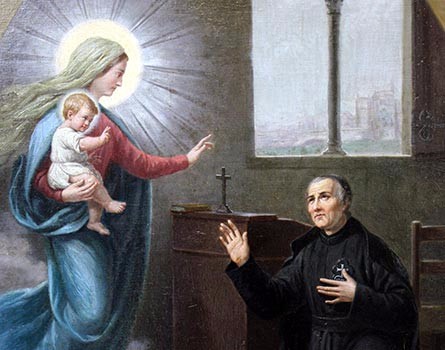
His Grace the Archbishop has asked the whole diocese to make a novena for the canonization of Blessed Dominic of the Mother of God, the great Passionist missionary, who received Blessed John Henry Newman into the Church in 1845.
We are making this prayer at all Masses, leading up to Saturday, when the Archbishop will be celebrating Mass for this intention at SS Giovanni & Paolo, the Passionist Generalate Church in Rome.
On display in our Relic Chapel at the moment is an autograph letter of Blessed Dominic:
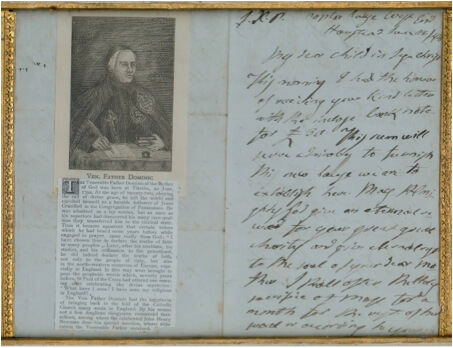
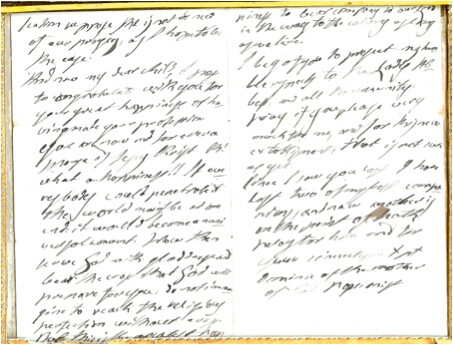
The letter came into our possession by the kindness of the Benedictine nuns of the Priory of Our Lady of the Angels, formerly at Fernham. It reads as follows:
A Letter from Blessed Dominic Barberi
J.X.P. Poplar Lodge West End
Hampstead June 18 / 48
My dear Child in Jesu Christ. This morning I had the honour of receiving your kind letter with the inclose bank note for £ 30 This sum will serve admirably to furnish this new lodge we are to establish here. May Almighty God give an eternal reward for your great great charity and give eternal rest to the soul of your dear mother. I shall offer the Holy sacrifice of Mass for a month for the rest of her soul or according to your in/tention in ye case she is not in need of our prayers, as I hope to be the case.
And now my dear child, I pray to congratulate with you for your great happiness of having made your profession. You are now and for ever a spouse of Jesus Christ. Oh! what a happiness!! If everybody could penetrate it the world might be at an end: it would become a rarified firmament. Follow then, serve God with gladness and bear the cross that God will prepare for you: do not imagine to reach the religious protection without a cross. But this is the greatest hap/piness to bear company to our Lord in the way to the calvary as long as we live.
I beg of you to present my humble respects to the Lady Abbess, and all the community. Pray if you please very much for me, and for this new establishment, that is not made as yet.
Since I saw you last I have lost two of my best companions, and now another is on the point of death. Pray for him and for yours sincerely in Xrt Dominic of the mother of God Passionist.
Probably the letter was written by Blessed Dominic to a recently-professed nun of Princethorpe (whence the community later moved to Fernham).
Blessed Dominic sends his humble respects to the “Lady Abbess” – but this is probably an instance of his well-known whimsical humour, since Our Lady, Queen of Peace was Abbess of Princethorpe. This was because in 1658, when the nuns were still at Montargis, near Orleans, in order to prevent King Louis XIV from imposing an absentee abbess, the Prioress assembled the community in chapter and suggested that Our Lady of Peace, to whom they had a special devotion, be elected as abbess in perpetuity. The vote was carried unanimously, and July 2nd was chosen as the day for the installation of Our Lady as Abbess. Hence, for the whole of its subsequent history, the community had Our Lady as the Abbess, and a statue of her in the first place in choir, holding a crosier. Therefore when Blessed Dominic says, “I beg of you to present my humble respects to the Lady Abbess”, he is probably asking his spiritual child to say a Hail Mary for him.
Visit of Bishop Schneider
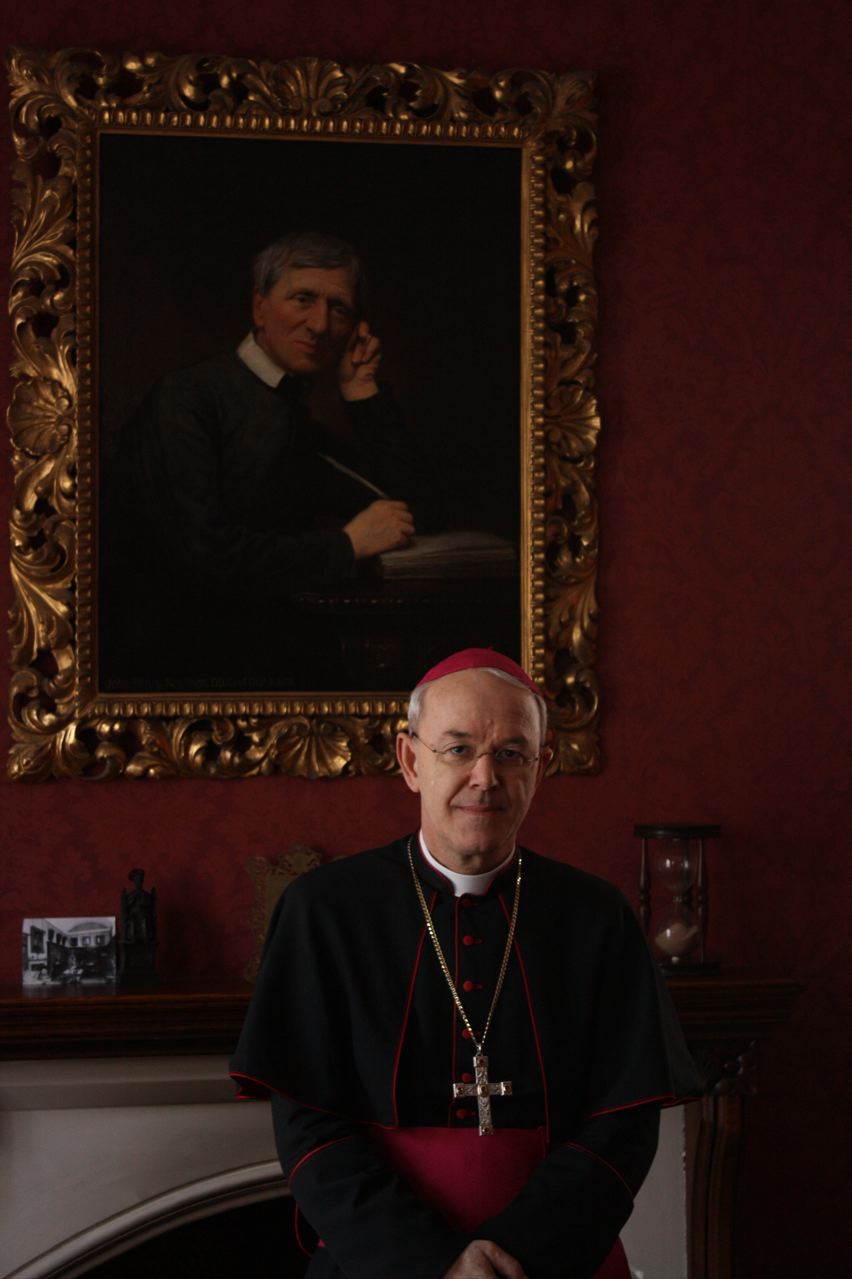
Bishop Athanasius Schneider, auxiliary Bishop of Astana, Kazakhstan, celebrated Compline and gave Benediction yesterday evening, and preached the sermon which is reproduced below. Bishop Schneider greatly impressed us with the account of his youth, growing up in the clandestine Church in the Soviet Union, and with his zeal for the faith today.
Only in the Cross of Christ is salvation, only in the Cross of Christ is hope, only in the Cross of Christ is life
Blessed John Henry Newman speaks to us the greatness and the mystery of the Cross saying: “The doctrine of the Cross is not on the surface of the world. The surface of things is bright only, and the Cross is sorrowful; it is a hidden doctrine; it lies under a veil; it at first sight startles us, and we are tempted to revolt from it. Like St. Peter, we cry out, “Be it far from Thee, Lord; this shall not be unto Thee.” [Matt. xvi. 22.] And yet it is a true doctrine; for truth is not on the surface of things, but in the depths.”
Blessed John Henry continues to say, that the doctrine of the Cross of Christ is the heart of the Christian religion: “The sacred doctrine of Christ’s Atoning Sacrifice is the vital principle on which the Christian lives, and without which Christianity is not. Without it no other doctrine is held profitably; to believe in Christ’s divinity, or in His manhood, or in the Holy Trinity, or in a judgment to come, or in the resurrection of the dead, is an untrue belief, not Christian faith, unless we receive also the doctrine of Christ’s sacrifice.
The world, the enemies of the Cross and even the enemies of the Cross amongst Catholic and Catholic clergy in our days say: The doctrine of the Cross makes us sad, that therefore the Gospel is a sad religion.” Blessed John Henry Newman answered already in those times with these words: “The Psalmist says, “They that sow in tears shall reap in joy;” and our Lord says, “They that mourn shall be comforted.” Let no one go away with the impression that the Gospel makes us take a gloomy view of the world and of life. It hinders us indeed from taking a superficial view, and finding a vain transitory joy in what we see. … That Cross will lead us to mourning, repentance, humiliation, prayer, fasting; we shall sorrow for our sins, we shall sorrow with Christ’s sufferings; but all this sorrow will only issue, nay, will be undergone in a happiness far greater than the enjoyment which the world gives. … They alone are able truly to enjoy this world, who begin with the world unseen. They alone can truly feast, who have first fasted; they alone are able to use the world, who have learned not to abuse it” (PPS VI, Sermon 7).
Saint John Maria Vianney left us very simple but profound words about the Cross and the meaning and the value of Christian suffering: “Our eternal happiness is the Cross of Christ. Thanks to the Cross of Christ we became children of God. On the Cross there came into existence the Christian religion. All the efficacy of the sacraments come from the Cross of Christ. When God sends us a cross, a true Christian should say to himself: Come, my soul, and bear the Cross. For, when we will be in heaven, we will understand the value of the sufferings. The Cross is indeed the ladder to heaven. The crosses in our life is similar to a beautiful stone bridge across a river.”
One has to love the Cross. Blessed him, to whom God sent a cross, because it is a path to holiness. We think when we love a little bit Our Lord, we should be free from all inconveniences. Have you been calumniated, my friends? Have you been loaded with insults? Have you been wronged? So much the better! That is a good sign; do not worry; you are on the road that leads to Heaven. Do you know when you ought to be really upset? When you have nothing to endure, when everyone esteems and respects you. Are you forgetting, then, that at your Baptism you accepted the Cross, which you must never abandon until death, and that it is the key that you will use to open the door of Heaven? Are you forgetting the words of our Saviour: “If any man will come after me, let him deny himself, and take up his cross daily, and follow me.” Not for a day, not for a week, not for a year, but all our life.
One has to expiate one’s sins either here on earth, or in the hereafter. When we would really love Our Lord, we would love the cross as well, for we would be happy to suffer for Him Who suffered for us. The Cross is always sent by God. We have to ask the grace to love our cross and then it will be easier for us. When we lack suffering, we are similar to an infertile soil. In the moments of suffering, the Christian should say: I am a friend of my Lord and God. He looks upon me. He consoles me! The cross emits a balsam, which fills the soul with happiness. Every morning we have to accept and to consecrate to the Lord all the sufferings and inconveniences which may occur during the day. And if the Lord hadn’t sent them to us on this day, the merits will nevertheless be credited to us. “We know that all things work together for good to those who love God” (Rom 8: 28). It is so consoling to lead the battle against the sin under the eyes of the Lord and to have the occasion to say at the end of a day: Here now, my soul, today for a while you were resembling the suffering Lord; like Him you have been persecuted, flagellated, you were bearing some physical pains etc. What a treasure is this for my last hour!”
With Saint John Vianney let us say: “O holy Cross, what great goods we have received from you. Thanks to you, the most pure Blood of Christ is shed every days in a sacramental manner in the sacrifice of our altars. On this Cross is sown the heavenly manna, which till the end of the time will nourish our souls. On this Cross began to grow that mysterious grape vine, by which juice is quenched the thirst of our souls in this exile. O holy and inestimable Cross of Our Lord Jesus Christ!” Amen.
Lent Project
Our Lent project this year is the work of the Companions of the Order of Malta in Oxford. There will be a second collection on Sunday 13th March. Here is a copy of their most recent newsletter, so that you can see more about what they do:
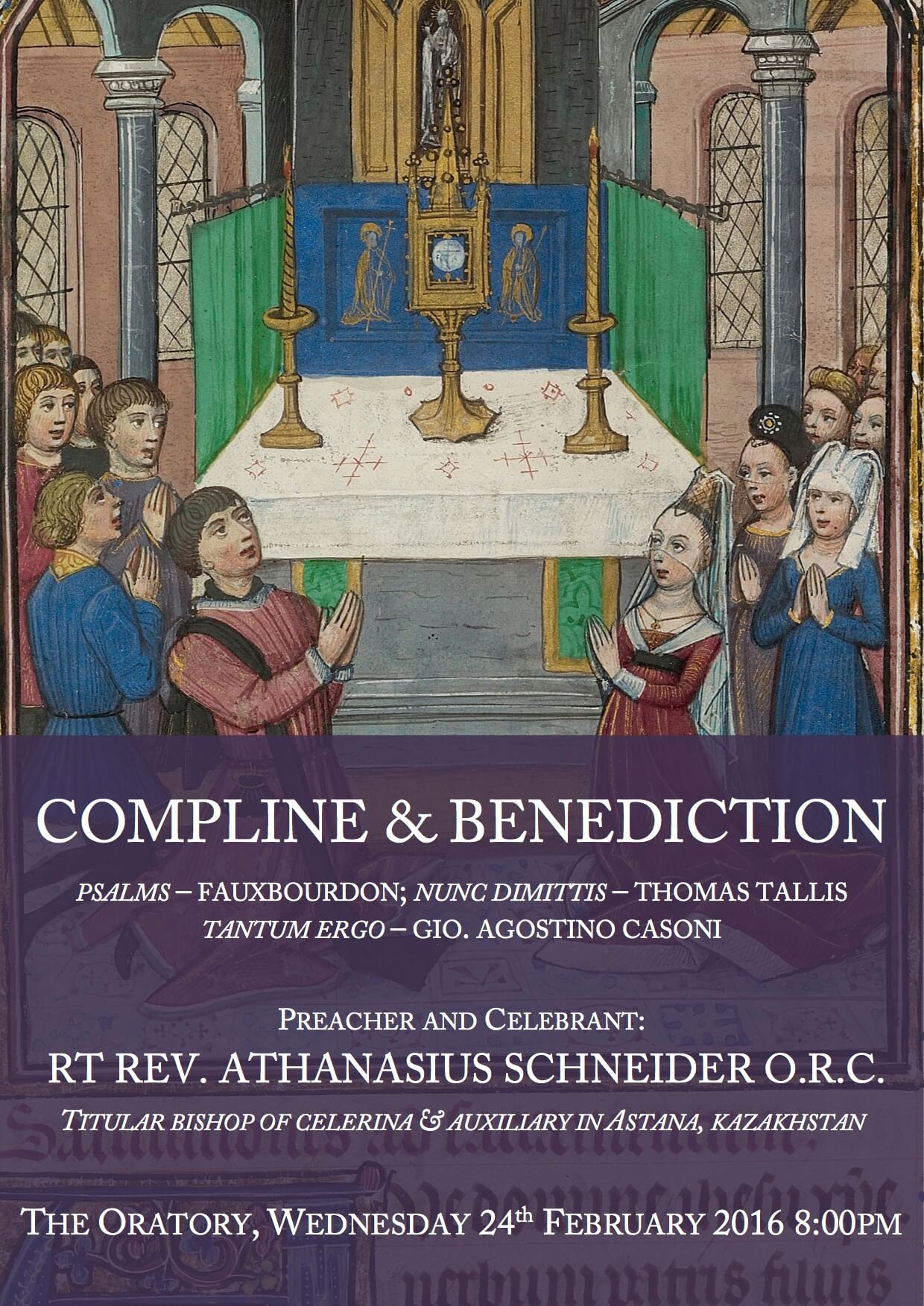
Compline with Bishop Schneider
On Wednesday 24th February at 8pm, there will be sung Compline, Sermon and Benediction, as part of our Lenten exercises.
The preacher will be His Lordship Bishop Athanasius Schneider, of Astana, Kazakhstan.
24 Hours for the Lord
“Mercy is the very foundation of the Church’s life”
In response to Pope Francis call to have “24 hours for the Lord” on Friday 4th March to Saturday 5th March during this Jubilee Year of Mercy, the Archbishop of Birmingham, Bernard Longley, invites all Catholics of the Archdiocese, including the baptized who feel estranged from the institutional church, to participate in a time of prayer, liturgies and reflection that will be held in the designated Jubilee Churches and Places of Pilgrimage, or to visit a local church during those twenty-four hours.
In our church, on Saturday 5th March, there will be the Pilgrimage Mass with Procession through the Holy Door and prayers to Our Lady of Oxford, Mother of Mercy, at 10am. After this, the Blessed Sacrament will be exposed (and on all Saturdays of Lent) until Benediction at 6pm.
Confessions will be heard continuously on 5th March from 9.40am – 6.30pm.
This “24 Hours with the Lord” is an opportunity for all to be experience a sense of belonging and welcome in the company of Jesus.
Sacramental Reconciliation is a way of “rediscovering a path back to the Lord, living a moment of intense prayer and finding meaning … (and it will be) for every penitent. …. a source of true interior peace” [Misericordiae Vultus n. 17]. Pope Francis said, “Mercy will always be greater than any sin”. [MV n. 3]

Lent at the Oratory
Full details of services and events for Lent and Holy Week may be found by clicking on the link in the ‘Downloads’ box on the right of this page.
Parish Priest’s Report 2015
Here is the Parish Priest’s Report for last year, given at the Parish Annual General Meeting last Saturday:
Parish Priest’s Report 2015
Parish Statistics:
• Baptisms: 42 (4 Adults)
• Receptions of Converts: 2
• First Holy Communions: 35
• Confirmations: 53
• Marriages: 20
• Funerals: 13
• Average Mass Attendance: 882 (Sundays in October)
• Confessions heard in our Church: 8,064
On the whole, those figures are within the usual parameters. The Mass attendance appears to be slightly down, and I would attribute that to two factors: firstly one of the Sundays in October when we counted was the day of the Oxford half-marathon, which brought the city to a standstill, imprisoned residents in their homes, and led to a massive drop in Mass attendance that day. I would urge you to try to persuade the City Council that such events should not happen too often. Secondly, we are all aware that parking in the city is particularly difficult at the moment, and some would say that getting I or out of Oxford is ‘impossible’. Businesses along the Woodstock Road have also reported an all-time low in takings, and so we should not be surprised, given how many travel in to Mass here, that this should affect us too. On a positive note: the very large number of confessions is an extremely encouraging sign that the message of the Year of Mercy is having an impact, about which, more later.
The number of funerals is up too! This is partly because for some of the year, the church of Blackfriars was out of action because some plaster fell dramatically from the ceiling, and so we were happy to be able to host our Dominican brethren here when their refectory was too small for Mass. As well as for some funerals, it was also a pleasure to have an ordination in our church for this reason. Plaster has been falling here too: from the high walls rather than from the ceilings, and though we haven’t, thankfully, had to close the church, nevertheless we have had to put up with dust and scaffolding, including on the feast of the Immaculate Conception, and indeed, there has been a bill for this urgent and necessary work of tens of thousands of pounds. To return to funerals: there have taken place in our church in 2015, Requiem Masses for the following: Audrey Brown, John Wall, Merle Grandi, Phyllis Horan, Charles Komarnicki, Sheila Gatford, Elizabeth Webb, Manuela Toporowska, Muriel Jennett, Penny Bible, Robin Wilson, Bridget Siedlik, and Joseph Clarke. And since the beginning of 2016: Sir Brian Tovey, Kitty McAleer, and Jean Taylor, with Elizabeth Edmondson’s funeral to take place next week.
I already spoke about Audrey Brown and John Wall last year, so I shall begin with Phyllis Horan, whose photograph now reigns from behind the bar, and whose energetic presence seemed so vital for many, many years. She was the last of that formidable, and now extinct breed: the ‘Social Club Woman,’ and since at Audrey Brown’s funeral, Phyllis very firmly warned me that she would haunt me if I spoke ill of her, I should record that this group of parish stalwarts kept things running here over many decades. Not that Phyllis was unable to take part in more recent escapades: it was she who led us all into the nearest pub when the coach returning from London broke down in December 2014, she had been the life and soul of the party at the Murder Mystery Dinner, and gave full instructions to the staff of Jacob’s Inn about the making of Irish coffee at the Wednesday Morning Group lunch just a few days before she died. Her death, fortified by the rites of Holy Church, was edifying – and I treasure the words she spoke to another parishioner on the afternoon of her death: “Tell the Fathers, thanks for everything.”
Sheila Gatford had been ill and unable to take part in parish life for a while, but some of us remember her in full command of the Thursday morning team of church cleaners. Father Manners, the last Jesuit Parish Priest of St Aloysius’, had asked her to take on the brass-cleaning in the 1970s, and she faithfully did this until she was unable to continue. Our current group of cleaners carries on its own loyal service every Thursday morning, and new volunteers are always welcome.
Manuela Toporowska was another long-standing parishioner who had been away in her last frailty, but who remained faithful to the parish over many years. Likewise, Robin Wilson was a devoted porter until a few years ago, bringing a meticulous dedication to the Lodge. I might here repeat my constant refrain that volunteering in the Porters’ Lodge is a huge service to the parish, and we really do need more people for this.
Sir Brian Tovey was quite a recent arrival in the parish, along with his wife, Mary. They had been among a pioneering group of Anglicans in London who came into the Church in the 1990s. Sir Brian had been director of G.C.H.Q. in Cheltenham, and was a distinguished art historian.
Another recent convert was Elizabeth Edmondson, whose Requiem takes place on Wednesday next. A successful crime writer, she had generously agreed to write the script for our next Murder Mystery Dinner, until her death intervened quickly, with the script incomplete. I hope that something can eventually be salvaged, but for the meantime, those who were to organize a murder are planning on Bingo instead. For some of my brethren, Bingo is the more heinous crime, but I am assured that this will be a very smart Italian ‘Tombola’ evening on 16th April.
Fr Daniel was invited to preach at Evensong at St Giles’ to mark Christian Unity Week last year. He enjoyed the experience and many of our own parishioners came across the road to hear him; and indeed the choir of St Giles’ singing ‘Tu es Petrus.’ We are fortunate indeed to have very cordial relations with our neighbours, and collaboration – especially in various ministries to the poor and homeless – has been extremely fruitful. Dr Andrew Bunch, the Vicar, came to preach at our own service for Christian Unity Week this year, which took the form of Compline, Sermon, and Benediction. This is a format which has really been rescued from a bygone age – but like so much that is bygone, it is well worth rescuing. Mr Edward de Rivera, who served as our Director of Music for twenty-five years, until December 2015, requested that we have Compline, Sermon and Benediction for St Edward’s Day in October. It was a quietly prayerful occasion, and the same formula will be resurrected again this year, on 24th February, when Bishop Athanasius Schneider of Kazakhstan (yes, Kazakhstan!) will preach.
Edward de Rivera arrived here on the Solemnity of the Immaculate Conception 1990. He built up a musical tradition in our church which had all but disappeared. The great heritage of Catholic music was retrieved from the dustbin of history and used for the purpose for which it was written: the worship of Almighty God in the sacred liturgy. In this, Edward was following in the long line of Oratorian musicians going back to the time of St Philip, who harnessed the talents of Palestrina and Animuccia for the glory of God. The most remarkable feature of Edward’s service to our parish over a quarter of a century was his utter reliability: he was here on every occasion promptly and dependably. Only once in that time did he miss a Sunday: when the snow was so deep that nobody could get through. For most of his tenure, Edward was supported by his dear wife, Veronica. We wish him every happiness in retirement, and record our profound gratitude. A Solemn Mass on 9th November 2015, the feast of the Dedication of the Lateran Basilica, and also Edward’s birthday, was a memorable way to mark his long service. Since December, our former organist, Mr Andrew Knowles, has taken over as Director of Music. He acquitted himself magnificently at a beautiful Carol Service on 16th December, and is gradually finding his feet – despite us not yet having a permanent organist appointed. People sometimes express surprise at the amount we spend on music: this year we expect to spend £27,000; but I make no apologies for attempting to make the Liturgy of the Church as beautiful as it can possibly be. Our Holy Father converted Rome by using the attractive things of the world to draw souls to God. I have mentioned already St Philip’s cultivation of the finest musicians; he also employed the medium of architecture, as we see at the Chiesa Nuova, and art: Philip himself commissioned paintings by Barrocci and Caravaggio for the church. I don’t think we should be satisfied, then, until all that we do here is to the same standard as Caravaggio’s painting: only the best us good enough for God. Later this year, we hope to have a performance of Monteverdi’s Vespers in our church, at which our Musical Foundation will be launched, to support the ongoing development of the finest music for the Mass. On a similar theme: you will know that we were able to replace the ugly scaffolding outside this room with a decent-looking fire escape. I am promised that what look like the reconstruction of First World War trenches in the playground will be resurfaced soon, and then the site will look a little more presentable.
We have also had to have work done in the house in the past year. A new boiler was installed, which will soon pay for itself in its markedly greater efficiency than its predecessor, installed over thirty years previously. As you can imagine, maintenance is always an ongoing task, whether it is loose slates on our roof, or sealing up the windows in the nave which banged noisily in the wind. All this has been aggravated by a number of burglaries and acts of vandalism during 2015, which have shaken us out of any complacency about security. I know that I have mentioned security systems before, but these really are now to be installed within the coming months, so as to protect and reassure the community and those who worship here.
Our buildings are a vital way in which we seek to evangelize the city of Oxford, most importantly by keeping our church open for visitors day after day. It is always remarkable to see how many people, familiar and unknown, come in to make a visit to the Blessed Sacrament; and the effect that coming into the church for the first time has on strangers too. Another way we seek to help others to grow in faith is by teaching, and the catechetical slots on Saturday mornings have continued to attract large numbers. We showed a series of films made by St Anthony Communications in the early part of 2015. In the Trinity Term, the Fathers spoke about various friends of St Philip, in preparation for his 500th Birthday, and in Michaelmas and the beginning of 2016, Fr Jerome has been giving a wildly-popular series on the Catholic history of Oxford, the transcripts of which may be purchased from him for a mere £3.00.
A number of parishioners had asked me to repeat the ‘Evangelium’ course. Thinking that so many had come last time that it would be a small group, we planned to have it this time in the library. That proved much too small from the start and a good number have been attending on Wednesday evenings down here in the Parish Centre. Fr Jerome does have a lively scripture group up in the Library, and other groups using the Parish Centre include the formidable phalanx of Women’s Oratory, now meeting at 5.00pm on Monday, the Brothers, who have also taken in bulk to their new meeting time of Sunday afternoon, Young Oratory, Little Oratory, the Wednesday Morning Group for over-60s, the S.V.P., the Mother and Toddler group, a home-schooling group, catechism classes, the Food Bank committee, the Gatehouse committee, the Oxford Poverty Action Trust Committee, Baptism parties, wedding receptions, and our new Guides and Scouts. Looking back, it is hard to imagine how we managed before the arrival of these new facilities, less than three years ago. We are close to finishing paying for them, which is no mean achievement. Eventually we would like to move on to redecorate the nave – especially given my previous comments about the importance of beauty – but everything in its time.
I mentioned the new Scouts and Guides. These are the first troop and company of the Scouts and Guides of Europe in England – run along Catholic and more traditional lines. The 1st St Philip Scouts went with Br Oliver, and Br Toby of Blackfriars, on their first camp to Farnborough Abbey in Hampshire, where they cooked their own food on fires which they lit themselves without matches. Last Saturday the first five boys made their solemn promises – much to the distraction of my First Communion class, who thought they were trying to set fire to the church. Others are working towards their own promises. Likewise, the 2nd St Frideswide Guides have gradually been acquiring their uniform and learning how to live their faith, how to be useful members of society, and above all, how to start fires.
Br Adam, from our foundation in York, has been with us during term time since Michaelmas, as he has begun his studies for the priesthood at Blackfriars. He too has been roped into the Scouts, and was marching some of them up and down this room last week in what I could only assume was a trailer for the new ‘Dad’s Army’ film. All being well, Br Henry O’Connell, who was also clothed for York in March, will also begin his studies here this coming autumn. Br Henry’s was the first clothing to take place in York where Oratorian life continues to grow apace. Fr Stephen Brown, a priest of the Leeds diocese, has been spending the past month here in Oxford as part of his postulancy for York. He will swap with the other York postulant next week and, God willing, we will there may be two more clothings there in March. Mass times in St Wilfrid’s have been moved around a bit to facilitate saying Mass when necessary at St Joseph’s, of which the Oratorian community has oversight. The principal Mass at St Wilfrid’s is now at midday on a Sunday, and is a sung Mass – we hope eventually a High Mass – in the Extraordinary Form. There too, music has been taking great leaps forward, with the establishment of choral scholarships and an ambitious repertoire. But most importantly, the house has acquired a dog, who is a Cocker Spaniel, Tessa – because of her Carmelite colouring, whom the Provost has been accused of over-indulging during his visits to York.
There have been some visiting choirs here in addition to our own. ‘Sospiri’ sang a magnificent first Vespers on the eve of St Joseph’s Day, ‘Vox’ sang Rachmaninoff’s Vespers on 27th March, the ‘Camerata of Curiosities’, who are not really visitors, because they are run by Andrew Knowles, gave a virtuoso performance of Bach’s Mass in B Minor as part of our celebrations of St Philip’s Birthday, raising a substantial amount for the Campaign, and Rachmaninoff’s Vespers were heard again because Blackfriars was out of action and so ‘Jubilate!’ performed here in June. The Little Singers of St Charles from Versailles are a children’s choir, who combine the practice of the faith with the best liturgical singing, and they delighted those who heard them sing at Mass and at a concert on the feast of Blessed Dominic Barberi. An innovation during the 40 Hours in October was the singing of Mendelssohn’s ‘Lauda Sion’ on the Saturday evening, we also heard Liszt’s ‘Via Crucis’ during Passiontide, and as usual we welcomed the Oratory Prep School for its carol service in December.
Other visitors have included several American summer schools, the Hopkins Society, who brought along with them a copy of the only time that Fr Hopkins was left in charge by Fr Parkinson and wrote the notices himself (‘Flowers for the Triduum may be brought to the Sacristy’) a whole cruise ship of French people who arrived the same Sunday as a party of members of the Ordinariate from British Columbia who were a little bemused, therefore, that the Parish Priest kept insisting on talking to them in French, and a groups of Spanish, German, French and American pilgrims following in the footsteps of Blessed John Henry, and similar groups from many nations. Father (now Bishop) Robert Barron came to film in our Church and Library in January.
In May, our own nation went to the polls in the General Election. The parish is split between two constituencies: Oxford West & Abingdon, and Oxford East. Fr Daniel chaired two lively hustings at the University Chaplaincy, which enabled voters to sift the candidates. My favourite memory is of the most honest answer, given by the Oxford West Green candidate Larry Sanders (brother of Bernie, the American Democrat Presidential hopeful), who when asked what his party thought of Catholic schools, said that he couldn’t remember; they were probably against them, but he thought they were a good thing.
I’m glad that’s what he thinks, since our own primary school gives a good Catholic grounding to its pupils. I always receive positive feedback from parishioners when the school comes to Mass in church, and in June, the diocesan inspectors spoke highly of the quality of religious education and collective worship. Speaking as a governor, as well as the chaplain, I can say that everyone is working tremendously hard to make St Aloysius’ fulfil its motto: “Be ambitious for the higher gifts.”
At Candlemas 2015 began the Year of Consecrated Life. Oratorians are not strictly speaking consecrated since we are not religious and take no vows. Nevertheless, we tend to get swept up in the general consecrated bundle. There are quite a lot of consecrated people living within our parish: Benedictines, Dominicans, Jesuits, Holy Child Sisters, and until September there were Sacred Heart Sisters. In May, Bishop Kenney, himself a Passionist, presided at Vespers in our Church – another event that had to be transferred from Blackfriars – for the religious of the Deanery, which adding in the Salesians, Capuchins, Assumptionists, the Spiritual Family of the Work, De la Salle Brothers, Conventual Franciscans, the Order of St Paul and any others I may have forgotten, adds up to quite a lot.
Episcopal visits to our church have become so common of late that nobody much notices when a mitre emerges from the sacristy doors. Our own Bishop Robert celebrated a Pontifical Mass on Easter Sunday and for the feast of Blessed John Henry Newman, and was here on many other occasions. Bishop Kenney was also here for the Liturgy on Good Friday, to give a talk to the Council of Christians and Jews about the Holy Land, to confirm in November, and to open the Holy Door on the third Sunday of Advent. His Grace the Archbishop came this year to meet the Patriarch of Constantinople at the Union, to lead the ever-popular Deanery Corpus Christi Procession which begins from our church, to confer the sacrament of Confirmation in the Extraordinary Form in October, and for the celebrations of the Silver Jubilee of the arrival of the first Fathers in September 1990. His Grace celebrated a Pontifical Mass of Thanksgiving at which Bishop Byrne preached, and Bishop Kenney also sat in choir. At Vespers that evening, the bishop of Arundel and Brighton, Richard Moth, also joined us.
The most distinguished visitor, His Eminence Cardinal Burke, came to celebrate the Mass on St Philip’s Day, in the five-hundredth year since his birth (St Philip’s, that is). Cardinal Burke is the Protector of the Order of Malta, and was invited jointly by the Order and by the Oxford Oratory. He was a magnificent sight in his Cappa Magna at the Solemn Mass on the feast day, and at Vespers celebrated for the order the following day – in our church again because Blackfriars was closed. His defence of the Church’s teaching make him a great confessor for the Faith in our times, and his sermon on St Philip, as well as his address at the Chaplaincy were both well-worth hearing. His Eminence also took the opportunity to see the work of the Companions of the Order of Malta with the poor. We shall be hearing more about this, as it is to be 2016’s Lent Project, but it is worth observing that the noble celebration of the Liturgy, the fervent preaching of the Gospel in all its integrity and the service of our fellow man are not ‘either or’ options, but a ‘both and’: they are linked inextricably together. As we shall hear, the Companions, drawn from members of the University, perform many corporal acts of mercy in our city, including the Shower Project across the road, visiting some of our house-bound parishioners, and serving a lunch for the homeless, which was cooked here with the help of the parish Conference of the S.V.P.
As well as the usual novena, first Vespers, and Pontifical Mass, we also marked our Holy Father’s five-hundred years with the Bach Mass and series of talks already mentioned, by the publication of ‘St Philip and the Oratory’ by Fr Jerome, and a children’s life of St Philip written by one of the Fathers and illustrated by Susan Bateman, and by the visit of the reliquary bust. This extraordinary creation was crafted in Seville and is travelling around the Oratories all over the world. We had planned to have rather more events connected with its visit, but it got delayed, somewhere between Maastricht and Alcalá de Henares, and then arrived in an enormous crate, quite unexpectedly, one morning in November, just before Advent.
A handful of parishioners joined Bishop Robert, Fr Nicholas, Br Oliver, Br Adam and myself in Florence in July for the celebrations there of St Philip’s birth. As well as the stifling heat, we also experienced the Oratorian charism of chaos in superabundance. There was a Mass at S. Firenze – the Florence Oratory – where the M.C. was appointed two minutes before the Mass began, an excellent reception in the Oratory House, a talk by a Servite describing St Philip as ‘Fiorentinissimo’, a prolonged vigil in the baptistery, brought to an end only when one of the Dominicans at San Marco mercifully sent a message to say that if we didn’t come now they’d close the church, the unveiling of a plaque at St Philip’s birthplace accompanied by verbose Italian speeches, and finally a very grand Mass in the Cathedral, celebrated by the Cardinal Archbishop of Florence, with people in mediaeval costume blowing silver trumpets.
A less exotic and less stressful trip was in June, when the Wednesday Morning Group and friends had a lovely day in Hereford, where we celebrated Mass in the well-restored Church of St Francis Xavier, and were royally treated at the Cathedral, where we saw the Mappa Mundi and Magna Carta, were given an extensive tour, lunch and tea, and graciously welcomed by the Dean at Evensong. The Wednesday Morning Group later that month heard a talk by Judith Schmidt on the ‘Christian Kingdom of Georgia’ which was fascinating, but made me determined never to go there.
In the Oratorian Community: Fr Dominic has been taking a sabbatical as Chaplain of Mayfield School, following his Silver Jubilee, Brother Oliver was made an acolyte on All Saints’ Day, which is one of the ‘ministries’ on the way to the priesthood. Fr Nicholas is doing some work for the Diocesan Marriage Tribunal in Birmingham, and is preparing to obtain a qualification in Canon Law through the University of Leuven in Belgium. It is always a joy to see those who have passed through our hands being ordained. Fr Stephen Morrison of the Norbertines celebrated Mass here on the feast of Ss Peter and Paul – he is a former undergraduate of Oriel College – and preached about the sedia gestatoria as a carbon-neutral mode of transport. Fr Kevin Athaide, a Brother of our Secular Oratory, was ordained priest in Leicester for the Diocese of Nottingham in September.
Mrs Eileen Healey cooked for priests (and bishops!) for many years and after definitively retiring earlier in 2015 she received in December, from the hands of Bishop Robert, the Papal medal, ‘Bene Merenti’ as a fitting tribute to her long service. As even higher honour was accorded to Fr Joseph Vaz of the Goa Oratory, the Apostle of Ceylon, who in January was made a saint, in the first ever canonization to take place in Sri Lanka. His missionary zeal fulfilled St Philip’s own desire to go to the ‘Indies’, which in his own life he found instead in Rome. There are rumours of a possible miracle in the cause of Blessed John Henry Newman, so we may have more Oratorian saints to come.
The Year of Mercy began on the feast of the Immaculate Conception and our own church has been designated as a Jubilee Church where the Plenary Indulgence can be gained. The Holy Door has been tastefully designed by Mrs Freddie Quartley, and is open before all Sunday Masses, and at the end of the Saturday ten o’clock Mass, when during this year there is a procession through the Holy Door to the shrine of Our Lady of Oxford, Mother of Mercy. There will be other events during the year and I hope that pilgrims will come to experience the torrent of Divine Mercy poured out upon us. Our forthcoming parish pilgrimages to Walsingham and Lourdes will also be opportunities to make the Year of Mercy one of conversion for us individually. In April we will host an exhibition about Mother Teresa in our Library and she is to be canonized on 4th September. She is a saint who visited our Parish, and even spoke to the children in our school, so this should be an occasion of grace for us too. May this new saint, together with St Thérèse of Lisieux, Blessed John Henry Newman, St Aloysius, St Philip, Our Lady of Oxford and the whole company of heaven intercede for us and for all who frequent our church or live in our parish in this year of our Lord.
Very Reverend Fr Daniel Seward, Cong. Orat.
Parish Priest
Lent Talks on Exodus and Leviticus

First Scout Promises
Five members of the First Oxford Scout Troop of St Philip Neri made their scout promises yesterday. A video produced by the scouts can be seen below:
By making their promises, they became the first scouts in an English troop of the International Guides and Scouts of Europe, a network of Catholic Guides and Scouts supported by the Holy See.
Catholic Scouting is an adventure for boys aged 11–17, and a way to live out the Christian vocation to holiness. Scouts are formed as men of faith and sons of the Church, by developing their physical health, practical skills, character and personality, service to their neighbour, and relationship with God.
New guides and scouts are always welcome. For more information, contact Br Oliver on fse.oxford@gmail.com.